
铁矿石

Search documents
申万宏源策略政策专题研究:反内卷有哪些国际成功经验可借鉴?
Shenwan Hongyuan Securities· 2025-08-12 06:44
Key Points - The core viewpoint of the report emphasizes the need to "break the internal competition" as highlighted by the General Secretary in July 2025, with a structured approach focusing on three dimensions: industry, enterprise, and government [4][6] - The report identifies the formation of effective price alliances as a significant international strategy to combat internal competition, characterized by public agreements on market share distribution, unified pricing, and supply limitations [4][12] - Notable examples of successful price alliances include OPEC and the iron ore price alliance, which provide valuable lessons for domestic policy [4][44] Group 1: Price Alliances - Price alliances are defined by their key features: public agreements for market share distribution, unified pricing, and supply restrictions [12] - The report discusses the historical context and evolution of OPEC, highlighting its ability to maintain price stability through coordinated production adjustments among member countries [22][38] - The iron ore price alliance is presented as a model for collective negotiation, demonstrating the importance of industry collaboration to enhance bargaining power [4][40] Group 2: International Examples - Countries like Argentina, Bolivia, and Chile are working towards establishing a "Lithium Triangle OPEC" to coordinate lithium production and pricing [44] - Indonesia has proposed a nickel group similar to OPEC, aiming to leverage its significant nickel reserves for better market positioning [46] - The report notes that Russia and Qatar have expressed interest in forming a natural gas output organization akin to OPEC, indicating a trend towards resource-based alliances [49] Group 3: Domestic Implications - The report suggests that China should establish industry alliances for key resources and manufacturing sectors, focusing on "quota + price limits" to secure pricing power and prevent market disruption [4][57] - It emphasizes the need for collective bargaining in industries like photovoltaics and new energy, advocating for a unified national approach to enhance negotiation strength [4][58] - The report outlines a strategic framework for managing key strategic resources, including refined export quotas and minimum price regulations to protect national interests [57]
黑色建材日报:库存继续增加,关注限产扰动-20250812
Hua Tai Qi Huo· 2025-08-12 06:22
Report Summary 1. Investment Ratings - Steel: No specific rating provided, strategy is to expect a sideways movement [2] - Iron Ore: No specific rating provided, strategy is to expect a sideways movement [4] - Coking Coal and Coke: No specific rating provided, strategy is to expect a sideways - to - bullish movement [7] - Thermal Coal: No specific rating provided, short - term price is expected to move sideways to bullishly [8] 2. Core Views - **Steel**: Inventory is increasing, and the impact of steel mill production restrictions in Tangshan is currently controllable. The fundamentals may improve marginally, but self - initiated production cuts are difficult due to good profits. The raw material prices are firm, and the steel futures are supported. Future focus is on production restrictions and terminal demand [1]. - **Iron Ore**: The market has revised its expectations, and the price is stable with a slight upward trend. The shipping volume is in line with the seasonal pattern, and the supply is well - supported. The demand is strong, but short - term production in Tangshan is affected by the parade. In the long run, the supply - demand situation is relatively loose [3]. - **Coking Coal and Coke**: There are concerns about Mongolian coal transportation, and the futures prices are strongly bullish. The supply of coking coal is insufficient, and the demand for coke is supported by good steel enterprise profits. Attention should be paid to the sixth round of price increase for coke [5][6]. - **Thermal Coal**: The demand is good, and the pit - mouth coal price is firm. The supply in the production areas is gradually recovering, and the price is expected to move sideways to bullishly in the short term. Medium - to - long - term focus is on non - power coal consumption and restocking [8]. 3. Summary by Industry Steel - **Market Analysis**: Futures prices fluctuated upward. Tangshan issued production restriction notices, with a currently controllable impact. Building materials are in the off - season with increasing inventory, while plates' sentiment has marginally improved due to production restrictions [1]. - **Supply - Demand and Logic**: Building materials' production and sales are in the off - season, and inventory is rising slightly. Plates are affected by Tangshan's production restrictions. Steel mill production restrictions before the parade may improve the fundamentals, but self - initiated cuts are difficult due to good profits. The raw material prices are firm, and the fundamentals have few contradictions [1]. - **Strategy**: The recommended strategy is a sideways movement for single - side trading, and no operations are recommended for cross - period, cross - variety, spot - futures, and options trading [2]. Iron Ore - **Market Analysis**: Futures prices fluctuated upward, and spot prices rose slightly. The shipping volume decreased slightly this period, with a decline in Australia and non - mainstream shipments and an increase in Brazilian shipments. Spot market transactions were few [3]. - **Supply - Demand and Logic**: Shipping is in line with the seasonal pattern, and supply is well - supported. The iron - making water output is high, and steel mill production enthusiasm is strong. The short - term impact of the parade on Tangshan's rolling mills has not affected blast furnaces. In the long run, the supply - demand is relatively loose [3]. - **Strategy**: The recommended strategy is a sideways movement for single - side trading, and no operations are recommended for cross - period, cross - variety, spot - futures, and options trading [4]. Coking Coal and Coke - **Market Analysis**: Futures prices were bullish. The customs clearance volume of imported coal is high, but the restrictions on Mongolian coal transportation may affect short - term supply [5]. - **Supply - Demand and Logic**: For coking coal, mine production cuts and rainy seasons have led to low output and insufficient supply. For coke, the new round of price increase needs time to materialize, and the supply pressure has eased, but the output is still lower than last year. The demand is supported by good steel enterprise profits [6]. - **Strategy**: The recommended strategy is a sideways - to - bullish movement for single - side trading of both coking coal and coke, and no operations are recommended for cross - period, cross - variety, spot - futures, and options trading [7]. Thermal Coal - **Market Analysis**: In the production areas, the price is strong. Some open - pit mines have not resumed production, and the demand for restocking is high. At ports, the inventory is decreasing, and the shipping is at a loss. The import cost has increased, and the trading activity is low [8]. - **Supply - Demand and Logic**: The supply in the production areas is gradually recovering, and the demand is good due to high temperatures. The price is expected to move sideways to bullishly in the short term, and medium - to - long - term focus is on non - power coal consumption and restocking [8].
8月中上旬铁矿石市场半月报告及下半月展望
Sou Hu Cai Jing· 2025-08-12 05:48
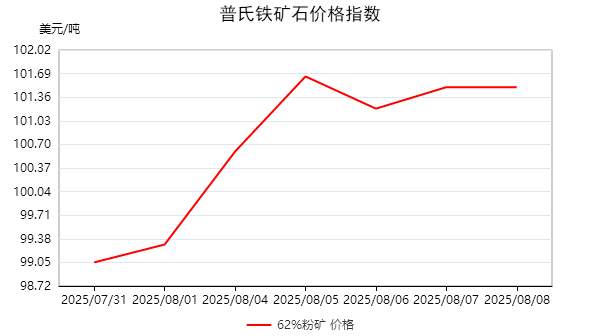
在8 月1 日至8 月11 日期间, 铁矿石期货09价格呈现出震荡变化的态势。8 月1 日,期货价格下跌,收 于783元/ 吨。随后价格逐步回升,8 月5 日,收盘价为798.5 元/ 吨,为这一时期的较高收盘价,价格的 上涨得益于需求强劲、港口库存下降及钢厂利润修复等利好因素支撑。目前铁水产量依旧处于高位,港 口库存处于降库状态,海外铁矿石发运小幅增加。多数钢厂盈利情况较好,在未有刚性政策性减产要求 下,短期需求支撑仍在增强。 1.普氏62%铁矿石价格走势回顾 8 月上旬,普氏62% 粉矿价格呈现显著波动。7 月31 日价格处于99.05 美元/ 吨低位,进入8月后,在8 月1 日- 8 月4 日快速上行,8 月5 日逼近101.69 美元/ 吨 ,随后8 月6 日有所回落,至101.36 美元/ 吨,8 月7 日- 8 月8 日价格企稳,维持在101.36 美元/ 吨水平。 2.全国主要港口库存依旧处于降库状态 这种库存变化,反映了铁矿石产业链的供需动态:可能是钢厂采购需求增加(如高炉开工率提升,主动 补库 ),也可能是港口发运节奏调整(到港量减少 ),或下游提货速度加快,导致港口库存阶段性下 降 。对钢 ...

铁矿石:中美关税政策落地,短期矿价区间运行
Hua Bao Qi Huo· 2025-08-12 03:20
Report Summary 1) Industry Investment Rating No industry investment rating is provided in the report. 2) Core View The Sino-US tariff policy has been implemented, and the domestic short - term macro situation has entered a window period. The market is more concerned about the Fed's interest - rate cut expectation. The black - series as a whole maintains a high - level consolidation cycle. Given the current high blast - furnace profits and the non - off - season characteristics of terminal demand, it is expected that the domestic demand will remain at a relatively high level in the short term. The supply - side pressure is not significant, the supply and demand of iron ore are in a stage of balance, and the port inventory tends to be stable. It is expected that the short - term iron ore futures price will fluctuate at a high level [2][3]. 3) Summary by Relevant Contents Supply Foreign ore shipments will gradually enter the seasonal recovery cycle, but the overall month - on - month growth rate is low. After the maintenance period of Australian BHP and FMG mines ended, shipments did not rebound rapidly. Brazilian shipments in this period remained at a moderately high level. Due to the month - on - month decline in shipments in July, the short - term arrivals in August are expected to remain low, and the actual supply - side pressure is not prominent [3]. Demand The daily average molten iron output in China has declined for three consecutive weeks with an expanding decline. The current daily average molten iron output is 240.32 (month - on - month - 0.39). The current profitability rate of steel mills is continuously rising, and the blast - furnace profit level is relatively good. The short - flow process has fallen into full - scale losses again. The short - term demand for iron ore remains resilient, and the high domestic demand strongly supports the price. It is necessary to pay attention to whether the molten iron output can remain at a high level in the later stage [3]. Inventory The daily consumption of imported ore at steel mills remains relatively high, and the inventory level at steel mills has slightly increased. Due to the weakening of weather influence and concentrated arrivals, the port inventory has increased in this period. As shipments rebound in the future, it is expected that the inventory will generally remain stable in the short term [3]. Price The price will fluctuate in a range. The price range of the i2601 contract is 770 yuan/ton - 800 yuan/ton, and the price range of the foreign FE09 contract is 102 - 105 US dollars/ton [3].
广发期货《黑色》日报-20250812
Guang Fa Qi Huo· 2025-08-12 02:33
1. Report Industry Investment Ratings There is no information about the report industry investment ratings in the provided content. 2. Core Views of the Report - **Steel**: Steel prices have strengthened again, with clear support levels for rebar and hot-rolled coils. Social inventory has increased significantly in the past two weeks due to positive arbitrage by futures-spot traders. Steel mills have few overstocked products as inventory has shifted from mills to traders. There are expectations of production restrictions in mid-to-late August. Short-term inventory pressure is not high, but off-season demand has low acceptance of high prices. The main contract is approaching the rollover period, and the price of the October contract may fluctuate at high levels. It is advisable to hold long positions and be cautious about chasing high prices [1]. - **Iron Ore**: The 09 contract of iron ore showed a volatile upward trend. Globally, iron ore shipments and arrivals at 45 ports have decreased. On the demand side, steel mills' profit margins are at a relatively high level, with a slight increase in maintenance volume and a slight decline in molten iron production, which remains at around 240,000 tons per day. Steel exports remain strong, maintaining short-term resilience in molten iron production. Terminal demand shows strong performance during the off-season but weakens month-on-month. In terms of inventory, port inventory has slightly increased, and steel mills' equity ore inventory has increased month-on-month. It is expected that molten iron production in August will remain high, with an average daily output of around 236,000 tons. Steel mills' improving profits support raw materials. There are also new supply-side policy expectations and production restriction expectations for Hebei steel mills before the September 3rd parade. It is recommended to go long on the 2601 contract on dips and conduct an arbitrage strategy of going long on coking coal 01 and short on iron ore 01 [4]. - **Coking Coal and Coke**: The coking coal futures showed a volatile upward trend, with intense price fluctuations recently. Spot auction prices are stable with a slight upward trend, and Mongolian coal prices are stable with an increase. The fifth round of coke price increases has been officially implemented, and the sixth round of price increases has been initiated. On the supply side, coal mine production has decreased month-on-month, and the market remains in short supply. Imported coal prices have rebounded this week after falling last week, and downstream users continue to replenish their inventories. On the demand side, coking plant operations are stable, and the high-level molten iron production of blast furnaces has slightly declined, with continuous downstream replenishment demand. It is expected that molten iron production in August will continue to decline slightly. In terms of inventory, coking plant inventory continues to decrease, port inventory has slightly increased, and steel mill inventory has decreased. It is recommended to go long on coking coal 2601 on dips and conduct an arbitrage strategy of coking coal 9 - 1 reverse spread [7]. 3. Summaries by Relevant Catalogs Steel - **Prices and Spreads**: Rebar and hot-rolled coil prices have increased, with different price levels and changes in different regions and contracts. For example, the spot price of rebar in East China is 3,360 yuan/ton, an increase of 20 yuan/ton from the previous value [1]. - **Cost and Profit**: The cost of steel billets and slabs has changed, and the profit of steel products has generally decreased. For example, the profit of East China hot-rolled coils has decreased by 23 yuan/ton [1]. - **Production**: The daily average molten iron production has slightly decreased, while the production of five major steel products has increased. Rebar production has increased significantly, with a 4.8% increase, and hot-rolled coil production has decreased by 2.4% [1]. - **Inventory**: The inventory of five major steel products has increased by 1.7%, the rebar inventory has increased by 1.9%, and the hot-rolled coil inventory has increased by 2.5% [1]. - **Trading and Demand**: Building material trading volume has decreased by 3.5%, the apparent demand for five major steel products has decreased by 0.7%, the apparent demand for rebar has increased by 3.6%, and the apparent demand for hot-rolled coils has decreased by 4.3% [1]. Iron Ore - **Prices and Spreads**: The warehouse receipt costs of various iron ore powders have increased, and the basis of the 09 contract has changed. For example, the warehouse receipt cost of PB powder has increased by 8.8 yuan/ton, and the basis of the 09 contract of PB powder has increased by 2.3 yuan/ton [4]. - **Supply**: The weekly arrivals at 45 ports have decreased by 5.0%, and the global weekly shipments have decreased by 0.5%. The monthly national import volume has increased by 8.0% [4]. - **Demand**: The weekly average daily molten iron production of 247 steel mills has decreased by 0.2%, the weekly average daily port clearance volume has increased by 6.3%, the monthly national pig iron production has decreased by 3.0%, and the monthly national crude steel production has decreased by 3.9% [4]. - **Inventory**: The 45-port inventory has decreased by 0.2%, the imported ore inventory of 247 steel mills has increased by 0.0%, and the inventory available days of 64 steel mills have decreased by 4.8% [4]. Coking Coal and Coke - **Prices and Spreads**: The prices of coking coal and coke futures have increased, and the basis and spreads have changed. For example, the 09 contract of coking coal has increased by 37 yuan/ton, and the 09 - 01 spread of coking coal has changed from -158 to -150 [7]. - **Supply**: The weekly production of coke has increased slightly, and the production of sample coal mines has decreased. For example, the daily average production of all-sample coking plants has increased by 0.3% [7]. - **Demand**: The weekly molten iron production of 247 steel mills has decreased by 0.2%, and the demand for coke remains supported [7]. - **Inventory**: Coke inventory has generally decreased, and coking coal inventory has changed differently. For example, the total coke inventory has decreased by 0.9%, and the coking coal inventory of all-sample coking plants has decreased by 0.5% [7].
黑色建材日报-20250812
Wu Kuang Qi Huo· 2025-08-12 01:02
Report Summary 1. Report Industry Investment Rating No investment rating information is provided in the report. 2. Core Viewpoints - As the "anti - involution" sentiment cools and the Politburo meeting's impact fades, the market sentiment becomes rational, and the futures prices start to weaken. If the demand cannot be effectively restored, the steel prices may decline, and the futures prices will gradually return to the supply - demand logic [3]. - The overall demand for the black sector is weak. Although the supply pressure is not significant, the demand growth is limited. The market is influenced by short - term sentiment, and prices will eventually move towards the fundamentals [3][6][10]. - For different products, the fundamentals vary. For example, steel products have high inventory and weak demand; the supply of iron ore is in the traditional off - season, and the demand has support; the over - capacity situation of industrial silicon and polycrystalline silicon remains unchanged; glass and soda ash have inventory pressure and weak demand [3][6][11][14][16][18][19]. 3. Summary by Product Steel Products - **Prices and Positions**: The closing price of the rebar main contract was 3250 yuan/ton, up 37 yuan/ton (1.151%) from the previous trading day. The registered warehouse receipts increased by 579 tons, and the position increased by 515 lots. The closing price of the hot - rolled coil main contract was 3465 yuan/ton, up 37 yuan/ton (1.079%), with a decrease of 1454 tons in registered warehouse receipts and 17218 lots in position [2]. - **Fundamentals**: Rebar showed a pattern of both supply and demand increasing, with social inventory accumulating for two consecutive weeks and the increase accelerating this week. Hot - rolled coils had both supply and demand decreasing, and inventory accumulation was significant. Currently, the inventory of both rebar and hot - rolled coils is rising, but the demand is insufficient [3]. Iron Ore - **Prices and Positions**: The main contract (I2601) of iron ore closed at 789.00 yuan/ton, up 2.00% (+15.50), with an increase of 37210 lots in position to 39.27 million lots. The weighted position was 92.48 million lots. The spot price of PB powder at Qingdao Port was 778 yuan/wet ton, with a basis of 37.83 yuan/ton and a basis rate of 4.58% [5]. - **Fundamentals**: The latest shipment and arrival volume of overseas iron ore both decreased. The daily average pig iron output decreased slightly due to blast furnace maintenance. The port inventory fluctuated slightly, and the steel mill's imported ore inventory increased slightly. The overall demand was slightly weak, but there was still demand support [6]. Manganese Silicon and Ferrosilicon - **Prices**: On August 11, the main contract of manganese silicon (SM509) rebounded, closing up 0.89% at 6100 yuan/ton. The main contract of ferrosilicon (SF509) closed up 1.00% at 5830 yuan/ton [8]. - **Analysis and Suggestions**: The market is affected by sentiment, and prices fluctuate greatly. It is not recommended for speculative funds to participate excessively in the short term. Hedging funds can seize hedging opportunities according to their own situations. The over - capacity pattern of manganese silicon remains unchanged, and there is a risk of weakening demand in the future [9][10][11]. Industrial Silicon and Polycrystalline Silicon - **Industrial Silicon** - **Prices and Positions**: The main contract (SI2511) of industrial silicon closed at 9000 yuan/ton, up 3.33% (+290), with an increase of 15809 lots in weighted position to 549604 lots. The spot price of 553 in East China increased by 100 yuan/ton, and the basis of the main contract was 200 yuan/ton; the 421 price increased by 50 yuan/ton, and the basis was - 50 yuan/ton [13]. - **Fundamentals**: The problems of over - capacity, high inventory, and insufficient demand remain. The production rate is expected to increase in August, and the demand can provide some support, but new inventory pressure may occur. It is expected that the price will fluctuate weakly [14]. - **Polycrystalline Silicon** - **Prices and Positions**: The main contract (PS2511) of polycrystalline silicon closed at 52985 yuan/ton, up 4.32% (+2195), with a decrease of 23165 lots in weighted position to 337163 lots. The spot price remained flat, and the basis of the main contract was - 5985 yuan/ton [15]. - **Fundamentals**: It is expected to increase production in August, and the downstream silicon wafer production also increases, but the silicon material is likely to accumulate inventory. The price is expected to fluctuate widely, and it is recommended to participate cautiously [16]. Glass and Soda Ash - **Glass** - **Prices and Inventory**: The spot price in Shahe decreased by 4 yuan, and in Central China by 30 yuan. As of August 7, the total inventory of national float glass sample enterprises was 61.847 million weight - boxes, up 3.95% month - on - month and down 8.18% year - on - year. It is expected to fluctuate in the short term and follow the macro - sentiment in the long term [18]. - **Soda Ash** - **Prices and Inventory**: The spot price was stable, and the total inventory of domestic soda ash manufacturers was 1.8762 million tons as of August 11, up 0.60% from last Thursday. The supply increased, and the demand was weak. It is expected to fluctuate in the short term, and there are still supply - demand contradictions in the long term [19].
四大矿山二季度产销数据简析
Hua Tai Qi Huo· 2025-08-12 00:52
Report Industry Investment Rating No relevant content provided. Core Views - The production and sales of Vale in the second quarter showed differentiation, and the annual production target remained unchanged. Vale's quarterly iron ore production in the second quarter was 83.6 million tons, a quarter-on-quarter increase of 23.6% and a year-on-year increase of 3 million tons or 3.7%. The quarterly iron ore sales volume was 77.346 million tons, a quarter-on-quarter increase of 16.9% and a year-on-year decrease of 2.45 million tons or 3.1% [3][4]. - Rio Tinto's production and sales both increased significantly in the second quarter, and the shipment of Simandou iron ore was advanced to November. In the second quarter of 2025, Rio Tinto's iron ore production from its Pilbara operations was 83.74 million tons, a quarter-on-quarter increase of 20% and a year-on-year increase of 5.4%. The sales volume was 86.47 million tons, a quarter-on-quarter increase of 14.8% and a year-on-year decrease of 1.1%, with the decline significantly narrowing compared to the first quarter [5][6]. - BHP Billiton's iron ore production and sales both increased quarter-on-quarter and year-on-year in the second quarter, and the target for the 2026 fiscal year was slightly raised. In the second quarter of 2025, BHP Billiton's iron ore production from its Pilbara operations (100% basis) was 77.48 million tons, a quarter-on-quarter increase of 14.2% and a year-on-year increase of 0.9%. The total sales volume was 76.723 million tons, a quarter-on-quarter increase of 14.9% and a year-on-year increase of 1.1% [8][9]. - FMG's production and sales both increased quarter-on-quarter and year-on-year in the second quarter, and the single-quarter shipment reached a record high. In the second quarter, FMG's total iron ore processing volume was 54.4 million tons, a quarter-on-quarter increase of 14.3% and a year-on-year increase of 7.1%. The iron ore shipment volume reached 55.2 million tons, a quarter-on-quarter increase of 19.7% and a year-on-year increase of 2.8% [10]. Summary by Directory Vale - Production: The quarterly iron ore production in the second quarter was 83.6 million tons, a quarter-on-quarter increase of 23.6% and a year-on-year increase of 3 million tons or 3.7%. The increase was mainly due to the strong performance of the Brucutu mine in Minas Gerais and the record-high production of the S11D mine in Parana. The annual production target for 2025 is 325 - 335 million tons, and the new projects VGR1 and Capanema are expected to contribute incremental output in the second half of the year [3][16]. - Sales: The quarterly iron ore sales volume in the second quarter was 77.346 million tons, a quarter-on-quarter increase of 16.9% and a year-on-year decrease of 2.45 million tons or 3.1%. Sales decreased in most regions, with the overall sales volume turning negative year-on-year [4][21]. - Shipping and Arrival: From the steel shipping data, Vale's shipments showed a positive year-on-year growth in the second quarter. As of July 21, the cumulative year-on-year increase in iron ore shipments was 2.24 million tons, and the cumulative year-on-year decrease in China's port iron ore arrivals narrowed to about 5.6 million tons [26]. Rio Tinto - Production: In the second quarter of 2025, the iron ore production from its Pilbara operations was 83.74 million tons, a quarter-on-quarter increase of 20% and a year-on-year increase of 5.4%. The Simandou iron ore will ship its first cargo in November 2025, earlier than previously planned, with a limited supply volume this year [5][31]. - Sales: The sales volume in the second quarter was 86.47 million tons, a quarter-on-quarter increase of 14.8% and a year-on-year decrease of 1.1%, with the decline significantly narrowing compared to the first quarter. The 2025 Pilbara iron ore shipment target (100%) remains unchanged at 323 - 338 million tons, but the shipment volume is expected to be at the lower end of the guidance due to the difficult-to-make-up reduction caused by extreme weather events in the first quarter [6][36]. - Shipping and Arrival: The incremental iron ore shipments in the second quarter showed a pattern of high in the front and low in the back. As of July 21, the cumulative year-on-year decrease in iron ore shipments was 4.65 million tons, and the cumulative year-on-year decrease in shipments to China was 1.08 million tons. The cumulative year-on-year decrease in China's port iron ore arrivals was 1.66 million tons [44]. BHP Billiton - Production: In the second quarter of 2025, the iron ore production from its Pilbara operations (100% basis) was 77.48 million tons, a quarter-on-quarter increase of 14.2% and a year-on-year increase of 0.9%. The production in 2025 fiscal year was 288 million tons, the same as last year, meeting the fiscal year target. The target guidance for the 2026 fiscal year is 284 - 296 million tons (100% basis) [8][51]. - Sales: The total sales volume in the second quarter was 76.723 million tons, a quarter-on-quarter increase of 14.9% and a year-on-year increase of 1.1% [9][54]. - Shipping and Arrival: The shipments continued to recover year-on-year. As of July 21, the cumulative year-on-year decrease in iron ore shipments was 1.09 million tons, and the cumulative year-on-year decrease in shipments to China was 1.67 million tons. The cumulative year-on-year decrease in China's port iron ore arrivals reached 7 million tons [60]. FMG - Production and Sales: In the second quarter, the total iron ore processing volume was 54.4 million tons, a quarter-on-quarter increase of 14.3% and a year-on-year increase of 7.1%. The iron ore shipment volume reached 55.2 million tons, a quarter-on-quarter increase of 19.7% and a year-on-year increase of 2.8%, with a record-high single-quarter shipment [10][63]. - Iron Bridge Project: The Iron Bridge magnetite project contributed 2.4 million tons, with continuous production increase and still in the phased capacity ramp-up [63]. - Fiscal Year Target: The 2026 fiscal year shipment target is set at 195 - 205 million tons (with a target shipment volume of 10 - 12 million tons for the Iron Bridge project), with the upper and lower limits of the guidance target for the 2025 fiscal year increased by 5 million tons respectively [10][63]. - Shipping and Arrival: The cumulative year-on-year growth in shipments was maintained. As of July 21, the cumulative year-on-year increase in iron ore shipments was 5.59 million tons, and the cumulative year-on-year increase in shipments to China was 5.84 million tons. The cumulative year-on-year decrease in China's port iron ore arrivals was 3.07 million tons [66].



铁矿石早报-20250812
Yong An Qi Huo· 2025-08-12 00:44
1. Report Industry Investment Rating - There is no information about the report industry investment rating in the provided content. 2. Core Viewpoints - There is no clear core viewpoint presented in the given content. 3. Summary by Relevant Catalogs 3.1 Spot Market - **Australian Ore**: Newman powder is priced at 775, with a daily increase of 8 and a weekly increase of 8; PB powder is at 778, up 8 daily and 5 weekly; Mac powder is 767, rising 7 daily and 5 weekly; Jinbuba powder is 752, increasing 10 daily and 7 weekly; mainstream mixed powder is 708, up 11 daily and 11 weekly; super special powder is 653, rising 6 daily and 7 weekly; Carajás powder is 879, increasing 6 daily and 1 weekly; Roy Hill powder is 748, up 8 daily and 5 weekly; KUMBA powder is 838, rising 8 daily and 5 weekly [1]. - **Brazilian Ore**: Brazilian blend is 812, with a daily increase of 3 and a weekly increase of 16; Brazilian coarse IOC6 is 768, up 8 daily and 5 weekly; Brazilian coarse SSFG is 773, rising 8 daily and 5 weekly [1]. - **Ukrainian Ore**: Ukrainian concentrate powder is 878, increasing 13 daily and 18 weekly [1]. - **Indian Ore**: 61% Indian powder is 741, up 10 daily and 7 weekly; 57% Indian powder is 598, rising 6 daily and 7 weekly [1]. - **Domestic Ore**: Tangshan iron concentrate powder is 971, increasing 13 daily and 44 weekly [1]. 3.2 Futures Market - **DCE Contracts**: i2601 is at 789.0, with a daily increase of 15.5 and a weekly increase of 23.0; i2605 is 768.0, up 15.0 daily and 25.5 weekly; i2509 is 796.5, rising 6.5 daily and 6.0 weekly [1]. - **FE Contracts**: FE01 is 101.76, with a daily decrease of 0.30 and a weekly increase of 2.33; FE05 is 99.59, down 0.45 daily and up 2.17 weekly; FE09 is 102.10, with a daily decrease of 0.15 and a weekly increase of 2.10 [1].
黑色金属周报:铁矿:供需暂无明显矛盾,基差走弱-20250811
Hong Yuan Qi Huo· 2025-08-11 15:14
Report Overview - Report Title: Black Metal Weekly - Iron Ore [1] - Date: August 11, 2025 [3] - Author: Bai Jing [3] 1. Report Industry Investment Rating No investment rating was provided in the report. 2. Core Viewpoints - The iron ore supply and demand currently show no significant contradictions. The current shipments and arrivals have both decreased compared to the previous period. Shipments continue to decline due to ongoing maintenance at some Australian mines, and arrivals from Australia and Brazil have decreased while non - mainstream arrivals have increased, keeping the overall supply at a relatively low level. [9] - The previous period's pig iron output was 240,320 tons, a decrease of 390 tons compared to the previous period. It is expected to have a slight rebound this period, remaining at a high - level fluctuation. The expectation of northern production restrictions in the middle and late period affecting demand has led to a continuous weakening of the 9 - 1 spread. After the main contract switch, the 01 basis has been significantly repaired, and it may continue to fluctuate strongly in the short term. [9] 3. Summary by Directory 3.1 First Part: Fundamentals and Conclusions 3.1.1 Price and Inventory - Last week, iron ore spot prices fluctuated slightly. For example, Carajás fines decreased by 5, PB fines by 3, BRBF increased by 13, etc. As of August 8, the Platts 62% index closed at $101.5, a weekly increase of $2.2, equivalent to about 848.5 yuan after currency conversion. [6] - As of August 8, the optimal deliverable was NM fines, with a latest quote of about 767 yuan/ton, and the converted warehouse receipt (factory warehouse) was about 792 yuan/ton. The 09 iron ore was at par with the spot, and the second - best deliverable was pb fines. [6] - The inventory of 47 ports in China increased compared to the previous period and was lower than the same period last year. As of now, the total inventory of 47 ports was 142.6727 million tons, an increase of 450,000 tons compared to the previous period, a decrease of 13.43 million tons compared to the beginning of the year, and 14.13 million tons lower than the same period last year. [6] 3.1.2 Supply - Shipments: The total global iron ore shipments this period were 3.0467 million tons, a decrease of 15,100 tons compared to the previous period. The total shipments from 19 ports in Australia and Brazil were 2.4277 million tons, a decrease of 36,200 tons compared to the previous period. Australian shipments were 1.5803 million tons, a decrease of 140,900 tons compared to the previous period, and the volume shipped from Australia to China was 1.3656 million tons, a decrease of 122,800 tons compared to the previous period. Brazilian shipments were 847,400 tons, an increase of 104,700 tons compared to the previous period. [7] - Arrivals: From August 4 to August 10, 2025, the total arrivals at 47 ports in China were 2.5716 million tons, a decrease of 50,800 tons compared to the previous period; the total arrivals at 45 ports in China were 2.3819 million tons, a decrease of 125,900 tons compared to the previous period; and the total arrivals at six northern ports were 1.203 million tons, a decrease of 50,100 tons compared to the previous period. [7] 3.1.3 Demand - The average daily pig iron output of 247 sample steel mills in the current period decreased. The average daily output was 240,320 tons/day, a decrease of 390 tons/day compared to the previous period. There were 4 new blast furnace restart operations and 3 blast furnace maintenance operations. According to the blast furnace start - stop plan, the pig iron output may slightly rebound in the next period. [8] - As of August 8, in the long - process spot market, the cash - inclusive cost of long - process rebar in East China was 3,114 yuan, and the point - to - point profit was about 196 yuan. The long - process cash - inclusive profit of hot - rolled coils was about 236 yuan. In the electric - arc furnace market, the flat - rate electricity cost of electric - arc furnaces in East China (Fubao's calculation) was about 3,369 yuan, and the off - peak electricity cost was about 3,241 yuan. The flat - rate electricity profit of East China rebar was about - 129 yuan, and the off - peak electricity profit was about - 1 yuan. [8] 3.2 Second Part: Data Sorting 3.2.1 Iron Ore Warehouse Receipt Price - As of August 8, the optimal deliverable was NM fines with a warehouse receipt price of about 792 yuan/ton, and the second - best was PB fines with a warehouse receipt price of 801 yuan/ton. [14] - A table provided detailed information on the chemical indicators, quality premiums, brand premiums, spot prices, and converted warehouse receipt prices of various iron ore varieties such as PB fines, Newman fines, and Mac fines. [14] 3.2.2 Iron Ore Inter - period - As of August 8, the 9 - 1 spread of iron ore closed at 16.5 (- 9.5). [17] 3.2.3 Iron Ore Import Profit No specific data or analysis was provided in the report. 3.2.4 High - Low Grade Price Difference No specific data or analysis was provided in the report. 3.2.5 Premium Index - As of August 7, the premium index for 62.5% lump ore was 0.185 (+ 0.0025), and the premium index for 65% pellet ore was 16 (+ 0.6). [25] 3.2.6 Brand Premium (Discount) and Inventory - The report presented inventory trends of various iron ore brands such as Mac fines, PB fines, and Jinbuba fines in 15 ports from 2021 to 2025, as well as the discount and premium trends of these brands over the years. [28] 3.2.7 Steel Mill Sintered Fines Inventory - As of August 8, the inventory of imported sintered fines decreased by 38,800 tons compared to August 1, a decrease of 2.96%. The inventory of domestic sintered fines increased by 2,100 tons, an increase of 2.35%. The average inventory days of imported ore decreased by 1 day, a decrease of 4.76%. [31] 3.2.8 Port Inventory and Berthing - The report showed the historical trends of total port inventory (45 ports), berthing vessel numbers at 47 ports, Australian ore inventory at ports (45 ports), Brazilian ore inventory at ports (45 ports), and trade ore inventory at ports (45 ports) from 2021 to 2025. [36] 3.2.9 Port Inventory by Ore Type - As of August 8, compared to August 1, the inventory of imported port lump ore decreased by 27,000 tons, a decrease of 1.59%; the inventory of pellet ore decreased by 43,000 tons, a decrease of 11.40%; the inventory of iron concentrate increased by 47,000 tons, an increase of 4.44%; and the inventory of coarse ore increased by 78,000 tons, an increase of 0.74%. [39] 3.2.10 Ore Removal The report presented the historical ore removal volume data from 2020 to 2025. [42] 3.2.11 Iron Ore In - Transit Volume The report showed the historical trends of iron ore in - transit volume from Australia, Brazil, and non - mainstream sources to China from 2022 to 2025. [45] 3.2.12 Iron Ore Import Volume The report presented the historical import volume data of iron ore in China, Australia, Brazil, South Africa, India, and other countries from 2020 to 2025. [48][49][50] 3.2.13 Australian Iron Ore Shipments - From August 8 to August 1, Australian shipments to China decreased by 123,000 tons, a decrease of 8.25%. Total Australian shipments decreased by 140,900 tons, a decrease of 8.19%. The proportion of shipments to China decreased by 0.1%, a decrease of 0.07%. [57] 3.2.14 Brazilian Iron Ore Shipments - From August 8 to August 1, Brazilian shipments to the world increased by 105,000 tons, an increase of 14.10%. [62] 3.2.15 Shipments of the Four Major Mines - From August 8 to August 1, Rio Tinto's shipments increased by 57,000 tons, an increase of 10.88%; BHP's shipments decreased by 87,000 tons, a decrease of 17.26%; Vale's shipments decreased by 27,000 tons, a decrease of 4.55%; FMG's shipments decreased by 25,000 tons, a decrease of 8.67%. The total shipments of the four major mines decreased by 82,000 tons, a decrease of 4.29%. [64] 3.2.16 Iron Ore Arrivals - From August 8 to August 1, the arrivals at 45 ports decreased by 126,000 tons, a decrease of 5.0%. The arrivals at northern ports decreased by 50,000 tons, a decrease of 4.0%. [71] 3.2.17 Freight Rates The report showed the historical trends of iron ore freight rates from Tubarão, Brazil, to Qingdao and from Western Australia to Qingdao from 2020 to 2025. [73] 3.2.18 Domestic Ore Production The report presented the estimated domestic ore production data from 2017 to 2025. [75] 3.2.19 Steel Mill Fines Consumption and Capacity Utilization - As of August 8, the blast furnace capacity utilization rate of 247 steel enterprises was 90.1%, a decrease of 0.15 percentage points compared to August 1. The average daily pig iron output was 240,300 tons, a decrease of 390 tons compared to August 1. The daily consumption of imported sintered fines increased by 1,850 tons compared to August 1, an increase of 3.10%. The daily consumption of domestic sintered fines increased by 100 tons compared to August 1, an increase of 1.23%. [77] 3.2.20 Pig Iron Production The report presented the historical daily pig iron production data of the National Bureau of Statistics and the China Iron and Steel Association from 2016 to 2025. [84] 3.2.21 Global Pig Iron Production The report showed the historical pig iron production data of the EU 28 countries, Japan, South Korea, India, the world, and China from 2020 to 2025. [87] 3.2.22 Global (Excluding China) Pig Iron Production The report presented the historical pig iron production data of regions outside China from 2017 to 2025 and the corresponding year - on - year and month - on - month changes. [92]
《黑色》日报-20250811
Guang Fa Qi Huo· 2025-08-11 11:18
Group 1: Steel Industry Report Industry Investment Rating No information provided. Core View Black night trading weakened. In the short - term, steel inventory pressure is not significant, but the off - season demand has low acceptance of high prices. The main contract is approaching the position transfer. It is expected that the high price will fluctuate. Previously, it was recommended to buy on dips, and current long positions can be held. Be cautious about chasing long positions due to limited release of terminal demand [1]. Summary by Relevant Catalogs - **Steel Prices and Spreads**: Most steel prices decreased. For example, the spot price of rebar in East China dropped from 3370 to 3360 yuan/ton, and the spot price of hot - rolled coil in East China decreased from 3470 to 3460 yuan/ton [1]. - **Cost and Profit**: The cost of Jiangsu converter rebar increased by 6 yuan/ton, and the profit of East China hot - rolled coil increased by 5 yuan/ton [1]. - **Production**: The daily average pig iron output decreased slightly by 0.2 to 240.5 tons, a decrease of 0.1%. The output of five major steel products increased by 1.8 to 869.2 tons, an increase of 0.2%. The rebar output increased by 10.1 to 221.2 tons, an increase of 4.8%, and the hot - rolled coil output decreased by 7.9 to 314.9 tons, a decrease of 2.4% [1]. - **Inventory**: The inventory of five major steel products increased by 23.5 to 1375.4 tons, an increase of 1.7%. The rebar inventory increased by 10.4 to 556.7 tons, an increase of 1.9%, and the hot - rolled coil inventory increased by 8.7 to 356.6 tons, an increase of 2.5% [1]. - **Transaction and Demand**: The building materials trading volume decreased by 0.9 to 9.7 tons, a decrease of 8.7%. The apparent demand for five major steel products decreased by 6.3 to 845.7 tons, a decrease of 0.7%. The apparent demand for rebar increased by 7.4 to 210.8 tons, an increase of 3.6%, and the apparent demand for hot - rolled coil decreased by 13.8 to 306.2 tons, a decrease of 4.3% [1]. Group 2: Iron Ore Industry Report Industry Investment Rating No information provided. Core View Last week, the 2509 iron ore contract showed a volatile and slightly stronger trend. In the future, the pig iron output in August will remain high, but is expected to decrease slightly to around 236 tons per day on average. Unilateral trading is recommended to buy the 2601 contract on dips, and the arbitrage strategy is to go long on coking coal 01 and short on iron ore 01 [4]. Summary by Relevant Catalogs - **Iron Ore - Related Prices and Spreads**: The warehouse receipt costs of various iron ore types decreased. For example, the warehouse receipt cost of Carajás fines decreased from 800.0 to 792.3 yuan/ton, a decrease of 1.0%. The 5 - 9 spread increased by 3.5 to - 37.0, an increase of 8.6% [4]. - **Supply**: The 45 - port arrival volume increased by 267.3 to 2507.8 tons, an increase of 11.9%, and the global shipment volume decreased by 139.1 to 3061.8 tons, a decrease of 4.3%. The national monthly import volume increased by 782.0 to 10594.8 tons, an increase of 8.0% [4]. - **Demand**: The daily average pig iron output of 247 steel mills decreased by 0.4 to 240.3 tons, a decrease of 0.2%. The daily average port clearance volume of 45 ports increased by 19.1 to 321.9 tons, an increase of 6.3%. The national monthly pig iron output decreased by 220.9 to 7190.5 tons, a decrease of 3.0%, and the national monthly crude steel output decreased by 336.1 to 8318.4 tons, a decrease of 3.9% [4]. - **Inventory**: The 45 - port inventory decreased by 28.7 to 13712.27 tons, a decrease of 0.2%. The imported ore inventory of 247 steel mills increased by 1.3 to 9013.3 tons, an increase of 0.0%. The inventory available days of 64 steel mills decreased by 1.0 to 20.0 days, a decrease of 4.8% [4]. Group 3: Coke and Coking Coal Industry Report Industry Investment Rating No information provided. Core View Last week, coke and coking coal futures rebounded after hitting the bottom. There is still a possibility of further price increases for coke. For both coke and coking coal, the speculative strategy is to buy the 2601 contract on dips, and the arbitrage strategy is to do 9 - 1 reverse spreads [6]. Summary by Relevant Catalogs - **Coke - Related Prices and Spreads**: The price of Shanxi first - grade wet - quenched coke remained unchanged at 1347 yuan/ton. The coke 09 contract decreased by 14 to 1668 yuan/ton, a decrease of 0.84%. The coking profit of Steel Union decreased by 11 to - 54 yuan/ton [6]. - **Coking Coal - Related Prices and Spreads**: The price of coking coal (Shanxi warehouse receipt) remained unchanged at 1260 yuan/ton, and the price of coking coal (Mongolian coal warehouse receipt) increased by 5 to 1139 yuan/ton, an increase of 0.4%. The coking coal 09 contract decreased by 18 to 1070 yuan/ton, a decrease of 1.6%. The sample coal mine profit increased by 22 to 440 yuan/ton, an increase of 5.34% [6]. - **Supply**: The daily average output of all - sample coking plants increased by 0.3 to 65.1 tons, an increase of 0.4%. The daily average output of 247 steel mills decreased by 0.2 to 46.8 tons, a decrease of 0.44%. The raw coal output decreased by 9.7 to 859.0 tons, a decrease of 1.1%, and the clean coal output decreased by 5.1 to 439.0 tons, a decrease of 1.1% [6]. - **Demand**: The pig iron output of 247 steel mills decreased by 0.4 to 240.3 tons, a decrease of 0.2%. The daily average output of all - sample coking plants increased by 0.3 to 65.1 tons, an increase of 0.4%, and the daily average output of 247 steel mills decreased by 0.2 to 46.8 tons, a decrease of 0.49% [6]. - **Inventory**: The total coke inventory decreased by 8.3 to 907.2 tons, a decrease of 0.9%. The coking coal inventory of Fenwei coal mines decreased by 6.7 to 112.0 tons, a decrease of 5.7%. The coking coal inventory of all - sample coking plants decreased by 4.8 to 987.9 tons, a decrease of 0.5% [6].