脑机接口

Search documents
市场最前沿丨加速“接入”现实!脑机接口迈入产业化快车道
Xin Hua Wang· 2025-12-23 09:59
Core Insights - Brain-computer interface (BCI) technology is advancing rapidly towards industrialization, with significant clinical trial results demonstrating its potential for improving the quality of life for patients with severe disabilities [1][2] - The year 2025 is anticipated to be a pivotal year for BCI development in China, supported by government initiatives and a clear roadmap for industry growth [1][5] Group 1: Technological Advancements - The second-generation BCI product released by Shanghai Ladder Medical Technology Co., Ltd. has increased the number of signal channels from 64 to 256, enhancing interaction efficiency by approximately 60% [2] - Breakthroughs in core components and decoding algorithms have been achieved, with improvements in the stability and integration of BCI systems, leading to the development of wireless, passive, and miniaturized systems [2] - AI technology has significantly improved decoding accuracy, enabling precise interpretation of users' motor intentions [2] Group 2: Application Scenarios - Invasive BCIs are primarily focused on medical applications, with numerous clinical cases addressing spinal cord injuries and stroke rehabilitation, while initial explorations in areas like blindness recovery and addiction treatment are underway [3] - Non-invasive BCIs are being deployed in consumer and industrial sectors, with devices already in mass production for applications such as fatigue monitoring and emotional recognition [3] Group 3: Policy and Industry Support - The establishment of the "Brain Intelligence World" industrial cluster in Shanghai aims to foster collaboration among nearly 20 teams and companies, with an initial investment of 1.2 billion yuan [4] - A collaborative effort among seven government departments aims to enhance BCI innovation capabilities by 2030, with new pricing projects and medical device standards being introduced [5] - The BCI market in China is expanding, with over 200 companies currently operating in the sector, and projections indicate the market could exceed 3.8 billion yuan by 2025 [5] Group 4: Future Outlook - The 14th Five-Year Plan emphasizes the importance of forward-looking strategies for future industries, positioning BCI as a potential new economic growth driver [5] - Experts believe that the next five years will be crucial for the BCI industry, particularly in areas with urgent social needs and clear clinical value [5][6]
市场最前沿|加速“接入”现实!脑机接口迈入产业化快车道
Xin Hua She· 2025-12-23 09:53
Core Insights - The article discusses the rapid advancement and industrialization of brain-computer interface (BCI) technology in China, highlighting significant clinical trial results and the establishment of a supportive policy framework [1][5]. Group 1: Technological Advancements - The second clinical trial of an invasive brain-computer interface has successfully enabled high-level paraplegic patients to control devices using their thoughts, marking a shift from 2D screen control to 3D physical interactions [1]. - In December, a second-generation BCI product was launched, increasing the number of signal channels from 64 to 256, resulting in a 60% improvement in interaction efficiency [2]. - Breakthroughs in core components and decoding algorithms have been achieved, with advancements in BCI chips and implantable electrodes, leading to increased stability and performance [2]. Group 2: Application Scenarios - BCI technology is being applied in various medical scenarios, including rehabilitation for spinal cord injury and stroke patients, with dozens of clinical cases reported [3]. - Non-invasive BCIs are being developed for consumer and industrial applications, with devices already in mass production for fatigue monitoring, emotion recognition, and smart driving [3]. Group 3: Policy and Industry Support - The establishment of the "Brain Intelligence World" industrial cluster in Shanghai aims to foster collaboration among nearly 20 teams and companies, with an initial investment of 1.2 billion yuan [4]. - A joint initiative by seven government departments aims to enhance BCI innovation capabilities by 2030, with new pricing projects and medical device standards being introduced [5]. - The BCI market in China is expected to exceed 3.8 billion yuan by 2025, with over 200 companies currently operating in the sector [5]. Group 4: Future Outlook - The "14th Five-Year Plan" emphasizes the importance of BCI technology as a new economic growth point, with expectations for significant breakthroughs in medical rehabilitation and other urgent social needs [5]. - The BCI industry is anticipated to generate substantial social and economic benefits, positioning itself as a key driver of future industrial growth [6].
大摩重磅机器人年鉴(七):脑机接口将是AI的终极物理体现
Hua Er Jie Jian Wen· 2025-12-23 08:24
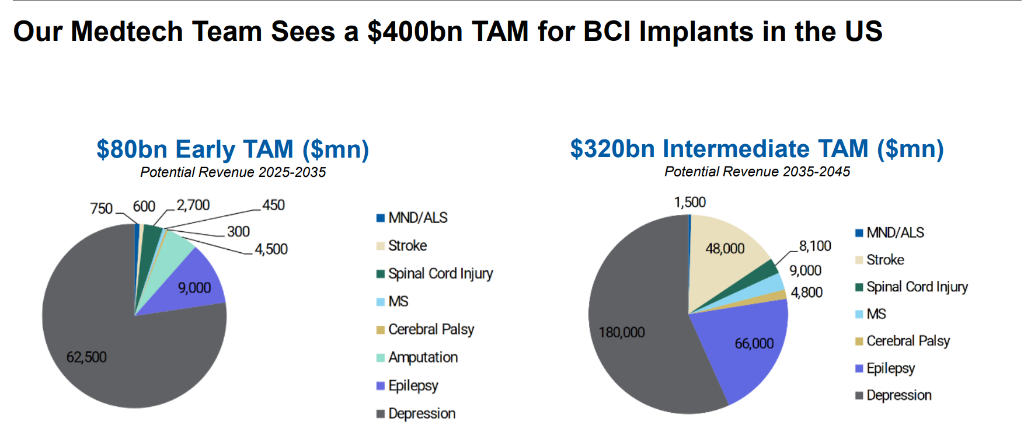
Core Insights - Brain-Computer Interface (BCI) technology is emerging as the "ultimate physical embodiment" of artificial intelligence, aimed at addressing medical challenges and serving as a key bridge for human-AI coexistence, with significant long-term market potential attracting global capital and enterprises [1][4] Market Potential - Morgan Stanley's report estimates that the total addressable market (TAM) for BCI implant devices in the U.S. could reach $80 billion by 2035 and soar to $320 billion by 2045, primarily targeting treatments for various neurological disorders such as ALS, stroke, spinal cord injuries, epilepsy, and depression [1][12] Competitive Landscape - A global competitive landscape is forming, with key players including Neuralink, Synchron, Precision, and Paradromics. China has announced a BCI technology development roadmap aiming for key breakthroughs by 2027 and to become a global leader by 2030 [4][12] Historical Context - The development of BCI is not new, tracing back to the discovery of brain electrical activity by Hans Berger in 1924, with significant advancements occurring in the early 21st century, such as the demonstration by Duke University's Miguel Nicolelis in 2003, where a monkey controlled a robotic arm via BCI [5] Technological Pathways - Current BCI implantation techniques include Neuralink's robotic surgery to insert threads into the motor cortex, Synchron's vascular electrode array implantation, and micro-invasive techniques from Precision and Paradromics [5] Neuralink's Vision - Elon Musk has set a four-tiered vision for Neuralink: first, to alleviate human suffering (e.g., "mind-reading" implants for paralyzed patients); second, to enhance human capabilities (e.g., future "blindness" implants); third, to understand and expand consciousness; and finally, to achieve human coexistence with AI/robots to mitigate existential risks posed by AI [9][11] Investment Trends - Investment in neurotechnology, including BCI, surged to approximately $1.8 billion by the end of 2025, indicating high capital interest. Neuralink leads with a valuation of $9 billion and over $1.3 billion in funding [12] Future Outlook - The report outlines a shift from technological exploration to commercialization and large-scale application of embodied AI, redefining productivity and human capabilities, and presenting a vast, multi-layered market landscape for investors [23]


登高稳行:成长乘势聚力,价值重构红利
Sou Hu Cai Jing· 2025-12-23 04:17
Group 1 - The core focus of China's economic policy in 2026 will shift towards technological self-reliance and new productivity paradigms, moving away from the traditional real estate and investment-driven growth model [1] - The report emphasizes the importance of integrating resources through a new type of national system, focusing on key technologies such as integrated circuits, industrial mother machines, and high-end instruments, while also planning for future industries like quantum technology and sixth-generation mobile communications [1] - The structural transformation aims to enhance the security of the industrial chain and create a high-quality supply system, fostering a virtuous cycle among technology, industry, and finance to inject long-term growth momentum into the capital market [1] Group 2 - The logic of stimulating domestic demand is undergoing a profound shift, transitioning from physical consumption driven by subsidies for appliances and automobiles to service consumption as the new engine [1] - China's service consumption currently accounts for less than 50%, significantly lower than the nearly 70% in the United States, indicating substantial room for improvement [1] - The aging population is driving the "silver economy," while younger generations prefer experiences and spiritual satisfaction, further reinforcing the structural upward trend in service consumption, supported by intensive policy initiatives [1] Group 3 - The global liquidity environment is expected to improve significantly in 2026, with the Federal Reserve potentially initiating an unexpected rate-cutting cycle due to increasing fiscal pressures and political cycles [2] - The weakening of the US dollar will create favorable conditions for global risk assets, particularly emerging market equities, benefiting both A-shares and Hong Kong stocks [2] - Domestic policies focusing on technology and consumption will provide valuation support, potentially leading to a market value reconstruction trend, with quality growth and high-dividend leaders showing investment value [2]

国家航天局统筹民商遥感卫星的“太空打星”模式 ;脑机接口医疗器械工作推进会召开,政策红利可期——《投资早参》
Mei Ri Jing Ji Xin Wen· 2025-12-22 23:19
Market News - The three major US stock indices closed higher, with the S&P 500 up 0.64%, Nasdaq up 0.52%, and Dow Jones up 0.47%. Major tech stocks had mixed results, with Tesla and Nvidia rising over 1%, while Intel and Netflix fell over 1% [1] - International oil prices increased, with WTI crude oil rising 2.48% to $57.92 per barrel and Brent crude oil rising 2.38% to $61.48 per barrel. Gold prices also surged, with spot gold reaching a record high of $4449.16, up 2.42% [1] Industry Insights - The National Space Administration is establishing a virtual observation constellation for commercial remote sensing satellites to enhance emergency disaster observation capabilities. This initiative aims to improve data acquisition efficiency and satellite utilization [2] - The satellite communication industry is projected to exceed 200 to 400 billion yuan by 2030, with an annual compound growth rate of 10% to 28%. The industry is transitioning from concept validation to large-scale application, driven by technological maturity and cost reduction [2] - The humanoid robot industry is expected to see significant growth, with an estimated shipment of 5,000 units by 2025 and nearly 60,000 units by 2030, reflecting a compound annual growth rate of over 95% [3] - The brain-computer interface (BCI) medical device market is projected to reach $40 billion by 2030 and $145 billion by 2040, indicating substantial potential in the healthcare sector for treating neurological disorders [4][5] Company Updates - Tianyin Electric announced that its general manager plans to reduce his shareholding by up to 155,810 shares, representing 0.37% of the total share capital [6] - Invech disclosed that a shareholder intends to reduce its stake by up to 549,490 shares, approximately 0.56% of the total share capital [6] - China National Foreign Trade announced that its executives plan to reduce their holdings by a total of approximately 19,240 shares [6] - Hongqi Chain reported that a major shareholder intends to reduce its stake by up to 13.6 million shares, not exceeding 1% of the total share capital [6] - Yuehai Feed announced plans for significant share reductions by its controlling shareholder and executives, totaling up to 20.9 million shares [6]



麦澜德20251222
2025-12-22 15:47
公司预计 2027 年中期实现认知功能障碍系列产品商业化落地,精神心 理及运动功能障碍方向落地速度更快,未来业务增长率预计可达 20%- 30%以上。 Q&A 迈安德公司目前在脑机接口领域的业务和规划是什么? 迈安德公司目前在脑机接口领域的业务主要集中在结合现有技术基础上进行创 新应用,包括盆底康复业务等。我们注意到患者对心理疾病关注和需求增加, 因此利用脑机接口技术开拓新业务领域。公司的整体规划是以"脑机接口加身 心同治"为主题,重点发展三大方向:认知功能障碍干预、运动功能障碍干预 以及精神与心身疾病调控。 脑机接口行业的发展背景及市场前景如何? 2025 年被称为脑机接口的元年,全球范围内对该技术的研究非常火热,并取 得了一些进展和商业化落地。最早的研究源于各国的"脑计划",如美国 2013 年启动,欧盟紧随其后,中国则从 2016 年开始实施中国脑计划,并陆 续获得重大产业项目支持。经过 10 年的发展,基础技术已经有了一定储备, 市场潜力巨大。目前主要应用于医疗端,包括神经疾病、神经损伤及精神疾病 患者。此外,中国在十四五期间布局了相关研究,并在 2022 年启动了重大项 目,如帕金森和阿尔兹海默症认 ...

医疗健康活跃度持续,伯汇生物获近亿元融资
2 1 Shi Ji Jing Ji Bao Dao· 2025-12-22 11:39
Group 1: Financing Trends - The technology and manufacturing sectors, along with healthcare, continue to dominate the financing market with a high density of cases and significant funding amounts [1] - In the past week, over 20 financing cases were reported in the technology and manufacturing sectors, including multiple transactions exceeding 500 million RMB [1] - The healthcare sector is also showing steady growth, with large transactions and innovative sub-sectors receiving attention [1] Group 2: Regional Financing Distribution - The majority of financing activities were concentrated in Jiangsu Province, Beijing, and Guangdong Province, with 7, 6, and 5 cases respectively [3] Group 3: Active Investment Institutions - Yizhuang Guotou and Guoke Investment were notably active, each disclosing 2 investments primarily in the technology and manufacturing, as well as healthcare sectors [5] Group 4: Notable Financing Cases in Healthcare - Beijing Bohui Biotechnology completed nearly 100 million RMB in A+ round financing, led by Yizhuang Guotou, to accelerate clinical progress and expand its pipeline [7] - Suzhou Jishi Medical Technology completed A round financing, focusing on eye disease treatment and prevention solutions [8] - Suzhou Baifu Laser Technology completed over 100 million RMB in C round financing to enhance product development and market expansion [9] - Kangyuan Bochuang completed 250 million RMB in B round financing to advance research in tumor immunity and next-generation kinase inhibitors [10] Group 5: Notable Financing Cases in Technology and Manufacturing - Chengdu Xinglian Xintong completed over 100 million RMB in B round financing to strengthen its position in the satellite communication sector [17] - Suzhou Xinshi Nuo Semiconductor Equipment completed over 500 million RMB in A+ round financing to enhance its capabilities in semiconductor automation [18] - Shanghai Fangqing Technology completed over 500 million RMB in Pre-A round financing to advance its distributed AI computing architecture [20] Group 6: Additional Notable Financing Cases - Shenzhen Haodian Technology completed over 100 million RMB in B round financing, focusing on lithium battery adhesive development [21] - Suzhou Junji Gene Technology completed nearly 100 million RMB in A round financing to enhance its automated gene technology applications [22] - Jiangxi Panmeng Semiconductor completed over 100 million RMB in A+ round financing for capacity expansion and technology development [39]

长三角议事厅·周报|沪苏同城化:硬联通之后,还需算四本账
Xin Lang Cai Jing· 2025-12-22 07:57
Core Insights - The integration of Shanghai and Suzhou has reached a significant milestone with improved transportation links, but the next phase focuses on smoother operational integration rather than just speed [1][2][3] - The recent proposal by the Jiangsu Provincial Party Committee emphasizes the need for Suzhou to transition from merely learning from Shanghai to fully integrating with it, highlighting the importance of addressing discrepancies in standards, interests, and assessments [1][2] Group 1: Hard Connectivity Achievements - The Shanghai Metro Line 11 has been extended to Kunshan, and high-speed rail travel between Suzhou North Station and Shanghai Hongqiao has been reduced to approximately 23 minutes [1] - The combined GDP of Shanghai and Suzhou is projected to exceed 8 trillion yuan in 2024, with Shanghai at 5.39 trillion yuan and Suzhou at 2.67 trillion yuan [1] Group 2: Soft Frictions in Integration - The main challenges in the integration process are categorized into three types of "soft frictions": differences in standards and processes, difficulties in benefit distribution, and structural constraints from assessment and competition logic [2][3] - The fragmentation in standards and processes leads to increased hidden costs for businesses operating across cities, as multiple recognitions and submissions are required [2] Group 3: Institutional Tools for Collaboration - Effective solutions to the identified soft frictions involve creating executable, assessable, and replicable institutional tools rather than merely increasing coordination meetings [4][5] - The Long Triangle Ecological Green Integration Development Demonstration Zone has successfully transformed cross-provincial collaboration from project-based to rule-based, addressing common bottlenecks with a practical "toolbox" approach [4] Group 4: Focus on Public Welfare - The integration's success is also measured by its impact on public welfare, with initiatives to streamline cross-city services such as social security transfers and public housing loans, aiming for completion within three working days [5] - The establishment of a unified social security card system aims to enhance daily experiences of integration by covering various services like transportation and library access [5] Group 5: Expanding Institutional Frameworks - The current focus should be on expanding successful practices from pilot projects into a broader institutional product library, allowing for systematic operation rather than isolated breakthroughs [6] - The goal is to align evaluation standards and regulatory measures across regions, facilitating smoother project approvals and enhancing the overall experience of integration for residents and businesses [6] Group 6: National Demonstration Significance - The Shanghai-Suzhou integration serves as a national model for cross-provincial collaboration, emphasizing the need for both speed and clarity in operational processes [7] - The ongoing investment in infrastructure, such as the 600 billion yuan allocated for railway construction in the Yangtze River Delta during the 14th Five-Year Plan, supports this integration effort [7]
【中国青年报】90后科研伉俪“脑机”筑梦
Zhong Guo Qing Nian Bao· 2025-12-22 06:49
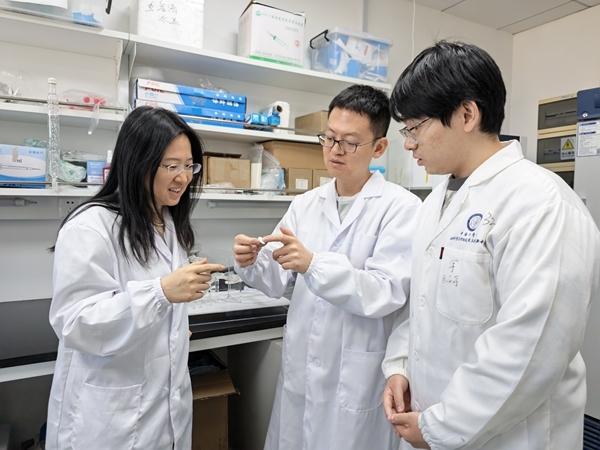
Core Viewpoint - The article highlights the significant advancements in invasive brain-computer interface (BCI) technology led by researchers Zhao Zhengtuo and Li Xue, showcasing their successful clinical trials that enable paralyzed patients to control devices using their thoughts, thus improving their quality of life [1][3][17]. Group 1: Clinical Trial Achievements - The second clinical trial demonstrated that a patient with high-level paraplegia could control a smart wheelchair and a robotic dog using only their thoughts, marking a breakthrough in BCI applications [1][4][17]. - The patient, who suffered from spinal cord injury, was able to control electronic devices like computers and tablets within 2-3 weeks of training after receiving the BCI implant [5][17]. - The technology evolved from controlling virtual devices to interacting with physical objects, allowing the patient to navigate real-world environments [6][7]. Group 2: Research and Development Approach - Zhao and Li emphasize the importance of addressing real-life problems faced by patients rather than merely showcasing technological capabilities [8][10]. - Their research approach has shifted from basic research to focusing on practical applications that enhance patients' daily lives, driven by the needs expressed by patients [9][10]. - The team has developed a flexible electrode that is less invasive, allowing for easier implantation compared to competitors, which is crucial for patient safety and comfort [14][15]. Group 3: Future Prospects and Vision - The researchers envision that BCI technology will not only assist patients with mobility issues but could also be applied in areas such as artificial sensory restoration and treatment of neurological disorders in the future [19][20]. - They aim for BCI devices to become as ubiquitous as smartphones, ensuring that anyone in need can benefit from this technology [20][21]. - The team is committed to continuous improvement and adaptation of their technology to meet evolving patient needs and to foster collaboration with various stakeholders in the healthcare and technology sectors [16][19].
并非“脑洞大开”!中国脑机接口成功让瘫痪患者“脑控”轮椅遛弯
Ren Min Ri Bao· 2025-12-22 04:08
Core Insights - The article highlights the successful implementation of an invasive brain-machine interface (BMI) system that allows high-level paraplegic patients to control devices like electric wheelchairs and robotic dogs using their thoughts, marking a significant advancement in medical technology [1][2]. Group 1: Clinical Trials and Technological Advancements - The second invasive BMI clinical trial was successfully conducted by a team from the Chinese Academy of Sciences and Fudan University, following the first trial in June, which focused on enabling a patient to control electronic devices [1][2]. - The upgraded BMI system, WRS02, has improved data reading rates by four times compared to its predecessor, aiming to facilitate clinical applications and collaborations with various smart devices [2][3]. Group 2: Patient Experience and Control Capabilities - The second patient, who suffered from high-level paraplegia due to a spinal injury, was able to control physical devices after a few weeks of training, expanding his interaction with the physical world beyond electronic screens [3][8]. - The technology team achieved breakthroughs in decoding complex neural signals, enhancing the control experience by reducing latency to under 100 milliseconds, allowing for a more natural interaction with devices [9][10]. Group 3: Future Directions and Ethical Considerations - The research team envisions a future where BMI technology can restore motor and language functions on a large scale within three years, with further advancements in sensory restoration and mental health treatment in the following years [10][11]. - Ethical concerns regarding the use of BMI technology, particularly in enhancing normal human capabilities, are raised, emphasizing the need for clear guidelines on its application [11][12]. Group 4: Industry Collaboration and Talent Development - The success of BMI technology is closely linked to the development of external smart devices, with the team actively collaborating with manufacturers to create a unified control protocol [12][19]. - There is a call for nurturing young talent from the industry to drive innovation in the BMI field, as current research is primarily concentrated in academic institutions [12][19].