
银行业

Search documents
女子一次出手8公斤金条,套现近900万元!近期千万元级别套现每天都有
Sou Hu Cai Jing· 2026-02-12 00:19
Core Viewpoint - The investor sentiment is shifting towards risk aversion amid significant fluctuations in gold prices, leading to increased selling and cautious buying behavior in the gold market [1][2]. Group 1: Investor Behavior - A notable increase in large-scale gold selling has been observed, with some investors cashing out millions due to high gold prices, such as a woman selling 8 kilograms of gold bars for nearly 9 million yuan [5][6]. - Many investors are opting to sell portions of their gold holdings to mitigate risk, even while maintaining a long-term positive outlook on gold prices [6][10]. - Smaller gold bars are becoming more popular among investors, with many choosing to make multiple smaller purchases rather than large single transactions to manage risk [8][10]. Group 2: Market Adjustments - Gold retailers, such as Cai Bai Jewelry, are adjusting their business strategies in response to market volatility, including implementing new buyback regulations and limiting the amount of gold that can be repurchased [6][12]. - Several banks have raised the minimum investment thresholds for gold accumulation products, reflecting a tightening of market conditions and a focus on risk management [11][12]. - The trading environment is becoming more controlled, with banks like ICBC implementing limits on gold accumulation and redemption during non-trading days to manage cash flow and risk exposure [12].


经济日报财经早餐【2月12日星期四】
Jing Ji Ri Bao· 2026-02-12 00:14
Group 1 - The Ministry of Finance issued the first tranche of 14 billion RMB government bonds in Hong Kong, with a subscription multiple of 3.94 times, indicating strong investor interest [2] - The Ministry of Commerce reported that online retail sales reached 989.73 billion RMB from January 19 to February 8, with online dining and tourism growing by 11.5% and 5.3% respectively [2] - The China Automobile Industry Association announced that in January, automobile production and sales reached 2.45 million and 2.346 million units respectively, with production increasing by 0.01% year-on-year and sales decreasing by 3.2% [2] Group 2 - The South African Agricultural Chamber stated that despite the impact of US tariffs, agricultural exports are expected to grow by 10% to reach 15.1 billion USD by 2025, setting a new historical high [3] - The Ministry of Culture and Tourism introduced a new complaint handling method for tourism, effective from March 15, 2026 [4] - The railway department announced the addition of night high-speed trains on major routes to meet passenger return travel demand, with ticket sales implemented in a staggered pre-sale manner [4]
存款流失假象背后:权益投资需构筑“吸引力前提”
Xin Lang Cai Jing· 2026-02-12 00:07
Core Viewpoint - The central bank has explored the impact of deposit changes on overall liquidity in its monetary policy report, indicating that a significant portion of deposits flowing into asset management products eventually returns to the banks' balance sheets, resulting in limited impact on overall liquidity [1][2]. Group 1: Deposit Trends and Asset Management - By 2025, asset management products are expected to raise funds of 4 trillion yuan from households and 1 trillion yuan from non-financial enterprises, with deposits and certificates of deposit accounting for 4.6 trillion yuan, or 50% of the new underlying assets in these products [3]. - Although deposits appear to be "moving" to asset management products for higher returns, a large portion of these funds returns to banks in the form of deposits with non-bank financial institutions, reflecting a demand for safety and stable returns among residents and enterprises [3][4]. - The investment strategies of asset management institutions are highly homogeneous, with new assets primarily concentrated in interbank deposits or certificates of deposit, indicating limited investment options [3]. Group 2: Future Interest Rates and Investment Trends - Interest rates in China are expected to remain low in the near term, with a predominant trend of switching financial asset allocations between deposits and fixed-income asset management products [4]. - In the long term, the substantial wealth accumulated by residents and enterprises necessitates a broader range of asset categories for investment, with a trend towards reallocating funds from debt assets to equity assets [4]. - A stable capital market is essential to attract more ordinary investors and gradually shift their risk preferences, highlighting the need for mechanisms that enhance the inherent stability of the capital market to promote healthy development [4].
加拿大央行称美国的政策加剧不确定性,使其难以判断下一步利率行动
Sou Hu Cai Jing· 2026-02-11 23:47
Core Viewpoint - The Bank of Canada management committee indicates that recent actions by the United States regarding trade, foreign policy, and central bank independence are contributing to a more "volatile" world and increasing uncertainty [1] Group 1: Interest Rate Decisions - In January, the Bank of Canada maintained its interest rate at 2.25% for the second consecutive time, citing rising uncertainty as the main reason for indecision on whether to raise or lower rates [1] - The minutes from the February 11 meeting highlight the challenges of effectively weighing and assigning probabilities to various risks in an unpredictable environment with little historical precedent [1] Group 2: Future Policy Direction - The Bank of Canada reiterated the difficulty in predicting the timing and direction of the next policy interest rate adjustment [1]
亚太发展中经济体提升内生增长动能(国际视点)
Sou Hu Cai Jing· 2026-02-11 22:57
Core Insights - The Asian Development Bank (ADB) has revised its economic growth forecast for developing economies in the Asia-Pacific region to 4.6% for 2026, an increase of 0.1 percentage points from previous estimates, supported by stable economic fundamentals and a favorable investment environment [1] Economic Growth Projections - East Asia's economic growth forecasts for 2025 and 2026 have been adjusted to 4.6% and 4.1% respectively, with overall inflation remaining moderate [1] - Southeast Asia is projected to grow by 4.5% in 2025 and 4.4% in 2026, with Indonesia, Malaysia, Singapore, and Vietnam showing strong growth, particularly Indonesia exceeding 5% and Vietnam over 8% in 2025 [1] Factors Driving Growth - The positive economic momentum in the Asia-Pacific region is attributed to effective growth policies in developing economies, a shift from traditional industries to emerging sectors, and a rebound in external demand for electronic products and industrial goods [2] - The tourism sector is recovering rapidly, with the region expected to welcome 331 million international visitors in 2025, a 6% increase year-on-year [2] Investment Trends - Despite global investment challenges, the Asia-Pacific region is seeing a significant increase in investment in high-tech industries and digital infrastructure, with AI-related trade surging and contributing nearly two-thirds of global growth in this sector [2] - Digital service trade, including telemedicine, online education, and fintech, is emerging as a new growth driver, with double-digit growth expected in digital delivery service exports by 2025 [2] Regional Integration and Trade - The Regional Comprehensive Economic Partnership (RCEP) has significantly attracted foreign direct investment, accounting for over 30% of global investment in regional cooperation mechanisms [3] - Trade between China and ASEAN has increased by 8.5% in the first 11 months of 2025, bolstering regional collaboration and resilience against external uncertainties [3] Policy Responses - Southeast Asian countries are implementing policy measures, such as interest rate cuts and digital economy initiatives, to stimulate domestic consumption and counter external risks [4] - Malaysia aims to increase the digital economy's share of GDP to 25.5% by 2030, while Indonesia is enhancing digital finance access for over 56 million users [4] - The integration of digital technologies with the real economy is expected to enhance productivity and strengthen regional competitive advantages [4]
货币政策发力支持房地产平稳健康发展
Xin Lang Cai Jing· 2026-02-11 22:50
Core Viewpoint - The People's Bank of China (PBOC) is implementing policies to support the stable and healthy development of the real estate sector, focusing on affordable housing and urban village renovations, with a target of 1 trillion yuan in mortgage supplementary loans by the end of 2025 [1][4][5]. Group 1: Monetary Policy Measures - The PBOC has optimized the affordable housing re-loan policy multiple times in 2025 to encourage banks to issue loans for local state-owned enterprises to acquire completed stock housing for affordable housing purposes [1][4]. - In May 2025, the PBOC decided to lower the re-loan interest rate by 0.25 percentage points, and in July, it expanded the scope of the affordable housing re-loan to enhance coordination with relevant policies and grant local governments greater autonomy [5][6]. Group 2: Supply-Side Analysis - The monetary policy in 2025 is expected to leverage policy tools to mobilize trillions of yuan for affordable housing and urban village renovation projects, improving the efficiency of project implementation [2][5]. - The financing environment is improving, with an increasing success rate for debt extensions and restructurings of distressed real estate companies, leading to a gradual reduction in industry liquidity risks [2][5]. Group 3: Demand-Side Analysis - By December 2025, the interest rates for new corporate loans and new personal housing loans are projected to be around 3.1%, marking a decrease of 2.5 and 2.7 percentage points respectively since the second half of 2018 [2][5]. - The reduction in mortgage rates and down payment ratios is expected to significantly lower housing purchase costs, enhancing the willingness of buyers with rigid and improved housing demands to enter the market [2][5]. Group 4: Future Policy Directions - The PBOC aims to effectively implement financial policies such as affordable housing re-loans and improve the foundational financial systems for real estate, contributing to the establishment of a new development model for the sector [6]. - There is considerable potential for future financial support for real estate, with initiatives like state-owned enterprises acquiring older second-hand homes and the use of REITs to revitalize existing real estate [3][6].
罗普特科技集团股份有限公司 关于为全资子公司提供担保的公告
Zhong Guo Zheng Quan Bao - Zhong Zheng Wang· 2026-02-11 22:42
Core Viewpoint - The company, 罗普特科技集团股份有限公司, is providing a guarantee for its wholly-owned subsidiary, 罗普特(上海)供应链管理有限公司, to support its business development by applying for a bank credit limit of 10 million yuan from Beijing Bank, with a maximum guarantee amount of 20 million yuan [1][4]. Group 1: Guarantee Details - The company has approved a total external guarantee limit of up to 330 million yuan for its wholly-owned and controlling subsidiaries, with 5 million yuan specifically allocated for 罗普特(上海)供应链管理有限公司 [2]. - The guarantee is a joint liability guarantee, with a maximum amount of 20 million yuan, covering principal, interest, penalties, and other related costs [5][6]. - The guarantee period is three years from the maturity of the underlying debt [5]. Group 2: Necessity and Reasonableness of the Guarantee - The guarantee is aimed at meeting the financing needs for project construction and daily operations of the subsidiary, which is expected to help expand its business scale [7]. - The subsidiary is financially stable and has good creditworthiness, making the overall risk of the guarantee manageable and not detrimental to the interests of the company and its shareholders [7]. Group 3: Current Guarantee Status - As of the announcement date, the total external guarantees provided by the company and its controlling subsidiaries amount to 27.5 million yuan, which represents 3.08% of the latest audited net assets and 1.81% of total assets [8].

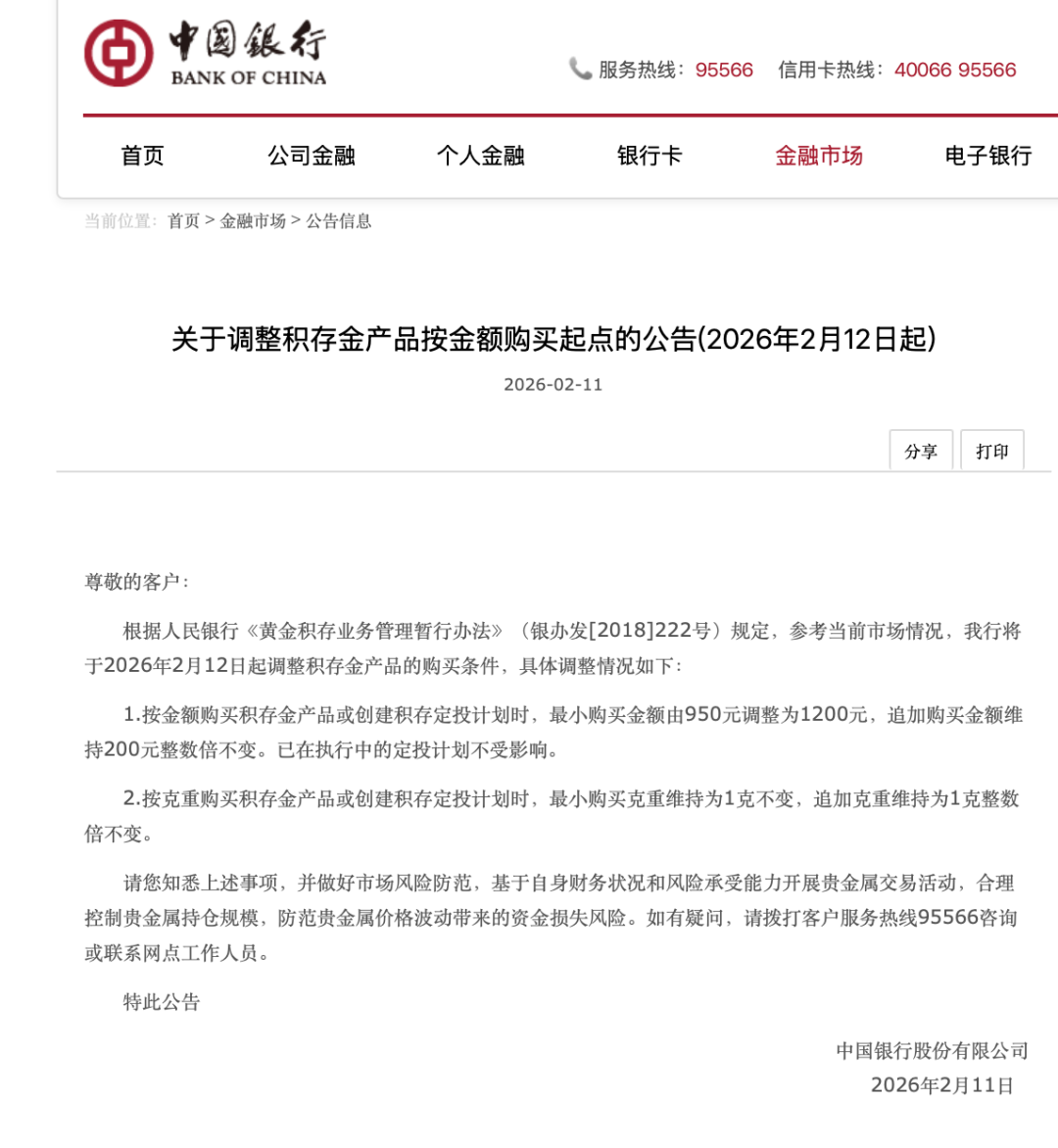
黄金大消息!又一国有大行宣布,上调起购金额
Zhong Guo Ji Jin Bao· 2026-02-11 22:38
Group 1 - The core point of the article is that China Bank has adjusted the minimum purchase amount for its accumulation gold products from 950 yuan to 1200 yuan, effective February 12, 2026 [1][2] - The adjustment in purchase conditions includes maintaining the additional purchase amount at 200 yuan and keeping the minimum weight for purchasing gold at 1 gram unchanged [2] - This change follows a trend among several banks, including Industrial and Commercial Bank of China and Agricultural Bank of China, which have also raised their minimum purchase amounts for accumulation gold products in early 2026 [5] Group 2 - In 2025, China Bank raised the minimum purchase amount for accumulation gold products four times, starting from 650 yuan in February and reaching 950 yuan by October [4] - The overall trend in the banking industry shows a tightening of access to accumulation gold business, with banks responding to regulatory requirements and market conditions to protect investors from irrational short-term trading [5] - The gold prices have shown significant volatility, with recent trends indicating a rebound above 5000 USD per ounce, which may influence banks' strategies regarding gold accumulation products [6][9]
“非农不冷”打压降息预期 市场重估美联储政策路径
智通财经网· 2026-02-11 22:31
Group 1 - The January employment data in the U.S. showed unexpected strength, with 130,000 new jobs added and the unemployment rate dropping to 4.3%, reducing market expectations for a rate cut by the Federal Reserve before mid-year [1][2] - The strong employment report has led traders to lower the probability of a rate cut in June to below 50%, which was previously considered the most likely time for the next cut [1] - Economists noted that while the January data is robust, it may be subject to downward revisions, and job growth remains concentrated in a few sectors, primarily healthcare [1][2] Group 2 - The healthy January employment data has put to rest concerns about a potential collapse in the labor market, which had been frequently mentioned by some dovish Federal Reserve officials [2] - There are still divergent policy stances within the Federal Reserve, with some officials advocating for maintaining restrictive interest rates to exert downward pressure on inflation [2] - Observers caution that it is still too early to predict the policy direction for June, as key indicators suggest that the labor market and overall economy are strengthening [3]
分红金额再创新高 上市公司春节前派发超3000亿元“红包”
Zhong Guo Zheng Quan Bao· 2026-02-11 21:01
Core Viewpoint - The total dividend amount distributed by listed companies before the Spring Festival has exceeded the previous year, reaching a new high of 348.8 billion yuan, indicating a strong commitment to enhancing investor returns and satisfaction [1] Group 1: Dividend Distribution Overview - From December 2025 to January 2026, 235 listed companies on the Shanghai and Shenzhen stock exchanges distributed a total of 348.8 billion yuan in dividends before the Spring Festival, surpassing the 344.6 billion yuan from the previous year [1] - The financial and consumer sectors remain the primary contributors to dividend distributions, with banking companies alone distributing 243.4 billion yuan, accounting for nearly 70% of the total [1][2] Group 2: Industry-Specific Insights - Major banks, including China Merchants Bank and Industrial Bank, have joined the trend of pre-Spring Festival dividends, distributing a total of 37.5 billion yuan [2] - Leading consumer companies such as Kweichow Moutai, Wuliangye, and Haitian Flavoring & Food have collectively distributed 44.8 billion yuan in dividends, reflecting their commitment to enhancing intrinsic value and investor confidence [3] Group 3: Changes in Dividend Timing - The timing of dividend distributions has shifted earlier, with a total of 264.7 billion yuan distributed in December 2025, which is 3.7 times the amount from December 2024, and now accounting for over 70% of the total pre-Spring Festival dividends [4] - Major banks have also advanced their dividend payments to December 2025, with a combined total of 189.9 billion yuan [4] Group 4: Private Company Dividend Trends - The willingness of private listed companies to distribute dividends has significantly increased, with a total of 61.6 billion yuan distributed, representing a year-on-year growth of 130% and an increase in their share of total dividends from 8% to 18% [5] - Notable private companies such as Industrial Fulian, Gree Electric, and Yili have also initiated pre-Spring Festival dividends for the first time, distributing 6.6 billion yuan, 5.6 billion yuan, and 3 billion yuan respectively [5]

