
债券

Search documents
A股震荡,债市交投活跃,国债ETF(511010)近10日净流入超1.5亿元
Mei Ri Jing Ji Xin Wen· 2025-11-07 07:05
Core Viewpoint - The fourth quarter bond market is expected to perform reasonably well, with improved sentiment for long positions following the People's Bank of China's announcement to restart government bond trading on October 27, which has limited the upward space for government bond yields [1] Economic Conditions - The macroeconomic pressures in China have become more evident, particularly after the October PMI fell below expectations, indicating a weakening economic environment [1] - Structural issues remain, with insufficient domestic demand being the primary concern, compounded by tariff disruptions affecting October exports [1] - Companies are facing difficulties in raising prices, which hampers the effectiveness of "anti-involution" policies in transmitting benefits downstream [1] Investment Recommendations - Despite the weak fundamentals, there is still potential for a decline in government bond yields, suggesting that investors should consider focusing on the 10-year government bond ETF (511260) and the government bond ETF (511010) [1]
新玩家入场,扫走75%的美债!中国持有的7781亿,无需担忧了
Sou Hu Cai Jing· 2025-11-07 04:13
Core Insights - A notable trend has emerged in global financial markets where several countries, including China, Japan, and the UK, along with the Federal Reserve, are reducing their holdings of U.S. Treasury bonds, reflecting complex considerations about the future of U.S. debt [1] Group 1: Data on U.S. Treasury Holdings - China has been continuously reducing its U.S. Treasury holdings since 2020, decreasing from a peak of $1.3 trillion to $778.1 billion as of September this year [3] - The Federal Reserve has implemented a dual strategy of interest rate hikes and selling off U.S. Treasuries to combat persistent domestic inflation, resulting in a reduction of its balance sheet to approximately $7.7961 trillion [3] Group 2: Reasons for Selling U.S. Treasuries - The total U.S. debt has surpassed $33 trillion, significantly exceeding last year's GDP of $24.5 trillion, raising concerns among central banks about a potential U.S. debt default [5] - Rising interest rates on U.S. Treasuries have increased the debt servicing burden, with annual interest payments exceeding $1 trillion [5] Group 3: Buyers of U.S. Treasuries - From last year to the first half of this year, the reduction in U.S. Treasuries amounted to $2.15 trillion, with U.S. individual investors, primarily hedge funds, increasing their holdings by $1.7 trillion, accounting for 75% of the market [6] - The rise in interest rates has made U.S. Treasuries, which now yield over 4%, attractive to risk-averse American investors seeking "risk-free" high returns [6] Group 4: Sustainability of Domestic Investment - There are concerns about whether American households can sustain their role as long-term buyers of U.S. Treasuries, as many families struggle to allocate significant funds for investment [7] - The rapid increase in U.S. debt suggests that relying solely on domestic investors may not be a viable long-term strategy, indicating potential risks in holding U.S. Treasuries [7]

11.7犀牛财经早报:22省快递价格上调 特斯拉股东会批准马斯克近万亿美元薪酬计划
Xi Niu Cai Jing· 2025-11-07 01:54
Group 1: Banking and Financial Products - As of the end of October, the scale of the bank wealth management market has reached 31.6 trillion yuan, an increase of 0.36 trillion yuan compared to September [1] - Some bank wealth management products have seen annualized returns rise above 10% over the past three months [1] - Experts are optimistic about the growth of bank wealth management scale in the fourth quarter, supported by the trend of "deposit migration" in a low-interest environment [1] Group 2: Bond Market - The "Technology Board" in the bond market has seen a strong growth, with a total issuance of 1.38 trillion yuan in the past six months [1] - Technology innovation bonds accounted for 77% of the total issuance this year, indicating a significant shift of funds towards the tech sector [1] - The current market for technology bonds is characterized by simultaneous increases in volume and price, along with enhanced institutional demand [1] Group 3: Gold Market - In the Shenzhen Shui Bei market, the price of gold jewelry has increased by nearly 60 yuan per gram, reaching close to 1,000 yuan [2] - The widening gap between buying and selling prices is noted, as the recovery price has decreased [2] - Some investors are attempting to extract physical gold through bank "accumulated gold" services for arbitrage, leading to several banks suspending related services [2] Group 4: Stock Market - The U.S. stock market experienced a significant sell-off, with major indices dropping over 2%, particularly in technology stocks [2] - Concerns over an "AI bubble" and worsening employment market conditions have heightened market anxiety, reflected in a sharp rise in the VIX fear index [2] - Uncertainty regarding the Federal Reserve's interest rate cut outlook has also contributed to the market decline [2] Group 5: Electric Vehicle and Battery Materials - As of the end of September, China's new energy storage installation capacity has exceeded 100 million kilowatts, growing over 30 times compared to the end of the 13th Five-Year Plan [3] - The price of electrolytes, a core material for batteries, is entering an upward cycle due to multiple driving factors, including the rise in new energy vehicles and explosive growth in the storage industry [3] Group 6: E-commerce and AI - This year's "Double Eleven" shopping festival has seen a significant integration of AI, with e-commerce platforms leveraging AI to enhance shopping experiences [4] - Consumers increasingly rely on AI for shopping decisions, leading to a transformation in how purchasing decisions are made [4] Group 7: Corporate Governance and Management - Tesla's shareholders approved a compensation plan for Elon Musk that could allow him to earn up to 878 billion yuan over the next ten years [4] - Guizhou Moutai addressed concerns regarding a significant reduction in advance payments from distributors, emphasizing the importance of maintaining stable partnerships [5] - Penghua Fund's managers denied rumors of a conflict, labeling them as malicious defamation [6]


大类资产早报-20251107
Yong An Qi Huo· 2025-11-07 00:36
Report Summary 1. Report Industry Investment Rating - No relevant information provided. 2. Core View - No core view presented in the given content. 3. Summary by Related Catalogs Global Asset Market Performance - **10 - year Treasury Bonds**: Yields for 10 - year Treasury bonds in major economies are as follows: US 4.084, UK 4.433, France 3.444, Germany 2.649, Italy 3.411, Spain 3.166, Switzerland 0.094, Greece 3.286, Japan 1.680, Brazil 6.167, China 1.802, South Korea 3.198, Australia 4.366, New Zealand 4.132 [3]. - **2 - year Treasury Bonds**: Yields for 2 - year Treasury bonds in major economies are: US 3.556, UK 3.781, Germany 1.985, Japan 0.934, Italy 2.174, China (1Y yield) 1.400, South Korea 2.763, Australia 3.599 [3]. - **Dollar - to - Emerging - Economy Currency Exchange Rates**: Exchange rates of the dollar against major emerging - economy currencies include: Brazil 5.352, Russia (not provided), South Africa zar 17.377, Korean won 1449.800, Thai baht 32.365, Malaysian ringgit 4.183 [3]. - **Renminbi Data**: In - shore RMB 7.119, off - shore RMB 7.121, RMB central parity rate 7.087, RMB 12 - month NDF 6.972 [3]. - **Major Economies' Stock Indices**: Latest values of major economies' stock indices are: S&P 500 6720.320, Dow Jones Industrial Average 46912.300, NASDAQ 23053.990, Mexican index 63093.120, UK index 9735.780, French CAC 7964.770, German DAX 23734.020, Spanish index 16118.000, Russian index (not provided), Nikkei 50883.680, Hang Seng Index 26485.900, Shanghai Composite Index 4007.760, Taiwan index 27899.450, South Korean index 4026.450, Indian index 8337.058, Thai index 1313.310, Malaysian index 1618.940, Australian index 9098.572, emerging - economy index 1393.770 [3]. - **Credit Bond Indices**: Data for credit bond indices are not provided [3]. Stock Index Futures Trading Data - **Index Performance**: Closing prices and percentage changes for A - shares, CSI 300, SSE 50, ChiNext, and CSI 500 are: A - shares closing price 4007.76, up 0.97%; CSI 300 closing price 4693.40, up 1.43%; SSE 50 closing price 3044.74, up 1.22%; ChiNext closing price 3224.62, up 1.84%; CSI 500 closing price 7345.72, up 1.61% [4]. - **Valuation**: PE (TTM) and环比变化 for CSI 300, SSE 50, and CSI 500 are: CSI 300 PE (TTM) 14.33,环比变化 0.15; SSE 50 PE (TTM) 11.98,环比变化 0.10; CSI 500 PE (TTM) 33.46,环比变化 0.51 [4]. - **Risk Premium**: No data provided [4]. - **Fund Flows**: Latest values and 5 - day average values of fund flows for A - shares, main board, SME board, ChiNext, and CSI 300 are: A - shares latest value 51.44, 5 - day average - 338.66; main board latest value - 36.32, 5 - day average - 267.02; SME board (not provided); ChiNext latest value 4.39, 5 - day average - 42.24; CSI 300 latest value 271.42, 5 - day average - 50.36 [4]. - **Transaction Amount and Changes**: Latest values and环比 changes of transaction amounts for Shanghai and Shenzhen stock markets, CSI 300, SSE 50, SME board, and ChiNext are: Shanghai and Shenzhen stock markets latest value 20552.48,环比 change 1829.07; CSI 300 latest value 5536.42,环比 change 852.81; SSE 50 latest value 1439.34,环比 change 264.86; SME board latest value 4036.04,环比 change 300.22; ChiNext latest value 5011.71,环比 change 275.40 [5]. - **Main Contract Basis and Premium/Discount**: Basis and percentage changes for IF, IH, and IC are: IF basis - 22.60, - 0.48%; IH basis - 3.34, - 0.11%; IC basis - 99.32, - 1.35% [5]. Treasury Bond Futures Trading Data - **Treasury Bond Futures**: Closing prices and percentage changes for T2303, TF2303, T2306, and TF2306 are: T2303 closing price 108.54, down 0.08%; TF2303 closing price 105.97, down 0.04%; T2306 closing price 108.27, down 0.10%; TF2306 closing price 105.94, down 0.05% [5]. - **Funding Rates**: Funding rates and daily changes for R001, R007, and SHIBOR - 3M are: R001 1.3621%, daily change - 10.00 BP; R007 1.4635%, daily change 0.00 BP; SHIBOR - 3M 1.5875%, daily change 0.00 BP [5].
拟发40亿认购额高达1182亿美元,美联储能干的事情,中国也能干!
Sou Hu Cai Jing· 2025-11-07 00:35
Core Viewpoint - China's recent issuance of USD sovereign bonds in Hong Kong attracted a total subscription amount of $118.2 billion, significantly exceeding the planned issuance of $4 billion, indicating strong international demand for Chinese debt instruments [1][3]. Group 1: Bond Issuance Details - The issuance of sovereign bonds is essentially a method for borrowing money, with the interest rates serving as a reflection of the country's creditworthiness [3]. - China offered a 3-year bond at an interest rate of 3.646% and a 5-year bond at 3.787%, which are lower than U.S. Treasury yields, suggesting a high level of confidence in China's credit [3][5]. - The oversubscription of the bonds indicates that international investors perceive China as a safer investment compared to the U.S., even at lower interest rates [5][6]. Group 2: Global Financial Dynamics - The influx of capital into Chinese bonds suggests a shift in investor sentiment, with many preferring to lend to China rather than keeping their money in the U.S., reflecting concerns over U.S. economic stability [5][6]. - China's ability to attract significant foreign investment is attributed to its strong trade surplus and industrial base, which provides a buffer against potential currency fluctuations [8][10]. - The current geopolitical landscape allows China to leverage its financial instruments to assist smaller nations, contrasting with the traditional debt-trap diplomacy often associated with Western powers [8][10]. Group 3: Military and Economic Strategy - China's military capabilities are seen as a means to protect its financial interests, allowing it to engage in global economic strategies that were previously dominated by the U.S. [6][11]. - The ability to issue bonds and attract investment while maintaining a stable economic environment positions China as a formidable player in the global financial system [10][11].
【财经分析】债市“科技板”半年记:发行规模1.38万亿元 精准滴灌科创领域
Xin Hua Cai Jing· 2025-11-07 00:16
Core Insights - The establishment of the "Technology Board" for innovation bonds has rapidly grown, with a total issuance of 1.38 trillion yuan as of November 6, 2023, becoming a significant financial force supporting technological innovation [1][2]. Group 1: Market Growth and Structure - From May 7 to November 6, 2023, a total of 1,186 innovation bonds were issued, accounting for 77% of the total issuance for the year, with the issuance scale reaching 1.38 trillion yuan, representing 81% of the annual total [2]. - The market is characterized by "increased volume and price, along with structural optimization," becoming an essential financial tool for supporting high-quality development in the real economy [2]. - The range of issuers has significantly expanded, with financial institutions and private equity firms accelerating their participation, leading to a shift from a state-owned enterprise-dominated market to a more diversified and market-oriented structure [2][3]. Group 2: Financing Costs and Trends - Since May, the average interest rate for innovation bonds has stabilized around 2%, which is significantly lower than the average interest rates for general credit bonds, effectively alleviating the financial pressures faced by technology companies [2]. - The distribution of bond terms has become more balanced, with a notable reduction in short-term bonds (1 year or less) and an increase in 3 to 5-year bonds, catering to medium to long-term financing needs [3]. Group 3: Regional Development and Innovation - The "Shaanxi Model" has emerged as a typical example of regional promotion of innovation bonds, with non-financial enterprises in Shaanxi issuing 16 innovation bonds totaling 14.85 billion yuan, ranking ninth nationwide [3]. - The region has established a multi-layered and comprehensive issuer system, including state-owned and private enterprises, with credit ratings ranging from AA to AAA [3]. Group 4: Future Outlook and Recommendations - The innovation bond market is expected to evolve with the expansion of product types and refinement of terms, leading to more precise pricing and the potential formation of a vibrant high-yield innovation bond market [6]. - Recommendations for enhancing the innovation bond ecosystem include improving incentive policies, establishing independent rating mechanisms, strengthening credit enhancement mechanisms, and optimizing the market environment [5]. - Future measures may include innovative tools linking equity and debt, and encouraging commercial banks to combine bond subscriptions with technology loans, creating a synergistic effect between bond financing and credit issuance [5].
债市“科技板”落地半年 发行规模达1.38万亿元
Zheng Quan Ri Bao· 2025-11-06 16:07
Core Viewpoint - The technology innovation bond market in China has shown significant growth in the past six months, with a total issuance of 1,186 bonds amounting to 1.38 trillion yuan, indicating a strong demand for financing in the tech sector [1][2]. Group 1: Market Growth and Trends - The issuance of technology innovation bonds (科创债) has reached a new high in the primary market, accounting for 77% of the total bonds issued this year, with a market share of 81% in terms of issuance scale [1][2]. - The market is characterized by a simultaneous increase in volume and price, along with an optimization of structure, making it a crucial financial tool for supporting high-quality development in technology innovation and the real economy [1][2]. Group 2: Diversification of Issuers - The issuance of technology innovation bonds has expanded significantly due to policy support, with a diversification of issuers including financial institutions and private enterprises, moving from a state-owned enterprise-dominated structure to a more market-oriented one [2][3]. - Financial institutions and investment firms are increasingly participating in the issuance of these bonds, with examples such as Chongqing Three Gorges Bank issuing 2.5 billion yuan in five-year technology innovation bonds [2][3]. Group 3: Financing Costs and Investment Focus - Since May, the average interest rate for technology innovation bonds has stabilized around 2%, which is significantly lower than that of general credit bonds, providing a substantial interest rate advantage for technology companies and venture capital institutions [3][4]. - The funds raised through these bonds are primarily directed towards cutting-edge fields such as artificial intelligence, semiconductors, biomedicine, and high-end manufacturing, creating a closed-loop system of issuance, investment, and exit [3][4]. Group 4: Support for Hard Technology Enterprises - Technology innovation bonds are becoming the largest source of financing for technology companies, particularly in sectors with long R&D cycles and high capital demands, such as biomedicine and new materials [4][5]. - The issuance of these bonds is increasingly aligned with the long-term financing needs of companies, with a shift towards longer-term bonds (3 to 5 years), which helps mitigate liquidity risks associated with short-term debt [4][5]. Group 5: Market Dynamics and Future Outlook - The issuance pace of technology innovation bonds has accelerated since late October, with a peak issuance of 16.95 billion yuan on a single day, reflecting strong market demand and investor interest [5]. - Analysts predict that technology innovation bonds will continue to expand, driven by ongoing policy support, improved liquidity, and a diverse range of investor participation, positioning them as a significant growth area in the credit bond market [5].
2025年11月小品种策略:把握年末信用利差压缩行情
Orient Securities· 2025-11-06 14:44
Group 1 - The report emphasizes the opportunity to capitalize on the year-end credit spread compression trend, with expectations of a slowdown in the rate of future increases, particularly in medium to long-term coupon-bearing products [12][13] - The report suggests that the central bank's resumption of bond purchases is not a one-time benefit but aims to encourage banks to expand their balance sheets and support fourth-quarter supply, indicating a potential for continued monetary easing [12][13] - In October, the credit bond yields experienced a significant decline, with the 5Y yield dropping by approximately 20 basis points, and AAA-rated 1Y bonds narrowing by at least 9 basis points, indicating a strong demand for coupon assets [12][13] Group 2 - In the corporate perpetual bond market, October saw a substantial increase in issuance, with 173 bonds issued totaling 172 billion, marking a 22% increase from the previous month, and achieving a net inflow of 52 billion [21][22] - The report notes that the financing costs for AAA and AA+ rated bonds slightly decreased, with rates at 2.31% and 2.56% respectively, while the issuance of AAA-rated bonds accounted for 91% of the total [21][22] - The sectors leading in issuance included public utilities, urban investment, and construction, with urban investment bonds from 13 provinces totaling 34.6 billion, and Shandong province leading with 10.6 billion [24][26] Group 3 - The report highlights that the ABS market has seen a widening premium compared to ordinary credit bonds, primarily due to a slower decline in yields, with expectations for overall yield declines to follow credit bonds but limited opportunities for excess returns [16][17] - It recommends prioritizing ABS types with a higher safety margin, such as urban investment ABS and low-risk types like fee income rights and affordable housing, while suggesting that the issuance of ABS from large central enterprises remains a viable option [16][17] - The report indicates that the trading volume of ABS has decreased, with a total issuance of 181.1 billion in October, reflecting a significant drop in financing scale [40]
ETF龙虎榜 | 涨价!引爆这一板块
Zhong Guo Zheng Quan Bao· 2025-11-06 13:56
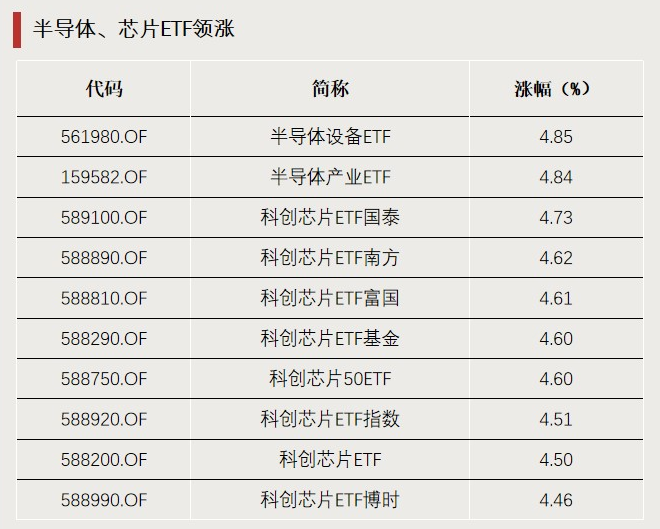
Group 1: Semiconductor Sector Performance - The semiconductor industry chain led the market rebound on November 6, with the top ten performing ETFs all related to semiconductors and chips [1][4] - The Semiconductor Equipment ETF (561980) had the highest increase at 4.85%, while the Semiconductor Industry ETF (159582) rose over 4.8% [5][4] - The surge in the semiconductor sector was primarily driven by rising prices of storage chips, with major storage manufacturers halting DDR5 contract pricing, leading to a 25%-30% increase in spot prices within a week [4][6] Group 2: Bond Market Activity - The bond market showed significant recovery, with bond ETFs seeing active trading, including six bond ETFs among the top ten by trading volume [2][8] - The Short-term Bond ETF had the highest trading volume at 314.13 billion, reflecting a notable increase from the previous day's trading volume [9][8] - The issuance of technology innovation bonds is expected to enhance the value of ETFs, potentially leading to excess returns for investors [9] Group 3: Hong Kong Stock Market Trends - Funds have started to flow into the Hong Kong technology sector, with the ETFs tracking the Hang Seng Technology Index receiving a net inflow of 34.89 billion on November 5 [3][10] - The Hang Seng Technology ETF (513130) saw a net inflow of 12 billion, while the Hang Seng Technology Index ETF (513180) received over 9 billion [3][10] Group 4: Future Outlook for Semiconductor Equipment - The semiconductor equipment sector is expected to return to an upward trend due to multiple favorable factors, including rising storage prices driven by AI technology demand [12][13] - The ongoing IPOs of major domestic storage companies and increased capital expenditure in the semiconductor equipment sector are anticipated to further boost demand [13] - Recent breakthroughs in lithography technology are expected to catalyze the semiconductor equipment sector, with continued market interest reflected in the inflow of funds into related ETFs [12][13]
Investinglive分析师Justin Low:本周债券市场出现的关键动向值得密切关注
Xin Hua Cai Jing· 2025-11-06 13:42
Group 1 - The bond market has shown significant movements this week, particularly with the ten-year U.S. Treasury yield rising to 4.16%, marking a one-month high [1] - If the U.S. Treasury yield continues to climb towards 4.21%, it may further bolster the strength of the U.S. dollar [1]