
芯片半导体

Search documents
策略周评20251026:四中全会后市场风格如何演绎?
Soochow Securities· 2025-10-26 02:35
Group 1 - The report highlights that the Fourth Plenary Session of the 20th Central Committee has set a strategic tone for the "15th Five-Year Plan," emphasizing the need to consolidate achievements from the "14th Five-Year Plan" while addressing complex international challenges [2][4] - The strategic goals outlined in the report include significant increases in economic, technological, defense, and comprehensive national strength, reflecting a response to intensified global competition and geopolitical instability [3][4] - The report emphasizes the importance of technological innovation as a driver for new productive forces, urging accelerated self-reliance in key technologies and the integration of technology and industry [5][6] Group 2 - The report indicates a structural adjustment in key tasks, prioritizing the construction of a modern industrial system, expanding high-level opening-up, and improving people's livelihoods to promote common prosperity [4][5] - The strategic deployment includes the establishment of a "space power" and "agricultural power," highlighting the need for comprehensive development in aerospace and rural modernization [5][6] - The current economic situation is assessed as stable with strong potential, and the report calls for sustained macroeconomic policies to support growth and mitigate local government debt risks [6][7] Group 3 - Historical data shows that after the release of similar reports, small-cap and growth stocks tend to outperform, with an average growth style increase of 3.24% observed in previous cycles [4][12] - The report anticipates that the emphasis on technological innovation will continue to dominate the policy landscape, with a focus on sustainable development and practical implementation in high-tech industries [5][6] - The global liquidity environment is expected to improve with potential interest rate cuts by the Federal Reserve, which may benefit growth stocks and facilitate a reallocation of global funds [7][10] Group 4 - The report identifies key sectors to watch, including technology trends in semiconductors, computing power, and energy storage, as well as high-growth areas like lithium battery supply chains and wind power [10] - It underscores the importance of the upcoming full text of the "15th Five-Year Plan" recommendations, which is expected to provide further guidance on industrial development [9][10] - The report concludes that the strategic focus on technology and industry development will reinforce the narrative around growth stocks, presenting structural investment opportunities in the medium to long term [10]
历史首次!未来5年重磅主线出现!
格隆汇APP· 2025-10-24 10:28
Core Viewpoint - The article highlights the significant growth potential in the aerospace and defense sectors in China, driven by the recent policy announcements and the "14th Five-Year Plan" which emphasizes technological self-reliance and the establishment of a modern industrial system [2][8][9]. Market Performance - On October 24, A-shares saw a collective rise, with the Shanghai Composite Index up 0.71% to 3950 points, marking a 10-year high. The Shenzhen Component Index increased by 2.02%, and the ChiNext Index rose by 3.57% [2]. - The aerospace and defense sectors, alongside semiconductor and AI industries, emerged as strong market performers, with the Aerospace ETF (159227) gaining 2.59% and experiencing a significant increase in trading volume [2][4]. Policy Impact - The recent Fourth Plenary Session emphasized the goal of becoming a "strong aerospace nation," marking a strategic shift for the aerospace industry in China [8][9]. - The "14th Five-Year Plan" aims to develop emerging pillar industries, including aerospace, which is expected to create several trillion-yuan markets [9][11]. Industry Growth Projections - The aerospace industry is projected to grow at an average annual rate of over 20% during the "14th Five-Year Plan" period, driven by increased R&D investments in missiles, rockets, and satellites [11]. - The commercial aerospace market in China is expected to reach 2.3 trillion yuan in 2024 and exceed 2.5-2.8 trillion yuan in 2025, with a compound annual growth rate exceeding 20% [20]. Investment Opportunities - The article suggests that the aerospace and defense sectors are closely tied to national five-year plans, indicating that investment strategies should consider the timing of policy announcements and order releases [23]. - The Aerospace ETF (159227) is highlighted as a stable investment option, tracking the National Aerospace Index and comprising a high percentage of defense and aerospace stocks [24][26]. Key Companies - Notable companies in the aerospace sector include AVIC Shenyang Aircraft Corporation, which is the only pure fighter jet listed company in A-shares, and Aero Engine Corporation of China, which supplies engines for major military aircraft [14][15]. - The C919 aircraft has surpassed 1500 orders, indicating strong market recognition and potential for growth in the civil aviation sector [16].




火力全开!“十五五”吹响科技冲锋号,芯片超级周期来了?
Ge Long Hui· 2025-10-24 06:56
Group 1: Market Trends - The semiconductor and technology sectors are experiencing a significant rally, with stocks like Kexiang Co., Puran Co., and Aerospace Zhizhuang hitting the daily limit up [1] - The A-share semiconductor sector has seen a cumulative increase of over 50% year-to-date [3] - The global semiconductor market is projected to reach $630.5 billion in 2024, reflecting a year-on-year growth of 19.7% [12] Group 2: Policy and Strategic Initiatives - The "14th Five-Year Plan" emphasizes the importance of technology modernization as a foundation for China's modernization [6] - The Chinese government aims to seize opportunities from the new round of technological revolution and industrial transformation [6] - The focus on artificial intelligence and digital technology innovation is set to enhance the supply of computing power, algorithms, and data [7] Group 3: AI and Semiconductor Demand - The demand for AI computing power is surging, leading to a memory crisis, with OpenAI's "Star Gate" project requiring 900,000 DRAM wafers monthly, accounting for nearly 40% of global DRAM capacity [9] - South Korea anticipates its semiconductor exports to exceed $165 billion in 2025, marking a record high for the second consecutive year [9] - The storage chip market is currently experiencing a price surge, with major players like Samsung and SK Hynix planning to raise prices by up to 30% in response to AI-driven demand [10][11] Group 4: Market Forecasts - Morgan Stanley predicts that the storage chip industry is entering a new upward cycle driven by AI applications, which is expected to last 4-6 quarters [15] - The global storage market is projected to approach $300 billion by 2027, with a pricing uptrend anticipated from 2024 to 2027 [15] - The World Semiconductor Trade Statistics (WSTS) forecasts that the semiconductor market will reach $7.28 trillion in 2025, with a year-on-year growth of 15.4% [12]
杨德龙:市场风格频繁切换 大盘维持震荡向上走势
Xin Lang Ji Jin· 2025-10-23 10:36
Group 1: Market Trends - The market is experiencing fluctuations, but the overall trend is upward, with significant rebounds in the new energy sector, particularly in lithium and photovoltaic industries [1][2] - The price of battery-grade lithium carbonate has increased by 1,500 yuan, averaging 77,600 yuan per ton, contributing to the rise in the new energy sector [1][2] Group 2: New Energy Sector Developments - The new energy sector is recovering significantly after a period of internal competition and capacity reduction, with a focus on clean energy as a national policy [2] - The Ministry of Industry and Information Technology (MIIT) emphasizes the need for technological innovation and the development of new battery technologies, including solid-state and metal-air batteries [2] - MIIT's four recommendations aim to enhance the resilience of the supply chain, optimize the development environment, and promote international cooperation in the new energy battery industry [2] Group 3: Banking Sector Insights - A major bank's stock price has reached a historical high, with a price-to-book ratio exceeding 1, indicating a shift in investor interest towards dividend assets amid market volatility [3] - The banking sector's low valuation and high dividend yield appeal to investors seeking stable returns, especially as technology stocks experience corrections [3] Group 4: Robotics Industry Growth - The humanoid robot sector is poised for significant growth, similar to the success seen in the electric vehicle industry, with industrial robot production increasing by nearly 30% in the first three quarters [4] - The supply chain for humanoid robots includes upstream components, midstream manufacturing, and downstream application services, with upstream component manufacturers likely to benefit first [4] Group 5: Investment Opportunities in Humanoid Robots - The investment in the embodied intelligence sector reached 19.5 billion yuan in the first half of 2025, with local governments supporting humanoid robot development [5] - The humanoid robot industry is transitioning from factory production to commercial and household applications, with potential market value reaching trillions in the next 5 to 10 years [5]
科创板50指数午后冲高,科创板50ETF(588080)等产品受市场关注
Mei Ri Jing Ji Xin Wen· 2025-10-22 06:28
Core Viewpoint - The semiconductor sector is experiencing a notable surge, with stocks like Cambricon and Haiguang Information seeing significant increases, which has positively impacted the STAR Market 50 Index, pushing it up by over 1% at one point [1] Group 1: Market Performance - The STAR Market 50 ETF (588080) has seen a continuous net inflow of funds exceeding 1 billion yuan over the first two trading days of the week, bringing its total scale to 72.6 billion yuan, making it the largest in its category [1] - The STAR Market 50 Index is composed of 50 securities from the STAR Market that have large market capitalization and good liquidity, with the semiconductor industry accounting for over 65% of the index [1] Group 2: Investment Insights - According to Shenwan Hongyuan Securities, the key cyclical catalysts for the end of the year and the beginning of the next have not yet arrived, but the trend of technology growth industries remains concentrated [1] - The STAR Market 50 ETF (588080) offers a low management fee rate of 0.15% per year, which can help investors to cost-effectively position themselves in the forefront of the technology sector [1]
杨德龙:股市走牛形成财富效应,有效增加居民财产性收入
Xin Lang Ji Jin· 2025-10-21 08:47
Group 1 - The A-share market has entered a bull market, with the Shanghai Composite Index rising over 16% this year and surpassing 3900 points, while the ChiNext Index has increased by 44% [2][4] - Investor confidence is growing, as evidenced by over 20 million new A-share accounts opened this year, a year-on-year increase of over 50% [2][6] - The bull market is seen as a key driver for economic growth and consumer spending, with the stock market acting as a barometer for economic development [1][3] Group 2 - The current bull market is supported by various policies aimed at stabilizing the stock market and boosting consumer confidence, including the "Special Action Plan to Boost Consumption" issued by the central government [1][3] - The technology sector has been a significant contributor to the bull market, with substantial gains in areas such as humanoid robots, semiconductor chips, solid-state batteries, and innovative pharmaceuticals [4][5] - The ongoing Fourth Plenary Session is expected to further support the technology sector, which is crucial for sustaining the current bull market [5] Group 3 - The rise in stock market values directly impacts household wealth and consumer spending, creating a psychological effect that influences consumer behavior [3][4] - Stable stock markets are essential for injecting capital into the real economy and enhancing consumer confidence, thereby promoting a positive cycle of consumption and economic growth [3][4] - The long-term trend of rising international gold prices reflects investor skepticism towards the US dollar, with many turning to gold as a hedge against inflation and currency devaluation [6]
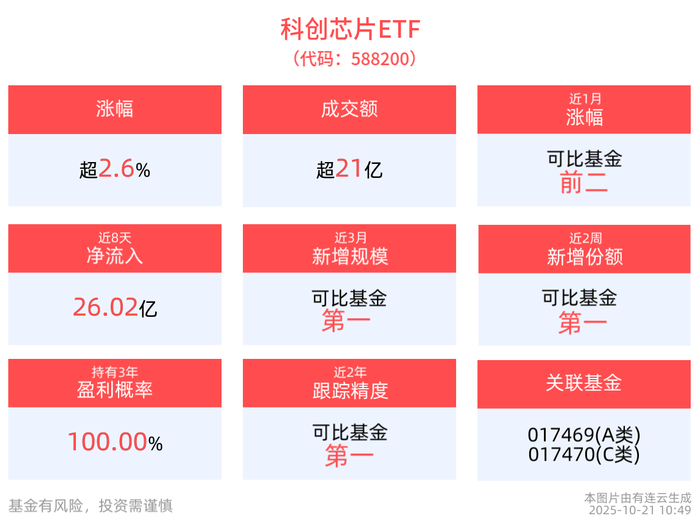
芯片半导体产业已开启新一轮向上周期,科创芯片ETF(588200)上涨2.64%,成分股源杰科技涨超17%
Xin Lang Cai Jing· 2025-10-21 03:29
Core Viewpoint - The semiconductor industry in China is experiencing significant growth driven by government support, evolving global trade dynamics, and increasing domestic demand for AI and consumer electronics [4][5]. Group 1: Market Performance - The Shanghai Stock Exchange Sci-Tech Innovation Board Chip Index rose by 2.76%, with notable increases in stocks such as SourceJect Technology (up 17.04%) and Baiwei Storage (up 6.30%) [1]. - The Sci-Tech Chip ETF (588200) increased by 2.64%, with a trading volume of 2.128 billion yuan and a turnover rate of 5.42% [3]. - Over the past three months, the Sci-Tech Chip ETF's scale grew by 7.184 billion yuan, ranking first among comparable funds [3]. Group 2: Fund Performance - The Sci-Tech Chip ETF saw a significant increase in shares, with a growth of 1.005 billion shares over the past two weeks, also ranking first among comparable funds [3]. - The ETF recorded a net inflow of 91.1468 million yuan, with a total of 2.602 billion yuan net inflow over the last eight trading days [3]. - As of October 20, 2025, the ETF's net value increased by 132.31% over the past three years, placing it in the top 1% of index equity funds [3]. Group 3: Industry Trends - The semiconductor industry is entering a new upward cycle, supported by government policies and the AI innovation cycle, which enhances expectations for self-sufficiency in chip production [4]. - The domestic semiconductor sector is witnessing a wave of mergers and acquisitions across various fields, including materials, equipment, EDA, packaging, and chip design [5]. - Companies are engaging in horizontal and vertical mergers to expand their scale and improve the supply chain, reshaping the landscape of the domestic semiconductor industry [5]. Group 4: Key Stocks - The top ten weighted stocks in the Sci-Tech Chip Index account for 59.69% of the index, with notable performers including SMIC (up 3.32%) and Haiguang Information (up 2.61%) [3][7]. - Investors without stock accounts can access domestic chip investment opportunities through the Sci-Tech Chip ETF linked fund (017470) [7].





王炸!寒武纪23倍增长引爆科技股 这是明牌!今天还有条主线 你注意到没?
Mei Ri Jing Ji Xin Wen· 2025-10-20 08:36
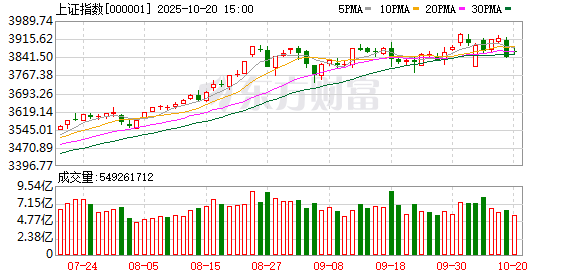
Market Overview - The total trading volume in the Shanghai and Shenzhen markets reached 1.74 trillion yuan, a decrease of approximately 200 billion yuan compared to the previous trading day [1] - Nearly 4,100 stocks rose, with significant gains in sectors such as coal, gas, non-metallic materials, electric machinery, aviation, communication services, batteries, communication equipment, and consumer electronics, while the precious metals sector experienced a sharp decline [1] Company Performance - After a pullback last week, the technology sector saw a significant rise, largely attributed to the impressive Q3 report from Cambrian [3] - Cambrian reported total revenue of 4.607 billion yuan for the first nine months of 2025, a year-on-year increase of 2386.38%, and a net profit of 1.605 billion yuan, showing substantial improvement [3] - In Q3 alone, Cambrian achieved a revenue of 1.727 billion yuan, up 1332.52% year-on-year, with a net profit of 567 million yuan [3] - Research institutions have positively reviewed Cambrian's performance, highlighting a significant increase in inventory, which reached approximately 3.7 billion yuan, an increase of about 1 billion yuan from the previous quarter [3] Sector Analysis - Dongwu Securities noted that Cambrian, as a leader in AI chips, is expected to capture market share due to the rapid growth of the AI chip market [4] - Based on Cambrian's performance announcement, Dongwu Securities raised its revenue forecasts for 2025-2027 to 6.771 billion yuan, 13.535 billion yuan, and 23.004 billion yuan, respectively, and adjusted net profit estimates to 2.106 billion yuan, 4.869 billion yuan, and 8.733 billion yuan [4] - The coal sector also performed well, with the coal ETF rising over 4% and a cumulative increase of over 11% in October [8] - The coal price at northern ports increased significantly, with a rise of 39 yuan per ton for thermal coal, and prices in Shanxi, Inner Mongolia, and Shaanxi also saw substantial increases [10] - The coal sector's strength is attributed to rising price expectations, supported by supply-side policies and seasonal demand increases [10][11] Investment Sentiment - The market continues to experience reduced trading volumes, with a focus on upcoming earnings reports as the deadline for Q3 disclosures approaches [7] - Investors are advised to pay attention to sectors with performance highlights, such as gold, AI-related TMT sectors, and non-bank financials, as well as industries less correlated with economic cycles [7] - The upcoming Fourth Plenary Session of the 20th Central Committee is expected to provide insights into China's economic development plans, which may influence market sentiment [11]
杨德龙:国际金价持续飙升本质上是对美元信用的质疑
Xin Lang Zheng Quan· 2025-10-16 11:35
Group 1: Market Overview - The overall market is experiencing a certain level of volatility due to President Trump's sudden trade war, but this is seen as a short-term impact, with the long-term trend of a slow bull market remaining unchanged [1] - The current technology bull market has lasted for a year, with significant gains in various technology sectors representing new productive forces [1][2] Group 2: Investment Opportunities - Key sectors to focus on include humanoid robots, solid-state batteries, computing algorithms, semiconductor chips, low-altitude economy, innovative pharmaceuticals, and New Energy 2.0, all of which have shown outstanding performance [1] - The humanoid robot sector is expected to become a major industry in China, following home appliances, mobile phones, and new energy vehicles, with many companies transitioning from automotive parts manufacturing [2] Group 3: Semiconductor Industry - Recent advancements in the semiconductor field indicate significant breakthroughs in "bottleneck" projects, positioning China as a potential global hub for chip production and research [3] - Bill Gates previously criticized the U.S. for attempting to stifle China's high-tech development through high-end chips, predicting that this would only strengthen China's R&D efforts [3] Group 4: Economic Trends - The current bull market is fundamentally driven by economic transformation and technological development, with the "14th Five-Year Plan" expected to unveil key industries for development, potentially creating new opportunities for technology stocks [4] - Despite short-term adjustments due to the trade war, technology stocks quickly attracted significant capital, leading to a rebound [4] Group 5: Gold Market - The outlook for gold remains positive, driven by the expansion of U.S. dollar issuance and the anticipated rise in gold prices, which have already seen a year-to-date increase of over 52% [5] - The ongoing uncertainty regarding the U.S. government and potential interest rate cuts by the Federal Reserve are expected to further support gold prices [5][6] Group 6: Currency Trends - The Chinese yuan has appreciated against the U.S. dollar, with the central bank's recent adjustments reflecting a recovery in the yuan's value [7] - The rise in the yuan is attributed to a combination of factors, including improved macroeconomic policies and significant foreign capital inflows into the A-share market [7]
杨德龙:特朗普挑起关税战不得人心 不会改变本轮牛市大趋势
Xin Lang Ji Jin· 2025-10-13 06:50
Group 1 - The market experienced a significant drop followed by a rebound, influenced by Trump's proposal for a 100% tariff, which is seen as a negotiation tactic rather than a long-term threat [1] - The impact of the tariff proposal on the market is expected to be less severe than previous instances, with investor confidence remaining relatively stable [1] - China's export dependence on the US has decreased from 19% in 2018 to below 10% currently, indicating a strengthening of its economic position [1] Group 2 - The current market rally is supported by strong economic policies and an influx of retail investors, with nearly 300 million new stock accounts opened in September [2] - The low-interest-rate environment is driving residents to invest in stocks and funds, potentially shifting 20-30 trillion yuan into the capital market over the next few years [2] - Foreign investment in Chinese assets is increasing, with $4.6 billion inflow in September and expectations for continued growth [2] Group 3 - The bull market is characterized by a divergence between sectors, with technology and innovation-driven industries seeing significant gains while traditional sectors lag [3] - Investors are advised to hold quality stocks during market adjustments and consider reducing positions in overvalued tech stocks [3] - The overall trend of the bull market is expected to continue despite short-term fluctuations [3] Group 4 - International gold prices have surpassed $4,000, reflecting concerns over US government credit and increasing debt levels, which have reached $37 trillion [4] - The rise in gold prices is accompanied by a significant increase in silver prices, driven by industrial demand, particularly in the photovoltaic sector [4] - The gold-silver ratio remains stable, with silver's price increase exceeding 70% this year compared to gold's over 50% [4] Group 5 - The current slow bull market in A-shares and Hong Kong stocks is anticipated to continue, marking a shift from real estate investment to stock market opportunities [5] - Investors are encouraged to focus on value investing and hold quality stocks for the medium to long term to capitalize on technological innovation [5]