货币金融服务

Search documents
乐在科技旗下小贷App被通报,关系网背后指向三胞集团
Nan Fang Du Shi Bao· 2025-10-09 11:27
Core Points - Jiangsu Provincial Communication Administration has been actively addressing the issue of apps and mini-programs illegally collecting and using personal information, with a recent report identifying seven apps, including "Xiao Cheng Borrowing," that have not completed rectification [1][3] - "Xiao Cheng Borrowing" is operated by Nanjing Lezai Technology Microloan Co., Ltd., which has been flagged for violating personal information collection regulations [1][3] - Lezai Technology has registered multiple microloan apps, with "Xiao Cheng Borrowing" being one of them, and the company was established in May 2023 with a registered capital of 100 million yuan [3] Company and Industry Insights - The financial software sector is under strict scrutiny from regulatory bodies, with the National Cyber Security Reporting Center having previously issued warnings regarding multiple financial apps' violations [3] - Lezai Technology's apps are linked to Sanbao Group, raising market concerns about potential undisclosed relationships and the implications for the company's operations [2][5] - The connection between Lezai Technology and Sanbao Group is highlighted by the fact that several apps registered by Lezai Technology share names with those previously registered by Nanjing Hongtu Technology Microloan Co., Ltd., which is linked to Sanbao Group [5][6] - Sanbao Group has faced financial difficulties, including a delisting from the Shanghai Stock Exchange, which raises questions about whether Lezai Technology is a vehicle for transferring Sanbao Group's credit business [7]
9月PMI点评:预计基本面对债市定价权逐步抬升
Changjiang Securities· 2025-10-09 02:43
1. Report Industry Investment Rating No relevant content provided. 2. Core Viewpoints of the Report - In September 2025, the manufacturing PMI increased by 0.4 pct month - on - month to 49.8%, slightly exceeding expectations but still below the boom - bust line, while the non - manufacturing PMI dropped by 0.3 pct to 50.0%. The supply - demand relationship needs optimization, and whether production is "front - loaded" remains to be seen. External demand is stable, domestic demand recovers slowly, and the gap between the "purchase price of major raw materials - ex - factory price" continues to widen, putting pressure on enterprise profit restoration. Small - scale enterprise sentiment has significantly improved, and the sentiment of emerging manufacturing industries has also improved. Service industry sentiment has declined, and the construction industry has improved but is still at a relatively low level. The sustainability of PMI restoration needs to be observed. The bond market priced the fundamentals further on the day the data was released, and it is expected that as the pricing power of fundamentals on the bond market gradually increases, the bond market performance in the fourth quarter may be better than that in the third quarter [2][7]. 3. Summary by Related Catalogs 3.1 Event Description - In September 2025, the manufacturing PMI was slightly better than expected but below the boom - bust line, rising 0.4 pct month - on - month to 49.8% (Bloomberg consensus forecast: 49.6%), basically in line with seasonality. The non - manufacturing PMI dropped 0.3 pct to 50.0% (Bloomberg consensus forecast: 50.2%), remaining at a seasonal low. Among them, the service industry PMI dropped 0.4 pct to 50.1%, and the construction industry PMI rose slightly by 0.2 pct to 49.3%, both weaker than seasonality [5]. 3.2 Event Comment - **Manufacturing Industry** - Manufacturing sentiment has moderately recovered, but the supply - demand relationship needs optimization, and whether production is "front - loaded" remains to be seen. In September, the manufacturing PMI improved more than expected, rising 0.4 pct to 49.8%. The production index rose 1.1 pct to 51.9%, reaching a new high since Q2 this year, while the new order index only increased 0.2 pct to 49.7%. The gap between the "production - new order" index widened to 2.2 pct, indicating that the supply recovery intensity may be greater than the demand improvement. Enterprises' willingness to replenish inventory has increased, but there are signs of inventory accumulation, and production may be "front - loaded" [7]. - There are differentiations in external and internal demand and price structure. External demand is stable, domestic demand recovers slowly, and the price indicators have generally improved, but the gap between the "purchase price of major raw materials - ex - factory price" continues to widen, which may still restrict enterprise profit restoration. In September, the purchase price index of major raw materials remained in the expansion range of 53.2%, while the ex - factory price index dropped to 48.2%, and the gap between the two widened to 5.0 pct. External demand remained resilient, with the new export order index rising to 47.8%, while domestic demand recovery was still relatively slow, with the new order index only increasing 0.2 pct to 49.7% [7]. - Small - scale enterprise sentiment has significantly improved, and the sentiment of emerging manufacturing industries has also improved. In September, the PMI of large - scale enterprises reached 51.0%, remaining in the expansion range. Small - scale enterprises improved significantly, with the PMI rising 1.6 pct month - on - month, while the sentiment of medium - scale enterprises declined. In terms of industries, the PMI of the equipment manufacturing and high - tech manufacturing industries remained in the high - sentiment range above 51%, with significant improvements in industries such as automobiles and railway, ship, and aerospace equipment. The PMI of the consumer goods industry also rose to 50.6% [7]. - **Non - manufacturing Industry** - Service industry sentiment has declined, and the construction industry has improved but is still at a seasonal low. In September, the non - manufacturing business activity index dropped 0.3 pct to 50.0%, and the service industry index dropped 0.4 pct to 50.1%. The end of the summer vacation effect is an important factor, with the sentiment of consumer - related industries such as catering and cultural and entertainment significantly declining, while modern service industries such as finance and telecommunications maintained high sentiment. The business activity index of the construction industry rose slightly by 0.2 pct, but the absolute level of 49.3% was still below the boom - bust line, indicating that real estate and infrastructure investment may continue to be under pressure [7]. - **Bond Market Outlook** - The sustainability of PMI restoration needs to be observed. On the day the data was released, the bond market priced the fundamentals further, with the yield of the 10 - year active treasury bond dropping 2 BP. A series of growth - stabilizing policies have been implemented recently, and the investment of 500 billion yuan in new policy - based financial instruments may support infrastructure investment. The expectation of optimizing real estate market regulation policies in many places has increased, but whether the economy will continue to improve in an environment of weak domestic demand and prices remains to be seen. It is expected that as the pricing power of fundamentals on the bond market gradually increases, the bond market performance in the fourth quarter may be better than that in the third quarter [7].
金价上涨的秘密:美元主导的世界货币格局正在巨变
经济观察报· 2025-10-07 07:30
Core Viewpoint - The recent surge in gold prices, reaching $4000 per ounce, reflects not only rising risk aversion but also a response to shifts in the global monetary order, particularly in the context of the Federal Reserve's interest rate cuts and a weakening dollar [2][5]. Group 1: Gold Market Dynamics - Gold prices have increased over 50% this year, driven by factors such as central banks accumulating gold reserves and private sectors actively investing in gold assets [2]. - The historical peak in gold prices coincides with a technical government shutdown in the U.S. and an uncertain global economic outlook, highlighting a blend of market risk appetite and instinct for safety [2]. Group 2: Renminbi Internationalization - The internationalization of the Renminbi (RMB) is currently in a phase of "spiral ascent" but faces structural challenges, despite China's growing economic influence [4]. - In Q1 2025, the RMB accounted for 2.12% of global foreign reserves, ranking sixth, significantly lower than the U.S. dollar's 57.74% [3]. Group 3: Market Adoption of Renminbi - A notable shift occurred in Q2 2024, where RMB cross-border transaction settlements surpassed those in USD for the first time, indicating a growing preference for RMB among enterprises [5]. - Surveys show that 68% of companies used RMB for cross-border trade settlements in Q4 2024, with 71% citing "asset safety" as the primary reason for this choice [5]. Group 4: Infrastructure and Policy Developments - The establishment of the Digital Renminbi International Operation Center and the upcoming 10th anniversary of the Cross-Border Interbank Payment System (CIPS) signify a shift towards a transaction-driven RMB infrastructure [12][16]. - The People's Bank of China is focused on enhancing the global cross-border payment system, promoting the principles of "no loss, compliance, and interoperability" for digital currency [15]. Group 5: Future Challenges and Strategies - Over 60% of enterprises perceive the complexity of cross-border RMB policies as a significant barrier, indicating a need for simplification and optimization of capital flow processes [20]. - To enhance RMB internationalization, strategies should focus on improving liquidity, developing onshore derivative markets for risk hedging, and creating tailored financial products for enterprises [20]. Group 6: Broader Implications - The ongoing structural changes in the global monetary environment are reflected in the increasing use of RMB and the historical highs in gold prices, suggesting a potential shift away from dollar dominance [21][22]. - The RMB's evolution from a policy-driven currency to one that gains market acceptance through transaction experiences is crucial for its future credibility and stability [17][24].


1美元兑1150000里亚尔!伊朗货币将抹掉四个零 什么情况?
Mei Ri Jing Ji Xin Wen· 2025-10-06 02:36
Group 1 - Iran's parliament has approved a comprehensive reform of its currency system, which will involve removing four zeros from the national currency over the next few years to simplify transactions after years of inflation [1] - The Iranian rial has depreciated significantly, with a current exchange rate of 1 USD to 1,150,000 rials, attributed to inflation rates exceeding 35% [1] - The reform will not happen overnight; the central bank has a two-year preparation period followed by a three-year transition period during which both old and new denominations will coexist [1] Group 2 - Syria plans to issue new banknotes that will remove two zeros from its currency to restore public confidence in the severely devalued Syrian pound [2] - The Syrian pound has lost over 99% of its value since the war began in 2011, with the current exchange rate at approximately 10,000 pounds to 1 USD, compared to 50 pounds to 1 USD before the conflict [2] - The central bank of Syria has confirmed that this currency reform is a strategic pillar of fiscal and monetary reform [2]

人民币的温度
Jing Ji Guan Cha Bao· 2025-10-01 15:00
Group 1 - The core viewpoint of the articles indicates a significant shift in the internationalization of the Renminbi (RMB), moving from a policy-driven approach to a market-driven one, where businesses are increasingly opting for RMB in cross-border transactions [1][10][17] - In the second quarter of this year, RMB cross-border transaction settlements surpassed those in USD for the first time, with 68% of surveyed companies using RMB for cross-border trade settlements by the fourth quarter of 2024 [1][2] - The RMB is perceived as more user-friendly and stable, with companies valuing its cash flow, security, and acceptance by trading partners [3][12] Group 2 - The establishment of the Digital RMB International Operation Center in Shanghai and the launch of various platforms signify China's efforts to create a transaction-driven RMB infrastructure [6][9] - The RMB's role is evolving from a settlement currency to an investment currency, with its global reserve share reaching 2.12% as of the first quarter of 2025 [11][12] - The RMB's internationalization is supported by a combination of policy simplification, development of onshore derivatives markets, and tailored financial products to enhance its competitiveness [14][15] Group 3 - The RMB's internationalization is not merely a result of administrative guidance but is increasingly driven by market dynamics and the desire for a more efficient and transparent payment system [10][13] - The recent trends in capital inflows and the rising interest in RMB-denominated assets reflect a broader structural change in the global monetary environment [15][16] - The future of RMB internationalization hinges on comprehensive financial reforms, robust infrastructure, and effective risk management to establish it as a necessary currency in global trade and finance [14][15]
【首席观察】人民币的温度
Sou Hu Cai Jing· 2025-10-01 06:42
Core Viewpoint - The internationalization of the Renminbi (RMB) is gaining momentum as more enterprises, including foreign and third-country trade partners, are actively requesting RMB settlements, reflecting a shift from a policy-driven approach to a market-driven one [3][4][14]. Group 1: RMB Usage in Cross-Border Transactions - In Q2 of this year, RMB cross-border transaction settlements surpassed those in USD for the first time, with 68% of surveyed enterprises using RMB for cross-border trade settlements [3][4]. - The primary reason for using RMB cited by 71% of enterprises is "asset safety" [3]. - The RMB is increasingly viewed as a stable and convenient currency, allowing enterprises to avoid dependence on the USD [8][11]. Group 2: Market Dynamics and Investment Trends - Following the Federal Reserve's interest rate cuts, RMB assets have attracted global investors, leading to significant inflows into RMB-denominated bonds and A-shares [8][9]. - As of August 2025, 1,170 foreign institutions have entered the Chinese bond market, holding approximately 4 trillion RMB in bonds [9]. - The RMB's role is evolving from a settlement currency to an investment currency, with potential to test the boundaries of becoming a reserve currency [15]. Group 3: Infrastructure and Policy Developments - The establishment of the Digital RMB International Operation Center in Shanghai aims to enhance cross-border payment systems and facilitate the internationalization of the RMB [12][13]. - Recent policy initiatives, such as the support for foreign institutions to conduct bond repurchase transactions, are designed to improve liquidity and operational efficiency in the RMB market [9][12]. - The RMB's internationalization is supported by a transaction-driven infrastructure that enhances its usability and market acceptance [10][11]. Group 4: Challenges and Future Directions - Despite the progress, over 60% of enterprises find cross-border RMB policies complex, and nearly 50% cite capital flow restrictions as a major bottleneck [17]. - Future strategies should focus on simplifying policies, developing onshore derivative markets for risk hedging, and creating tailored financial products to encourage RMB usage among enterprises [18]. - The goal is to transition the RMB from a "optional" asset to a "must-hold" currency in global trade and finance, requiring comprehensive financial reforms and international collaboration [18][19].

东盟黄金存中国?3800美元金价背后,人民币正在悄悄换道超车
Sou Hu Cai Jing· 2025-09-30 23:14
Core Insights - The article discusses the ongoing transformation of the global financial order, highlighted by the significant rise in gold prices from $1,800 to over $3,800, signaling a shift away from the dollar-centric financial system [1][6]. Group 1: China's Role in Gold Custody - China is emerging as a custodian for foreign sovereign gold, with several Southeast Asian countries opting to store their gold in China, challenging the traditional dollar-centered financial system and establishing new trust relationships [2]. - This strategy of gold custody is seen as a response to the diminishing influence of the U.S. dollar and aims to create a new settlement system, reminiscent of the impact of Alipay on consumer payment habits [2]. Group 2: CIPS and the Shift from SWIFT - The rise of the Cross-Border Interbank Payment System (CIPS) is a strategic move to bypass U.S. dollar dominance, as evidenced by a decrease in the use of the SWIFT system for RMB transactions [3]. - Despite a drop in payment amounts, the RMB has become the third-largest financing and payment currency globally, indicating a shift towards more independent transaction systems [3]. Group 3: Dual Strategy for Financial Stability - China is implementing a dual strategy to promote the internationalization of the RMB, combining gold custody to build a credit system based on tangible assets and the CIPS system to facilitate RMB transactions [4]. - This approach is considered more robust than the Bretton Woods system, as it ensures control over gold reserves and a self-sufficient payment system [4]. Group 4: Future of the Global Currency System - The dominance of the U.S. dollar is expected to decline, leading to a more diversified international currency system where currencies like the RMB, Euro, Yen, and Indian Rupee will play significant roles [5]. - The evolving currency landscape is likened to the competitive smartphone market, where multiple brands coexist, providing consumers with more choices and fostering a healthier market [5]. Group 5: Implications for Ordinary Investors - Ordinary investors are advised to diversify their asset allocations beyond the dollar, considering RMB, gold, and other quality assets as viable options [8]. - The ongoing monetary transformation may present unexpected opportunities, similar to the wealth creation seen after the collapse of the Bretton Woods system in 1971 [8].
经济总体产出扩张略有加快
Ren Min Ri Bao· 2025-09-30 20:15
Core Insights - The manufacturing Purchasing Managers' Index (PMI) for September is at 49.8%, showing a 0.4 percentage point increase from the previous month, indicating a slight improvement in economic output [1] - The non-manufacturing business activity index stands at 50.0%, down 0.3 percentage points from last month, suggesting stability in the non-manufacturing sector [2] - The comprehensive PMI output index is at 50.6%, reflecting a 0.1 percentage point increase, indicating a slight acceleration in overall economic output [1] Manufacturing Sector - Manufacturing production activities have accelerated, with the production index reaching 51.9%, up 1.1 percentage points, marking a six-month high [1] - The new orders index is at 49.7%, a 0.2 percentage point increase, indicating improved market demand [1] - Key industries such as equipment manufacturing, high-tech manufacturing, and consumer goods are expanding, with PMIs of 51.9%, 51.6%, and 50.6% respectively, all above the manufacturing average [1] Non-Manufacturing Sector - The non-manufacturing business activity index is at 50.0%, indicating stability, while the service sector index is slightly higher at 50.1%, remaining in the expansion zone [2] - Certain industries, including postal, telecommunications, and financial services, have business activity indices above 60.0%, indicating strong growth [2] - However, sectors closely related to consumer spending, such as dining and entertainment, have seen indices drop below the critical point due to the end of the summer season [2] Economic Outlook - The production and operation activity expectation index for manufacturing is at 54.1%, indicating positive market expectations for the near term [2] - Analysts predict that the "year-end effect" and "holiday effect" will boost investment and consumption-related demand, particularly in construction and service sectors [2] - Overall, the macroeconomic environment is expected to continue improving in the fourth quarter, supported by potential policy measures and market confidence [3]
2025年9月PMI数据点评:PMI边际回升:供给推动
Haitong Securities International· 2025-09-30 15:02
Group 1: Manufacturing Sector Insights - In September 2025, the Manufacturing PMI rose to 49.8%, an increase of 0.4 percentage points from the previous month[7] - The production index reached a six-month high at 51.9%, up 1.1 percentage points, indicating active manufacturing activities[13] - New orders index was at 49.7%, showing a slight increase of 0.2 percentage points but still in the contraction zone[13] Group 2: Raw Materials and Pricing - The main raw materials purchasing price index decreased slightly to 53.2%, down 0.1 percentage points, while the factory price index fell to 48.2%, down 0.9 percentage points[19] - The procurement volume index rose to 51.6%, an increase of 1.2 percentage points, indicating accelerated raw material purchases[21] Group 3: Non-Manufacturing Sector Performance - The services business activity index fell to 50.1%, a decrease of 0.4 percentage points, with notable sector differentiation[22] - The construction business activity index was at 49.3%, a marginal increase of 0.2 percentage points, but still below the critical point[26] Group 4: Economic Policy and Risks - The government announced a new policy financial tool worth 500 billion yuan to support project capital, aimed at boosting infrastructure activities[27] - Real estate demand remains weak, posing a risk to overall economic recovery[28]
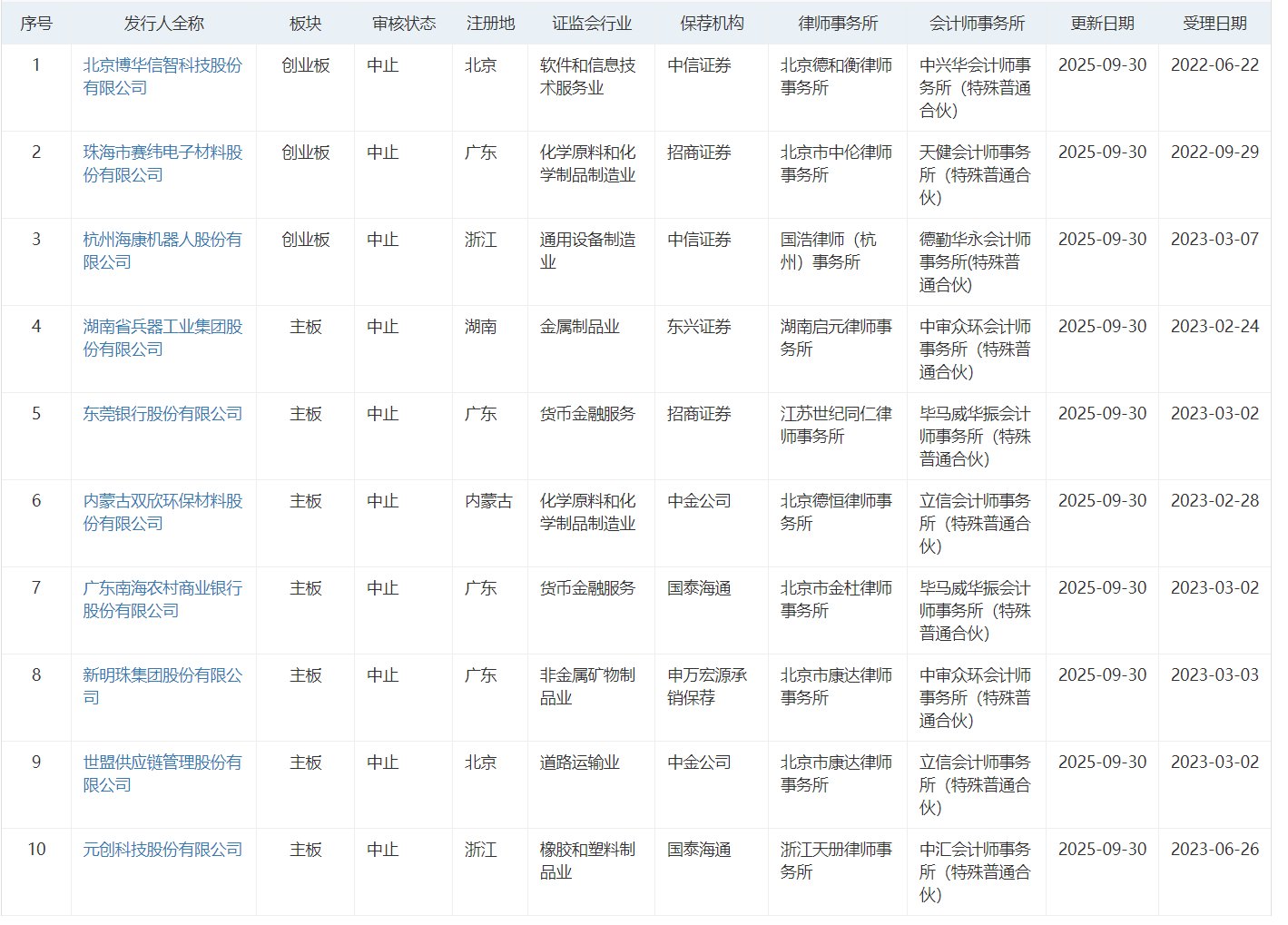
博华科技、珠海赛纬、海康机器等37家企业深交所IPO审核状态变更为“中止”
智通财经网· 2025-09-30 12:53
Core Viewpoint - On September 30, 37 companies had their IPO review status changed to "suspended" by the Shenzhen Stock Exchange, indicating a significant shift in the IPO landscape [1]. Group 1: Companies with Suspended IPOs - Beijing Bohua Xinzhi Technology Co., Ltd. (Beijing) - suspended on the ChiNext board, engaged in software and information technology services [2]. - Zhuhai Saijie Electronic Materials Co., Ltd. (Guangdong) - suspended on the ChiNext board, involved in chemical raw materials and chemical products manufacturing [2]. - Hangzhou Hikrobot Co., Ltd. (Zhejiang) - suspended on the ChiNext board, focused on general equipment manufacturing [2]. - Hunan Weapon Industry Group Co., Ltd. (Hunan) - suspended on the main board, operating in the military products industry [2]. - Dongguan Bank Co., Ltd. (Guangdong) - suspended on the main board, providing monetary financial services [2]. - Inner Mongolia Shuangxin Environmental Protection Materials Co., Ltd. (Inner Mongolia) - suspended on the main board, engaged in chemical raw materials and chemical products manufacturing [2]. - Guangdong Nanhai Rural Commercial Bank Co., Ltd. (Guangdong) - suspended on the main board, also in monetary financial services [2]. - New Mingzhu Group Co., Ltd. (Guangdong) - suspended on the main board, involved in non-metallic mineral products manufacturing [2]. - Shimen Supply Chain Management Co., Ltd. (Beijing) - suspended on the main board, operating in the road transportation industry [2]. - Yuanchuang Technology Co., Ltd. (Zhejiang) - suspended on the main board, focused on rubber and plastic products manufacturing [2]. Group 2: Additional Companies with Suspended IPOs - Shenzhen Xilichuang Technology Group Co., Ltd. (Guangdong) - suspended on the main board, engaged in computer, communication, and other electronic equipment manufacturing [2]. - China Resources New Energy Holdings Co., Ltd. - suspended on the main board, involved in power and heat production and supply [2]. - Jiangxi Liyuan Haina Technology Co., Ltd. (Jiangxi) - suspended on the ChiNext board, focused on electrical machinery and equipment manufacturing [2]. - Shenzhen Aiwei Electric Technology Co., Ltd. (Guangdong) - suspended on the ChiNext board, operating in the automotive manufacturing sector [2]. - Beijing Weitongli Electric Co., Ltd. (Beijing) - suspended on the main board, engaged in electrical machinery and equipment manufacturing [2]. - Yifeng New Materials Co., Ltd. (Shandong) - suspended on the ChiNext board, involved in chemical raw materials and chemical products manufacturing [3]. - Shandong Chunguang Technology Group Co., Ltd. (Shandong) - suspended on the ChiNext board, focused on computer, communication, and other electronic equipment manufacturing [3]. - Guangxi Tianyuan Biochemical Co., Ltd. (Guangxi) - suspended on the main board, engaged in chemical raw materials and chemical products manufacturing [3]. - Ningbo Huikang Industrial Technology Co., Ltd. (Zhejiang) - suspended on the main board, involved in electrical machinery and equipment manufacturing [3].