
金融

Search documents
联交所拟取消恒宇集团(02448.HK)上市地位
Ge Long Hui· 2026-02-23 09:08
Group 1 - The Hong Kong Stock Exchange announced that the listing status of Hengyu Group Holdings Limited (currently in liquidation) will be canceled effective from February 26, 2026, at 9:00 AM [1]
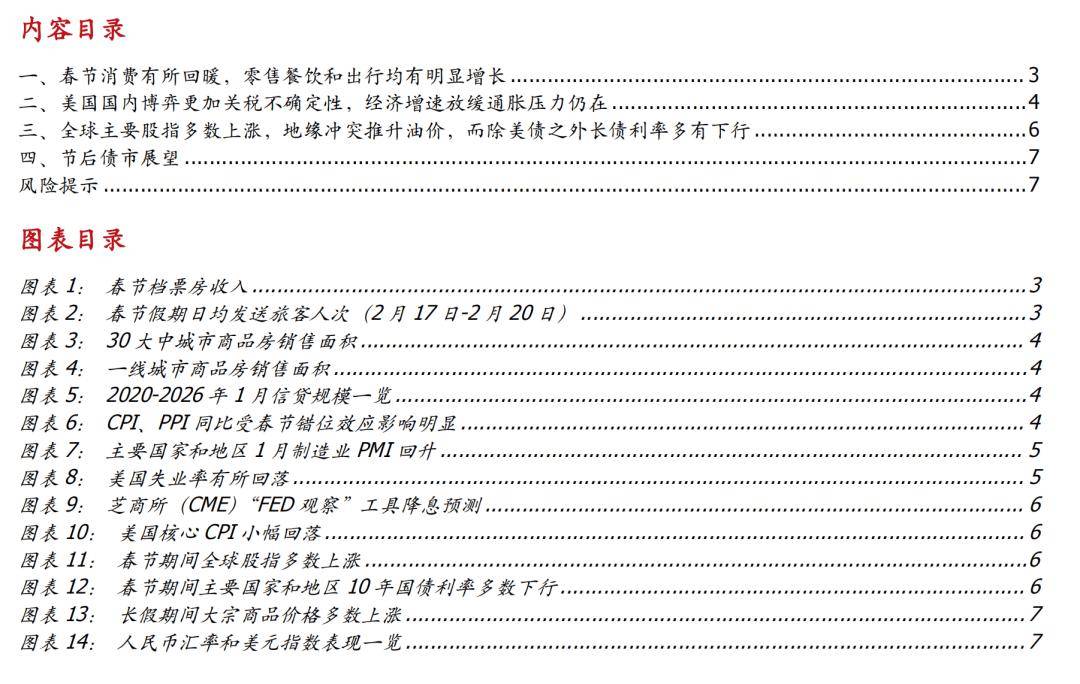
春节期间的关注点:国内高频数据消费有所回暖,美国国内博弈更加关税不确定性,全球资本市场股市多数上涨,油价攀升金银修复
Sou Hu Cai Jing· 2026-02-22 23:49
Group 1: Domestic High-Frequency Data - Retail and catering sales showed a significant increase, with average daily sales during the first four days of the Spring Festival rising by 8.6% compared to the same period in 2025, up from a 5.4% increase in the previous year [2][10] - Travel activity also increased, with an average daily passenger volume of 30.99 million during the Spring Festival, representing a 10.9% increase from 2025. Railway travel increased by 13.3% to 11.44 million, while civil aviation travel rose by 8.9% to 2.46 million [2][10] - Box office revenue for the Spring Festival was low, with an estimated total of around 6 billion yuan, which is below the levels of the past three years and similar to 2022 [2][10] - Real estate transactions were low during the Spring Festival, with average daily sales in 30 major cities at seasonal lows, making the data less relevant for broader analysis [2][10] Group 2: Overseas Macro Environment - The U.S. is experiencing increased uncertainty regarding tariffs due to internal conflicts between judicial and executive branches, with a recent Supreme Court ruling declaring many tariffs imposed by the previous administration as legally invalid [3][25] - Economic growth in the U.S. has slowed, with Q4 GDP rising by only 1.4%, significantly lower than the 4.4% growth in Q3, influenced by government shutdowns and reduced consumer spending [4][25] - Inflation pressures remain, with the core PCE price index rising to 3.0% year-on-year in December 2025, up from 2.8%, which may complicate future interest rate decisions by the Federal Reserve [4][25] Group 3: Global Capital Markets - Most global stock indices rose during the Spring Festival, with the South Korean market leading with a 3.09% increase. The U.S. stock market also saw slight gains, with the Nasdaq up 1.51% and the S&P 500 up 1.07% [5][34] - Oil prices increased by 5.7% due to geopolitical tensions, while gold and silver prices recovered, with silver rising by 5.6% and gold by 0.7% during the same period [5][40] - Bond yields in major economies mostly declined, with the 10-year U.S. Treasury yield slightly rising to 4.08%, while other regions like Germany and France saw decreases in long-term bond yields [5][38] Group 4: Post-Festival Bond Market Outlook - The bond market is expected to continue strengthening post-festival, supported by a weak economic backdrop and low financing demand, which provides overall protection for the bond market [6][43] - Seasonal declines in funding demand and limited impact from central bank liquidity withdrawal are anticipated, maintaining a loose monetary environment [6][43] - The low positions of trading institutions and the continued allocation by investment institutions driven by lower costs and declining yields from other assets are expected to stabilize the market [6][43]

美国去年经济增速为2021年以来最低
Sou Hu Cai Jing· 2026-02-22 10:54
Economic Performance Summary - The U.S. economy is projected to grow at a rate of 2.2% in 2025, which is a decline from 2.8% in 2024 and represents the lowest growth rate since 2021 [1] - The initial annualized quarterly growth rate for Q4 2025 is estimated at 1.4%, significantly below the expected 2.8%, marking the slowest growth since the tariff impacts began in Q1 2025 [1] Economic Challenges - The U.S. economy faces multiple headwinds, including unpredictable tariff policies, a weak labor market, strict immigration policies, and record federal government shutdowns [1] - The economy experienced a contraction in Q1 2022 due to a surge in imports before tariffs were implemented, marking the first quarterly shrinkage since Q2 2022 and the worst performance in nearly three years [1] Consumer Spending and Investment - Consumer spending, which accounts for two-thirds of U.S. economic activity, increased by 3.5% and 2.4% in the last two quarters of the previous year [2] - The surge in technology stocks has boosted household wealth, leading to increased consumer spending, particularly in AI-driven computer and peripheral expenditures, which grew by 70% over the past year, exceeding $300 billion by the end of 2025 [2] Wealth Disparity and Economic Outlook - The economic landscape shows a widening wealth gap, with the top 10% of households controlling over two-thirds of national wealth, while the middle 40% has seen their wealth share decline from approximately 36% to below 30% [3] - Rising costs of living, including housing, healthcare, and childcare, are outpacing income growth for many Americans, complicating the economic outlook [3] Federal Reserve and Interest Rates - There is increasing pressure on the Federal Reserve to lower interest rates, as the government shutdown is projected to result in a GDP loss of at least two percentage points [3] - Despite calls for rate cuts, persistent inflation remains a significant barrier, with the core personal consumption expenditures price index rising to 3.0% in December, above the Fed's 2% target [3]
过去30年来未见之局面!美股指数波动之小创1960年来之最,而个股波动率却高达指数7倍
Hua Er Jie Jian Wen· 2026-02-22 01:34
Core Viewpoint - The U.S. stock market is experiencing a rare divergence, with the S&P 500 index showing stability while individual stocks exhibit significant volatility, indicating potential turmoil ahead [1] Group 1: Market Conditions - The S&P 500 index has recorded its narrowest trading range since the 1960s, while individual stock volatility is approximately seven times that of the index, marking the largest gap in at least 30 years [1][3] - Investor behavior is being significantly impacted by this unusual market environment, with hedge funds net selling U.S. stocks at the fastest pace since March of last year [1][5] - The current market structure has historical precedents, having appeared before major turning points such as the 2008 financial crisis and the introduction of significant tariffs by Trump [1][4] Group 2: Investor Sentiment - Investors are increasingly adopting defensive strategies, leading to a reassessment of concentrated positions due to stock and sector-specific sell-offs [5][6] - Evidence of declining investor confidence is mounting, with significant sell-offs prompting many to reconsider the risks associated with high concentration in their portfolios [6] Group 3: AI Impact - The initial bullish sentiment surrounding artificial intelligence has shifted to one of uncertainty, reshaping investment logic from seeking opportunities to avoiding potential collapses [2] - The rapid adoption of AI is seen as surpassing the pace of the internet boom in the late 1990s, leading to unprecedented levels of disruption this year [6] - Concerns regarding AI's impact are affecting major tech companies, with significant declines observed in stocks like Microsoft and Meta since the rotation began last October [2]
下周关注丨苹果公司举行年度股东大会,这些投资机会最靠谱
Di Yi Cai Jing· 2026-02-22 01:09
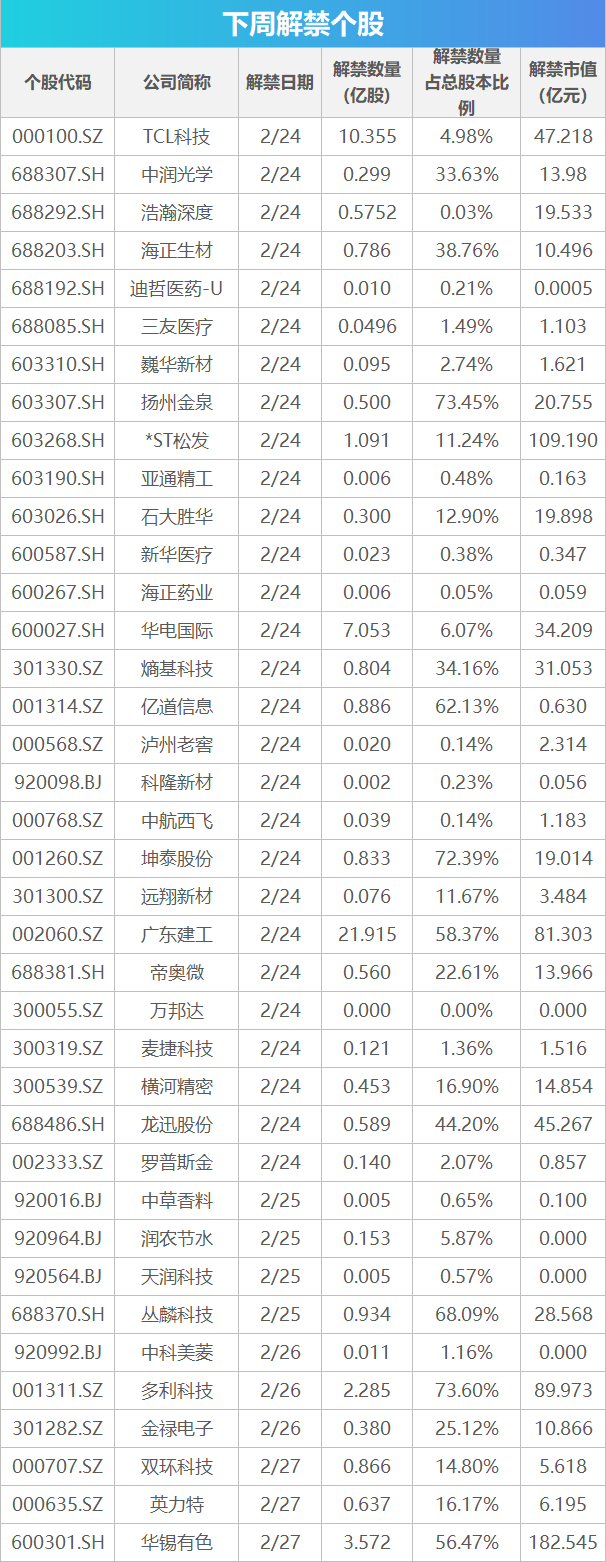
Group 1 - The 1-year and 5-year LPR will be announced on February 24, with the current rates remaining unchanged at 3.0% and 3.5% respectively, marking the eighth consecutive month of stability [2] - The domestic refined oil price adjustment window will open on February 24, following a previous increase of 205 CNY/ton for gasoline and 195 CNY/ton for diesel on February 3 [3] Group 2 - The MSCI China Index will undergo adjustments effective February 27, 2026, including the addition of 37 stocks and the removal of 16 stocks [4] - Apple Inc. will hold its annual shareholder meeting on February 24, focusing on new product development, AI technology implementation, and supply chain adjustments [5] Group 3 - A total of 56.43 billion shares of restricted stocks will be released in the A-share market from February 24 to 27, with a market value exceeding 87 billion CNY [6] - Notable companies with significant restricted stock releases include Huaxi Nonferrous and *ST Songfa, each exceeding 10 billion CNY in market value [6] Group 4 - Two new stocks will be issued in the week following the holiday, with Hai Fei Man on February 24 and Gu De Electric Materials on February 25 [8]

美国高院刚宣判,特朗普大怒,美媒发现不对劲:中方根本不在意
Sou Hu Cai Jing· 2026-02-21 16:56
Group 1 - The U.S. Supreme Court ruled that Trump's tariffs imposed under the International Emergency Economic Powers Act (IEEPA) were illegal, requiring congressional authorization for such actions [2][3][5] - The ruling means that hundreds of billions of dollars collected in tariffs over the past year are now considered "illegal gains," leading to potential lawsuits for refunds from U.S. companies [5][6] - The authority of the president to impose tariffs has been significantly weakened, creating uncertainty for U.S. trade policy moving forward [6][21] Group 2 - China's calm reaction to the ruling reflects its prior understanding that the legal basis for Trump's tariff strategy was weak, indicating a long-term strategic outlook rather than a short-term victory [11][19] - Chinese companies are focusing on building a resilient domestic economy, with significant investments in technology and consumer markets, which can withstand external pressures [18][22] - The visit of German Chancellor Merz to China, accompanied by business leaders, highlights the importance of stable supply chains and the attractiveness of the Chinese market for global companies [11][13] Group 3 - The ruling is expected to create more procedural hurdles for future tariff implementations, making it less likely that the U.S. will pursue aggressive tariff policies as it did in the past [21][22] - The focus for China is on enhancing its economic self-sufficiency and technological capabilities, which are seen as critical for navigating future trade challenges [19][23]

康曼德资本董事长丁楹:马年新程,在不确定中把握确定性
Zhong Guo Ji Jin Bao· 2026-02-21 12:57
Group 1 - The core viewpoint of the article emphasizes the transition of China's capital market from liquidity recovery to structural pricing, highlighting a year of stabilization and differentiation in 2025 [2] - The macro environment in 2025 saw marginal improvements in global liquidity, with the Federal Reserve's multiple interest rate cuts providing external support for risk assets, while domestic policies continued to stabilize the market [2] - The market structure in 2025 was characterized by a focus on a few sectors with medium to long-term logic, such as AI computing power, self-controllable technologies, and high-end manufacturing, while traditional real estate and some cyclical industries were still in a clearing and bottoming phase [2] Group 2 - In 2026, the Chinese economy is expected to experience a weak recovery with structural upward trends, driven by a new round of technological and industrial cycles [3] - The focus on new technologies, renewable energy, digital economy, and biomedicine is reshaping production relationships and capital return structures, while traditional economic sectors are gradually declining [3] - The economic growth model is shifting from total expansion to quality enhancement, with stable growth policies expected to continue [3] Group 3 - The capital market in 2026 will shift its core variable from liquidity recovery to profitability, with a focus on fundamental performance rather than speculative narratives [4] - High-quality companies, particularly in the Hong Kong stock market and technology manufacturing sectors, are anticipated to reach profitability turning points between 2025 and 2026 [4] - The investment logic will increasingly return to fundamentals, leading to a more rational pricing system [4] Group 4 - The capital market is expected to exhibit three main characteristics: a higher probability of structural bull markets over broad bull markets, a balance between growth and value investments, and continued volatility with an upward shift in market stability [5] - Investors will prioritize company quality and industry dynamics, with high-growth sectors requiring caution regarding valuations, while traditional value assets regain significance [5] Group 5 - The investment strategy for 2026 is termed "Double Horses Running Together," focusing on both growth and stable assets [6] - Growth sectors, particularly those related to AI and new productive forces, are seen as long-term investment themes, while stable assets in finance, resources, and consumption are being revalued as quasi-debt equities [6] - The investment approach will involve a dynamic adjustment of asset allocation, favoring growth in the first half of the year and gradually shifting towards value in the second half [7]
骗了全世界几十年!欧洲高福利耗尽,8亿件衬衫换飞机已成历史
Sou Hu Cai Jing· 2026-02-21 08:07
Group 1 - The core argument suggests that Europe's economic decline is not due to high welfare systems fostering laziness, but rather a result of structural issues in the economy and the loss of external advantages that previously supported welfare funding [3][5][36] - The first source of wealth for Europe, referred to as "global scissors difference," is based on the exploitation of cheaper labor in developing countries, allowing European companies to reap excessive profits [9][12][14] - The second source of wealth, termed "anti-rebellion insurance," was a political strategy to appease the working class during the Cold War, ensuring social stability through welfare and higher wages [15][17][19] Group 2 - The decline of the "global scissors difference" is attributed to emerging economies like China and Vietnam moving up the value chain, reducing Europe's competitive edge in manufacturing [21][23] - The end of the Cold War has diminished the need for capitalists to maintain high welfare standards, leading to a shift in wealth distribution away from workers [23][26] - The narrative blaming high welfare for economic issues is criticized as a diversion from the real problems of low wages and the hollowing out of industries [24][28][30] Group 3 - The sustainability of Europe's welfare system is questioned, with predictions of gradual reductions in benefits and increasing costs for healthcare and education [32][34] - Social unrest in various European countries is seen as a manifestation of the underlying economic crisis, with elites failing to address the root causes [32][36] - The current crisis is framed as a result of a welfare system built on external exploitation and internal compromises, which is now collapsing as external resources dwindle [36][37]

券商马年投资展望:这些板块不能错过
Zhong Guo Zheng Quan Bao· 2026-02-21 04:37
Market Outlook - The A-share market is expected to experience a low-volatility trend with a long-term decline in market volatility [2] - The upward trend in the stock market is not yet over, indicating further potential for growth [2] - A-shares are anticipated to maintain a fluctuating upward trend, with the importance of fundamentals increasing after a valuation adjustment [2][3] Capital Flow - The demand for asset allocation among domestic residents has been activated by profit effects, with various medium- to long-term funds entering the market, suggesting an active capital flow in 2026 [2][3] - Incremental capital is expected to cover a broader range, driven by increasing motivation among individual investors to enter the market [3] - Public funds and insurance capital are likely to continue increasing their allocation to equity assets, reshaping global capital flow logic [4] Key Investment Sectors - Key sectors to focus on include: - Non-ferrous metals, chemicals, and new energy [2] - Technology growth, manufacturing expansion, cyclical consumption transformation, and U.S. stocks [2] - New energy, non-ferrous metals, basic chemicals, oil and petrochemicals, non-bank financials, military industry, and machinery [3] - AI, new energy, military industry, innovative pharmaceuticals, price increase chains, and overseas expansion chains [4] - Technology innovation themes and consumption sectors [4] - TMT and advanced manufacturing sectors, with potential shifts towards cyclical and financial sectors [4]

黄金、白银,大涨!美三大股指全线收涨
Xin Lang Cai Jing· 2026-02-21 04:30
20日美股大型科技股与存储芯片股反弹 当地时间周五上午,美国最高法院公布裁决,认定美国《国际紧急经济权力法》没有授权总统征收大规 模关税,意味着特朗普政府关税政策受到重大挫折。美国商务部同一天公布的初步数据显示,美国2025 年第四季度经济增速为1.4%,显著低于市场预期的2.8%;美国2025年经济增速为2.2%,低于2024年的 2.8%。尽管经济数据利空,但投资者看好关税壁垒可能被消除对美国企业盈利状况的提振,美国三大 股指周五集体收涨。截至收盘,道指涨0.47%,标普500指数涨0.69%,纳指涨0.90%。 本周,美股从上周的AI股和软件股抛售潮中反弹,纽约股市三大股指全部累计上涨。其中,道指涨 0.25%,标普500指数上涨1.07%,纳指上涨1.51%。 20日国际金价银价显著上涨 纽约白银期价本周涨超5.6% 美国最高法院的裁决可能迫使联邦政府进一步举债,引发投资者对美债信用的担忧,进而增持黄金以对 冲风险。此外,周五的最新数据显示,美国去年12月核心个人消费支出(PCE)价格指数同比上涨 3.0%,涨幅高出市场预期。通胀压力反弹叠加经济增长放缓,引发市场对美国经济陷入滞胀的担忧, 黄金的"抗 ...