
传媒

Search documents
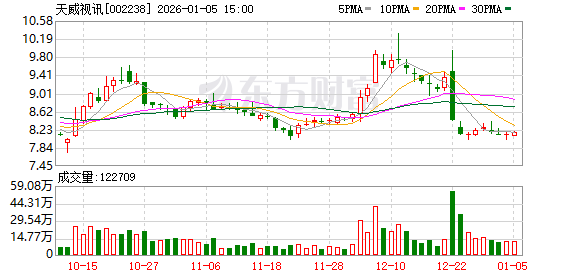
天威视讯:截至2025年12月19日收盘股东总数为26219户
Zheng Quan Ri Bao· 2026-01-05 14:32
证券日报网讯 1月5日,天威视讯在互动平台回答投资者提问时表示,截至2025年12月19日收盘,公司 股东总数为26219户。 (文章来源:证券日报) ...


新华报业信创建设成果获省级认可
Jiang Nan Shi Bao· 2026-01-05 14:27
Group 1 - The core viewpoint of the article highlights that the "Xinhua Model and Cultural Media High-Quality Data Set Innovation Construction" plan by Xinhua News Media Group has been recognized as a typical solution for information technology application innovation in Jiangsu Province, marking a new phase of standardized and large-scale development in the cultural media sector [1][2] - The plan aims for "self-controllable, safe, compliant, and efficient" objectives, utilizing an innovative "1+3+10+N" overall architecture to create a comprehensive ecosystem covering data governance, model training, application scenarios, and security assurance [1] - The hardware localization rate of the solution exceeds 85%, achieving a dynamic balance between localization adaptation and performance efficiency, and it is compatible with mainstream domestic CPUs and operating systems [1] Group 2 - The inclusion in the provincial typical solution list serves as authoritative recognition of Xinhua News Media's achievements in innovation construction, aligning with national strategies and provincial digital cultural industry development plans [2] - Xinhua News Media plans to leverage this recognition to deepen its "media scenario + innovation technology" dual-driven strategy, expanding applications in governance, education, and rural revitalization [2] - The company aims to play a leading role in the industry by sharing its innovation construction experiences and collaborating with the upstream and downstream of the industry chain to build an innovation ecosystem, contributing to the high-quality development of the digital cultural industry in Jiangsu [2]
新华网:新华网是新华社控股的国有文化企业
Zheng Quan Ri Bao Zhi Sheng· 2026-01-05 14:19
Core Viewpoint - Xinhua Net, a state-owned cultural enterprise controlled by Xinhua News Agency, emphasizes the importance of market value management and is committed to enhancing operational quality and developing innovative services [1] Group 1: Company Overview - Xinhua Net is a state-owned cultural enterprise with a focus on market value management [1] - The major shareholder and management prioritize the company's market value management efforts [1] Group 2: Business Strategy - The company aims to improve operational management quality and develop digital, intelligent, and cultural creative services [1] - Xinhua Net aligns its services with national development strategies to enhance its influence and market competitiveness [1] Group 3: Future Outlook - The company is focused on increasing its internal value and expanding its market competitiveness [1]

金融工程日报:沪指12连阳重返4000点,刷新近33年以来连阳记录-20260105
Guoxin Securities· 2026-01-05 14:07
- No quantitative models or factors were mentioned in the provided content
603014,重大资产重组
Xin Lang Cai Jing· 2026-01-05 14:04
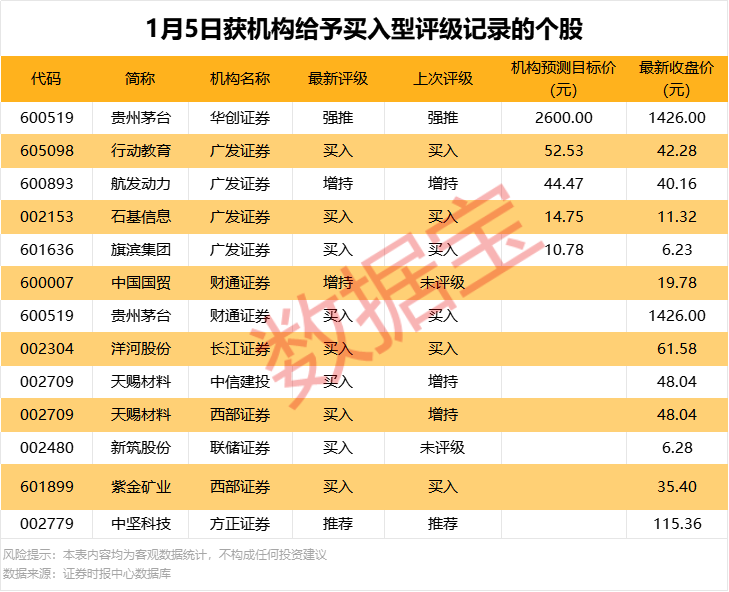
Market Overview - On January 5, the A-share market opened positively with all three major indices rising, and the total trading volume reached 2.57 trillion yuan, an increase of over 500 billion yuan compared to the previous trading day, with more than 4,100 stocks closing higher [1][10] - The leading sectors included brain-computer interfaces, hyperbaric oxygen chambers, and blood oxygen monitors, while concepts such as Hainan Free Trade Zone, duty-free shops, and free trade ports saw declines [1][10] Institutional Ratings - A total of 13 buy ratings were issued today, covering 11 stocks, with Tianqi Lithium and Kweichow Moutai receiving significant attention, each having two buy ratings [2][11] - Among the rated stocks, five had target price predictions, with Kweichow Moutai showing the highest upside potential of 82.33%, with a target price of 2,600 yuan compared to its latest closing price of 1,426 yuan [2][11] - The average increase for stocks with buy ratings was 2.26%, outperforming the Shanghai Composite Index, with notable gainers including Qibin Group, Shiji Information, and Tianqi Lithium, which rose by 5.06%, 4.52%, and 3.69% respectively [2][11] Stock Performance - BlueFocus Media led the net buying list with an institutional net purchase of 186 million yuan, followed by Haike New Source and Dongwei Semiconductor with net purchases of 117 million yuan and 110 million yuan respectively [5][15] - Conversely, Wuzhou New Spring and Zhongchao Holdings faced significant net selling, each exceeding 200 million yuan [6][15] Northbound Capital Flow - Northbound funds saw net buying in 18 stocks, with BlueFocus Media, Liou Shares, and Pudian Shares leading the net purchases, each exceeding 100 million yuan [18][19] - The top net selling stock was Zhongchao Holdings, with a net outflow of 178 million yuan, followed by Tongyu Communications with 161 million yuan [18][19] Corporate Announcements - Weigao Blood Products announced plans to acquire 100% of Weigao Purui for 8.511 billion yuan, constituting a major asset restructuring [20] - Xusheng Group received a project notification from an overseas electric vehicle manufacturer, amounting to approximately 7.8 billion yuan [20] - Huayou Cobalt expects a year-on-year net profit increase of 40.8% to 55.24% for 2025 [20] - Zhongcai Technology anticipates a year-on-year net profit increase of 73.79% to 118.64% for 2025 [20]


电广传媒:公司将积极探索低空经济、机器人与文旅的融合
Zheng Quan Ri Bao Wang· 2026-01-05 12:48
Group 1 - The company, Dianguang Media, is actively promoting the integration of "culture + technology + tourism" [1] - The company plans to explore the low-altitude economy and the integration of robotics with cultural tourism [1] - The company aims to enhance the experience and operation of scenic spots through technological empowerment [1]

1.5日报
Ge Long Hui· 2026-01-05 12:43
Group 1 - iMoutai ranks first in the shopping category on the Apple Store, indicating strong consumer demand for its products, particularly among high-end Apple users [1] - Global gold and silver prices have risen while oil prices have fallen due to the arrest of Maduro, with Venezuela's oil production potentially increasing as the U.S. has the necessary refining experience [1] - Venezuela's current oil production is about one-fifth of its peak, and if production returns to peak levels, GDP per capita could exceed $10,000 [1] Group 2 - Century Huatong announced a share buyback plan of 300-600 million for employee stock ownership, leading to a significant increase in stock price [2] - Salt Lake Co. forecasts an 85% year-on-year increase, resulting in a stock price surge [3] - Kuaishou's stock price has risen significantly, benefiting from the AI hardware market, while software also sees some gains [5] - Insurance stocks have surged, with Ping An rising by 6%, as many consumers shift to insurance products following a decrease in deposit profits [5]
财达证券每日市场观-20260105
Caida Securities· 2026-01-05 12:25
Market Overview - On December 31, 2025, the Shanghai and Shenzhen indices experienced mixed performance, with a total trading volume of CNY 2.07 trillion, a decrease of approximately CNY 90 billion from the previous trading day[1] - The market showed stability despite more stocks declining than rising, with notable gains in the aerospace, media, real estate, and non-ferrous metals sectors, while telecommunications, agriculture, and electronics faced declines[1] - The total trading volume for the year exceeded CNY 400 trillion, marking a year-on-year growth of over 60%, achieving a historical high[3] Sector Performance - The aerospace sector is rapidly regaining strength, with leading stocks reaching new highs and increasing trading volumes, indicating a sustained upward trend[1] - The non-ferrous metals sector is also performing steadily, supported by historical price increases in precious metals and a weak US dollar, suggesting a potential for long-term growth[1] - The top three sectors for net capital inflow on December 31 were aerospace equipment, military electronics, and advertising marketing, while the semiconductor, components, and photovoltaic equipment sectors saw the largest outflows[4] Regulatory Developments - The Ministry of Transport has initiated measures to promote the integration of public transportation data with enterprise data, aiming to enhance efficiency across various sectors, including logistics and green technology[5] - New regulations for green product certification have been introduced, covering 122 product categories and involving over 8,000 certified enterprises, marking a significant shift towards comprehensive regulatory oversight[7] Economic Indicators - The price of live pigs increased by 1.7% month-on-month in late December 2025, reflecting ongoing trends in agricultural pricing[8] - Natural gas consumption in November 2025 was reported at 36.28 billion cubic meters, a year-on-year increase of 5.1%, although total consumption for the first eleven months showed a slight decline of 0.1%[8] Investment Insights - The recent regulatory changes in fund sales fees aim to enhance investor returns by capping service fees for equity funds at 0.4% and for index and bond funds at 0.2%, promoting a shift towards long-term holding[12][14]

数据复盘丨传媒、医药生物等行业走强 118股获主力资金净流入超1亿元
Zheng Quan Shi Bao Wang· 2026-01-05 12:02
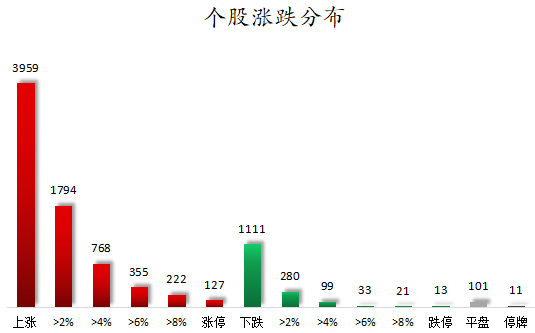
Market Overview - On January 5, 2026, the A-share market experienced a "good start," with major indices such as the Shanghai Composite Index, Shenzhen Component Index, ChiNext Index, and STAR Market Index all showing strong performance. The Shanghai Composite Index closed at 4023.42 points, up 1.38%, with a trading volume of 10,673 billion yuan [1] - The total trading volume for both Shanghai and Shenzhen markets reached 25,463.13 billion yuan, an increase of 5,010.9 billion yuan compared to the previous trading day [1] Sector Performance - The media, pharmaceutical, and other sectors showed strong gains, with notable stocks like Fenglong Co. achieving a seven-day consecutive limit-up [2][6] - Among the industry sectors, media, pharmaceuticals, insurance, electronics, computers, defense, non-ferrous metals, food and beverage, and precious metals had the highest gains. Conversely, sectors such as oil and petrochemicals, banking, and transportation saw declines [3] Individual Stock Performance - A total of 3,959 stocks rose, while 1,111 stocks fell, with 127 stocks hitting the daily limit-up and 13 stocks hitting the limit-down [3] - The top individual stocks with significant net inflows included Shenghong Technology with a net inflow of 2.007 billion yuan, followed by Tianji Co. and Dongfang Fortune with net inflows of 871 million yuan and 726 million yuan, respectively [9][11] Capital Flow - The net capital outflow from the main funds in the Shanghai and Shenzhen markets was 6.298 billion yuan, with the ChiNext seeing a net inflow of 1.497 billion yuan and the STAR Market experiencing a net outflow of 4.263 billion yuan [7] - Among the 31 primary industry sectors, 12 sectors saw net capital inflows, with the non-ferrous metals sector leading with a net inflow of 1.907 billion yuan [7] Institutional Activity - Institutional investors had a net selling of approximately 4.97 billion yuan, with BlueFocus being the top net buy stock at around 186 million yuan [16][18] - The stocks with the highest net selling included Aerospace Development, with a net outflow of 1.649 billion yuan, followed by Xinyi Sheng and Shunhao Co. [13][14]






开门红可期
Huafu Securities· 2026-01-05 11:49
Group 1 - The market is expected to have a strong start in the new year, with a slight decline of 0.33% in the overall A-share market during the last week of December, influenced by the New Year holiday [3][13] - The Shanghai Composite Index and the CSI 500 saw slight increases, while the CSI 300 and ChiNext Index experienced declines. The technology and advanced manufacturing sectors showed slight gains, whereas consumer and healthcare sectors faced losses [3][13] - Among the 31 Shenwan industries, oil and petrochemicals, defense and military, and media sectors led the gains, while electric equipment, food and beverage, and public utilities lagged [3][13] Group 2 - The stock-bond yield spread has decreased to 0.5%, indicating a divergence in market valuations, with the valuation dispersion index rising by 1.7% [21] - Market sentiment has improved, with the sentiment index increasing by 25.2% to 59.9, while the industry rotation strength has decreased to 40, indicating a potential warning level [22][28] - The average daily trading volume of the Stock Connect increased by 519 billion yuan compared to the previous week, with significant inflows into the defense, automotive, and home appliance sectors [34] Group 3 - Meta announced the acquisition of Manus, deepening its layout in AI applications, which highlights the strategic value of AI agents in the current market [44] - Upwind New Materials officially entered the humanoid robot sector with the launch of the "Qiyuan Q1," indicating a growing interest in personal robotics [45] - Blue Arrow Aerospace's IPO application has been accepted, accelerating the capitalization process in the commercial aerospace sector, which is expected to bring new investment opportunities [46] Group 4 - The report maintains a positive outlook for the market, suggesting that the spring rally may start early, supported by improving overseas liquidity, expectations of renminbi appreciation, and positive industrial trends [48] - It is recommended to focus on opportunities in domestic computing power, as well as in commercial aerospace and intelligent driving sectors, which are expected to benefit from policy support [48]