茶饮

Search documents
茶咖日报|喜茶正式上线淘宝闪购!超4000家门店全线入驻
Guan Cha Zhe Wang· 2025-08-22 12:02
Group 1 - Heytea has officially launched on Taobao Flash Sale, with over 4,000 stores nationwide fully operational [1] - The collaboration with Taobao Flash Sale aims to provide differentiated products and brand experiences to a broader consumer base [1] - The overall market capacity for food delivery has increased from 100 million orders per day to over 200 million [1] Group 2 - Moutai has also announced its entry into Taobao Flash Sale, indicating a trend among leading brands to utilize this platform for business growth [2] - The launch of Heytea on Taobao Flash Sale is seen as a significant move, suggesting a shift in the industry from competition for traffic to ecosystem building [2] - The new customer count for tea merchants on Taobao Flash Sale saw a week-on-week increase of 255% on the day of the autumn equinox [1][2] Group 3 - Chayan Yuese has opened three new stores in Changsha, expanding into the new Chinese baking sector with products priced mainly between 3-6 yuan [1][2] Group 4 - Cangzhong Ancient Tea announced that some bank accounts have been frozen due to a lawsuit, impacting normal payment operations [4] - The lawsuit involves a business cooperation contract dispute, with the company and its executives listed as defendants [5] Group 5 - Kudi Coffee (Hengqin) Co., Ltd. has been established with a registered capital of 100 million USD, focusing on various services including restaurant management and supply chain management [6][7] Group 6 - Tianrun Dairy reported a net loss of 21.86 million yuan for the first half of 2025, with total revenue of 1.395 billion yuan, a decrease of 3.30% year-on-year [8] - The company has invested in 20 enterprises and participated in 1,269 bidding projects, indicating active engagement in the market [8]



要情绪、要体验、要特昂,在深圳的一场消费「价值感」实验
36氪· 2025-08-22 11:20
Core Viewpoint - The discussion of "consumption downgrade" has been replaced by the consensus of "consumption stratification," indicating a shift in consumer behavior towards valuing experience, identity, and future potential rather than merely seeking low prices [3][4]. Group 1: Consumer Behavior Trends - Consumers are increasingly emphasizing "value for money" rather than just low prices, showing a willingness to pay for "emotional value" in areas like tea drinks and supermarkets [3][4]. - Experience consumption is a major category for younger consumers, with activities such as travel, concerts, and outdoor events being prioritized [3][4]. - The new consumption trends are characterized by a focus on emotional and practical values, leading to the emergence of new economic sectors like toy economy, pet economy, and cultural creative economy [4]. Group 2: New Consumption Landscape - The retail sales of consumer goods reached 24.55 trillion yuan in the first half of the year, with a year-on-year growth of 5.0%, indicating steady growth in the overall market [4]. - New consumption is defined by diverse demands from target customer groups, driven by new technologies, concepts, and models, leading to continuous product and service innovation [4]. - The essence of new consumption lies in the innovation of product categories, scenarios, and the emotional connection consumers have with brands [4]. Group 3: Event Overview - The Shenzhen Craft Beer Festival and the Third Shenzhen Teao Festival aim to explore new consumption scenarios and promote night economy development [5][7]. - The event will feature various activities, including beer competitions, live music, and creative showcases, designed to create a vibrant social atmosphere [7][12]. - Over 70 brands will participate, fostering cross-industry collaboration and creative exchanges to inspire new lifestyle concepts [12][14]. Group 4: Brand and Market Insights - The event organizers recognize the importance of brand beliefs that can transcend cycles, memorable product expressions, and commercial language that reflects urban culture [14]. - The "CITYFORCE Annual Brand" initiative will be launched to identify brands that excel in commercial, user, and social value, showcasing innovation and experience [14].

从奶茶杯到黄金柜:新消费浪潮中,那些被忽略的投资密码
Sou Hu Cai Jing· 2025-08-22 10:17
Group 1: New Consumption Opportunities - The emergence of new consumption opportunities is evident in everyday scenarios, such as affordable beverages and jewelry, which reflect deeper commercial insights [1] - The success of brands like Mixue Ice City and Laopuhuang highlights the importance of understanding consumer needs and market dynamics [1][4] Group 2: Mixue Ice City's Business Model - Mixue Ice City has achieved remarkable growth through a low-price strategy and effective supply chain management, allowing it to dominate the market with over 30,000 stores [4][5] - The brand's ability to reduce costs by 30% through direct sourcing and efficient logistics has positioned it as a leader in the sub-10 yuan price segment [5][6] - The company's expansion into Southeast Asia demonstrates its adaptability, although challenges in markets like Australia reveal the limitations of its pricing strategy [7] Group 3: Laopuhuang's Unique Positioning - Laopuhuang has redefined the value of gold jewelry by integrating culture and craftsmanship, appealing to a younger, high-net-worth demographic [8][9] - The brand's premium pricing strategy is justified by the unique customer experience and cultural significance of its products, leading to higher customer loyalty [10][11] - Laopuhuang's cautious expansion strategy has preserved its brand prestige, contrasting with competitors' rapid growth [11] Group 4: Competitive Landscape in the Beverage Industry - The tea beverage market is segmented by price, with Mixue Ice City dominating the under-10 yuan segment, while brands in the 10-20 yuan range compete on supply chain efficiency [12][13] - The pressure on premium brands to lower prices indicates a shift in consumer preferences and market dynamics [12] Group 5: Investment Insights - Investors should focus on understanding the underlying supply chain dynamics and consumer behavior rather than relying solely on brand reputation [15][16] - Recognizing cultural and experiential value in products can lead to better investment decisions, as seen with Laopuhuang and Mixue Ice City [15][16] - Observing subtle market signals and consumer trends can provide valuable insights into future investment opportunities [16][18]

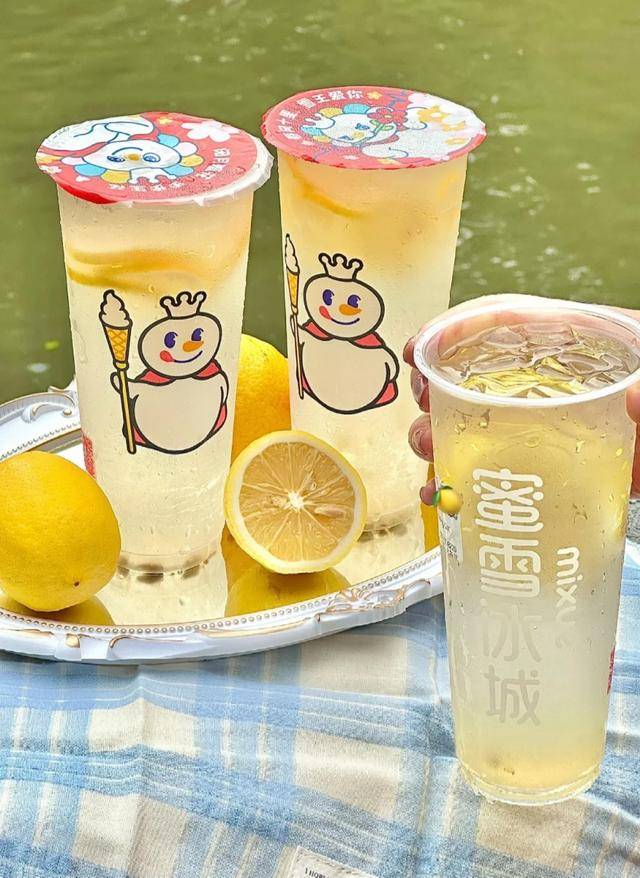
上市计划再推3年,甜啦啦怎么了?
Sou Hu Cai Jing· 2025-08-22 05:44
Core Viewpoint - The company Sweet Lala has postponed its planned IPO to 2028 due to operational challenges and a need to improve its supply chain, brand recognition, and overall performance [1][4][18]. Expansion and Store Performance - Sweet Lala's store count has declined for three consecutive periods, with a drop from 6,748 stores at the end of 2023 to 6,233 by the end of 2024, and further down to 6,178 by June 2025 [5]. - The company aimed to open over 10,000 stores by 2024, but the actual expansion has significantly slowed, with new store openings dropping from 2,935 in 2023 to 1,908 in 2024, and only 623 in the first half of 2025 [5]. - International expansion has also fallen short, with only 200 overseas stores established by mid-2025, compared to an initial target of 500 for 2024 [5]. Financial Performance and Market Position - Sweet Lala's revenue for 2023 exceeded 2 billion, with a target of 3.5 billion for 2024; however, it lags behind competitors, as leading brands reported revenues over 3 billion in 2023 and many surpassed 4.5 billion in 2024 [5]. - The management has set ambitious revenue goals of over 10 billion in 2025, 50 billion in three years, and 100 billion in five years, which appear overly aggressive given the current performance [6]. Supply Chain Challenges - The company faces significant supply chain issues, with material costs approximately 30% higher than competitors like Mixue Ice City, which has established a more efficient supply chain [7][8]. - Sweet Lala's reliance on external procurement limits its cost control and bargaining power, leading to higher material prices compared to competitors [8][11]. Franchisee Pressure - Franchisees are experiencing financial strain due to high material costs and a lack of competitive pricing, with reported profit margins significantly lower than those claimed by the brand [12][14]. - The company's pricing strategy does not provide a competitive edge, as many products are priced similarly or lower than those of Mixue Ice City, further squeezing franchisee profits [12][13]. Brand Recognition and Marketing - Sweet Lala's brand recognition is significantly lower than competitors, with fewer social media followers and less consumer awareness, leading to higher customer acquisition costs for franchisees [15][16]. - The company is attempting to enhance its brand presence through collaborations and marketing campaigns, but the effectiveness of these efforts remains uncertain [15]. Internal Management Issues - The company is facing internal instability, with frequent changes in mid-level management and a shift towards a more rigid management style that has led to decreased operational efficiency [16][17]. Conclusion - The postponement of the IPO is seen as a necessary adjustment period for the company to address its growth bottlenecks and structural challenges, particularly in supply chain efficiency and franchisee profitability [18].

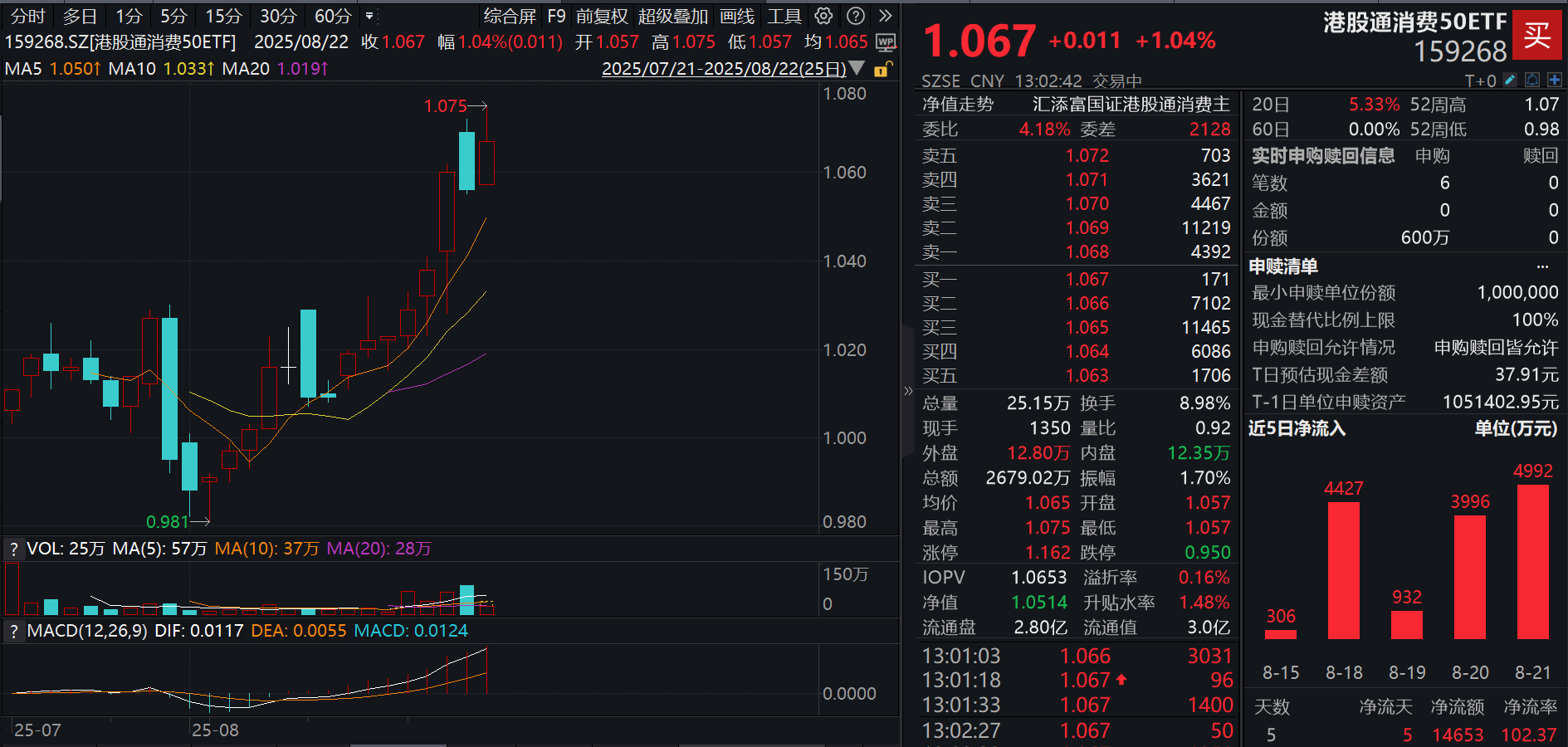
麦肯锡盘点中国消费市场的五大惊喜!港股通消费50ETF(159268)涨超1%!消费ETF(159928)昨日大举“吸金”超3.6亿元!
Xin Lang Cai Jing· 2025-08-22 05:30
Group 1: Market Performance - The Hong Kong A-shares and the Hong Kong Stock Connect Consumption 50 ETF (159268) both saw gains, with the ETF rising over 1% and attracting a net inflow of 6.4 million yuan for six consecutive days, totaling over 150 million yuan [1] - Notable stocks included Miniso, which surged over 18% post-earnings, Li Ning up over 7%, Anta Sports up over 3%, and Pop Mart up over 2% [1] Group 2: Company Earnings - Miniso reported a second-quarter revenue of 4.966 billion yuan, a year-on-year increase of 23.1%, with adjusted operating profit rising 8.5% to 852 million yuan and an adjusted operating profit margin of 17.2%, exceeding company guidance [2] Group 3: Consumer Trends - McKinsey highlighted five surprising trends in the Chinese consumer market for the first half of 2025, indicating a shift in consumer sentiment despite weak confidence and ongoing pressures in the real estate market [5] - The report noted a steady recovery in core retail categories, with air travel surpassing 2019 levels and China's automotive exports becoming the largest globally, with an expected export volume of nearly 5.5 million vehicles in 2024, eight times that of 2019 [6] Group 4: Tourism and Capital Markets - The number of inbound tourists to China reached a record high, with over 35 million visitors in the first quarter of 2025, a year-on-year increase of 19.6% [9] - The capital market's recovery in 2025 has been significant for consumer enterprises, with four of the top ten IPOs in Hong Kong coming from the consumption sector, indicating strong investor confidence in the long-term prospects of the Chinese consumer market [12] Group 5: Cultural and Product Trends - Pop Mart's Labubu character gained international popularity, with revenue from its monster series increasing by 726% in 2024, contributing significantly to the company's overall revenue [15]
卖爆整条街,比黑糖珍珠还火,“布丁珍奶”席卷广州、成都
3 6 Ke· 2025-08-22 01:35
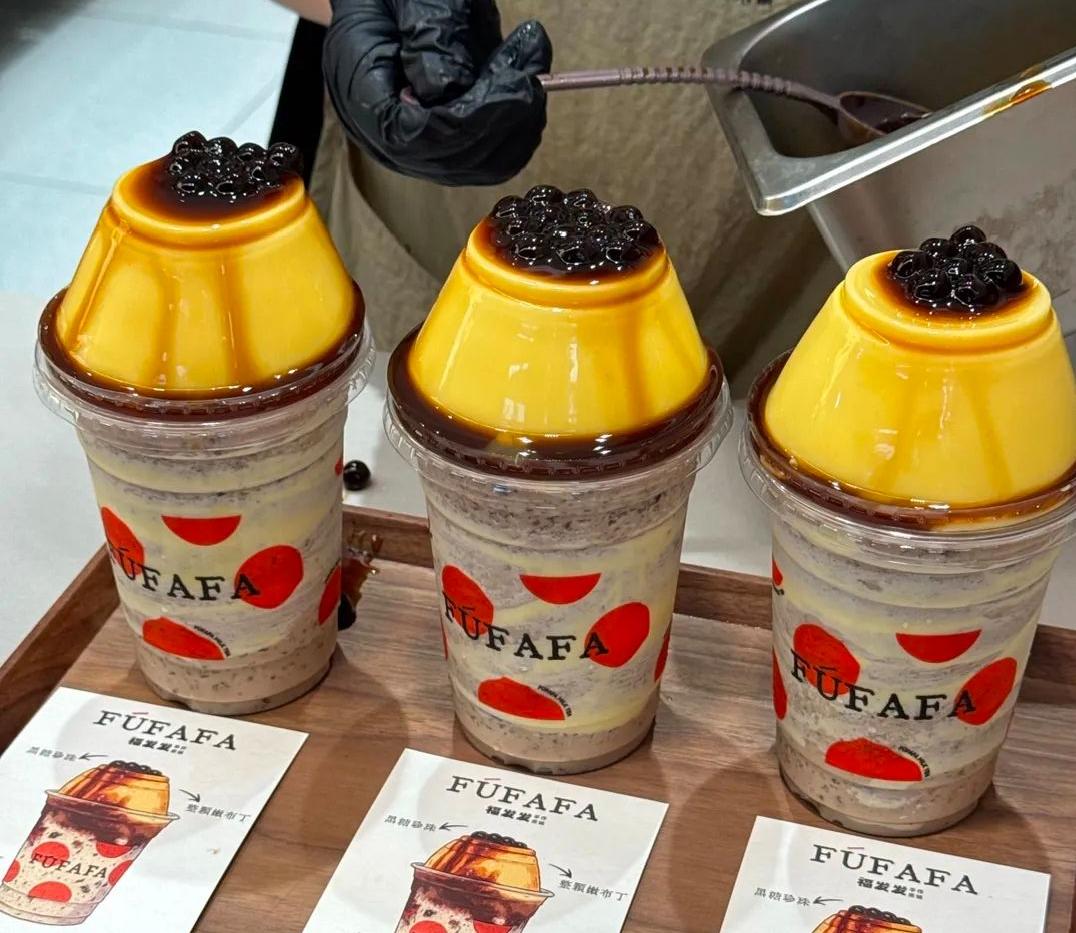
这究竟是一款什么产品?为秋冬上新带来哪些新思路? 01 被网友誉为"人生奶茶" "布丁珍奶"火速席卷饮品圈 "排队半小时也要喝""两天6杯根本停不下来!" 整块布丁倒扣在奶茶杯上,立刻成了消费者争相打卡的爆款。 近日,"布丁珍茶"横扫各大社交平台,"一口沦陷""Duang到上头"等种草笔记持续刷屏。 从上海、广州到成都、南京,多地茶饮店迅速跟进,有的门店上架3天就"卖爆整条街"。 以成都福发发·手作茶铺的"嫩布丁可可珍奶"为例,单杯16.9元。整杯珍珠沙冰上放一块布丁,再淋上黑糖珍珠,清爽滑嫩又有嚼劲的独特口感,网友 评"喝到了人生布丁奶茶"。 最近,颠覆传统奶茶形态的"布丁珍奶",在全国多地掀起热潮,成为不少消费者口中的"人生奶茶"。 在这款产品里,布丁不只是饮品中的配料,而是作为一款单独的甜点完整地放置在饮品上方(布丁倒扣在杯盖里,放置在奶茶杯上),再淋上糖浆或黑糖 珍珠。 极具视觉冲击力的出品形态,成功引发大量消费者追捧。 从上海、广州、南京等热门城市,到徐州、福州、南通等区域市场,奶茶店争相上新,有品牌上架3天就"卖爆整条街"。 嫩布丁可可珍奶,图源来自大众点评商家图册 还有南京的OLLY OWL歪头 ...
茶饮店扎堆,“特调大战”、“小甜水”不香了?
3 6 Ke· 2025-08-22 01:17
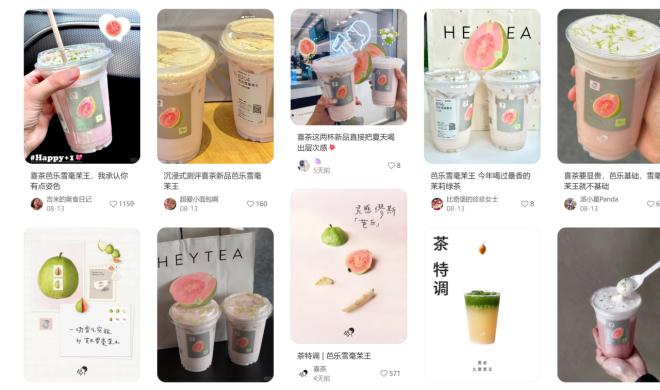
Group 1 - The core viewpoint of the article highlights the emergence of a "specialty drink war" in the tea beverage industry, with leading brands like Heytea and Chayan Yuese launching innovative specialty drinks to capture market share [1][2] - Specialty drinks are defined as beverages that combine tea and coffee with fruits, spices, and alcohol, utilizing advanced extraction techniques to create visually appealing and multi-layered flavors [1][22] - The trend is driven by consumer demand for diverse flavors, appealing aesthetics, and perceived health benefits, as specialty drinks often feature lower sugar content and natural flavors [22][23] Group 2 - Major brands such as Heytea and Chayan Yuese have recently introduced new specialty drink products, including Heytea's Guava Snow and Yellow Skin Nine Steeped Tea, which showcase unique flavor combinations and attractive presentations [2][10] - Specialty drink stores are rapidly expanding, with OONE CCUP opening flagship locations and offering a "creative drink zone" that has seen significant sales growth [11][17] - Innovative product strategies are being employed by specialty drink shops, focusing on specific drink categories and creating a matrix of offerings to differentiate themselves from traditional tea beverages [26][28] Group 3 - The article discusses the importance of visual appeal and the experience of handcrafting drinks, with many specialty drink stores featuring open preparation areas where customers can watch the drink-making process [29][30] - The ambiance and design of specialty drink stores are also emphasized, with unique decor and themes that enhance the customer experience and encourage social media sharing [30] - The overall trend reflects a shift in consumer preferences towards fresh, low-burden beverages that offer both taste and an engaging experience, indicating a potential for continued growth in the specialty drink market [25][30]
从看不懂到投不进:大基金为何集体错判泡泡玛特、老铺黄金和卡游|深氪
36氪未来消费· 2025-08-21 08:17
Core Viewpoint - The article discusses the contrasting fortunes of companies in the Hong Kong stock market, particularly focusing on the success of "Lao Pu Gold" and the missed investment opportunities by venture capitalists in the primary market [2][3]. Group 1: Lao Pu Gold's Journey - Lao Pu Gold, which saw its stock price increase by 12 times since its listing, was initially overlooked in the primary market, with no prior funding rounds before its IPO [4][5]. - The company received a significant investment from Black Ant at a valuation of 52.25 billion RMB, marking a rare entry into the investment round [5][6]. - Despite the initial lack of interest, the company's mid-year report showed a nearly 200% year-on-year profit increase, leading to a surge in demand during its IPO, with retail subscriptions oversubscribed by over 580 times [9][10]. Group 2: Market Sentiment and Investment Decisions - The article highlights a shift in market sentiment, where previously overlooked companies like Lao Pu Gold became highly sought after, leading to significant regret among investors who missed the opportunity [11][12]. - The investment community's failure to recognize the potential of companies like Lao Pu Gold and others in the consumer sector is emphasized, with many expressing regret for not investing [13][14]. - The article notes that the consumer sector, particularly non-essential goods, has become the hottest area for investment, with significant inflows from both domestic and foreign capital [20][24]. Group 3: The Changing Landscape of Consumer Investment - The article outlines how the consumer market has evolved, with companies like Bubble Mart and Lao Pu Gold emerging as leaders, while traditional sectors like tea drinks faced challenges [19][35]. - It discusses the competitive landscape, where companies that innovate and create unique products are more likely to succeed, contrasting with those that follow existing trends [44][45]. - The narrative also touches on the varying backgrounds of founders in the consumer space, which influences investor perceptions and decisions [45][46].

茶咖日报|曾刷爆朋友圈的网红咖啡,无锡唯一门店本月底闭店
Guan Cha Zhe Wang· 2025-08-20 12:05
Group 1: %Arabica Coffee Closure - %Arabica's first store in Wuxi will close by the end of August due to contract expiration, marking the only store of the brand in the city since its opening in 2020 [1] - The brand does not plan to exit the Wuxi market and may appear in a pop-up format while actively seeking a new location [1] - The brand's popularity has declined, with several stores, including those in Shanghai and Xiamen, closing after only a short period of operation [1] Group 2: Yiming Foods Performance - Yiming Foods reported a revenue of 1.401 billion yuan for the first half of 2025, a year-on-year increase of 2.12%, and a net profit of 32.22 million yuan, up 21.73% [2] - The company closed 104 stores in the first half of 2025, reducing the total number of stores from 1,968 to 1,864 [2] - The decline in revenue from both franchise and direct stores indicates a challenging market environment, prompting the company to seek changes [2] Group 3: New Brand Launches by Yiming Foods - Yiming Foods launched two new brands, "Yicheng Coffee" and "Thick Pizza," with plans to expand their presence in the market [3] - The company aims to open 600 Thick Pizza stores and enter 200 locations with Yicheng Coffee, collaborating with 500 external terminals [3] Group 4: Wanglaoji's International Expansion - Wanglaoji has established a production line in Malaysia and signed a global strategic cooperation agreement with Baosteel Packaging for local production in Southeast Asia [4][5] - The company is launching new international cans and plans to expand its market presence in Southeast Asia, North America, Europe, and Oceania [5] - The global plant-based beverage market is experiencing significant growth, with Southeast Asia showing a 25% growth rate in 2023, prompting Wanglaoji to accelerate its international strategy [5] Group 5: Hainan International Coffee Conference - The first Hainan International Coffee Conference will be held in Haikou on August 22-23, 2025, focusing on global coffee industry trends and opportunities [6] - The conference will feature participants from 13 coffee-producing countries and cover various aspects of the coffee industry, including brand value and market opportunities [6] - A product showcase will feature 20 innovative products, highlighting Hainan's unique coffee offerings [6] Group 6: PinkShake's Closure - The tea brand PinkShake has closed all its stores, with reports indicating that the management has gone missing and employees have not been paid for two months [7] - The brand, which focused on healthy and trendy milk drinks, had only opened its first store in June 2022 [7]

云姨夜话丨半年报里看“饮”情
Qi Lu Wan Bao· 2025-08-20 10:32
Core Insights - The beverage industry is experiencing significant growth, with companies like Wanglaoji reporting double-digit revenue and profit increases due to product innovation and market expansion strategies [2][5] - New product launches are accelerating across the tea beverage sector, with brands focusing on seasonal flavors and health-oriented ingredients to attract consumers [3][4] - The international expansion of Chinese beverage brands is gaining momentum, with companies like Cha Bai Dao and Wanglaoji making strides in overseas markets [4][5][6] Group 1: Company Performance - Baiyunshan's Wanglaoji reported a revenue of 6.499 billion yuan and a net profit of 1.295 billion yuan for the first half of the year, marking growth rates of 12.69% and 15.87% respectively [2] - China’s Wanglaoji has seen its overseas market scale grow 6.5 times over the past decade, with a compound annual growth rate exceeding 25% [5] - China Resources Beer reported a revenue of 23.94 billion yuan and a net profit of 5.79 billion yuan for the first half of the year, with a profit increase of 23% [7] Group 2: Market Trends - The new tea beverage market is projected to exceed 150 billion yuan in 2024, with over 40% of sales coming from delivery channels [5][8] - The tea beverage sector is witnessing a trend of launching new products, with the top 10 brands introducing 43 new items in the previous month alone [3] - Companies are increasingly focusing on health-oriented products and unique regional flavors to differentiate themselves in a competitive market [3][4] Group 3: Strategic Initiatives - Wanglaoji is enhancing its global presence by launching international products and forming partnerships for localized production [5][6] - New beverage brands are rapidly expanding overseas, with Cha Bai Dao set to open its first store in North America [4] - China Resources Beverage is investing in marketing and product diversification to create a second growth curve, despite facing short-term profit pressures [8]