
数据中心

Search documents
“储备+培育+发行多轨并行” 江苏省用好REITs工具推动高质量发展
Zheng Quan Ri Bao Wang· 2025-10-17 11:16
Core Insights - The REITs market in China is expanding, with 75 products expected to be listed by September 2025, raising over 200 billion yuan, with Shanghai Stock Exchange accounting for 51 projects and 1.4 billion yuan in financing, covering various sectors such as data centers, rental housing, and logistics [1][2] Group 1: REITs Development in Jiangsu - Jiangsu has established a "reserve + cultivation + issuance" model for public infrastructure REITs, successfully launching 8 REITs that raised 24 billion yuan, with 12 REITs having 19 underlying assets located in Jiangsu [2][3] - The Dongwu Suyuan REIT, launched in June 2021, focuses on incubating high-tech enterprises in Suzhou Industrial Park, attracting over 100 renowned companies [2][3] - The Huatai Jiangsu Expressway REIT, launched in November 2022, facilitated a 36.05 billion yuan investment in highway expansion and addressed land rights issues for service areas [3] Group 2: Policy and Regulatory Support - Jiangsu's local government and regulatory bodies, including the Jiangsu Securities Regulatory Bureau, are actively supporting the REITs market by providing training and updating project reserves to enhance asset utilization [4][5] - The Jiangsu Development and Reform Commission is streamlining the application process for REITs projects, focusing on quality and compliance to promote high-quality development in infrastructure [5] Group 3: Market Collaboration and Future Outlook - The Shanghai Stock Exchange is committed to building a robust REITs market, providing feedback on transparent and growth-oriented projects, and collaborating with local authorities to identify and support quality projects [6][7] - Ongoing initiatives include direct engagement with project stakeholders and organizing events to enhance communication and address concerns, thereby improving the overall experience for enterprises and fund managers [7]
氪星晚报 |文心4.5最强衍生模型发布,PaddleOCR-VL登顶OCR综合性能全球第一;保时捷就CEO布鲁姆的继任者达成一致;Waymo计划明年在伦...
3 6 Ke· 2025-10-17 09:19
Group 1: Company Performance - Jingneng Power reported a total electricity generation of 71.675 billion kWh for the first three quarters of 2025, a year-on-year decrease of 3.02% [1] - Northern Heavy Industries expects a net profit of 170 million to 185 million yuan for the first three quarters of 2025, representing a year-on-year increase of 56.90% to 70.74% [2] - Volvo Group's net sales for the third quarter of 2025 were 110.7 billion Swedish Krona, a year-on-year decline of 5% [9] Group 2: Product and Market Trends - JD.com reported that the iPhone Air achieved a record of 100 million yuan in sales within one second during the 11.11 shopping event [3] - JD.com also noted that the sales of the iPhone 17 series increased by 150% year-on-year, with nearly 40% of users opting for trade-in offers [6] Group 3: Strategic Developments - Porsche has reached an agreement on the successor to CEO Oliver Blume, who will step down next year, addressing investor concerns over the dual CEO structure [4] - Kuaishou and Oman Telecommunications signed a strategic cooperation agreement to promote WPS 365 in Oman, enhancing customer experience in the region [5] - CATL's subsidiary, Runshi New Energy, increased its registered capital from 2.41 million yuan to 10 billion yuan, marking a growth of approximately 414,838% [8] Group 4: Investment and Financing - Meta is set to secure nearly 30 billion USD in financing for its data center in Louisiana, marking one of the largest private capital transactions in history [9]
氪星晚报 |文心4.5最强衍生模型发布,PaddleOCR-VL登顶OCR综合性能全球第一;保时捷就CEO布鲁姆的继任者达成一致;Waymo计划明年在伦敦推出无人驾驶出行服务
3 6 Ke· 2025-10-17 09:13
Group 1: Company Performance - Jingneng Power reported a 3.02% year-on-year decline in electricity generation for the first three quarters of 2025, totaling 71.675 billion kWh, with thermal power generation down 5.98% and renewable energy generation up 220.06% [1] - Northern Heavy Industries expects a net profit of 170 to 185 million yuan for the first three quarters of 2025, representing a year-on-year increase of 56.90% to 70.74% [2] - Volvo Group's net sales for the third quarter of 2025 decreased by 5% year-on-year, amounting to 110.7 billion Swedish Krona [9] Group 2: Product Launches and Sales - JD.com reported that the iPhone Air achieved a record of 100 million yuan in sales within one second during the 11.11 shopping festival [3] - The iPhone 17 series saw a 150% year-on-year increase in sales during the 11.11 event, with nearly 40% of users opting for trade-in offers [6] Group 3: Strategic Developments - Porsche has reached an agreement on the successor to CEO Oliver Blume, who will step down next year, amid challenges such as tariffs and the transition to electric vehicles [4] - Kuaishou and Oman Telecommunications signed a strategic cooperation agreement to promote WPS 365 in Oman, enhancing customer experience in the region [5] - Ningde Times' subsidiary, Runshi New Energy, increased its registered capital from 2.41 million yuan to 10 billion yuan, marking a growth of approximately 414,838% [8] Group 4: Investment and Financing - Meta secured nearly 30 billion USD in financing for its data center in Louisiana, marking one of the largest private capital transactions in history [9]
午报三大指数均跌超1%,防御性板块逆势走强,农业银行再创新高
Sou Hu Cai Jing· 2025-10-17 04:38
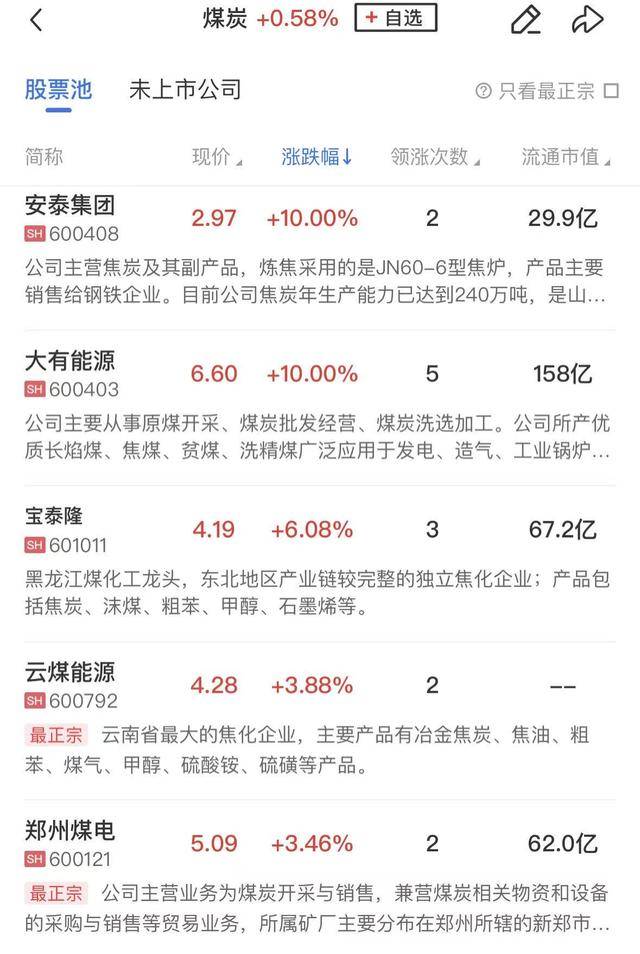
Market Overview - The market experienced a downward trend with the ChiNext Index falling over 2% and the Shanghai Composite Index down 1% [1] - The total trading volume in the Shanghai and Shenzhen markets was 1.18 trillion, a decrease of 32.6 billion from the previous trading day [1] - Defensive sectors such as coal and gas stocks showed strong performance, with notable gains in companies like Dayou Energy and Guo Xin Energy [1][3] Coal Sector - The coal sector saw a rise of 0.58%, with Dayou Energy achieving a 10% increase and a significant performance boost from other coal companies [2][18] - National Energy Administration's recent inspections have restricted overproduction, leading to a continuous decline in domestic coal output, which is expected to drive prices up [2][18] - Analysts predict that coal prices will rebound in the second half of 2025, improving profitability for coal companies [18] Gas Sector - The gas sector rose by 0.62%, driven by increased demand for natural gas as winter heating begins in various regions [3][12] - Companies like Changchun Gas and Guo Xin Energy saw significant stock price increases, with Changchun Gas reaching a 10.01% rise [4][13] Banking Sector - The banking sector was active, with Agricultural Bank of China hitting a historical high and other banks like Qingdao Bank and Xiamen Bank rising over 2% [5][6] - China Construction Bank announced plans to support new industrialization with a financing target exceeding 5 trillion over the next three years [5] Data Center Sector - The data center sector faced significant declines, with stocks like Shenghong and Zhongheng Electric dropping over 10% [8][9] - The overall sentiment in the market remains cautious, with a focus on potential recovery opportunities after the current downturn [8] Stock Performance Highlights - Notable stocks included Dayou Energy with a 10% increase and multiple stocks in the coal and gas sectors showing strong performance [1][2][3] - The market is currently characterized by a lack of strong upward momentum, with defensive sectors outperforming others [1][8]



汇聚全球顶级LP!「2025亚太母基金财富论坛」第二批重磅嘉宾名单揭晓
FOFWEEKLY· 2025-10-17 04:01
Group 1 - The article highlights the shift in the global economic landscape, emphasizing the increasing strategic positioning of foreign capital in China, with many international institutions raising their growth forecasts for the Chinese economy [1] - There has been a significant rebound in private equity merger and acquisition activities in the Asia-Pacific region since 2024, indicating a potential surge in transaction activity in 2025, driven by corporate investors [1] - Long-term capital from sovereign wealth funds in the Middle East and family offices in Southeast Asia is increasingly investing in key sectors in China, such as technology manufacturing, energy transition, and consumption upgrades [1] Group 2 - The Asia Pacific Fortune Forum 2025 (APFOF 2025) will be held in Sydney, Australia, from November 12 to 14, focusing on enhancing economic cooperation in the Asia-Pacific region and promoting efficient global capital flow [2] - The forum will gather over 500 foreign LPs, global business and political leaders, and quality innovative projects from various regions, including Australia, the US, Europe, and Asia [2] Group 3 - The confirmed attendees include prominent figures such as the Australian Federal Minister for Justice, the head of the Australian Trade Commission, and investment directors from major financial institutions, indicating a high-profile gathering [9][10][12] - The forum will cover various sectors, including healthcare, technology, clean energy, and agriculture, showcasing innovative companies and investment opportunities [41][49][59] Group 4 - The event is organized by APFOF and co-organized by FOFWEEKLY and Shiny Fund, which focus on private equity and fund management, aiming to create a bridge for global capital markets [67][68] - The forum will feature a limited number of VIP attendees, with specific pricing for participation, indicating an exclusive networking opportunity [70][72]
外卖平台将取消超时罚款,韩国股市创历史新高 | 财经日日评
吴晓波频道· 2025-10-17 03:36
Financial Data Summary - In September, China's new social financing amounted to 3.53 trillion yuan, with new RMB loans of 1.29 trillion yuan and new RMB deposits of 2.21 trillion yuan [2] - The cumulative increase in social financing for the first three quarters of 2025 reached 30.09 trillion yuan, an increase of 4.42 trillion yuan year-on-year [2] - The M2-M1 spread narrowed significantly to 1.2% at the end of September, indicating a shift of deposits from time deposits to demand deposits for investment or consumption [3] U.S. Federal Reserve Insights - The probability of a rate cut by the Federal Reserve in October has risen to 97.3%, with expectations for a 25 basis point cut [4] - Recent comments from Fed officials lean towards a dovish stance, focusing on employment risks rather than inflation changes [5] - Fed Chair Powell indicated a potential halt in the reduction of assets, suggesting a strategy of maintaining slight rate cuts while adjusting market liquidity through balance sheet management [6] Delivery Industry Developments - Major food delivery platforms, including JD.com, Meituan, and Ele.me, are moving to eliminate penalties for delivery delays, shifting to a service score management system [7][8] - This change aims to reduce pressure on delivery personnel and improve their working conditions, marking a shift towards a more humane and regulated industry [8] AI Infrastructure Investment - An investment group led by BlackRock and NVIDIA announced a $40 billion acquisition of Aligned data centers, which are crucial for AI infrastructure [9] - The deal is expected to be the largest data center transaction in history, highlighting the growing demand for AI-related infrastructure [9][10] Payment Industry Regulation - The People's Bank of China has canceled 11 payment licenses this year, indicating a tightening regulatory environment in the payment sector [11][12] - The number of licensed third-party payment institutions has decreased to 164, with a focus on eliminating smaller, less compliant players [12] Cryptocurrency Market Incident - Paxos mistakenly minted 300 trillion PYUSD stablecoins, marking the largest token burn in cryptocurrency history, although it did not result in actual financial loss [13] - This incident underscores the regulatory challenges and risks associated with stablecoin issuance and the potential for market disruption [14] South Korean Stock Market Performance - The KOSPI index in South Korea has surpassed 3700 points, marking a 56% increase year-to-date, driven by foreign investment and strong performances from major companies [15] - The market's growth is attributed to various factors, including AI infrastructure development and government measures to enhance market transparency [15][16] Market Trends and Outlook - The current market environment is characterized by a lack of clear direction, with many growth sectors experiencing volatility and a need for new catalysts to break out of the current trading range [17][18]



破局AI基建天价成本!Meta(META.US)完成近300亿美元数据中心融资 SPV表外架构成科技巨头新范本
智通财经网· 2025-10-17 03:13
这种架构能帮助科技公司避免在资产负债表上承担巨额债务,同时为华尔街投资者提供投资实物资产的 选择,使相关投资具备投资级资质。随着保险公司及其他类型投资者寻求与资产挂钩的债务产品,结构 化投资的需求正不断上升。埃隆·马斯克旗下的人工智能初创公司xAI在最新一轮200亿美元融资中,也 在采用类似架构——该公司仅租赁芯片,而非完全持有芯片所有权。 智通财经APP获悉,马克·扎克伯格旗下Meta(META.US)拟为其位于美国路易斯安那州乡村地区的数据 中心园区敲定一份近300亿美元的融资方案,这标志着史上规模最大的私募资本交易即将完成最后一 步。 据知情人士透露,蓝猫头鹰资本公司(Blue Owl Capital Inc.)与Meta将共同持有路易斯安那州里奇兰教 区"许珀里翁"(Hyperion)数据中心园区的所有权,其中这家科技巨头仅保留20%的份额。为支持该园区 的建设,摩根士丹利牵头设立了一家特殊目的实体(SPV),并为其安排了超过270亿美元的债务融资和约 25亿美元的股权融资——这种用于大型交易的架构正变得越来越普遍。 报道称,摩根士丹利于今年早些时候启动该交易的筹备工作,期间众多资产管理公司和基础设施 ...

AIDC:产业专家解读NV 800VDC架构白皮书
2025-10-16 15:11
Summary of Conference Call on AI Data Center Power Supply Industry Overview - The AI data center power supply and distribution sector is undergoing significant transformation, with traditional low-voltage systems unable to meet the demands of high-power density GPU servers, which have exceeded 130 kW and are expected to rise to 400-500 kW in the next three years [1][2][5]. Key Points and Arguments - **Transition to 800V HVDC**: NVIDIA has proposed a two-wire 800V HVDC system as the future direction for power supply, with a transition path towards Solid State Transformers (SST) [1][2][4]. - **Current Upgrades and New Builds**: Existing data centers can upgrade by adding low-voltage rectifiers to convert outputs to 800V HVDC, while new data centers should directly adopt 480V to 800V HVDC systems [5][6]. - **SST as the Ultimate Solution**: SST is viewed as the ultimate integration method for power supply and distribution, expected to enter the market by the end of 2027, optimizing size, weight, and efficiency [1][8][15]. - **Efficiency Improvements**: The transition to 800V aims to enhance system efficiency, reduce size, and accommodate peak current demands from AI workloads [1][9][11]. - **Power Supply Unit (PSU) Design Changes**: NVIDIA suggests transitioning PSU designs from 54V to 800V to lower costs and heat dissipation needs [11][16]. Additional Important Insights - **High Power Density Requirements**: The demand for high power density in AI training necessitates two-level compensation systems, with Battery Energy Storage Systems (BESS) providing long-term support and supercapacitors addressing short-term peak loads [3][18]. - **Challenges with Current Systems**: Existing low-voltage UPS systems face significant transmission losses and cannot meet high power density requirements, prompting the need for new technologies [5][6][26]. - **Market Dynamics**: The industry is moving towards a more integrated approach, with companies needing to adapt to higher voltage levels and the transition from AC to DC systems [26]. - **Certification Requirements**: Data center power equipment must pass customer-specific certifications, even if they have NVIDIA's certification, indicating a complex certification landscape [25]. Future Trends - **Emergence of Central Rectifiers**: Central rectifier technology is expected to be implemented before SST, although specific technical details are still pending [13][14]. - **Development of 800V DC-DC Modules**: Suppliers are currently developing 800V to 54V DC-DC modules, with some manufacturers already in the sampling phase [17][18]. - **Role of BESS**: BESS systems are being utilized for large-scale energy storage, providing grid-level support rather than device-level, particularly in North American data centers [19][20]. This summary encapsulates the critical developments and future directions in the AI data center power supply industry, highlighting the shift towards higher voltage systems and the integration of advanced technologies to meet evolving demands.
英伟达800Vdc白皮书有哪些值得关注的信息?
2025-10-16 15:11
Summary of Key Points from the Conference Call Industry and Company Involved - The discussion revolves around the **data center industry** and **NVIDIA**'s new **800V DC power supply white paper**. Core Insights and Arguments - **Power Supply Challenges**: Traditional 48V power supply solutions face issues such as heat dissipation and high current in large-scale applications. NVIDIA recommends an **800V power supply solution** which has been successfully applied in charging stations and energy storage sectors, indicating a level of maturity [1][2] - **Proposed Power Supply Solutions**: The white paper outlines four main power supply solutions: 1. **Existing 50V Architecture**: Utilizes UPS and PSU to convert AC to 48-54V DC for server power [2] 2. **Modification of Existing Solutions**: Retains UPS while adding rectifiers to convert mains power to 800V DC [6] 3. **New Data Center Solutions**: Eliminates UPS, using energy storage systems for backup and load smoothing [6] 4. **Centralized Power Supply Solutions**: Employs larger power modules (60kW to over 100kW) for efficiency and reduced cabinet numbers [6][11] - **Energy Storage Systems**: These systems play a crucial role in smoothing load fluctuations, reducing electricity costs, and addressing carbon emissions. NVIDIA suggests two complementary energy storage systems for data centers [10] - **Solid-State Transformers (SST)**: SSTs are highlighted for their compact size and high efficiency, although they face risks due to high voltage modules. Companies like Jindian Technology are collaborating with NVIDIA for prototype development [3][7][15] Additional Important Insights - **Panama Power Solution**: This solution is noted for its maturity and reliability compared to competitors like Siercon, indicating potential for expansion in the North American market [12][13] - **Impact of AI Data Center Construction**: The acceleration of AI data center construction in the U.S. is expected to significantly increase energy storage demand, benefiting companies like Sierce, Magmite, and Oton [14] - **Future of SST in Data Centers**: While SSTs are not yet widely adopted, their advantages suggest a gradual integration into data centers as the technology matures [8][16] - **Market Competitors**: Companies such as Jindian Technology, Igor, Sifang Co., and Xinte Electric are noted for their competitive advantages in the SST field, with Jindian Technology projected to achieve significant revenue from data center applications by 2026 [17] This summary encapsulates the key points discussed in the conference call, focusing on the advancements in power supply solutions for data centers and the implications for the industry and related companies.

网宿科技股东减持终止 年内已有11家数据中心公司遭股东减持
Zhong Guo Jing Ying Bao· 2025-10-16 14:58
Core Viewpoint - The data center industry has entered a "reduction mode" since 2025, with significant shareholder sell-offs observed among listed companies in this sector, driven by industry cycles and capital logic [1] Group 1: Shareholder Reduction Trends - As of October 16, 2025, 11 out of 20 data center stocks in the CSI All Share Index have experienced shareholder reductions [1] - Notably, Wangsu Technology (300017.SZ) has seen a reduction of 36.62 million shares this year, leading the sector [4] - Other companies with significant reductions include Data Port and Capital Online, indicating a broader trend of shareholder sell-offs in the data center industry [4] Group 2: Reasons for Shareholder Reductions - The primary reasons for increased shareholder reductions include intensified industry competition, performance pressure on certain companies, and the exit needs of early investors [4][5] - The utilization rate of intelligent computing centers is only 32%, and traditional IDC price wars are intensifying, leading to profit pressures for companies [1] - Early-stage investors are seeking exits as projects mature or as lock-up periods expire, exemplified by the planned reduction of 3% shares by a major investor in Guanghuan Xinwang [6] Group 3: Market Environment and Decision-Making - The market environment has led to a rational shift in major shareholder decision-making, with a focus on value alignment rather than solely on stock price [3] - Shareholders typically consider stock price and performance when deciding to reduce holdings, aiming to maximize cash-out benefits while maintaining market stability [6][7] - Personal funding needs are a significant driver for reductions, as shareholders may need to convert equity into cash for other investments or personal financial adjustments [6][7]
