
原材料

Search documents
华安基金:港股红利前期回调较充分,外部扰动下或迎风格切换
Xin Lang Ji Jin· 2025-10-14 09:15
Market Overview and Key Insights - The Hong Kong dividend sector saw a counter-trend increase last week, with the Hang Seng Hong Kong Stock Connect China Central State-Owned Enterprises Dividend Total Return Index rising by 1.08%, while the Hang Seng Index fell by 3.11% and the Hang Seng Tech Index dropped by 5.48% [1] - The utility and energy sectors led the gains, while consumer discretionary and healthcare sectors lagged [1] - The previous volatility in the dividend style may have been sufficiently corrected, making current valuations attractive for investment [1] Policy Support and Banking Sector Outlook - Under supportive monetary policy, the banking sector in Hong Kong is expected to see fundamental improvements, with a stabilization in interest margin decline leading to better net interest income growth [2] - Policies aimed at local debt management, stabilizing real estate, and reducing internal competition have significantly alleviated extreme risks in bank loans, which is beneficial for reducing non-performing asset pressure [2] Dividend Yield and Valuation of Central State-Owned Enterprises - The dividend yield of the Hang Seng Hong Kong Stock Connect China Central State-Owned Enterprises Dividend Index is 6.10%, compared to 4.62% for the CSI Dividend Index, with a price-to-book (PB) ratio of 0.59 and a price-to-earnings (PE) ratio of 6.67 [2] - Since the beginning of 2021, the total return index has accumulated a return of 136%, outperforming the Hang Seng Total Return Index by 121% [2] Future Market Outlook - The low interest rate environment during the domestic interest rate cut cycle and the weak economic recovery are favorable for dividend strategies [2] - The willingness and ability of central state-owned enterprises to distribute dividends are strong, enhancing the investment value of the Hong Kong Stock Connect central state-owned enterprise dividends [2] ETF Overview - The Huaan Hong Kong Stock Connect Central State-Owned Enterprises Dividend ETF (code: 513920) tracks the Hang Seng Hong Kong Stock Connect China Central State-Owned Enterprises Dividend Index, reflecting the performance of high-dividend securities listed in Hong Kong with central state-owned enterprises as the largest shareholders [3] - This ETF is the first in the market to combine the attributes of Hong Kong stocks, central state-owned enterprises, and dividends [3] Recent Performance of the ETF - The top ten weighted stocks in the Hang Seng Hong Kong Stock Connect Central State-Owned Enterprises Dividend Index have shown varied performance, with notable dividend yields and weekly price changes [6]


【读财报】9月上市公司定增动态:实际募资总额1447亿元,中国船舶、芯联集成募资额居前
Xin Hua Cai Jing· 2025-10-13 23:12
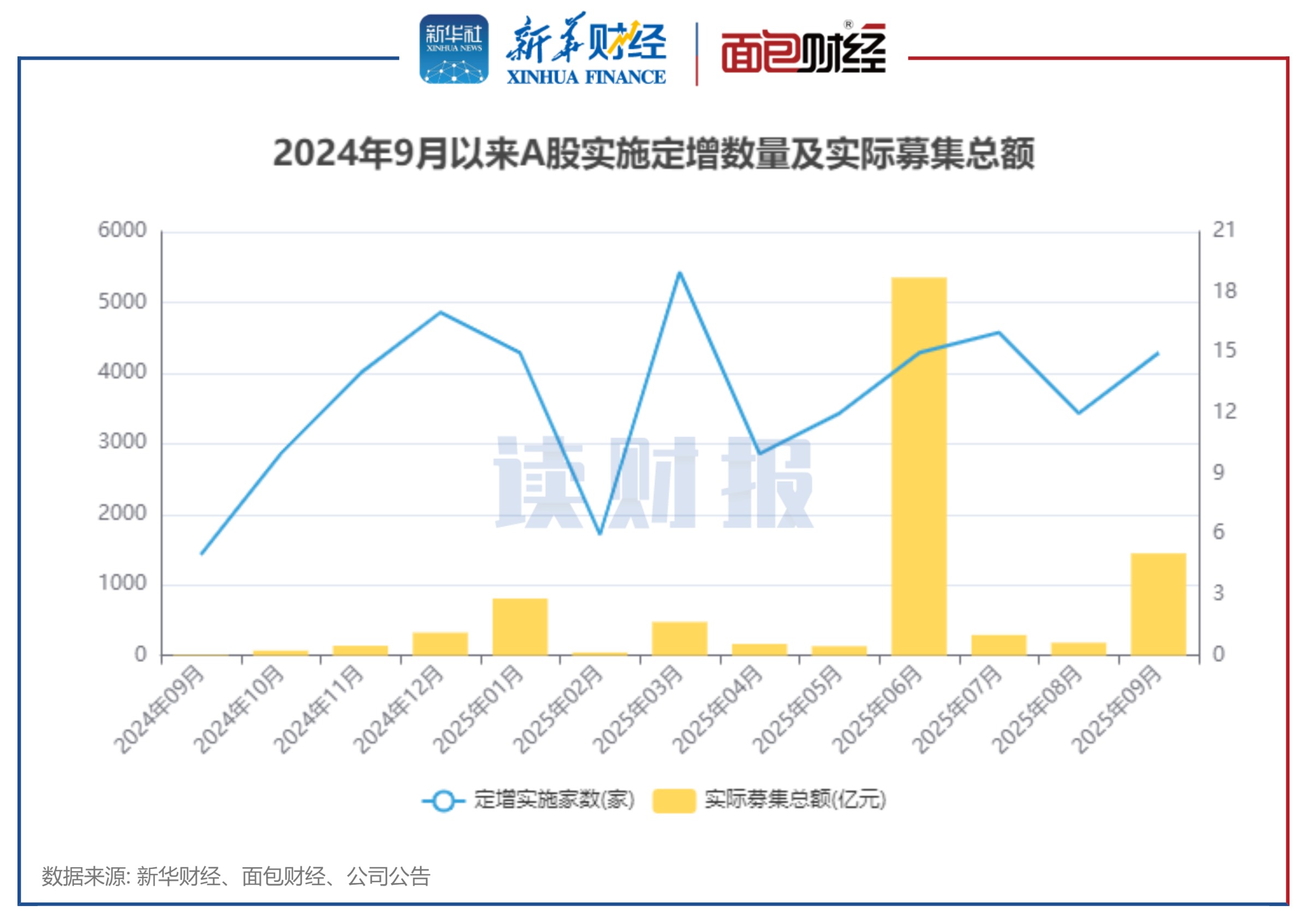
Core Points - In September 2025, A-share listed companies in China executed 15 private placements, marking a 200% year-on-year increase, with total funds raised amounting to approximately 144.71 billion yuan, a staggering 10,359% increase year-on-year [1][2] - A total of 33 private placement proposals were disclosed in September 2025, with a proposed fundraising scale of approximately 32.6 billion yuan, reflecting a 37.45% year-on-year increase [1][7] Company Summaries - China Shipbuilding ranked first in actual fundraising, raising 114.77 billion yuan by issuing 3.053 billion shares at a price of 37.59 yuan per share, with funds intended for the merger with China Shipbuilding Industry Corporation [4][5] - ChipLink Integrated raised 5.307 billion yuan through the issuance of approximately 1.314 billion shares at 4.04 yuan per share, with the funds aimed at acquiring 72.33% equity in ChipLink Integrated Circuit Manufacturing (Shaoxing) Co., Ltd. [4][5] - Guosen Securities raised 5.192 billion yuan by issuing shares at 8.25 yuan per share, with the net proceeds intended for the acquisition of 96.08% of Wanhe Securities [4][5] Industry Analysis - The industrial sector led the private placements with 5 instances, raising a total of approximately 122.44 billion yuan, followed by the information technology sector with 4 placements, and the materials sector with 2 placements [6][7] - The information technology and industrial sectors each disclosed 8 private placement proposals in September 2025, with the information technology sector proposing a total fundraising amount exceeding 6.9 billion yuan [14][15]





七部门联合推动服务型制造创新发展 到2028年,打造50个领军品牌,建设100个创新发展高地
Zheng Quan Shi Bao· 2025-10-12 22:01
Core Viewpoint - The Ministry of Industry and Information Technology and six other departments have jointly issued the "Implementation Plan for Deepening the Innovation and Development of Service-Oriented Manufacturing (2025-2028)", aiming to enhance the role of service-oriented manufacturing in high-quality development by 2028 [1] Group 1: Objectives and Tasks - The plan aims to complete 20 standard formulations, create 50 leading brands, and establish 100 innovation development hubs by 2028 [1] - It identifies seven main tasks and three special actions to promote the innovation and development of service-oriented manufacturing [1] Group 2: Challenges and Solutions - Current challenges in service-oriented manufacturing include weak supply capacity of key technologies, an incomplete standard system, uneven application of typical models across industries, and difficulties in statistical monitoring [1] - The plan proposes to strengthen technological innovation by focusing on key common technology breakthroughs and model innovations, and to publish a list of key common technologies for service-oriented manufacturing [1] Group 3: Support for Productive Services - The plan emphasizes the need to cultivate and expand key productive service industries, including technology services, industrial design, software and information services, productive financial services, intellectual property services, energy-saving and environmental protection services, and quality management services [2] - It aims to promote the application of service-oriented manufacturing models across various sectors, including raw materials, equipment manufacturing, electronics, and consumer goods [2] Group 4: Infrastructure and Technology Integration - The plan calls for strengthening new information infrastructure, deepening the integration of "5G + Industrial Internet", and enhancing the supply of industrial data elements [2] - It also emphasizes the integration of artificial intelligence technology with service-oriented manufacturing to foster innovation [2] Group 5: Brand and Platform Development - The plan includes actions to enhance shared manufacturing, develop shared manufacturing platforms and factories, and promote resource sharing in inspection and testing [3] - It aims to cultivate leading enterprises and brands in service-oriented manufacturing, along with strengthening brand evaluation and promotion [3] Group 6: Policy Support and Implementation - The plan requires robust policy support to ensure the implementation of related initiatives, including incorporating key common technology breakthroughs into the scope of technical transformation support [3] - It encourages local governments to increase support for manufacturing enterprises' service businesses and guides financial institutions to enhance financial services based on market principles [3]
从卖产品到卖方案!七部门力推服务型制造业价值跃升
券商中国· 2025-10-11 23:31
Core Viewpoint - The article emphasizes the critical transformation of the manufacturing industry from "selling products" to "selling solutions," supported by national policies aimed at enhancing service-oriented manufacturing [1][2]. Summary by Sections National Policy Framework - On October 11, the Ministry of Industry and Information Technology and six other departments issued the "Implementation Plan for Promoting Service-Oriented Manufacturing Innovation Development (2025-2028)," outlining three core goals by 2028: establishing 20 service-oriented manufacturing standards, creating 50 leading brands, and building 100 innovation development hubs [2]. Current State and Challenges - Service-oriented manufacturing has shown initial advantages in China, with a continuous increase in development levels from 2018 to 2023. Provinces like Zhejiang and Guangdong are leading, with Zhejiang alone having established 73 national-level service-oriented manufacturing demonstration enterprises [2]. - However, challenges such as weak key technology supply, an incomplete standard system, uneven application of typical models across industries, and difficulties in statistical monitoring hinder the large-scale advancement of service-oriented manufacturing [3]. Strategic Framework for Implementation - The plan proposes a systematic approach to promote service-oriented manufacturing through seven core tasks, focusing on key common technology breakthroughs and model innovations. It encourages enterprises to increase innovation investments and enhance collaboration with industrial intelligence technologies [4]. - The plan also aims to strengthen the technology service industry, improve digital capabilities of testing and certification institutions, and develop financial services that support manufacturing enterprises [4]. Industry-Specific Strategies - The plan emphasizes "classified policies" to promote service-oriented manufacturing across various sectors, including raw materials, equipment manufacturing, electronics, and consumer goods. It aims to enhance the competitive position of industries like new energy vehicles and machinery [5]. - A significant focus is placed on strengthening the digital infrastructure, promoting the integration of 5G and industrial internet, and enhancing data resource management [5]. Practical Implementation Actions - The plan outlines three major special actions to facilitate policy implementation, with a priority on developing shared manufacturing platforms that enable collaborative production and resource sharing among enterprises [6]. - It aims to cultivate 100 leading service-oriented manufacturing enterprises and 50 brands, establishing a brand evaluation system to promote exemplary cases [6]. - The plan also focuses on creating innovative application scenarios driven by demand, targeting production, consumption, and national strategic needs [7].

美元“潮汐”转向下的全球资本新航线
Sou Hu Cai Jing· 2025-10-08 08:12
Group 1 - The current shift in the dollar cycle is leading to a reallocation of global capital, with expectations of a transition from a "tight" to a "loose" liquidity environment [1] - Emerging markets are experiencing increased capital inflows, with a net inflow of $44.8 billion in August, up from $38.1 billion in July and $28.2 billion in August of the previous year [2] - China is becoming a focal point for international capital, with $39 billion net inflow into Chinese bonds and stocks in August, while other emerging markets saw a net outflow of $7.4 billion in stocks [2] Group 2 - The anticipated decrease in U.S. interest rates is expected to lower financing costs for companies with high overseas debt, improving profit expectations, particularly in sectors like aviation and raw materials [3] - The shift in dollar liquidity presents opportunities but also challenges, including potential reversals in Federal Reserve policy, structural deficits in some emerging markets, and external factors like geopolitical conflicts and energy price fluctuations [3] - The reallocation of capital emphasizes the importance of economic resilience, policy flexibility, and core competitiveness in markets to truly benefit from the current dollar cycle shift [3]
深度丨国庆假期,海外发生了什么?【陈兴团队•财通宏观】
陈兴宏观研究· 2025-10-07 09:01
Global Asset Performance - Global stock indices mostly rose during the holiday week, with the MSCI global index up 0.8%, and Taiwan and Korea indices leading with gains of 3.6% each [2][5] - The US stock market saw slight increases in major indices, with the Nasdaq, Dow Jones, and S&P 500 rising by 0.5%, 0.8%, and 0.4% respectively [5][7] - In the bond market, US Treasury yields declined, while government bond yields in several other countries also fell [10][12] - The US dollar index decreased by 0.1% to 97.7, while the offshore RMB slightly depreciated by 0.1% to 7.14 [16][18] Overseas Economic Developments Monetary Policy in the US and Europe - There is a divergence in views regarding potential interest rate cuts by the Federal Reserve, with some officials advocating caution [18][20] - The European Central Bank's president indicated that the impact of tariffs on inflation is lower than expected, with inflation in the Eurozone remaining stable at around 2% [20][36] US Economic Indicators - The ADP report indicated a decrease of 32,000 jobs in September, with the leisure and hospitality sector seeing the largest declines [22][24] - The ISM non-manufacturing PMI fell to 50%, indicating weak business activity and continued pressure on employment [24][26] - The US housing market shows signs of recovery, with new home sales increasing by 20.5% month-on-month, although home prices remain under pressure [29][31] Government Shutdown Impact - The US government shutdown, which began on October 1, may last over a week, affecting the release of key economic data [27][31] - Historical data suggests that government shutdowns can slightly impact GDP growth, with estimates indicating a reduction of 0.1-0.2 percentage points per week [31][34] Commodity Market Trends - Global commodity prices, excluding oil, generally rose, with LME tin leading the gains at 4.2% [14][16] - Precious metals also saw increases, with COMEX gold up 2.7% and silver up 3.9% during the holiday week [14][16] Regional Economic Insights - Eurozone inflation remains stable, with a CPI increase to 2.2% in September, driven mainly by service costs [36][37] - Japan's political landscape is shifting with the election of the first female president of the ruling party, who is expected to continue a conservative policy approach [37]


大摩:维持恒指“基本”情境至2026年6月目标24500点
智通财经网· 2025-10-02 08:17
Core Viewpoint - Morgan Stanley's report indicates that the covered markets are nearing their "bull case" target for June 2026, primarily due to valuation multiple expansion, but questions the sustainability of this trend without significant acceleration in global growth [1] Market Analysis - The analysis suggests that Asian and emerging market stock valuations are unlikely to sustain without a renewed acceleration in earnings growth, with optimism for a rebound in India's growth [1] - The report anticipates a potential further weakening of the US dollar, with the Bank of Japan having room for interest rate hikes, while the Federal Reserve is expected to implement significant rate cuts [1] Investment Strategy - Following increased holdings in China and South Korea this year, current portfolio risk is lower than in previous years, with "overweight" positions in Japan, Singapore, India, UAE, and Brazil, while "underweight" positions are taken in Indonesia and Saudi Arabia [1] - The industry strategy favors sectors including finance, domestic e-commerce/consumption, and industrials, while maintaining an "underweight" stance on energy and materials (excluding gold), and adopting a selective strategy in the information technology sector [1] Index Projections - Morgan Stanley maintains a "base case" target for the Hang Seng Index at 24,500 points by June 2026, corresponding to a forecasted P/E ratio of 10.6x; the "bull case" target is set at 28,000 points with a P/E ratio of 11.5x, while the "bear case" target is 18,300 points with a P/E ratio of 8.2x [1]
新开源(300109):2025年中报点评:Q2 业绩同环比下降,看好长期成长性
GUOTAI HAITONG SECURITIES· 2025-09-30 05:11
Investment Rating - The report maintains an "Accumulate" rating for the company [2][6][13] Core Views - The company's Q2 2025 performance showed a decline both year-on-year and quarter-on-quarter, but the PVP application range is extensive, and the medical sector is showing signs of recovery [2][13] - The report projects a decrease in EPS for 2025 and 2026 to 0.70 and 0.82 CNY respectively, with a new EPS estimate for 2027 at 1.02 CNY [13] - The target price is set at 23.10 CNY based on a 33x PE valuation for 2025 [13] Financial Summary - Total revenue for 2023 is projected at 1,583 million CNY, with a slight increase to 1,606 million CNY in 2024, followed by a decrease to 1,520 million CNY in 2025 [4][14] - Net profit attributable to the parent company is expected to decline from 493 million CNY in 2023 to 350 million CNY in 2024, and further to 342 million CNY in 2025 [4][14] - The company’s gross margin and net margin for Q2 2025 were reported at 41.86% and 18.2% respectively, showing a decline from Q1 2025 [13] Market Data - The company's current price is 17.89 CNY, with a 52-week price range of 11.95 to 19.87 CNY [6][7] - The total market capitalization is approximately 8,695 million CNY [7] Industry Insights - PVP is widely used across various sectors including pharmaceuticals, food industry, and electronics, with applications enhancing battery performance and electronic skin sensitivity [13] - The report indicates a stabilization in PVP prices after a significant drop in H1 2025, which had previously impacted revenue and margins [13]

重磅!全球投资者布局中国新利器
Zhong Guo Ji Jin Bao· 2025-09-29 14:34
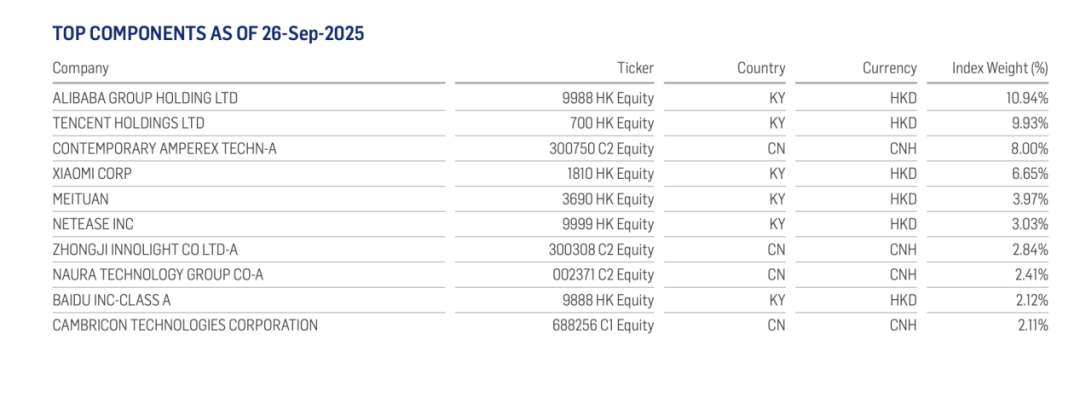
Group 1 - The CNQQ ETF, focused on Chinese technology, was launched on September 26 on NASDAQ, aiming to provide global investors with exposure to China's tech and innovation sectors [1] - The underlying index, Solactive ChinaAMC Transformative China Tech Index, was developed in collaboration with Solactive AG and China Asset Management, emphasizing companies with strong R&D capabilities [2] - The index uses a non-traditional market capitalization weighting method, selecting the top 100 stocks based on adjusted market cap and R&D spending, with a maximum weight of 10% per stock [2] Group 2 - The Solactive ChinaAMC Transformative China Tech Index includes nearly 100 Chinese companies listed in mainland China and Hong Kong, spanning five sectors: automotive and transportation, commercial and consumer services technology, electronic and electrical products, healthcare technology, and industrial and manufacturing technology [2] - Major holdings in the CNQQ ETF include Alibaba Group (10.94%), Tencent Holdings (9.93%), and Contemporary Amperex Technology (8.00%) [4] Group 3 - Morgan Stanley noted a shift in investor sentiment towards Chinese technology since the "9·24" event, indicating a cautious optimism regarding the Chinese stock market and improving corporate earnings in various sectors [5] - The Hong Kong technology fund has seen significant inflows, ranking first in capital inflow among single market sector funds, while U.S. technology funds have experienced outflows [8]




前8月全国太阳能发电装机容量同比增近五成
Zhong Guo Zheng Quan Bao· 2025-09-26 20:48
Group 1 - As of the end of August, the total installed power generation capacity in China reached 3.69 billion kilowatts, representing a year-on-year growth of 18.0% [1] - Solar power generation capacity reached 1.12 billion kilowatts, with a significant year-on-year increase of 48.5%, while wind power capacity reached 580 million kilowatts, growing by 22.1% [1] - The cumulative average utilization hours of power generation equipment from January to August were 2,105 hours, a decrease of 223 hours compared to the same period last year [1] Group 2 - In August, the total electricity consumption in China exceeded 1 trillion kilowatt-hours, reaching 1,015.4 billion kilowatt-hours, with a year-on-year growth of 5% [1] - From January to August, the cumulative electricity consumption was 6,878.8 billion kilowatt-hours, reflecting a year-on-year increase of 4.6% [1] - The electricity consumption in the manufacturing sector in August grew by 5.5%, marking the highest growth rate for the year, with notable recovery in industries such as steel, building materials, non-ferrous metals, and chemicals [1] Group 3 - The high temperatures this summer, the highest since 1961, have led to a rapid increase in electricity consumption in the tertiary sector and among residents, with many regions experiencing record load levels [2] - Policies aimed at promoting consumption and stabilizing industrial growth have contributed to a recovery in the macro economy, with continuous capacity release across various industries [2]
