传媒

Search documents
券商金股,年度排名出炉!
证券时报· 2025-12-31 03:47
Core Viewpoint - The article highlights the impressive performance of brokerage firms' recommended stocks, known as "golden stocks," which achieved over 50% returns in 2025, showcasing the effectiveness of early identification and continuous recommendation of high-performing stocks [2][5]. Group 1: Performance of Brokerage Firms - As of December 29, 2025, ten brokerage firms reported golden stock portfolios with returns exceeding 50%, with the highest being Guoyuan Securities at 83.73% [5][6]. - Other top performers included Northeast Securities and Kaiyuan Securities, with returns of 67.47% and 67.00% respectively [6]. - The consistent success of these golden stocks indicates a mature business model for brokerage research departments, which regularly showcase their best stock picks [5]. Group 2: Strategies for Success - The article notes that many brokerage firms achieved exceptional returns by identifying and recommending high-growth stocks early on, such as Xinyi Technology, which saw a 440% increase after being recommended for four consecutive months [8][9]. - Guoyuan Securities focused on sectors like media, pharmaceuticals, and machinery, with notable recommendations such as Giant Network and JiBit, which saw significant monthly gains [8]. - Northeast Securities also excelled in the technology sector, with stocks like Shenghong Technology and Sijian New Materials showing substantial price increases [8]. Group 3: Popular Stocks Among Institutions - Tencent Holdings emerged as the most recommended stock by various brokerage firms throughout 2025, being featured in recommendations from nearly seven firms each month [11]. - The article indicates that while certain stocks were popular among institutions, this did not guarantee higher success rates, as less than 40% of the most recommended stocks saw price increases in the same month [11][12].


资金风向标 | 两融余额较上一日增加35.5亿元 汽车行业获融资净买入额居首
Sou Hu Cai Jing· 2025-12-31 01:53
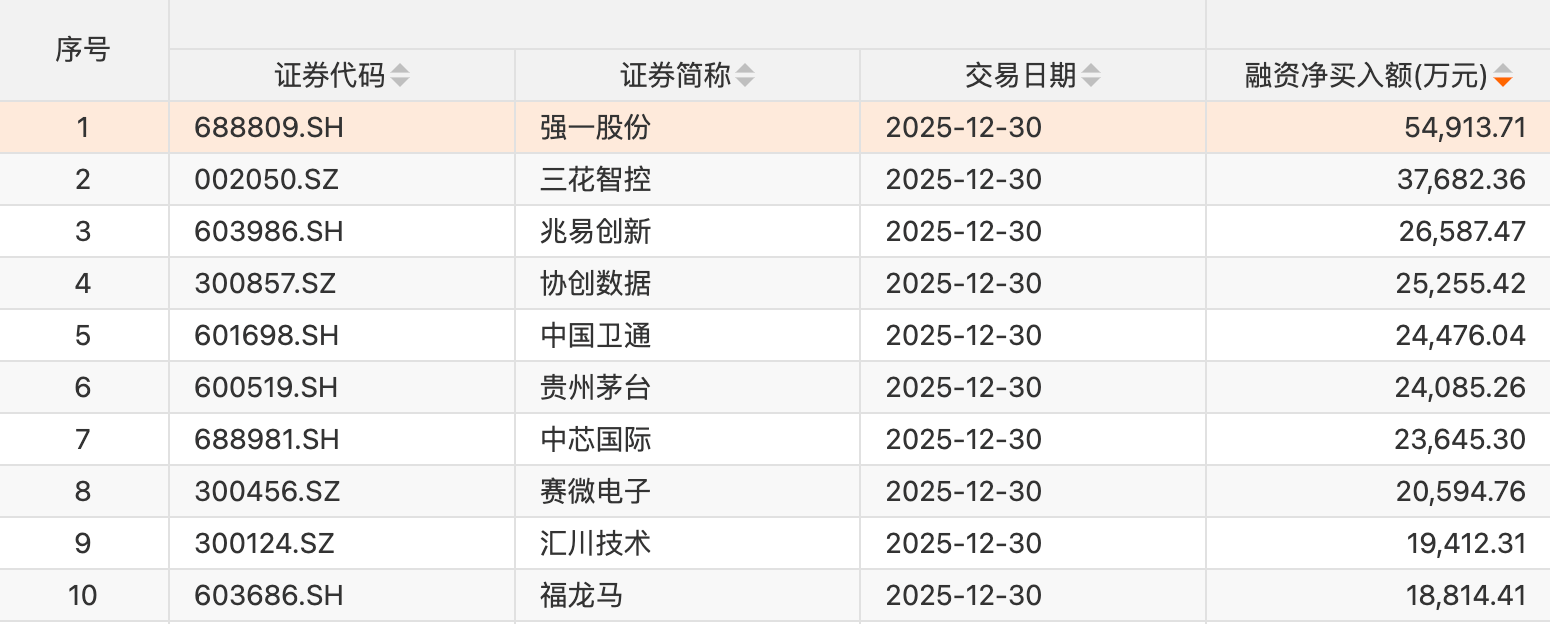
Group 1 - As of December 30, the margin balance of A-shares reached 25,552.84 billion yuan, an increase of 35.5 billion yuan from the previous trading day, accounting for 2.59% of the A-share circulating market value [1] - The trading volume of margin financing on the same day was 2,300.23 billion yuan, a decrease of 0.3 billion yuan from the previous trading day, representing 10.63% of the total A-share trading volume [1] - Among the 31 primary industries, 20 experienced net financing inflows, with the automotive industry leading at a net inflow of 1.177 billion yuan [1] Group 2 - A total of 37 individual stocks had net financing inflows exceeding 100 million yuan, with Qiangyi Co., Ltd. leading at a net inflow of 549 million yuan [1] - Other notable stocks with significant net financing inflows included Sanhua Intelligent Controls, Zhaoyi Innovation, Xiechuang Data, China Satellite Communications, Kweichow Moutai, SMIC, Saiwei Electronics, Huichuan Technology, and Fulongma [1][2] - The report from Yongxing Securities indicates continued policy support for automotive consumption, alongside steady growth in new energy vehicle sales, maintaining an "overweight" rating for the automotive industry [2]





37股获融资净买入额超1亿元
Zheng Quan Shi Bao Wang· 2025-12-31 01:41
Group 1 - On December 30, among the 31 primary industries tracked by Shenwan, 20 industries experienced net financing inflows, with the automotive industry leading at a net inflow of 1.177 billion yuan [1] - Other industries with significant net financing inflows included machinery and equipment, electronics, defense and military, computers, media, and household appliances [1] Group 2 - A total of 1,837 individual stocks received net financing inflows on December 30, with 180 stocks having inflows exceeding 30 million yuan [1] - Among these, 37 stocks had net financing inflows exceeding 100 million yuan, with Qiangyi Co., Ltd. leading at a net inflow of 549 million yuan [1] - Other notable stocks with high net financing inflows included Sanhua Intelligent Controls, Zhaoyi Innovation, Xiechuang Data, China Satellite Communications, Kweichow Moutai, SMIC, Saiwei Electronics, and Huichuan Technology [1]
30日转债行业涨跌参半,估值环比抬升:转债市场日度跟踪20251230-20251231
Huachuang Securities· 2025-12-31 01:13
Report Industry Investment Rating No information provided in the given content. Core Viewpoints - On December 30, the convertible bond industry showed mixed performance in terms of gains and losses, with valuations rising on a month - on - month basis [1]. - The mid - cap growth style was relatively dominant in the market [1]. - The trading sentiment in the convertible bond market weakened [1]. - The convertible bond price center increased, and the proportion of high - price bonds rose [2]. - The convertible bond valuations increased [2]. - In the A - share market, more than half of the underlying stock industry indices declined, while in the convertible bond market, 14 industries rose [3]. Summary by Related Catalogs Market Overview - **Index Performance**: The CSI Convertible Bond Index rose 0.14% month - on - month, the Shanghai Composite Index remained unchanged, the Shenzhen Component Index rose 0.49%, the ChiNext Index rose 0.63%, the SSE 50 Index rose 0.06%, and the CSI 1000 Index rose 0.04% [1]. - **Market Style**: Mid - cap growth was relatively dominant. Large - cap growth rose 0.57%, large - cap value fell 0.13%, mid - cap growth rose 0.81%, mid - cap value rose 0.66%, small - cap growth rose 0.66%, and small - cap value rose 0.34% [1]. - **Fund Performance**: The trading sentiment in the convertible bond market weakened. The trading volume of the convertible bond market was 75.057 billion yuan, a 2.96% month - on - month decrease; the total trading volume of the Wind All - A was 2.161532 trillion yuan, a 0.18% month - on - month increase; the net outflow of the main funds in the Shanghai and Shenzhen stock markets was 23.828 billion yuan, and the yield of the 10 - year treasury bond decreased by 0.02 bp to 1.86% [1]. Convertible Bond Price - The overall weighted average closing price of convertible bonds was 134.53 yuan, a 0.09% month - on - month increase. Among them, the closing price of equity - biased convertible bonds was 202.44 yuan, a 1.47% increase; the closing price of bond - biased convertible bonds was 118.85 yuan, a 0.18% decrease; the closing price of balanced convertible bonds was 129.71 yuan, a 0.01% increase [2]. - The proportion of bonds with a closing price above 130 yuan was 59.95%, a 1.15 - percentage - point increase. The largest change in proportion occurred in the 120 - 130 (including 130) range, with a proportion of 28.01%, a 1.39 - percentage - point decrease. There were no bonds with a closing price below 100 yuan. The median price was 132.60 yuan, a 0.07% month - on - month decrease [2]. Convertible Bond Valuation - The fitted conversion premium rate of 100 - yuan par value was 33.54%, a 0.45 - percentage - point month - on - month increase; the overall weighted par value was 101.88 yuan, a 0.19% month - on - month decrease [2]. - The premium rate of equity - biased convertible bonds was 18.25%, a 1.38 - percentage - point increase; the premium rate of bond - biased convertible bonds was 86.78%, a 2.11 - percentage - point increase; the premium rate of balanced convertible bonds was 25.17%, a 0.42 - percentage - point increase [2]. Industry Performance - **Underlying Stock Market**: Among the A - share industries, the top three decliners were Commerce and Retail (-1.56%), Real Estate (-1.22%), and Utilities (-1.14%); the top three gainers were Petroleum and Petrochemical (+2.63%), Automobile (+1.35%), and Non - Ferrous Metals (+1.31%) [3]. - **Convertible Bond Market**: Among the convertible bond industries, the top three gainers were Automobile (+2.08%), Petroleum and Petrochemical (+1.25%), and Textile and Apparel (+0.77%); the top three decliners were Environmental Protection (-2.57%), National Defense and Military Industry (-1.23%), and Building Materials (-1.16%) [3]. - **By Category**: - **Closing Price**: The large - cycle category decreased by 0.38%, manufacturing increased by 0.54%, technology decreased by 0.24%, large - consumption increased by 0.10%, and large - finance decreased by 0.05% [3]. - **Conversion Premium Rate**: The large - cycle category decreased by 0.21 percentage points, manufacturing increased by 0.57 percentage points, technology increased by 0.028 percentage points, large - consumption increased by 0.63 percentage points, and large - finance increased by 0.79 percentage points [3]. - **Conversion Value**: The large - cycle category decreased by 0.74%, manufacturing increased by 0.17%, technology decreased by 0.36%, large - consumption decreased by 0.43%, and large - finance decreased by 0.20% [3]. - **Pure Bond Premium Rate**: The large - cycle category decreased by 0.55 percentage points, manufacturing increased by 0.81 percentage points, technology decreased by 0.16 percentage points, large - consumption increased by 0.12 percentage points, and large - finance decreased by 0.065 percentage points [4]. Industry Rotation - Industries such as Petroleum and Petrochemical, Automobile, and Non - Ferrous Metals led the gains. For example, Petroleum and Petrochemical had a daily increase of 2.63% in the underlying stock market and 1.25% in the convertible bond market; Automobile had a 1.35% increase in the underlying stock market and 2.08% in the convertible bond market [54].
金融界财经早餐:2026年“国补”政策出炉!房产业再迎催化,个人卖房满2年免征增值税;长鑫科技科创板IPO获受理;MiniMax今日启动招股(12月31日)
Jin Rong Jie· 2025-12-31 00:38
Economic Policies - The Central Rural Work Conference emphasized the importance of modernizing agriculture and rural areas, with a focus on food production and policies to support farmers' income stability [1] - The 2026 national subsidy plan was released, allocating 62.5 billion yuan for consumer goods replacement and updates, with new categories including smart glasses and smart home products [1] - A new tax policy was announced, reducing the VAT on the sale of homes held for less than two years from 5% to 3%, which is expected to increase the activity in the second-hand housing market [2] Capital Market Developments - The A-share market saw significant growth in 2025, with the Shanghai Composite Index reaching over 4000 points and total market capitalization hitting 119.04 trillion yuan, driven by increased capital inflow [4] - Hong Kong's IPO market is set for a strong start in the new year, with three Chinese tech companies planning to raise over $1 billion through IPOs [5] - Tesla's delivery expectations for Q4 have been revised downwards, with analysts predicting a 15% year-on-year decline in vehicle deliveries [5] Industry Highlights - The automotive industry is undergoing a digital transformation, with goals set for 2027 to enhance manufacturing capabilities and digital integration across various enterprises [2] - China's automotive sales are projected to grow by 17% in 2025, positioning the country as the largest global automotive market, surpassing Japan [6] - The price of copper has reached historical highs due to increased demand from energy transition and AI infrastructure developments [8] Company Updates - Guizhou Moutai announced adjustments to its product lineup for 2026, focusing on various series of its liquor products [10] - Tianpu Co. has seen its stock price surge by 718.39% since August 2025, leading to a suspension for verification due to significant deviation from its fundamentals [10] - Ningde Times plans to build over 3,000 battery swap stations by next year, enhancing its network for electric vehicle charging [10] - Xiaomi is expanding its automotive product matrix, planning to launch at least four new models in 2026, including both electric and range-extended vehicles [11] - China National Airlines intends to purchase 60 Airbus A320NEO aircraft, totaling approximately $9.53 billion, to enhance its fleet capacity [10]
中国“双碳”五年ESG覆盖2529家上市公司 央企100%披露彰显“压舱石”底色
Chang Jiang Shang Bao· 2025-12-30 23:21
Core Insights - The integration of Environmental, Social, and Governance (ESG) factors into corporate strategy and practice has significantly deepened and broadened among Chinese listed companies in the five years since the "dual carbon" goals were proposed [1][4] - The ESG concept has evolved rapidly in China's capital market from awareness to institutional development, with regulatory bodies enhancing disclosure guidelines and investors incorporating ESG performance into decision-making [1][2] Group 1: ESG Disclosure Progress - From 2019 to 2024, the number of A-share listed companies disclosing ESG practices increased from 1,011 to 2,529, representing a 150% overall growth [2] - The disclosure rates for these years were 26.82%, 27.16%, 31.14%, 35.99%, 41.45%, and 46.53%, showing a steady upward trend [2] - In 2024, the banking sector had the highest disclosure rate at 100%, followed by non-bank financials (87.06%), steel (81.82%), coal (74.81%), utilities (73.28%), real estate (63.74%), and media (63.57%) [2] Group 2: ESG Ratings and Challenges - In 2024, among companies that disclosed ESG information, the distribution of ESG ratings was as follows: 94 companies rated AAA, 696 rated AA, 1,096 rated A, and 1,031 rated BBB, indicating a "middle-heavy" distribution [3] - Despite the increase in disclosure volume, there are structural challenges in ESG development, such as inconsistent report quality, lack of key quantitative data, and a tendency to focus on form over substance [3] - The governance mechanisms often lack integration, with ESG efforts typically confined to specific departments rather than being incorporated into board-level strategic oversight and long-term planning [3] Group 3: Future Outlook - The ESG landscape in China is transitioning from a "scale expansion phase" to a "quality improvement phase," necessitating deeper integration of disclosure and practice [4] - As regulatory frameworks continue to improve and market understanding deepens, ESG is expected to evolve from mere compliance to a core driver of long-term value creation and sustainable development [4] - For Chinese companies to achieve high-quality development amidst the green transition, it is essential to align strategic actions with ESG practices effectively [4]
新浪财经隔夜要闻大事汇总:2025年12月31日
Sou Hu Cai Jing· 2025-12-30 22:49
Market Overview - The S&P 500 index closed lower for three consecutive days, reflecting internal divisions within the Federal Reserve regarding interest rate policies, with most officials favoring further rate cuts if inflation decreases, while some advocate for maintaining rates unchanged [1][4] - The market maintains expectations for two rate cuts by the Federal Reserve in 2026, despite a recent 25 basis point cut [1][4] - Global stock markets are projected to rise for three consecutive years as investors assess the outlook for U.S. interest rates and monetary policy [1] Company Updates - Tesla's stock fell by 1.17% after releasing a pessimistic delivery forecast, predicting a 15% year-over-year decline in Q4 deliveries [1][21] - Meta Platforms' stock rose by 1.10% as it plans to acquire Manus AI for $2.5 billion to expand into enterprise-level AI [1] - Rivian's stock dropped by 5.5%, indicating a weakening momentum as it failed to maintain the $20 mark, with a significant decline in trading volume [1][18] - Boeing's stock increased by 1.2% following the announcement of an $8.6 billion contract for F-15 fighter jets for Israel [1][19] - Disney agreed to pay a $10 million civil penalty to settle allegations of violating the Children's Online Privacy Protection Act related to YouTube content [6][20]
“三个有需必应”是关键
Xin Lang Cai Jing· 2025-12-30 20:11
Group 1 - The core strategy for Chengdu's state-owned enterprises (SOEs) is to respond to three key needs: urban functionality, industrial development, and support for private enterprises, aiming to enhance the city's leadership as a megacity by 2026 [1] - Chengdu's infrastructure development will focus on creating a "1-hour commuting circle" and integrating rail transit with urban development, emphasizing green ecological foundations and multi-dimensional urban transformation [1][2] - Chengdu's environmental group plans to promote at least 50 major projects in water conservancy, energy, flood control, and underground pipelines by 2026, with a strategic investment in emerging industries of no less than 2.5 billion [2] Group 2 - Chengdu's transportation group is implementing the "Chengdu Expressway" doubling plan, accelerating key projects like the expansion of the Fifth Ring Road and the Chengwenqiong Expressway, while also focusing on affordable rental housing [2] - The Chengdu Urban Investment Group aims to optimize its main business by enhancing urban functions and integrating industrial layout with urban strategies, focusing on significant urban renewal projects [2][3] - The Chengdu Media Group is committed to driving the city's cultural and creative industry, enhancing the operation of cultural parks, and developing digital creative industries, including the establishment of a micro-short drama industry base [3]
年度行情今日收官 十家券商金股组合收益率超百分之五十
Zheng Quan Shi Bao· 2025-12-30 18:19
Core Insights - The article highlights the performance of brokerage firms' recommended stocks, known as "golden stocks," which have achieved over 50% returns in 2025, with some firms excelling by identifying and recommending stocks early in their upward trends [1][3]. Group 1: Performance of Golden Stocks - As of December 29, 2025, 10 brokerage firms' golden stock portfolios recorded returns exceeding 50%, with the highest being 83.73% from Guoyuan Securities [3]. - Other notable performers include Northeast Securities and Kaiyuan Securities, with returns of 67.47% and 67%, respectively [3]. - The golden stock strategy has become a mature business for many brokerage firms, showcasing their research capabilities and market insights [3]. Group 2: Strategies for Success - Early identification of stocks at low prices and consistent recommendations have been key strategies for achieving high returns [4]. - For instance, Kaiyuan Securities recommended Xinyisheng for four consecutive months, resulting in a total increase of 440% from May to August [5]. - Guoyuan Securities focused on sectors like media, pharmaceuticals, and machinery, with significant monthly gains from stocks like Giant Network and JiBit [4]. Group 3: Popularity of Tencent - Tencent Holdings emerged as the most recommended stock, being favored by around seven brokerage firms monthly, making it the top "golden stock" of the year [2][6]. - The popularity of stocks varies by quarter, with technology stocks dominating in the first quarter, consumer stocks in the second, financial stocks in the third, and a return to technology stocks in the fourth quarter [6]. Group 4: Market Trends and Recommendations - The article notes that not all popular stocks achieve high success rates, with less than 40% of the most recommended A-share stocks showing gains in the same month they were recommended [7].







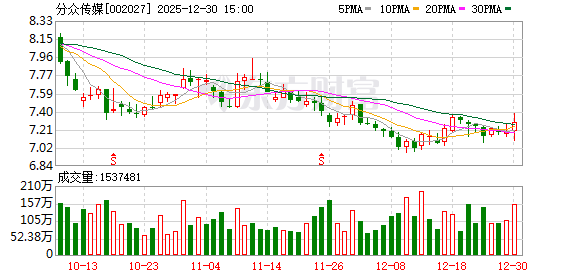
分众传媒:公司的核心价值在于对城市主流人群必经之路的深度覆盖
Zheng Quan Ri Bao· 2025-12-30 14:11
证券日报网讯 12月30日,分众传媒在互动平台回答投资者提问时表示,公司的核心价值在于对城市主 流人群必经之路的深度覆盖,而写字楼作为城市主流消费人群高频出入的重要场景的属性不会改变。公 司将持续关注产业变化对媒体场景的影响,在多变的环境中把握确定性的流量。 (文章来源:证券日报) ...