
高技术制造业

Search documents
41326亿元、191947亿元、5924.6亿元!“数”读重磅数据透视经济韧性与活力
Yang Shi Wang· 2025-06-16 07:54
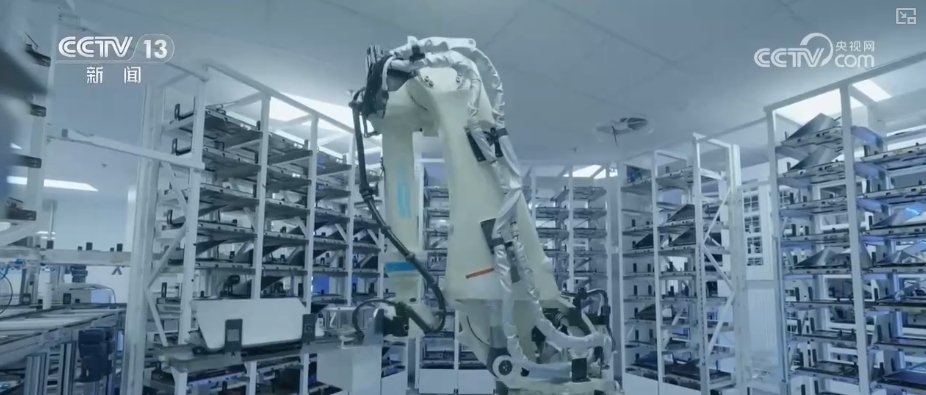
Economic Growth - In May, the national industrial added value above designated size increased by 5.8% year-on-year, with equipment manufacturing and high-tech manufacturing growing at 9.0% and 8.6% respectively, outpacing the overall industrial growth by 3.2 and 2.8 percentage points [1][12] - The service industry production index rose by 6.2% year-on-year in May, accelerating by 0.2 percentage points compared to the previous month [2][14] Consumer Market - The total retail sales of consumer goods reached 41,326 billion yuan in May, marking a 6.4% year-on-year increase, which is 1.3 percentage points higher than the previous month [3][16] - Sales of household appliances and audio-visual equipment, communication equipment, cultural and office supplies, and furniture saw year-on-year growth ranging from 25.6% to 53% [11][16] Investment Trends - From January to May, fixed asset investment (excluding rural households) totaled 191,947 billion yuan, with a year-on-year growth of 3.7%, particularly in high-tech industries such as information services and aerospace manufacturing [4][16] - Investment in equipment and tools increased by 17.3% in the first five months, contributing 63.6% to overall investment growth [11] Employment and Market Activity - The employment situation remained stable, with a decrease in the urban survey unemployment rate [6] - Macro policies have effectively enhanced market activity, leading to increased passenger turnover and a rise in domestic tourism during the "May Day" holiday [10] Industry Performance - The production of lithium-ion batteries, shipbuilding, and boiler manufacturing industries achieved double-digit growth in May, driven by large-scale equipment updates [8] - The production of new energy vehicles, tablets, and electric bicycles saw significant increases of 31.7%, 30.9%, and 20.5% respectively [8][12]

5月“消费强投资弱”,经济运行保持较强韧性
Dong Fang Jin Cheng· 2025-06-16 06:52
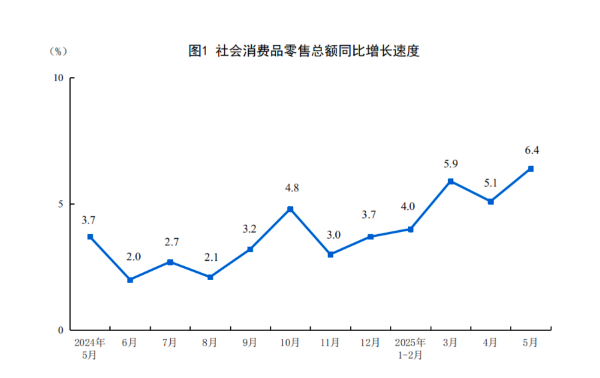
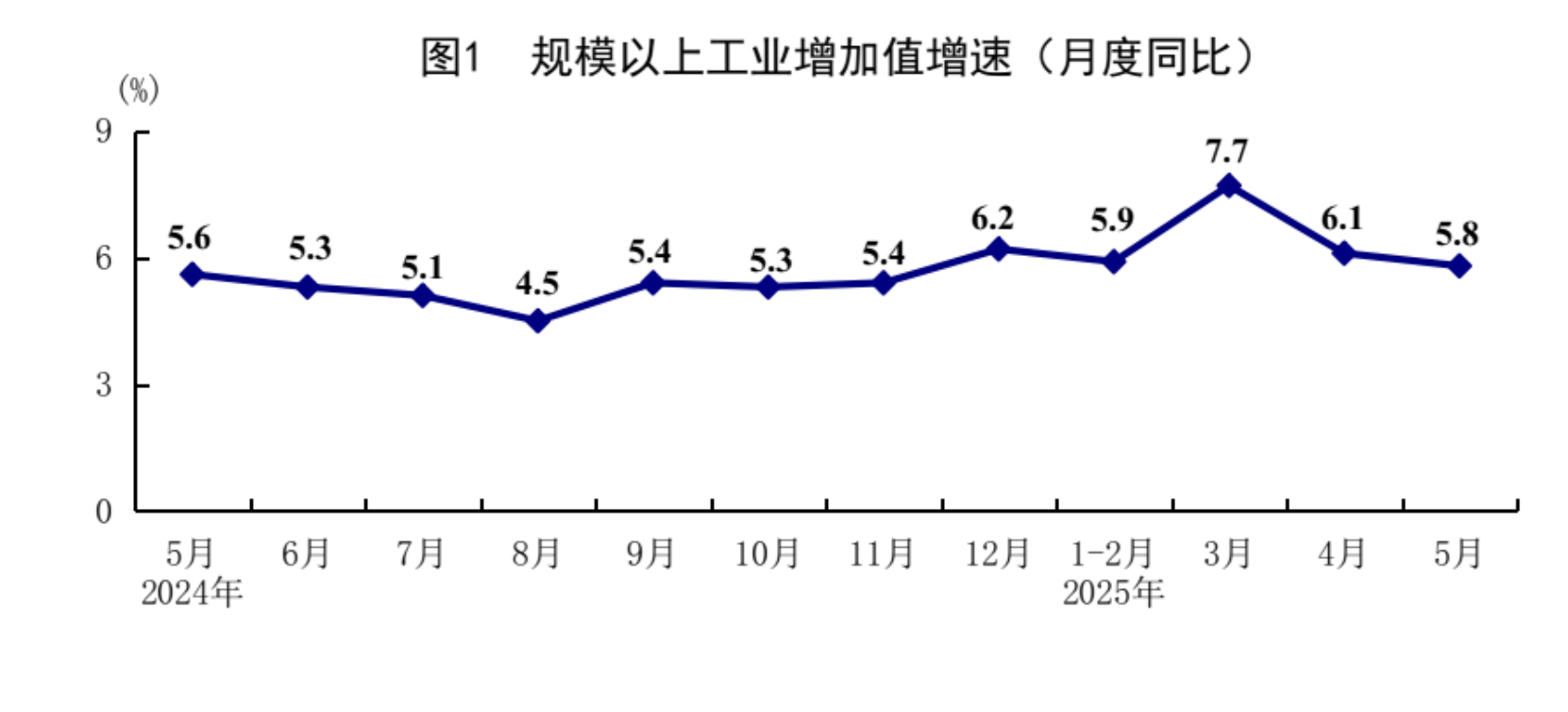
Economic Performance - In May, the industrial added value increased by 5.8% year-on-year, down from 6.1% in April, with a cumulative growth of 6.3% from January to May[1] - The total retail sales of consumer goods grew by 6.4% year-on-year in May, up from 5.1% in April, with a cumulative growth of 5.0% from January to May[1] - Fixed asset investment from January to May increased by 3.7% year-on-year, down 0.3 percentage points from the previous value, with May's investment growth at 2.7%, a decline of 0.8 percentage points from April[1][2] Industrial Sector Insights - The manufacturing sector's added value growth slowed to 6.2% in May, down 0.4 percentage points from the previous month, primarily due to external trade environment changes affecting export trade[4] - Despite a slowdown in export delivery value growth to 0.6% in May, the industrial added value remained around 6.0% due to domestic demand policies and technological innovation[5] - High-tech manufacturing added value grew by 8.6%, indicating strong support for overall industrial performance[5] Consumer Behavior - The rapid growth in retail sales was driven by the "old-for-new" policy for durable goods, with significant increases in categories like home appliances (53.0% growth) and communication equipment (33.0% growth) in May[8] - Automotive retail sales saw a rebound with a 13.6% increase, although the retail sales growth was only 1.1%, indicating pricing pressures in the market[8][9] Investment Trends - Manufacturing investment from January to May showed a cumulative year-on-year growth of 8.5%, with equipment investment growing by 17.3%, contributing significantly to overall investment growth[10] - Real estate investment continued to decline, with a cumulative drop of 10.7% from January to May, and a monthly decline of 12.4% in May, reflecting ongoing market adjustments[11] - Infrastructure investment (excluding electricity) grew by 5.6% year-on-year from January to May, but May's growth slowed to 5.1% due to weak project funding and execution[12] Future Outlook - The economic outlook suggests continued challenges from external trade dynamics, with expectations of further monetary easing and fiscal measures to support growth in the second half of the year[3][13] - The real estate market's stabilization is crucial for boosting consumer confidence and investment, with anticipated support measures to enhance housing market recovery[11][14]
5月经济数据点评:经济叙事的三重分化
Soochow Securities· 2025-06-16 06:31
Economic Performance - In May, industrial added value increased by 5.8% year-on-year, while the service production index rose by 6.2%[3] - Retail sales grew by 6.4% year-on-year, up 1.3 percentage points from the previous month[3] - Fixed asset investment accumulated a year-on-year growth of 3.7%, down 0.3 percentage points from last month[3] Sector Analysis - Infrastructure and manufacturing investment grew by 10.4% and 8.5% respectively in the first five months of the year[3] - New energy vehicle production surged by 40.8%, while industrial robots increased by 32%[3] - Real estate sales and investment saw declines of -2.9% and -10.7% respectively in the first five months[3] Price Trends - The Producer Price Index (PPI) fell from -2.7% to -3.3% year-on-year, indicating price pressures affecting investment[3] - Consumer Price Index (CPI) showed signs of stabilization, nearing the mid-level of 2022-2024[3] Future Outlook - The economy is expected to meet the annual growth target of around 5%, but structural changes will depend on the evolution of the current economic narratives[3] - Key issues to monitor include the potential overconsumption of durable goods, export growth rates, and the government's policy responses[3]
5月中国经济展现较强韧劲,消费增速大幅回升
Di Yi Cai Jing· 2025-06-16 05:34
Economic Overview - China's macroeconomic policies are well-prepared to respond dynamically to changing circumstances, ensuring stable economic operation [1][11] - In May, the total retail sales of consumer goods increased by 6.4% year-on-year, a significant rebound of 1.3 percentage points compared to April [1][3] - The industrial added value above designated size grew by 5.8% year-on-year in May, showing a slight decline of 0.3 percentage points from April [1][6] Consumption Growth - The increase in consumer spending is supported by several factors, including the "old-for-new" policy, promotional events like "6·18", and strong holiday consumption [3][4] - Retail sales of household appliances and communication equipment saw significant growth, contributing 1.9 percentage points to the total retail sales increase [4] - The restaurant sector experienced a year-on-year revenue growth of 5.9% in May, reflecting improved consumer confidence [4][6] Industrial Production - Industrial production remains robust, with a year-on-year growth of 5.8% in May, supported by macroeconomic policies and industrial upgrades [6][8] - The equipment manufacturing and high-tech manufacturing sectors outperformed the overall industrial growth, with increases of 9% and 8.6% respectively [6][8] - High-tech product output, such as 3D printing equipment and integrated circuits, saw substantial growth, with increases of 40% and 11.5% respectively [6] Investment Trends - From January to May, fixed asset investment (excluding rural households) reached 191,947 billion yuan, growing by 3.7% year-on-year [10] - Infrastructure investment grew by 5.6%, while manufacturing investment increased by 8.5%, contrasting with a decline of 10.7% in real estate development investment [10] - The issuance of new local government special bonds exceeded 440 billion yuan in May, indicating a strong push for effective investment [10] Future Outlook - The economic environment remains complex, with external uncertainties and domestic challenges persisting, necessitating continued policy support [1][8] - The focus will be on enhancing consumer capacity and willingness, improving the consumption environment, and promoting high-quality development [4][11] - The manufacturing investment growth rate is expected to gradually decline to around 8% by 2025, influenced by external pressures and domestic productivity improvements [10]
最新发声:政策留有后手
Zheng Quan Shi Bao Wang· 2025-06-16 04:48
Economic Overview - In May, the overall economic operation remained stable with signs of improvement, showcasing strong resilience and vitality in China's economy [1][2] - The retail sales of consumer goods in May increased by 6.4% year-on-year, accelerating by 1.3 percentage points compared to the previous month [1] - The industrial production saw a year-on-year increase of 5.8% in May, with a month-on-month growth of 0.61% [1] Service Sector - The service sector's production index grew by 6.2% year-on-year in May, which is an acceleration of 0.2 percentage points from the previous month [1] Fixed Asset Investment - From January to May, the total fixed asset investment (excluding rural households) reached 191,947 billion yuan, reflecting a year-on-year growth of 3.7% [1] Real Estate Market - The real estate market is stabilizing, with the price decline in new residential properties continuing to narrow in May [3][4] - The sales area and sales volume of new commercial housing from January to May decreased by 2.9% and 3.8% year-on-year, respectively, remaining stable compared to the previous four months [3] - The inventory of unsold commercial housing decreased by 7.15 million square meters in May, marking three consecutive months of decline [3] Policy Measures - The implementation of proactive macroeconomic policies has effectively enhanced consumption vitality and supported production growth [5] - The policy toolbox is well-stocked, allowing for dynamic adjustments to respond to changing circumstances, ensuring continued economic stability [6]
刚刚,重要经济数据公布!
第一财经· 2025-06-16 02:31
Core Viewpoint - The article highlights the stable growth of China's economy in May 2025, driven by effective macroeconomic policies and a focus on high-quality development, despite external uncertainties and domestic demand challenges [1]. Group 1: Industrial Production - In May, the industrial added value of large-scale enterprises increased by 5.8% year-on-year and 0.61% month-on-month, with manufacturing growing by 6.2% [2]. - Equipment manufacturing and high-tech manufacturing sectors saw significant growth, with increases of 9.0% and 8.6% respectively, outpacing overall industrial growth by 3.2 and 2.8 percentage points [2]. - The manufacturing purchasing managers' index was at 49.5%, indicating a slight improvement, while the business activity expectation index rose to 52.5% [2]. Group 2: Service Sector - The service sector production index grew by 6.2% year-on-year in May, with notable increases in information transmission, software, and IT services at 11.2% [3]. - The business activity index for the service sector was at 50.2%, indicating stable growth, while the business activity expectation index reached 56.5% [3]. Group 3: Market Sales - The total retail sales of consumer goods reached 41,326 billion yuan in May, growing by 6.4% year-on-year, with urban retail sales increasing by 6.5% [4]. - The sales of home appliances and communication equipment surged due to the "trade-in" policy, with growth rates of 53.0% and 33.0% respectively [5]. Group 4: Fixed Asset Investment - From January to May, fixed asset investment (excluding rural households) totaled 191,947 billion yuan, with a year-on-year growth of 3.7% [6]. - Manufacturing investment grew by 8.5%, while real estate development investment declined by 10.7% [6]. Group 5: Trade and Employment - In May, the total value of goods imports and exports was 38,098 billion yuan, with exports increasing by 6.3% [7]. - The urban surveyed unemployment rate was 5.0% in May, showing a slight decrease from the previous month [8]. Group 6: Consumer Prices - The Consumer Price Index (CPI) fell by 0.1% year-on-year in May, with core CPI rising by 0.6% [9]. - The prices of food and beverages increased slightly, while transportation and communication prices saw a significant decline of 4.3% [9]. Group 7: Producer Prices - In May, the producer price index for industrial producers decreased by 3.3% year-on-year, indicating ongoing deflationary pressures in the industrial sector [10].

5月份国民经济运行总体平稳、稳中有进
Guo Jia Tong Ji Ju· 2025-06-16 02:00
Economic Overview - In May, under the strong leadership of the Central Committee, the national economy maintained stable operation, with steady growth in production and demand, and overall employment stability [2][10] - The economic performance reflects resilience and vitality, although external uncertainties and the need to enhance domestic demand remain challenges [10] Industrial Production - In May, the industrial added value of enterprises above designated size increased by 5.8% year-on-year and 0.61% month-on-month [3] - The equipment manufacturing industry and high-tech manufacturing industry saw significant growth, with increases of 9.0% and 8.6% respectively, outpacing the overall industrial growth by 3.2 and 2.8 percentage points [3] - The manufacturing purchasing managers' index was at 49.5, up 0.5 percentage points from the previous month [3] Service Sector - The service production index grew by 6.2% year-on-year in May, accelerating by 0.2 percentage points from the previous month [4] - Key sectors such as information transmission, software, and IT services saw growth rates of 11.2%, 8.9%, and 8.4% respectively, exceeding the overall service production index growth [4] Consumer Market - The total retail sales of consumer goods reached 41,326 billion yuan in May, marking a year-on-year increase of 6.4% [5] - The sales of home appliances and communication equipment surged by 53.0% and 33.0% respectively, driven by the "replace old with new" policy [5] - Online retail sales amounted to 60,402 billion yuan, growing by 8.5% year-on-year, with physical goods accounting for 24.5% of total retail sales [5] Fixed Asset Investment - From January to May, fixed asset investment (excluding rural households) totaled 191,947 billion yuan, up 3.7% year-on-year [6] - Manufacturing investment grew by 8.5%, while real estate development investment declined by 10.7% [6] Trade Performance - In May, the total value of goods imports and exports reached 38,098 billion yuan, a year-on-year increase of 2.7% [7] - Exports rose by 6.3% to 22,767 billion yuan, while imports fell by 2.1% to 15,331 billion yuan [7] Employment Situation - The urban surveyed unemployment rate was 5.0% in May, a decrease of 0.1 percentage points from the previous month [8] - The average weekly working hours for employees were reported at 48.5 hours [8] Price Trends - The Consumer Price Index (CPI) fell by 0.1% year-on-year in May, with core CPI rising by 0.6% [9] - The Producer Price Index (PPI) for industrial producers decreased by 3.3% year-on-year [9]
推动经济高质量发展的“新动能”正持续积聚
Zheng Quan Ri Bao· 2025-06-15 16:17
Group 1 - The concept of "new momentum" is crucial for promoting high-quality economic development, driven by technological innovation and new industries, business models, and forms [1] - In May, sales revenue in high-tech industries grew by 15% year-on-year, while the core digital economy industries saw an 11.2% increase, indicating a strong growth trend [1] - The integration of digital and physical realms is accelerating, with technologies like big data, cloud computing, and artificial intelligence becoming key drivers for industrial upgrades and economic structure optimization [1] Group 2 - In May, sales revenue for industrial robots and special operation robots increased by 13.2% and 28.3% year-on-year, reflecting the deepening implementation of the "Artificial Intelligence +" initiative [2] - The high-tech manufacturing PMI has remained in the expansion zone for four consecutive months, showcasing robust development in new quality productivity [2] - The emergence of new foreign trade models, such as bonded maintenance projects, indicates an increase in the "new momentum" within the foreign trade sector, enhancing the competitiveness of high-tech and high-value-added products [2] Group 3 - There is a recognition of the need to stabilize the foundation for the continuous recovery of the national economy amidst external uncertainties, emphasizing the importance of technological innovation in creating new growth points [3] - The ongoing transition from old to new momentum is essential for exploring new fields and tracks, which will further cultivate "new momentum" to support high-quality economic development [3]
从资本市场透视供需再平衡:原因剖析与路径优化
Sou Hu Cai Jing· 2025-06-13 03:12
Core Viewpoint - China's economy is currently facing a complex situation of short-term demand insufficiency and supply surplus, reflecting both cyclical fluctuations and structural imbalances during the industrial transformation process. The capital market serves as an economic "barometer," capturing supply-demand changes and providing forward-looking economic signals for decision-makers. The article suggests enhancing short-term demand management while deepening supply-side reforms to optimize macro-control using capital market signals, thereby improving the efficiency and quality of supply-demand dynamic balance [1]. Group 1: Current Imbalance of Total Supply and Demand - Since 2022, persistent low domestic prices and capital market price adjustments reflect issues of insufficient total demand and supply imbalance [2]. - Total demand remains weak, with both investment and consumption under pressure. As of April 2025, CPI has been low for 25 months, and PPI has experienced negative growth. The GDP deflator index has declined for eight consecutive quarters, indicating weak future demand expectations [3]. - Investment in real estate has led to a significant drop in related asset prices, with real estate development investment growth slowing since April 2022, causing related industries like black metal smelting and cement to experience negative price growth [3]. - Consumer spending is also affected by slowing income growth, with actual income growth decreasing from 8.2% in 2015 to 5.1% in 2024, and retail sales growth dropping from 10.4% in April 2015 to 4.7% in April 2025 [3]. Group 2: Structural Supply Imbalance - Traditional industries face overcapacity pressures, with industrial capacity utilization hovering around 75%, below the internationally recognized level of 80%. As of April 2025, indices for traditional cyclical industries like steel and chemicals have dropped by 27.7% and 31.1% respectively from their 2022 peaks [4]. - Emerging industries are experiencing rapid expansion alongside price declines, with significant price drops in sectors like photovoltaics and new energy vehicles. The photovoltaic equipment index has fallen by 68.4% from its 2022 peak [4]. - External demand uncertainty is increasing, with export prices for products like optical fibers and new energy vehicles declining significantly, reflecting the negative impact of external demand fluctuations on enterprises [4]. Group 3: Analysis of Causes for Imbalance - The supply-demand imbalance stems from a combination of external complexities and domestic economic transformation challenges, influenced by cyclical factors, structural contradictions, and trend changes [5]. - Post-pandemic recovery has been asymmetric, with industrial production recovering faster than consumer spending, leading to inventory buildup and increased supply pressure [6]. - Investment is increasingly directed towards innovation-driven industries, with significant capital inflow into high-tech manufacturing, while traditional manufacturing sectors see capital outflow [7]. - The shift towards high-quality development is reshaping supply-demand relationships, with a focus on efficiency and green low-carbon initiatives impacting traditional energy-intensive industries [8]. Group 4: Policy Recommendations - The government emphasizes addressing structural supply-demand contradictions to promote balance, suggesting the use of market signals to guide policy formulation [9]. - Establishing a multi-dimensional monitoring network that includes stock market indices, futures price trends, and ETF fund flows is recommended to enhance macroeconomic assessment [10]. - Implementing market-oriented capacity governance mechanisms and targeted policies to promote industrial upgrades is crucial for addressing overcapacity and guiding enterprises towards quality improvement [11]. - Demand management strategies should focus on using market information for counter-cyclical adjustments, supporting technology innovation and improving income distribution to enhance consumer capacity [13].
效益提升景气改善 装备制造业持续向中高端迈进
Zhong Guo Chan Ye Jing Ji Xin Xi Wang· 2025-06-11 22:34
高端化提升含"金"量,智能化提升含"新"量,绿色化提升含"绿"量 效益提升景气改善装备制造业持续向中高端迈进 今年以来,我国政策工具箱持续丰富完善,存量政策与增量政策协同发力,推动生产和消费需求稳步回 升,经济运行呈现出更强的稳定性和协调性。中国制造业经历了4月份短暂波动后,开始呈现稳步恢复 态势。5月31日,中国物流与采购联合会、国家统计局服务业调查中心发布的5月份中国制造业采购经理 指数(PMI)为49.5%,比4月份上升0.5个百分点,制造业景气水平有所改善。 中国物流与采购联合会特约分析师张立群认为,5月份PMI指数出现回升,表明加紧实施更加积极有为 的宏观政策综合成效已开始显现。同时,PMI生产指数、采购量指数、新订单指数均出现回升,表明在 多项政策综合效应下企业预期改善,生产经营活动有回暖迹象。 党的二十大提出,"到2035年基本实现新型工业化,加快建设制造强国"。制造业高质量发展是我国经济 高质量发展的重中之重。2024年以来,国家出台了多项支持制造业高质量发展的政策,制造业转型升级 步伐加快,继续向高端化、智能化、绿色化方向发展,推动新质生产力的形成。 市场活力持续提升 据工业和信息化部最新数 ...