
债券

Search documents
美债收益率普遍涨超4个基点
Sou Hu Cai Jing· 2025-10-23 19:54
Core Insights - The U.S. 10-year Treasury yield increased by 4.78 basis points, reaching 3.9970% with intraday trading between 3.9436% and 4.0028% [1] - The 2-year Treasury yield rose by 4.20 basis points, hitting a daily high of 3.4864% after a period of slight decline [1] - The 30-year Treasury yield saw an increase of 4.99 basis points [1] Treasury Yield Movements - The 2/10 year Treasury yield spread increased by 0.579 basis points, reported at +50.851 basis points [1] - The 10-year Treasury Inflation-Protected Securities (TIPS) yield rose by 1.20 basis points to 1.6904% [1] - The 2-year TIPS yield increased by 2.85 basis points to 0.9859% [1] - The 5-year TIPS yield rose by 3.89 basis points, stabilizing after the issuance of 5-year TIPS [1] - The 30-year TIPS yield increased by 3.57 basis points to 2.3557% [1]
中资离岸债每日总结(10.22) | 三峡集团发行
Sou Hu Cai Jing· 2025-10-23 15:44
Group 1 - The cost of protection against significant declines in bond yields is rapidly increasing in the options market, driven by concerns over a potential U.S. government shutdown and escalating global trade tensions [2] - The recent surge in demand for high-quality safe-haven assets has led to a downward shift in the yield curve, with a notable increase in the cost of bullish options relative to bearish options for U.S. Treasury bonds [2] - A significant number of traders are now increasing their hedging efforts, which may lead to more buying of U.S. Treasuries, particularly targeting a drop in the 10-year Treasury yield below 4% [2] Group 2 - As of October 21, the yield on China's two-year government bonds is 1.50%, while the yield on ten-year government bonds is 1.84%. In the U.S., the two-year Treasury yield has decreased by 1 basis point to 3.45%, and the ten-year yield has decreased by 2 basis points to 3.98% [7] - The market has seen a slight increase in short positions and a decrease in long positions, making the bond market susceptible to upward movements due to short covering [2] Group 3 - In the primary market, one company issued bonds today, and in the ratings summary, one company had its rating updated by an institution [3][5] - China’s foreign exchange management data shows that in September 2025, banks settled 1.88 trillion yuan and sold 1.52 trillion yuan, with cumulative settlements from January to September reaching 13.27 trillion yuan [12]


【财经分析】供需结构仍偏弱 信用债四季度布局需审慎
Xin Hua Cai Jing· 2025-10-23 13:59
Core Viewpoint - The recent decline in market risk appetite, influenced by ongoing US-China tariff issues, has led to a recovery in bond market sentiment, resulting in a general decrease in credit bond yields [1][2]. Market Sentiment and Trends - The credit bond market has seen a general downtrend in yields, with credit spreads narrowing. From October 13 to 17, yields on municipal bonds with a maturity of 10 years or less fell by 1 to 6 basis points, while credit spreads narrowed by 1 to 7 basis points [2]. - Institutions are currently favoring short to medium-term bonds with higher coupon rates and a safety margin, particularly 3-year municipal bonds and 2 to 4-year bank capital bonds. Demand for long-term bonds has not recovered in parallel [1][2][3]. Institutional Behavior - Fund demand for credit bonds with maturities of 3 years or more remains weak. In contrast to the period from mid-March to early April, where funds increased their holdings of medium to long-term credit bonds, the recent weeks have seen a shift back to shorter maturities [3][4]. - The demand for credit bonds is expected to decline further in the fourth quarter due to a decrease in the growth of wealth management products, which typically see a larger increase in the first half of the year [4][5]. Future Outlook - The credit bond market is anticipated to continue a pattern of oscillation and consolidation in the fourth quarter, with institutions likely to reduce their credit bond positions due to a weak supply-demand structure [4][5]. - Analysts suggest that, given the current supply-demand imbalance, credit bonds are unlikely to yield excess returns compared to interest rate bonds, and liquidity issues may exacerbate risks during interest rate hikes [5][6]. Investment Strategies - Institutions are advised to maintain a cautious approach, focusing on short-duration bonds with higher coupon rates to identify structural opportunities. Specific recommendations include targeting municipal bonds with maturities of 1 to 3 years and yields above 2.2% [7][8].
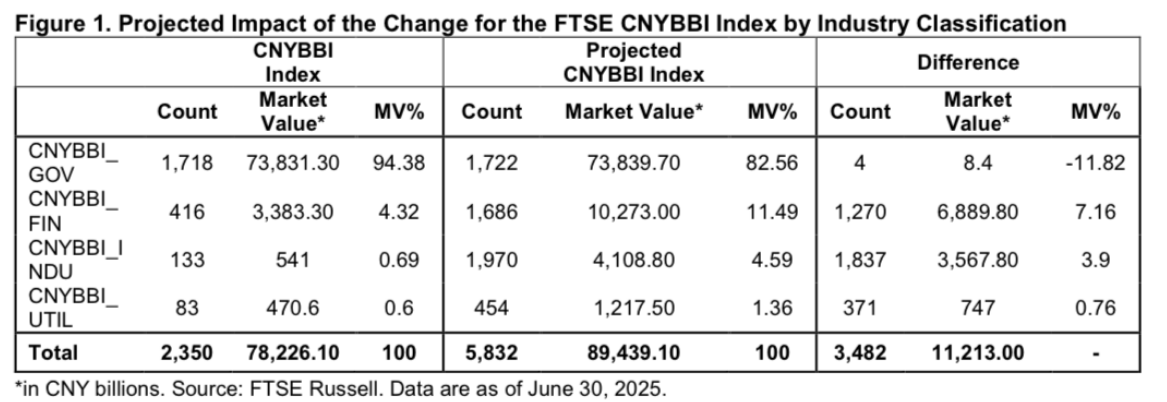
富时中国人民币在岸债券指数迎扩容 纳入标准修订有望吸引超三千只新券
Xin Hua Cai Jing· 2025-10-23 06:56
新华财经23日获悉,富时罗素(FTSE-Russell)消息称,更新其旗舰指数——富时中国人民币在岸债券指数(CNYBBI)的纳入标准,并进行多项重要调 整,扩大合格证券的范围,提升指数的市场代表性与覆盖深度,为投资者提供更全面的在岸债券市场视角。 我国债券市场持续发展,已成为全球第二大债券市场。随着市场透明度和流动性不断提升,投资者对更全面、精准的固收市场投资工具需求也在不断增长。 整体来看,此次修订提升了指数的广度与深度,为全球投资者提供了更具代表性的在岸债券市场工具。随着我国债市的持续发展,指数的调整将更好地反映 市场结构变化与投资需求。 (文章来源:新华财经) 富时罗素还提及,修订实施后,预计将有3482只市值为11.21万亿元人民币的证券进入该指数,截至2025年6月30日,按市值加权计算占该指数的12.5%。 | | CNYBBI | | | | Projected | | | Difference | | | --- | --- | --- | --- | --- | --- | --- | --- | --- | --- | | | Index | | | | CNYBBl Index | | ...
博时基金2025年第四季度宏观策略报告:A股震荡上行,结构上建议均衡配置
Xin Lang Ji Jin· 2025-10-23 06:17
Market Overview - In Q3 2025, both domestic and international equity markets experienced overall growth, with notable increases in the ChiNext and STAR Market indices in China, and the Nasdaq and S&P 500 indices overseas [2] - The A-share market saw significant leadership from the technology TMT and advanced manufacturing sectors, with respective increases of 37.2% and 27.1% [2] - The trading logic for the market is influenced by reduced policy disturbances from the US government, alleviated growth and inflation concerns, and a favorable liquidity environment [2] Macro Analysis - The US economy is expected to grow by 1.8% in 2025, a decline from the previous three-year average of nearly 3%, but still away from recession [3] - The Federal Reserve's recent interest rate cuts are anticipated to improve financial conditions, supporting a narrative of economic resilience [4] - Domestic demand in China has weakened, with industrial output growth slowing and retail sales growth declining to 3.4% year-on-year by August [5] Asset Analysis - Bond yields have risen significantly in Q3, driven by pressures on the liability side, with long-term rates increasing more than short-term rates [8] - The bond market is expected to return to being driven by economic fundamentals after the release of liability pressures [8] - The current environment suggests a focus on mid-to-short-term high-yield bonds, while long-term opportunities remain uncertain [10] A-share Market - The A-share market has shown a strong upward trend, with the core focus on technology TMT and advanced manufacturing sectors [12] - By the end of Q3, the valuation metrics for the A-share market indicated a high level, with the PE ratio exceeding the three-year average by two standard deviations [12] - Profit expectations for Q4 are under pressure due to high base effects from the previous year [12] Currency and Policy Environment - The RMB has maintained a strong position in Q3, with expectations for continued strength influenced by domestic monetary policy adjustments [13] - The external liquidity environment is favorable for domestic equity markets, although potential volatility remains due to changes in high-risk preference funding [14] Investment Strategy - The investment strategy suggests an overweight in equities and a standard allocation to bonds, focusing on sectors with high growth potential such as AI and semiconductors [16] - The strategy emphasizes a balanced approach in asset allocation, particularly in light of the upcoming "15th Five-Year Plan" and the implications of recent quarterly reports [18] - The focus should remain on high-growth sectors while being cautious of potential volatility in previously high-performing areas [18]
科创债ETF国泰(551880)盘中飘红,关注平衡风险与收益的优质配置选择
Sou Hu Cai Jing· 2025-10-23 05:59
Group 1 - The core viewpoint of the article emphasizes the accelerating development of the sci-tech bond market, supported by policies that enhance the bond market's ability to meet the needs of technological innovation [1] - Policies are encouraging long-term funds to increase their allocation to sci-tech bonds, which have longer durations compared to general bonds, aligning better with the duration needs of insurance and other long-term funds [1] - The valuation of sci-tech bonds is inherently higher than that of general bonds due to policy support, indicating potential for credit spread compression [1] Group 2 - The sci-tech bond ETF (551880) is highlighted as a quality allocation choice that balances risk and return, benefiting from high-grade credit bonds to withstand short-term market fluctuations [1] - The ETF also allows investors to share in the long-term development opportunities within the technology innovation sector, supported by ongoing policy incentives [1]
每调买机系列之四:债市调整期的抗跌资产图谱
ZHESHANG SECURITIES· 2025-10-23 05:25
Report Industry Investment Rating No relevant content provided. Core Viewpoints of the Report - The anti - fall asset spectrum during the bond market adjustment period is: Treasury bonds > Certificates of deposit > Urban investment bonds > Bank perpetual bonds > Bank secondary capital bonds. Low - grade urban investment bonds sometimes show resilience beyond their credit ratings in liquidity - driven adjustments, and investors can return to the coupon strategy under liquidity pressure [1]. Summary According to Relevant Catalogs 1. Bond Market Adjustment Review and Core Driving Factors - The bond market generally shows a characteristic of "long bull and short bear". In recent years, the bond market yield has been oscillating downward, but there have been several sharp market drops. Since 2020, the bond market has experienced six significant adjustments. Except for the large - scale and long - lasting adjustment in 2020, during the other five adjustments, the adjustment range of the 10Y Treasury bond yield was generally concentrated between 10 - 30bp, and the adjustment duration was concentrated between 10 - 30 days [2][13]. - The core driving factors of the six adjustments can be summarized into three categories: - Monetary policy and liquidity drive (e.g., May 2020, August 2023, February 2025): Central bank actively tightens or marginally tightens liquidity, rapid increase in capital interest rates, or supply shocks and credit events leading to liquidity stratification. Short - term interest rates usually rise more than long - term ones, and the yield curve flattens bearishly [17]. - Economic growth and inflation expectation drive (e.g., February 2022): Macro - economic data such as PMI and credit are better than expected, or there is significant inflation pressure (PPI, CPI). The market forms a solid consensus of "fundamental improvement", which is the core signal of the bull - to - bear transition. Long - term interest rates rise more significantly, and the term spread may widen [27]. - Policy drive (e.g., September 2024): Caused by major policies such as real estate and epidemic prevention or external events such as trade tariffs, the market's economic expectation for the future changes fundamentally, and funds flow from safe - haven assets to risk assets [28]. 2. Anti - fall Asset Selection Matrix under Different Driving Factors - Credit bonds are afraid of liability - side shocks, and interest - rate bonds are afraid of fundamental repair expectations. When institutional behavior dominates, interest - rate bonds are more anti - fall; when fundamental repair expectations dominate, credit bonds are relatively more anti - fall [29]. - **Monetary policy and liquidity drive (e.g., August 2023, February 2025)**: The anti - fall degree of various assets (the smaller the yield increase, the more anti - fall) is: Low - grade urban investment bonds (short - term) > Treasury bonds (medium - long - term) > Certificates of deposit ≈ High - grade urban investment bonds (short - term) > Perpetual and secondary capital bonds (all terms). Under liquidity shocks, low - grade urban investment bonds and interest - rate bonds, especially medium - long - term Treasury bonds, are the most anti - fall. Certificates of deposit have a medium adjustment range as they are directly affected by capital interest rates. Perpetual and secondary capital bonds have the most severe adjustment and are the most vulnerable due to their duration and liquidity premium risks [3][29]. - **Multiple factors such as policy drive + economic growth and inflation expectation (e.g., August 2022, September 2024)**: The anti - fall degree of assets is: Treasury bonds (short - term) > Certificates of deposit > Treasury bonds (medium - long - term) > High - grade perpetual/urban investment bonds > Low - grade perpetual bonds > Low - grade urban investment bonds. Short - term Treasury bonds and certificates of deposit are relatively insensitive to changes in risk appetite. Long - term interest - rate bonds are significantly adjusted due to improved fundamental expectations. Credit bonds, especially low - grade ones, have the largest adjustment range, and funds flow from low - grade credit bonds to risk assets such as equities. Overall, Treasury bonds > Certificates of deposit > Urban investment bonds > Bank perpetual bonds > Bank secondary capital bonds. Low - grade urban investment bonds can attract some investors to adopt the coupon strategy in the liquidity pressure stage due to their relatively high coupon income, thus showing better anti - fall characteristics than high - grade credit bonds in some periods [4][30]. 3. Summary of Common Characteristics of Anti - fall Assets and Investment Suggestions - Assets with strong anti - fall ability generally have higher liquidity, lower duration risk, and stronger safe - haven attributes. The anti - fall ability of low - grade urban investment bonds partly comes from their "high coupon" feature. In periods of high volatility and uncertainty, some investors turn to the "coupon strategy" [37]. - **Investment suggestions**: - Predict the decline space based on driving factors. Find 1 - 2 adjustments with the most similar driving factors, macro - environment, and market structure from historical reviews as a "reference". When expecting liquidity tightening or institutional behavior shocks, significantly shorten the portfolio duration and increase the allocation of certificates of deposit [39]. - Choose to take profits in time based on odds factors. The assets with the largest adjustment in a sharp bond market decline are often those that were over - bought due to crowded trading, such as short - term interest - rate bonds from January to February this year [39]. - Build a "core - satellite" asset portfolio: Use interest - rate bonds and certificates of deposit as the core ballast to provide anti - fall ability during bond market adjustments, and use perpetual and secondary capital bonds and urban investment bonds to seek higher coupons and excess returns [39]. - Use perpetual and secondary capital bonds as the "reverse indicator" of the market: They are both a signal of market over - optimism and risk accumulation when their spreads narrow significantly and trading is crowded, and an early indicator of market adjustment, suggesting reducing risk assets and switching to a defensive mode [39]. - Use the low - grade urban investment bond coupon strategy as a buffer for fluctuations: In the stage of rising market volatility without systematic credit risk, carefully select short - to - medium - term low - grade urban investment bonds with reliable cash flows, and adopt the "buy and hold to maturity" strategy to obtain high coupons. In the current market environment where the downward space of interest rates is limited and volatility is increasing, the allocation value of the coupon strategy is prominent [40].
美国国债:收益率全线收低,20年期标售表现强劲
Sou Hu Cai Jing· 2025-10-22 23:25
本文由 AI 算法生成,仅作参考,不涉投资建议,使用风险自担 【美国国债收益率全线小幅收低,受多因素影响】130亿美元20年期美债续发获强劲需求,支撑美债走 高,收益率全线小幅收低。美国时段午后,短端和中端品种延续涨势,利差略微趋陡,走势还受5年期 美债期货大宗买盘提振。 纽约时间下午3点刚过,美债收益率全线下行1.5至1个基点,短端和中端领 涨,2s10s和5s30s利差日内略微趋陡。 20年期国债标售表现强劲,中标收益率较发行前交易水平低1.2 个基点,助美债维持小涨。交易商获配比例为10%,间接投标人获配63.6%,直接投标人获配26.3%。 美元互换利差在美国时段早盘扩大,并收于日内高点。此前有报道称,美联储向其他监管机构展示修订 版计划,放宽对华尔街大型银行的资本金提案。 美债期权有多笔交易受关注,包括12月10年期美债跨 式期权大额买盘,权利金约2200万美元,以及11月10年期美债看跌期权大额买盘。 截至美东时间下午 04:39,美国2年期国债收益率下跌1.06个基点,报3.4445%;5年期国债收益率下跌1.05个基点,报 3.5533%。 美国10年期国债收益率下跌1.15个基点,报3.95 ...
实体经济获精准高效融资支持
Zheng Quan Ri Bao· 2025-10-22 22:54
Core Viewpoint - The transfer of corporate bond issuance responsibilities to the Shanghai, Shenzhen, and Beijing stock exchanges has significantly improved financing support for the real economy, with a total of 82 companies issuing 123 corporate bonds and raising 89.398 billion yuan over the past two years [1][2]. Group 1: Market Development and Reforms - The corporate bond issuance responsibilities were officially transferred to the stock exchanges in October 2023, marking the beginning of a systematic reform aimed at addressing long-standing structural issues in the market [2]. - Regulatory authorities have unified the review standards for corporate and enterprise bonds, enhancing information disclosure requirements focused on repayment capacity [3][4]. - The reform has led to a significant increase in the efficiency of corporate bond issuance, with AAA-rated issuers rising from 43.1% to 47.1% over the past year [6]. Group 2: Innovation and Risk Management - The market has seen a diversification of bond types, with innovative products such as green bonds and bonds supporting small and micro enterprises being introduced, aligning with national strategic goals [6][7]. - Risk management capabilities have improved, with the proportion of bonds with a maturity of five years or less increasing from 29.4% to 32.8%, thereby reducing maturity mismatch risks [7]. Group 3: Synergy and Financing Efficiency - Corporate bonds have evolved from a single financing tool to a key driver of high-quality development in the bond market, enhancing the overall market ecosystem [8]. - The integration of corporate bonds with equity financing has optimized the financing structure for companies, with 19.51% of the issuing companies being A-share listed [8][9]. - The ongoing reforms are expected to further enhance the collaborative advantages of the corporate bond market, providing more precise and efficient financing support for the real economy [9][10].
企业债券发审职责划转两周年:实体经济获精准高效融资支持
Zheng Quan Ri Bao· 2025-10-22 17:09
Core Insights - The corporate bond issuance responsibilities have been successfully transitioned to the Shanghai, Shenzhen, and Beijing stock exchanges for two years, resulting in 82 companies issuing 123 corporate bonds and raising a total of 89.398 billion yuan, primarily benefiting key sectors like transportation, construction, and power generation [1][2] Group 1: Regulatory and Structural Reforms - The transition of corporate bond issuance responsibilities aims to address historical regulatory fragmentation, enhancing the efficiency of the bond market and reducing financing costs for market participants [2] - Regulatory bodies have strengthened information disclosure requirements focusing on repayment capacity, optimizing the entire review and registration process to support the healthy development of the corporate bond market [3][4] Group 2: Market Dynamics and Innovations - The corporate bond market has seen an increase in the quality of issuers, with AAA-rated issuers rising from 43.1% to 47.1% over the past year, while the proportion of non-local government financing bonds has decreased from 51.14% to 36.59% [5] - Innovative bond types have emerged, including green bonds and bonds supporting small and micro enterprises, aligning with national strategic goals and enhancing financing options for various sectors [6] Group 3: Risk Management and Resilience - The corporate bond market has improved its risk management capabilities, with short-term bonds (5 years or less) increasing from 29.4% to 32.8%, thereby better matching cash flow recovery cycles and reducing maturity mismatch risks [6] - The proportion of bonds with early repayment clauses has decreased from 39.53% to 35.77%, enhancing the stability of bond durations [6] Group 4: Synergy and Direct Financing - The corporate bond market has evolved into a vital component of the broader bond market, facilitating high-quality development and enhancing the synergy between equity and debt financing [8][9] - Among the 82 companies that issued corporate bonds, 16 are A-share listed companies, indicating a trend towards optimizing financing structures through a combination of equity and debt [8] Group 5: Future Directions - To further enhance the corporate bond market's support for new productive forces, there is a need to diversify issuer and investor types, improve information disclosure, and develop market-oriented exit mechanisms [7][10]