
纺织服装

Search documents
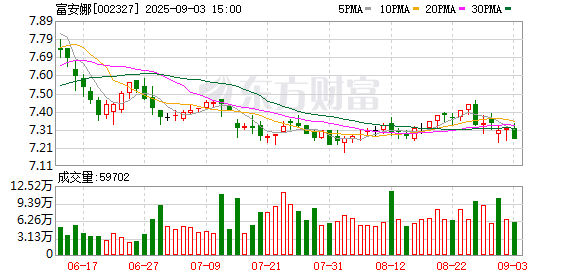
富安娜:累计回购公司股份5664855股
Zheng Quan Ri Bao· 2025-09-03 07:11
(文章来源:证券日报) 证券日报网讯 9月2日晚间,富安娜发布公告称,截至2025年8月31日,公司通过回购专用证券账户以集 中竞价交易方式累计回购股份数量为5,664,855股,占公司总股本的0.6758%,最高成交价为7.41元/ 股,最低成交价为7.26元/股,成交总金额为人民币41,560,691.24元(不含交易费用)。 ...


南山智尚:公司在印度尼西亚的生产基地选址位于宾坦岛,目前该基地正处于建设阶段
Mei Ri Jing Ji Xin Wen· 2025-09-03 00:30
Group 1 - The company has confirmed that its production base in Indonesia is located on Bintan Island, which is far from risk areas, ensuring geographical safety and stability [2] - The construction of the production base is currently underway, and some Chinese technical and operational personnel have already been dispatched to the local area to support the project [2] - The company will provide further updates on the progress and specific plans for the Indonesian production base through regular reports and subsequent announcements [2]
月度前瞻 | 8月经济:“景气”分水岭?(申万宏观·赵伟团队)
赵伟宏观探索· 2025-09-02 16:36
Demand - External demand is expected to be better than internal demand in the short term, with August exports projected to maintain resilience at around 5.1% despite some downward pressure due to "transshipment tariffs" and "reciprocal tariffs" [2][11][100] - Internal demand shows signs of weakness, primarily due to limited use of subsidy funds, with retail sales expected to grow by 4.4% year-on-year in August [2][26][100] - Service consumption and investment are performing relatively well, driven by high travel activity and increased private investment in the service sector, with overall investment growth expected to remain stable at 1.6% [3][11][100] Supply - Production remains robust, with the manufacturing PMI rising to 49.4% in August, indicating continued high production levels, particularly in export-oriented sectors [4][43][100] - Industries with high external demand dependency, such as textiles and specialized equipment, are experiencing significant production index increases, while sectors like agriculture and automotive are lagging [4][50][100] - Industrial output is projected to grow by 5.8% year-on-year in August, supported by strong performance in the "export chain" [5][55][100] Inflation - PPI is expected to show improvement due to rising commodity prices and low base effects, with the main raw material purchase price index increasing by 1.8% to 53.3% [6][64][100] - CPI is anticipated to decline further, influenced by weak food prices and low downstream PPI, with an expected year-on-year drop of 0.4% in August [8][80][100] Outlook - The economic narrative for August centers around "resilient external demand and weak internal demand," with a focus on the effectiveness of incremental policies and the recovery of internal demand [9][91][100] - Overall, nominal GDP is projected to grow by 3.6% and real GDP by 4.8% year-on-year in August [9][91][100]

“月度前瞻”系列专题之二-8月经济:“景气”分水岭?-20250902
Shenwan Hongyuan Securities· 2025-09-02 11:55
Demand - External demand is expected to perform better than internal demand, with August exports projected to decline by 5.1% due to high base effects and tariff impacts, but the pressure is manageable due to improved external demand and market share gains[1][12] - Domestic consumption and manufacturing investment are expected to weaken, with retail sales projected to grow by only 4.4% year-on-year in August, influenced by limited use of subsidy funds[1][24] Supply - The manufacturing PMI rose by 0.1 percentage points to 49.4% in August, indicating sustained production activity, particularly in export-oriented sectors[3][42] - Industrial output is expected to grow by 5.8% year-on-year in August, supported by resilient indicators in the export chain, such as a 3.8 percentage point increase in high furnace operation rates[4][51] Inflation - The Producer Price Index (PPI) is expected to show limited year-on-year improvement of -2.9% in August, despite rising commodity prices, due to low capacity utilization in mid and downstream sectors[5][64] - The Consumer Price Index (CPI) is projected to decline by 0.4% year-on-year in August, driven by weak food prices and a high youth unemployment rate affecting rental prices[6][68]
维珍妮附属重续肇庆市物业租赁协议
Zhi Tong Cai Jing· 2025-09-02 10:50
Core Viewpoint - Virginie (02199) announced a new property leasing agreement due to the expiration of the current lease for its smart residential units in 2024, which will end on September 30, 2025 [1] Group 1: Leasing Agreement Details - Virginie Smart Living, a wholly-owned subsidiary, signed a new leasing agreement with Virginie Investment Properties on September 2, 2025 [1] - The new lease will be effective from October 1, 2025, to September 30, 2026, for a duration of one year [1] - The monthly rent for the property is set at RMB 210,900, equivalent to approximately HKD 229,900 [1] Group 2: Property Specifications - The leased property consists of 128 apartment units located at No. 8 Yanyang Avenue, Zhaoqing New District, Zhaoqing City, Guangdong Province, China [1] - The total construction area of the property is approximately 14,061 square meters [1]
月度前瞻 | 8月经济:“景气”分水岭?(申万宏观·赵伟团队)
申万宏源宏观· 2025-09-02 10:15
Group 1: Demand - External demand is expected to be better than internal demand in the short term, with August exports projected to maintain resilience at 5.1% despite potential pressures from "transshipment tariffs" and "reciprocal tariffs" [2][11][100] - Internal demand shows signs of weakness, primarily due to limited use of subsidy funds, with retail sales expected to grow by only 4.4% in August [2][26][100] - Service consumption and investment are performing relatively well, driven by high travel activity and increased private investment in the service sector, with overall investment growth expected to remain stable at 1.6% [3][11][100] Group 2: Supply - Production remains robust, with the manufacturing PMI rising to 49.4% in August, indicating continued production activity despite some constraints from "anti-involution" policies [4][43][100] - Industries with high external demand dependency, such as textiles and specialized equipment, are experiencing higher production indices, while sectors like agriculture and automotive are lagging [4][50][100] - Industrial output is projected to grow by 5.8% year-on-year in August, supported by strong performance in the export chain [5][55][100] Group 3: Inflation - Expectations of supply contraction and rising commodity prices are likely to support a rebound in the Producer Price Index (PPI), with a projected improvement in PPI year-on-year [6][64][100] - The Consumer Price Index (CPI) is expected to decline further due to weak food prices and low downstream PPI, with an anticipated drop of 0.4% year-on-year in August [8][80][100] Group 4: Outlook - The economic outlook for August centers around the resilience of external demand and the weakness of internal demand, with a projected nominal GDP growth of 3.6% and real GDP growth of 4.8% [9][91][100]

“月度前瞻”系列专题之二:8月经济:“景气”分水岭?-20250902
Shenwan Hongyuan Securities· 2025-09-02 10:12
Demand - In August, external demand is expected to outperform internal demand, with exports projected to decline by 5.1% due to high base effects and tariff impacts, but the pressure is manageable due to improving external demand and market share gains[1] - Domestic consumption and manufacturing investment are expected to weaken, with retail sales projected to grow by only 4.4% year-on-year, influenced by limited use of subsidy funds[1][27] - High-frequency indicators show that retail sales of passenger cars and white goods in August increased by only 0.8% and 2.1% year-on-year, respectively[27] Supply - The manufacturing PMI rose by 0.1 percentage points to 49.4% in August, indicating sustained production activity, with the production index increasing by 0.3 percentage points to 50.8%[3][45] - Industries with high external demand, such as textiles and specialized equipment, showed significant production index increases of 23.6 percentage points to 57.1% and 8.6 percentage points to 63.9%, respectively[49] - Industrial added value is expected to grow by 5.8% year-on-year in August, supported by resilient indicators in the export chain[4][54] Inflation - The Producer Price Index (PPI) is expected to show limited year-on-year improvement at -2.9%, despite rising commodity prices and a low base effect, with the main raw material purchase price index increasing by 1.8 percentage points to 53.3%[5][61] - Consumer Price Index (CPI) is projected to decline by 0.4% year-on-year in August, constrained by weak food prices and downstream PPI[6]
富安娜(002327.SZ):已累计回购0.68%股份
Ge Long Hui A P P· 2025-09-02 09:09
格隆汇9月2日丨富安娜(002327.SZ)公布,截至2025年8月31日,公司通过回购专用证券账户以集中竞价 交易方式累计回购股份数量为5,664,855股,占公司总股本的0.6758%,最高成交价为7.41元/股,最低成 交价为7.26元/股,成交总金额为人民币4156.069万元(不含交易费用)。 ...
破发股盛泰集团股东拟减持 A股募12.6亿中信证券保荐
Zhong Guo Jing Ji Wang· 2025-09-02 07:26
Core Viewpoint - Itochu Asia plans to reduce its stake in Sheng Tai Group by up to 3% of the total share capital through both centralized bidding and block trading methods, following a notification issued on September 1, 2025 [1] Group 1: Shareholding and Reduction Plan - As of the announcement date, Itochu Asia holds 116,680,000 shares in Sheng Tai Group, representing 21.00% of the total share capital [1] - The reduction plan allows for a maximum of 5,555,600 shares (1% of total share capital) to be sold through centralized bidding within three months after the announcement, and an additional 11,111,200 shares (2% of total share capital) through block trading [1] Group 2: Company Background and Financials - Sheng Tai Group was listed on the Shanghai Stock Exchange on October 27, 2021, with an initial issuance of 55.56 million shares at a price of 9.97 yuan per share [2] - The total funds raised from the initial public offering amounted to 554 million yuan, with a net amount of 463 million yuan after expenses [2] - The company has also issued convertible bonds in 2022, raising a total of 701.18 million yuan, with a net amount of approximately 683.85 million yuan after deducting issuance costs [3][4]


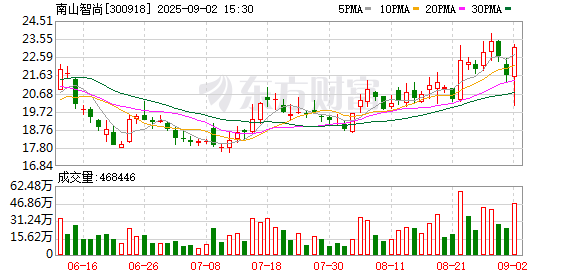
南山智尚股价涨5.09%,鹏华基金旗下1只基金位居十大流通股东,持有293.44万股浮盈赚取322.78万元
Xin Lang Cai Jing· 2025-09-02 07:07
Group 1 - The core viewpoint of the news is that Nanshan Zhishang's stock price increased by 5.09% to 22.72 CNY per share, with a trading volume of 722 million CNY and a turnover rate of 7.86%, resulting in a total market capitalization of 11.499 billion CNY [1] - Nanshan Zhishang, established on April 29, 2007, and listed on December 22, 2020, is primarily engaged in the production and sales of fabrics and clothing, with revenue composition being 50.11% from fine woolen fabrics, 37.84% from clothing, 10.90% from ultra-high fiber, and 1.15% from other sources [1] Group 2 - Among the top ten circulating shareholders of Nanshan Zhishang, Penghua Fund's carbon neutrality theme mixed fund A (016530) reduced its holdings by 14,700 shares in the second quarter, now holding 2.9344 million shares, which is 0.68% of the circulating shares, with an estimated floating profit of approximately 3.2278 million CNY [2] - The Penghua carbon neutrality theme mixed fund A (016530) was established on May 5, 2023, with a latest scale of 2.08 billion CNY, achieving a year-to-date return of 76.11% and ranking 209 out of 8,184 in its category, while its one-year return is 164.2%, ranking 30 out of 7,971 [2]