
钢铁

Search documents
摩洛哥竞争委员会批评摩钢铁行业高度垄断
Shang Wu Bu Wang Zhan· 2026-02-13 07:35
Core Insights - The Moroccan steel industry is highly monopolized, with Riva, Sonasid, and Moroccan Steel (Hadumar) controlling 80%-90% of the market share [1] - The Herfindahl-Hirschman Index (HHI) for the industry has consistently exceeded 2500, indicating a high level of market concentration [1] - Approximately 87% of sales are conducted through a few large distributors, giving them significant bargaining power within the supply chain [1] Cost Structure and Market Vulnerability - The cost structure of the industry is heavily reliant on global raw material and energy prices, with scrap metal accounting for 70%-75% of billet production costs and about 88% of rebar costs [1] - International market fluctuations significantly impact prices, and additional factors such as energy costs, shipping fees, and exchange rate changes exacerbate the transmission of external shocks [1] - Despite protective measures for imports, the domestic market remains vulnerable to international price volatility [1] Recommendations for Industry Resilience - The competition committee suggests enhancing monitoring and regulation of foreign dumping and subsidy practices [1] - It advocates for the restructuring of the domestic scrap metal industry to improve recycling capabilities and market transparency [1] - There is a push to reduce energy dependence by promoting renewable energy applications and liberalizing the electricity market [1] - The industry is encouraged to transition towards high-value-added products and strengthen product quality control and compliance regulation to ensure construction safety and fair market competition [1]
短期经济增长
Guoxin Securities Co., Ltd· 2026-02-13 07:25
Economic Growth - The operating rate of blast furnaces in 247 steel mills nationwide was 79.55%, an increase of 0.53 percentage points from the previous week[1] - The capacity utilization rate of steel mills rose to 85.71%, up by 0.26 percentage points week-on-week[1] - The average daily pig iron output reached 2.2864 million tons, an increase of 0.072 million tons from the previous week[1] Inflation - The average wholesale price index for agricultural products was 129.91, up by 0.36% compared to January's average[2] - The average wholesale price index for the "vegetable basket" was 132.80, reflecting a 0.46% increase from January[2] Interest Rates - The average overnight SHIBOR rate was 1.3192%, down by 0.0514 percentage points from the previous week[3] - The average 1-day repo rate was 1.3963%, decreasing by 0.0684 percentage points week-on-week[3] Policy Developments - The State Council approved the "Modern Capital Metropolitan Area Spatial Coordination Plan (2023-2035)" aimed at establishing a world-class metropolitan area centered around the capital[4] - A joint announcement by the People's Bank of China and eight departments clarified that virtual currency-related activities are illegal and strictly prohibited within the country[4] Risk Factors - Potential geopolitical deterioration beyond expectations poses a risk to economic stability[5] - An unexpected recession in Europe and the U.S. could adversely affect market conditions[5]
钼价格|钼精矿、钼铁、氧化钼最新价格
Xin Lang Cai Jing· 2026-02-13 06:16
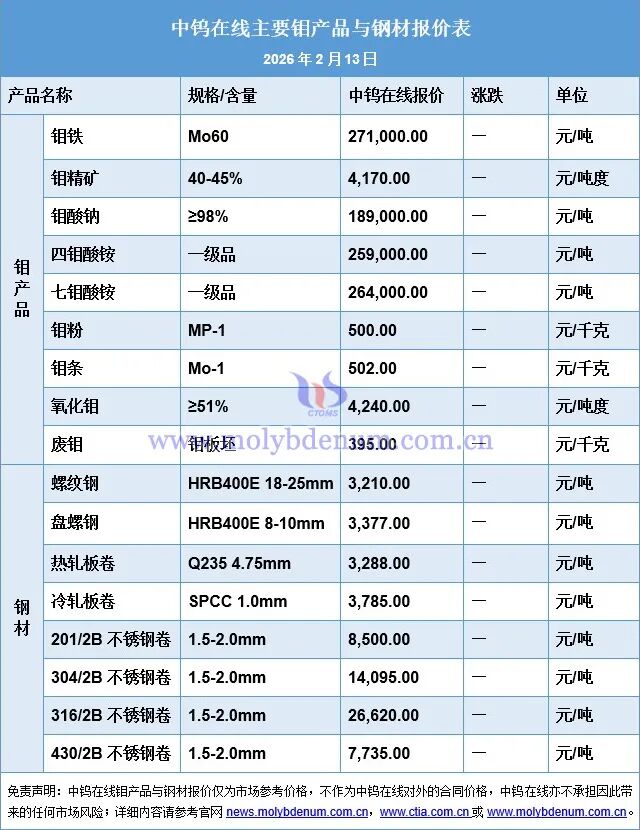
Group 1: Molybdenum Market Overview - The domestic molybdenum market is maintaining a stable operation, with many traders entering vacation mode as the Spring Festival approaches, leading to reduced market participation and no significant price fluctuations [5][6] - Current prices for molybdenum concentrate, molybdenum iron, and molybdenum oxide are approximately 4,170 yuan/ton, 271,000 yuan/ton, and 4,240 yuan/ton respectively [5][6] Group 2: Steel Production Data - In late January 2026, key steel enterprises produced a total of 21.3 million tons of steel, with an average daily output of 1.936 million tons, reflecting a month-on-month increase of 3.2% [2][6] - Regional production increases include 19,000 tons in Northeast China, 23,000 tons in North China, 19,000 tons in East China, and 6,000 tons in Central South China, while Northwest and Southwest China saw decreases of 5,000 tons and 3,000 tons respectively [2][6]

华菱钢铁股价跌5.01%,中欧基金旗下1只基金重仓,持有184.54万股浮亏损失57.21万元
Xin Lang Ji Jin· 2026-02-13 06:13
Group 1 - Hunan Hualing Steel's stock price dropped by 5.01% to 5.88 CNY per share, with a trading volume of 381 million CNY and a turnover rate of 0.92%, resulting in a total market capitalization of 40.623 billion CNY [1] - The company, established on April 29, 1999, and listed on August 3, 1999, is located in Changsha, Hunan Province, and primarily engages in the production and sales of steel products [1] - The revenue composition of Hunan Hualing Steel includes: 46.31% from sheet products, 25.15% from other businesses and products, 19.28% from long products, and 9.26% from steel pipes [1] Group 2 - One fund under China Europe Fund holds a significant position in Hunan Hualing Steel, with the China Europe Ruihong Regular Open Mixed Fund (004848) holding 1.8454 million shares, accounting for 2.35% of the fund's net value, ranking as the ninth largest holding [2] - The estimated floating loss for the fund today is approximately 572,100 CNY [2] - The China Europe Ruihong Regular Open Mixed Fund was established on November 24, 2017, with a current size of 441 million CNY, and has achieved a year-to-date return of 2.75%, ranking 4880 out of 9022 in its category [2]

商务预报:2月2日-8日国内重要生产资料价格情况
Shang Wu Bu Wang Zhan· 2026-02-13 06:07
Core Insights - The article provides a detailed overview of the price trends for various commodities, highlighting both month-on-month and year-on-year changes in prices [1] Price Trends - Thermal coal (calorific value 5000-5500 kcal) is priced at 776 yuan/ton, showing a slight decrease of 0.1% month-on-month and a more significant decline of 5.1% year-on-year [1] - No. 2 smokeless block coal is priced at 1134 yuan/ton, with a month-on-month decrease of 0.4% and a year-on-year decrease of 9.8% [1] - Diesel (0) is priced at 6953 yuan/ton, reflecting a month-on-month increase of 1.0% but a year-on-year decrease of 13.2% [1] - Gasoline (92) is priced at 8385 yuan/ton, with a month-on-month increase of 1.7% and a year-on-year decrease of 12.0% [1] - Rebar (Φ16-25mm) is priced at 3350 yuan/ton, showing a month-on-month decrease of 0.3% and a year-on-year decrease of 7.6% [1] - High-speed wire rod (Φ6.5mm) is priced at 3551 yuan/ton, with a month-on-month decrease of 0.1% and a year-on-year decrease of 6.6% [1]
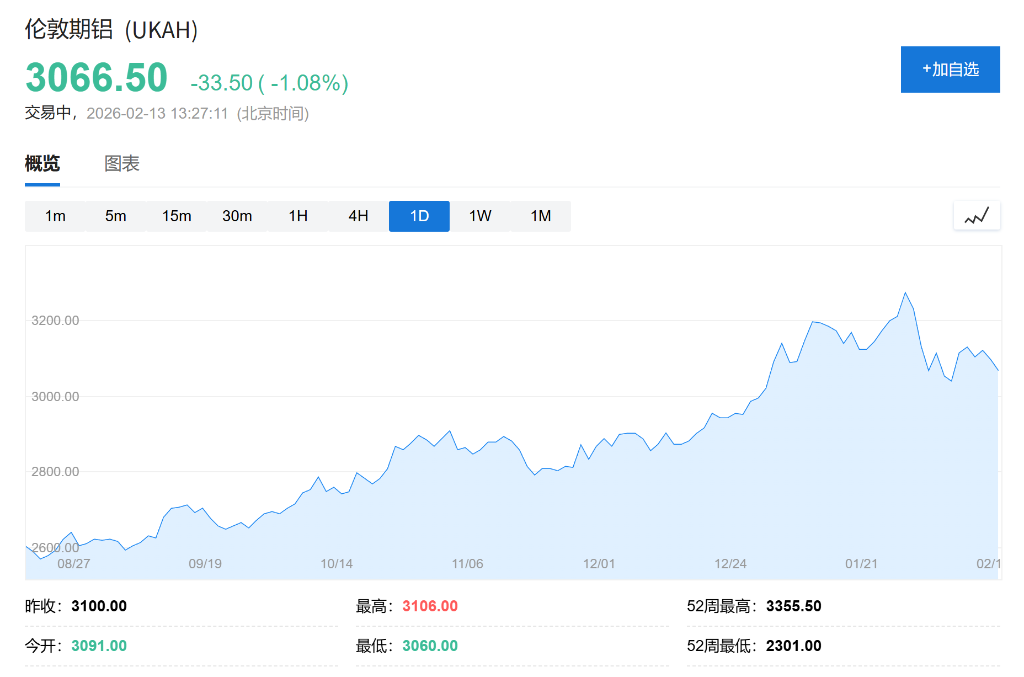
伦铝跳水!报道:美国考虑部分取消铝和钢铁关税
Hua Er Jie Jian Wen· 2026-02-13 05:59
Group 1 - The Trump administration is planning to reduce tariffs on steel and aluminum products to address rising inflation and improve voter support ahead of the midterm elections [1] - The government is reviewing the list of products affected by tariffs and plans to exempt certain items while stopping the expansion of the tariff scope [1] - The adjustment reflects a softening of the Trump administration's trade stance, which previously imposed tariffs as high as 50% on steel and aluminum imports [1] Group 2 - The adjustment comes amid a growing "affordability crisis" in the U.S., with over 70% of American adults rating the economy as "fair" or "poor" [5] - Republican lawmakers are facing tough elections, and concerns over the impact of tariffs on small businesses and consumers have become a focal point [5] - The complexity of the current tariff system has led to calls for simplification, as the existing mechanism is seen as difficult to enforce [6] Group 3 - The misuse of national security claims for imposing tariffs has sparked controversy, with companies requesting tariffs on various foreign goods under this pretext [7] - The policy adjustment aims to bring clarity to the complex lobbying process in Washington, potentially benefiting exporters from countries like the UK, Mexico, Canada, and EU member states [7]
铁矿石库存周度数据-20260213
Guan Tong Qi Huo· 2026-02-13 05:45
下游盈利 港口总库存 日均疏港量 钢厂进口矿库存 钢厂进口矿日耗 到港量 内矿铁精粉产量 日均铁水产量 钢厂开工率 产能利用率 钢厂盈利率 本期 16946.32 351.19 10703.93 285.54 2361.3 38.81 230.49 80.13 86.41 38.53 5.00 上期 17140.71 341.08 10316.64 282.24 2484.7 38.81 228.58 79.53 85.69 39.39 3.50 周变动 -194.39 10.11 387.29 3.30 -123.40 0.00 1.91 0.60 0.72 -0.86 1.50 粗粉 块矿 球团 精粉 贸易矿 巴西矿 澳大利亚矿 本期 13022.43 1950.58 380.76 1592.55 本期 11165.93 5423.87 7881.48 上期 13023.75 2100.22 398.21 1618.53 上期 11316.72 5536.43 7903.27 周变动 -1.32 -149.64 -17.45 -25.98 周变动 -150.79 -112.56 -21.79 注:数据来源 ...
特朗普又要TACO:拟削减部分钢铁铝制品关税!
Jin Shi Shu Ju· 2026-02-13 05:33
Group 1 - The Trump administration is planning to reduce certain tariffs on steel and aluminum products to address the rising cost of living for American citizens, which has negatively impacted his approval ratings ahead of the midterm elections [1] - The tariffs, which were previously raised to as high as 50% on steel and aluminum imports, have been criticized for increasing prices on consumer goods, including food and beverage cans [1][2] - A recent Pew Research Center poll indicates that over 70% of American adults view the economy as average or poor, with about 52% believing Trump's economic policies have worsened the situation [1] Group 2 - The softening of steel and aluminum tariffs is one of the earliest policies introduced in Trump's second term, with economists noting that the costs of tariffs are being borne by American citizens, undermining Trump's claim that foreign companies would pay for them [2] - Trump's trade policies have faced political backlash, including opposition from both Republican and Democratic lawmakers regarding tariffs on Canada, which may set the stage for further votes against his economic policies [3] - Several Republican lawmakers are facing tough re-election campaigns due to voter concerns about the impact of tariffs on small businesses and consumers, prompting the adjustment of metal tariffs to simplify the increasingly complex lobbying process in Washington [4] Group 3 - The current tariff system has been described as overly complex and difficult to enforce, indicating a need for simplification [6] - Countries such as the UK, Mexico, Canada, and EU member states may benefit from the relaxation of U.S. tariffs on steel and aluminum products, as discrepancies in tax rates have been reported by companies exporting to the U.S. [7] - Numerous applications from U.S. companies have sought additional tariffs on foreign products, often framing them as national security risks, highlighting the extent to which businesses are leveraging this narrative [8]
午评:沪指跌0.7% 军工装备板块涨幅居前
Zhong Guo Jing Ji Wang· 2026-02-13 04:26
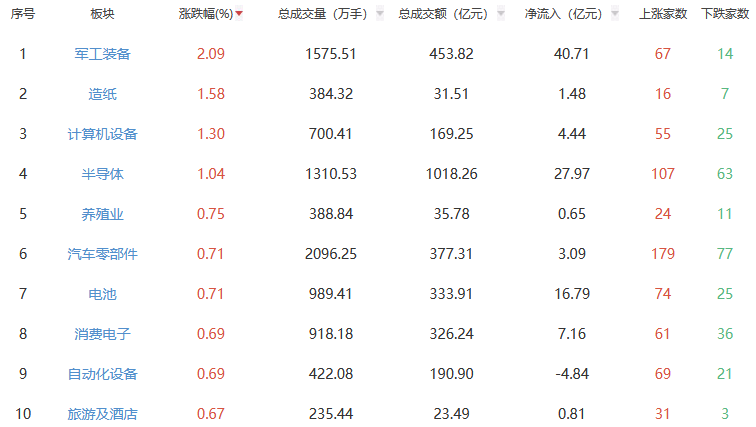
Core Viewpoint - The A-share market experienced a collective decline in the morning session, with the Shanghai Composite Index down by 0.70%, the Shenzhen Component Index down by 0.67%, and the ChiNext Index down by 0.96% [1] Industry Performance - The military equipment sector led the gains with an increase of 2.09%, followed by the paper industry at 1.58%, and computer equipment at 1.30% [2] - Other sectors that showed positive performance include the breeding industry (0.75%), automotive parts (0.71%), and battery (0.71%) [2] Declining Sectors - The oil and gas extraction and services sector saw the largest decline at -2.15%, followed by photovoltaic equipment at -1.95%, and small metals also at -1.95% [2] - Additional sectors with notable declines include port shipping (-1.88%), steel (-1.88%), and communication equipment (-1.35%) [2]
午评:创业板指跌近1%,石油、电力等板块走低,军工板块上扬
Sou Hu Cai Jing· 2026-02-13 04:14
Market Overview - The three major stock indices experienced a downward trend, with the Shanghai Composite Index testing the 4100-point support level and the ChiNext Index declining nearly 1% [1] - As of the midday close, the Shanghai Composite Index fell by 0.7% to 4105.04 points, the Shenzhen Component Index decreased by 0.67%, and the ChiNext Index dropped by 0.96%, while the Northbound 50 Index rose by 0.86% [1] - The total trading volume across the Shanghai, Shenzhen, and Northbound markets was approximately 1.21 trillion yuan [1] Sector Performance - Sectors such as oil, building materials, steel, insurance, electricity, and non-ferrous metals saw declines, while military, semiconductor sectors, storage chips, photolithography machines, and military trade concepts were active [1] Investor Sentiment - Dongguan Securities noted that with the Spring Festival approaching, investor sentiment is becoming more cautious, leading to a decrease in trading activity and a potential phase of consolidation with reduced volume [1] - Short-term vigilance is advised regarding possible market fluctuations and profit-taking pressures [1] - Investors are encouraged to maintain rationality, avoid blind chasing of highs or panic selling, and manage positions with a balanced allocation strategy [1] - Focus should be on core assets with solid fundamentals and high profit certainty, as well as growth sectors experiencing improved conditions [1]
