医药生物

Search documents
主动权益基金规模回升 三季度大举增持AI算力板块
Shen Zhen Shang Bao· 2025-11-03 00:54
近日,公募基金三季报落下帷幕,主动权益基金的动向也浮出水面。天相投顾数据显示,截至三季度 末,主动权益基金的规模为40708.02亿元,较二季度末增长逾6000亿元。 从权益仓位角度来看,三季度末股票基金仓位为90.88%,偏股混合基金仓位为89.09%,灵活配置混合 基金仓位为74.89%;从持仓行业角度看,主动权益基金本季度重仓前十行业持仓占其股票比例合计 82.39%,分别为电子、医药生物、电力设备、食品饮料、汽车、通信、银行、有色金属、家用电器、 国防军工。其中,电子持仓比例为25.60%、医药生物持仓比例为12.33%、电力设备持仓比例为9.68%, 为前三大重仓行业。 从重仓A股角度来看,三季度末主动权益基金重仓股前三名分别为宁德时代、新易盛、中际旭创。从增 减持角度来看,主动权益基金三季度增持市值前五名分别为中际旭创、新易盛、工业富联、宁德时代、 寒武纪,上述个股除了宁德时代外,其余均为AI算力板块个股;减持市值排名前五名分别为美的集 团、顺丰控股、招商银行、格力电器、比亚迪。不难看出,权益基金三季度明显增持科技股。 Wind数据显示,从三季度权益基金投资的科技细分方向来看,半导体为第一大重仓行 ...
【读财报】A股11月逾1600亿元解禁 锐捷网络、创新新材解禁规模居前
Xin Hua Cai Jing· 2025-11-02 23:27
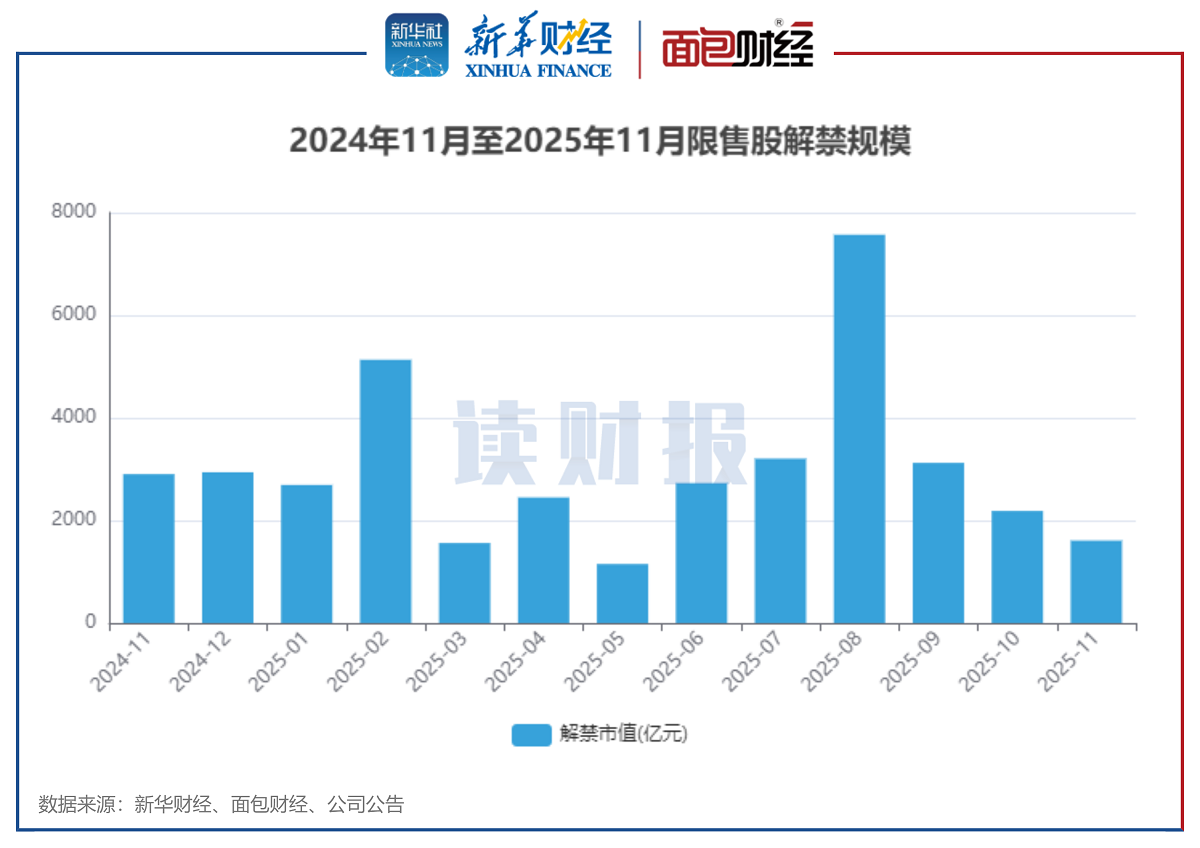
Core Viewpoint - In November 2025, a total of 124 companies in the A-share market will face the unlocking of restricted shares, amounting to approximately 8.952 billion shares with a total market value of 160.677 billion yuan, reflecting a month-on-month decrease of about 26.45% and a year-on-year decrease of about 44.64% [1][2]. Group 1: Unlocking Scale and Key Companies - The largest unlocking scale is attributed to Ruijie Networks, with a market value exceeding 50 billion yuan [1][3]. - The top three companies by unlocking scale are Ruijie Networks, Innovation New Materials, and Huaxia Eye Hospital [3][10]. - Ruijie Networks will have 700 million shares unlocked on November 20, with a market value of approximately 52.78 billion yuan, accounting for 88% of its total share capital [3][4]. Group 2: Industry Distribution - The industries with the highest unlocking market values are telecommunications, biomedicine, and electronics [10]. - In the telecommunications sector, Ruijie Networks significantly contributes to the unlocking scale, while in biomedicine, Huaxia Eye Hospital, New Nobel, and New World lead in unlocking market value [10]. Group 3: Anniversary Unlocking - Seven companies will have 39 million restricted shares unlocked in November, with a total market value of 12.262 billion yuan, including companies like Juxing Technology and Jintian Titanium Industry [1][9]. - Juxing Technology has the largest anniversary unlocking scale at approximately 3.307 billion yuan, followed by Jintian Titanium Industry and Wanyuantong with 3.195 billion yuan and 3.011 billion yuan, respectively [14].


百亿级私募,持仓方向浮现
Shang Hai Zheng Quan Bao· 2025-11-02 23:05
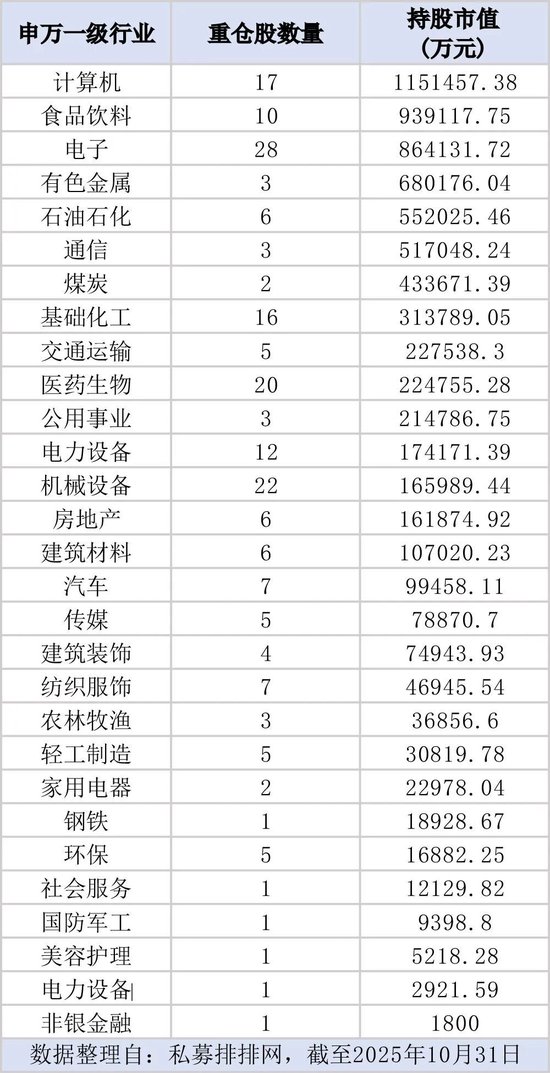
Core Insights - The article highlights the significant investment activities of large private equity firms in the A-share market, with a total holding value of approximately 718.57 billion yuan as of October 31, 2023, across 203 listed companies [2][8] - The focus of these investments is primarily on growth sectors such as technology, healthcare, and consumer goods, indicating a balanced approach between growth and value investments [1][8] Investment Trends - As of the end of Q3, 35 large private equity firms increased their stakes in 18 companies, maintained their holdings in 87 companies, and reduced their stakes in 34 companies, while entering the top ten shareholders of 64 new companies [2][8] - The computer industry emerged as the top sector for these private equity firms, with a total holding value of 1.15 billion yuan across 17 companies [3][8] - Other notable sectors include food and beverage with 939.12 million yuan across 10 companies, and electronics with 864.13 million yuan across 28 companies [3][8] Sector Analysis - The article provides a detailed breakdown of the investment distribution across various sectors, with significant holdings in: - Computer: 1.15 billion yuan [3] - Food and Beverage: 939.12 million yuan [3] - Electronics: 864.13 million yuan [3] - Non-ferrous Metals: 680.18 million yuan [3] - Oil and Petrochemicals: 552.03 million yuan [3] - Communication: 517.05 million yuan [3] - The article also notes that private equity firms are diversifying their investments into sectors like healthcare, building materials, and real estate, reflecting a balanced investment strategy [8][9] Notable Companies - Specific companies mentioned include: - Online and Offline, which saw new investments from 聚鸣投资 with a holding value of 0.66 billion yuan [5][12] - Meishi Technology, which was newly added to the top shareholders list by 聚鸣投资 [6][12] - Zhouming Technology, which received increased investments from 宁泉资产 [7][12] Future Outlook - Analysts suggest that the technology sector will continue to perform well due to ongoing liquidity and rapid development in the tech industry, with particular attention on domestic computing, AI, and new hardware products expected to launch in 2026 [8][9] - The article indicates that structural opportunities in the market are likely to expand, with private equity firms showing interest in sectors such as non-ferrous metals, healthcare, and building materials [8][9]

券商三季度新进206只个股 重点布局有色金属、医药生物板块
Zheng Quan Shi Bao· 2025-11-02 18:05
Core Insights - As of the end of Q3 2025, securities firms have emerged as significant institutional investors in the A-share market, holding a total market value exceeding 66.6 billion yuan across 361 stocks [1][2]. Group 1: Securities Firms' Holdings - A total of 44 securities firms appeared in the top ten shareholders of 361 stocks, collectively holding 5.195 billion shares, corresponding to a market value exceeding 66.6 billion yuan [2]. - The most concentrated sectors for securities firms' holdings are hardware equipment and chemicals, with 41 and 33 stocks respectively, followed by pharmaceuticals and machinery with 26 and 20 stocks [2]. Group 2: New Entrances and Increases - In Q3, securities firms entered the top ten shareholders of 206 new stocks, primarily in the non-ferrous metals, pharmaceuticals, hardware equipment, and chemicals sectors [4]. - Notable new entries include Guotai Junan entering Postal Savings Bank with a holding value of 727 million yuan, and CITIC Securities entering Huayuan Ecology with a holding value of 344 million yuan [4]. Group 3: Increased Holdings - A total of 63 stocks saw increased holdings from securities firms in Q3, with Dongfang Securities increasing its stake in Inner Mongolia Electric Power by 21.94 million shares, resulting in a market value increase of over 88 million yuan [5]. - CITIC Securities increased its holdings in Northeast Securities by 7.86 million shares, leading to a market value increase of 134 million yuan [5]. Group 4: Proprietary Business Performance - Securities firms' proprietary business performance is closely linked to their stock holdings, with Huatai Securities holding the highest number of stocks at 50, followed by CITIC Securities and Guotai Junan with 39 and 36 respectively [6]. - In the first three quarters of the year, the total proprietary business income of listed securities firms reached 186.857 billion yuan, accounting for over 44% of their total revenue [6]. Group 5: Leading Firms in Proprietary Income - CITIC Securities led the proprietary income with 31.603 billion yuan, reflecting a year-on-year growth of approximately 46% [7]. - Guotai Junan ranked second with 20.37 billion yuan in proprietary income, showing a growth of over 90% [7].




中小盘周报:国有“三资”改革大幕拉开,国资并购重组未来已来-20251102
KAIYUAN SECURITIES· 2025-11-02 13:44
Policy Insights - The "Three Assets" reform of state-owned enterprises (SOEs) is expected to initiate a new wave of mergers and acquisitions (M&A) in the state sector, with a focus on asset securitization[3] - Hubei and Anhui provinces are leading the reform efforts, with specific actions planned from September to December 2025 to enhance asset management and debt linkage[3][17] - The core principles of the reform include maximizing the assetization of state resources, securitization of state assets, and leveraging state funds[15] Investment Opportunities - Potential M&A targets include central state-owned enterprises (SOEs) with low asset securitization rates and strong restructuring intentions, particularly in sectors like defense, utilities, and transportation[4][24] - Local SOEs with recent changes in ownership, capital operations, or urgent M&A intentions are also recommended for investment consideration[4][24] Market Performance - The A-share market saw a general increase, with mid-cap indices like the CSI 500 and CSI 1000 outperforming large-cap indices such as the SSE 50 and CSI 300, with respective increases of +1.00% and +1.18%[30] - The lithium battery electrolyte index recorded the highest weekly increase of 17.12%, with top performers including Tianji Co. (+41.86%) and Haike New Source (+39.42%)[30][34] Key Recommendations - Focus on sectors such as smart vehicles and high-end manufacturing, with specific stocks like Hu Guang Co., Rui Hu Mould, and Ao Lai De recommended for their growth potential[6][36] - The report highlights the importance of identifying companies with significant restructuring potential and those that can benefit from the upcoming M&A wave in the state sector[4][24] Risk Factors - Potential risks include changes in macroeconomic conditions, IPO policies, refinancing policies, and M&A regulations that could impact the market dynamics[7]
晓数点|一周个股动向:最牛股已走出8连板,银行、建材行业获主力抢筹
Di Yi Cai Jing· 2025-11-01 11:25
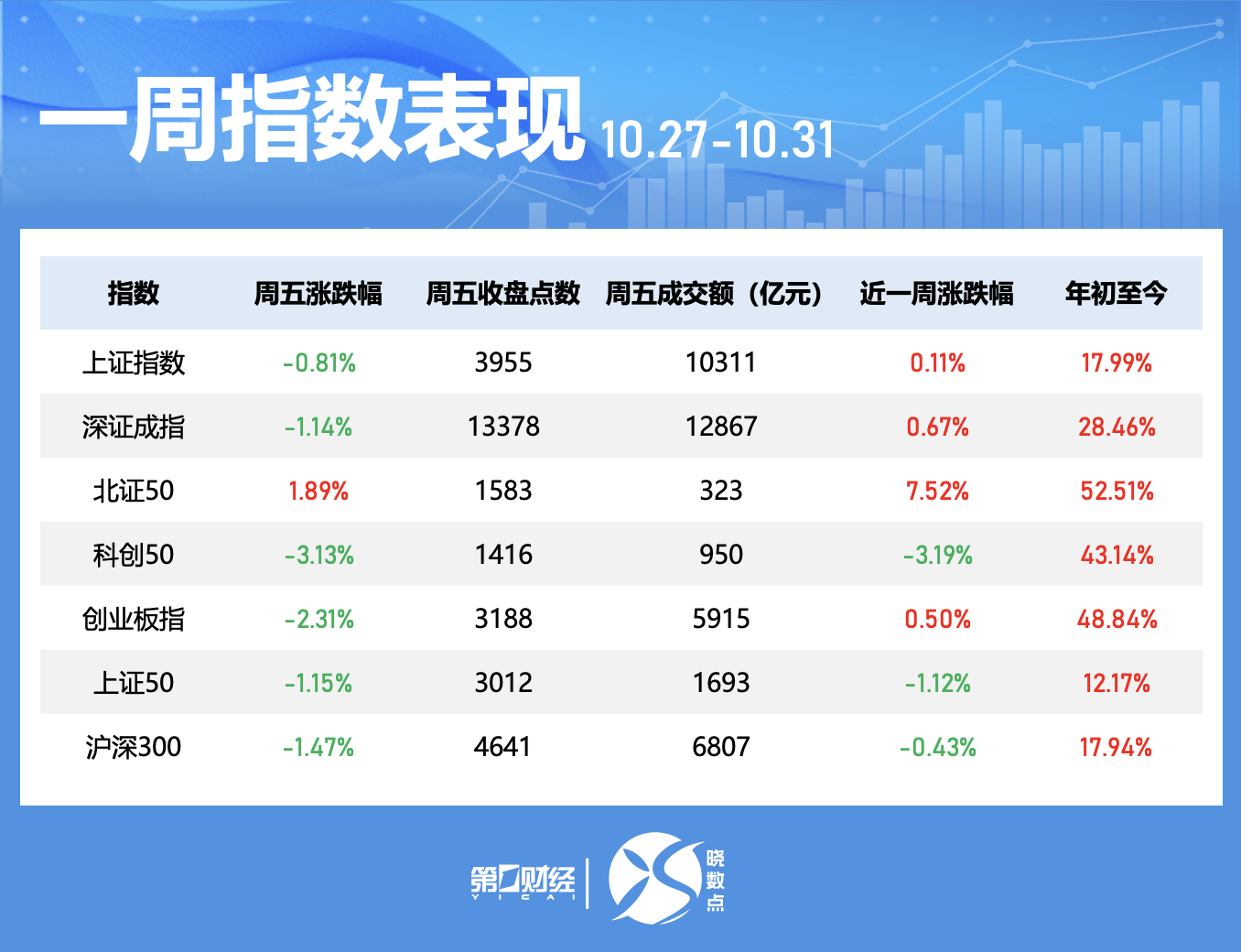
Market Overview - A-shares experienced a rise and subsequent pullback during the week of October 27 to 31, with the Shanghai Composite Index breaking through 4000 points for the first time in 10 years [1] - By the end of the week, the Shanghai Composite Index increased by 0.11%, the Shenzhen Component Index rose by 0.67%, and the ChiNext Index gained 0.5% [1] Sector Performance - Quantum technology concepts led the gains, while sectors such as new energy, cultivated diamonds, and storage chips also showed active performance [1] - The banking and construction materials sectors attracted significant capital inflows, with banks receiving a net inflow of 8.45 billion yuan [8] Stock Performance - A total of 23 stocks saw a rise of over 30%, with Time Space Technology and Strait Innovation both exceeding 60% gains [4] - Conversely, 80 stocks experienced a decline of over 10%, with eight stocks, including Pearl River Piano and Sino Medical, dropping more than 20% [4] Trading Activity - 49 stocks had a turnover rate exceeding 100%, with Chaoying Electronics leading at 279.46% [6] - The electronics, pharmaceutical, and computer sectors dominated the high turnover stocks [6] Institutional Interest - 425 companies were surveyed by institutions, with Union Medical receiving the most attention from 317 institutions [13] - Institutions focused on sectors such as pharmaceuticals, industrial machinery, electronic components, and electrical equipment [13] Financing Activity - A total of 2032 stocks received net financing purchases, with 170 stocks exceeding 100 million yuan in net purchases [11] - Shenghong Technology topped the list with a net purchase of 18.46 billion yuan [12] New Ratings - 87 stocks received initial attention from institutions, with Naxin Micro receiving a "Buy" rating and a target price of 207 yuan [15][16] - Other stocks such as Tengjing Technology and Kingsoft Office also received favorable ratings from various securities firms [16][17]
本周活跃度前十个股名单出炉,49股累计换手率超100%
Di Yi Cai Jing· 2025-11-01 09:28
按照申万一级行业分类看,本周换手率100%以上的个股中,所属电子、医药生物、计算机等行业的个 股居多。 从一周涨跌幅来看,本周换手率超过100%的个股中,海峡创新、先锋新材(维权)、天际股份等本周 累计涨幅居前,均超40%。 本周五个交易日中有49只个股换手率超过100%。其中,超颖电子排名居首,周换手率达到279.46%;此 外,泰凯英、建发致新等7股本周换手率均超200%。 ...
高位科技股带动A股主要指数调整
Zhong Guo Zheng Quan Bao· 2025-11-01 01:54
Market Overview - The A-share market experienced a decline in October, with major indices falling, particularly the ChiNext Index which dropped over 2% [1][2] - The total market turnover for October exceeded 36 trillion yuan, with the Shanghai Composite Index reaching a peak of 4000 points [1][5] - The Shanghai Composite Index rose by 1.85% in October, while the Shenzhen Component and ChiNext Index fell by 1.10% and 1.56% respectively [1][5] Sector Performance - The coal, steel, and non-ferrous metal sectors led the market, with significant gains of 10.02%, 5.16%, and 5.00% respectively [5][6] - The healthcare, media, and retail sectors also performed well, with increases of 2.42%, 2.39%, and 2.08% respectively [3] - Conversely, the communication, electronics, and non-ferrous metal sectors faced declines, with drops of 4.07%, 3.06%, and 2.03% respectively [3] Small-cap Stocks - Small-cap stocks showed strong performance, with the CSI 1000 Index, CSI 2000 Index, and Wind Micro-cap Index rising by 0.29%, 1.05%, and 1.69% respectively [2] - In contrast, large-cap indices such as the SSE 50 and CSI 300 fell by 1.15% and 1.47% respectively, indicating a shift in investor preference towards smaller stocks [2] Financing and Leverage - The leverage sentiment in the A-share market was optimistic, with the margin financing balance increasing by over 10 billion yuan in October [5][6] - As of October 30, the margin financing balance reached 24.81 billion yuan, marking a significant increase in investor confidence [5][6] Future Outlook - Analysts predict that the A-share market will maintain a fluctuating upward trend in November, supported by policy drivers and improvements in external conditions [1][8] - The upcoming release of important economic data is expected to provide clearer direction and expectations for the market [4][8] - The focus for November is anticipated to be on technology self-reliance, modern industrial system construction, and national security capabilities as outlined in the "14th Five-Year Plan" [8]

43只科创板活跃股获主力资金净流入
Zheng Quan Shi Bao Wang· 2025-10-31 15:01
Market Performance - The Sci-Tech 50 Index fell by 3.13%, closing at 1415.53 points, with a total trading volume of 5.229 billion shares and a turnover of 259.796 billion yuan, resulting in an average turnover rate of 2.74% [1] - Among the tradable stocks on the Sci-Tech board, 367 stocks closed higher, with 12 stocks rising over 10%, including Sangfor Technologies and Foxit Software, which hit the daily limit [1] - A total of 220 stocks closed lower, with 5 stocks declining over 10% [1] Turnover Rate Analysis - The turnover rate distribution shows that 3 stocks had a turnover rate exceeding 20%, 22 stocks had a turnover rate between 10% and 20%, and 81 stocks had a turnover rate between 5% and 10% [1] - The stock with the highest turnover rate was C Bait, a new listing, with a turnover rate of 42.39% and a daily trading volume of 6.92 billion yuan, experiencing a decline of 1.92% [1] - C Heyuan, another new listing, had a turnover rate of 37.86%, closing up by 4.79% with a trading volume of 18.98 billion yuan [1] Fund Flow Insights - In the high turnover stocks, 43 stocks saw net inflows of main funds, with C Heyuan, Rongchang Biology, and Maiwei Biology receiving the most significant inflows of 187 million yuan, 136 million yuan, and 126 million yuan, respectively [2] - Conversely, stocks like Lanjit Technology, Western Superconducting, and Huahong Company experienced substantial net outflows of 1.417 billion yuan, 817 million yuan, and 612 million yuan, respectively [2] Leverage Fund Movements - A total of 78 stocks in the high turnover category received net purchases from leveraged funds, with Lanjit Technology, Huahong Company, and Guodun Quantum seeing the largest increases in financing balances of 1.285 billion yuan, 700 million yuan, and 453 million yuan, respectively [3] - Stocks like Sainuo Medical, Borui Pharmaceutical, and Maiwei Biology had significant reductions in financing balances, decreasing by 119 million yuan, 78.93 million yuan, and 62.07 million yuan, respectively [3] Quarterly Performance - Among the high turnover stocks, 105 companies released their Q3 reports, with Source Technology, Goodway, and Huafeng Technology showing remarkable net profit growth rates of 19,348.65%, 837.57%, and 558.51%, respectively [3]
230股本月股价创新高 27股获机构净买入
Zheng Quan Shi Bao Wang· 2025-10-31 14:57
Market Performance - The Shanghai Composite Index increased by 1.85% this month, with 230 stocks reaching historical highs [1] - Among the tradable A-shares, 3,051 stocks rose, accounting for 56.06%, while 2,364 stocks fell, making up 43.44% [2] Historical Highs - A total of 230 stocks reached historical highs this month, with 114 from the main board, 55 from the ChiNext, 50 from the Sci-Tech Innovation Board, and 11 from the Beijing Stock Exchange [2] - The average increase for stocks that reached historical highs was 10.24%, with the largest increase being 103.60% for Zhendemedical [2] Sector Analysis - The electronics, machinery equipment, and non-ferrous metals sectors had a significant concentration of stocks reaching historical highs, with 58, 34, and 29 stocks respectively [2] - The average closing price of stocks that reached historical highs was 72.30 yuan, with 46 stocks priced over 100 yuan and 53 stocks priced between 50 and 100 yuan [2] Market Capitalization - The average total market capitalization of stocks reaching historical highs was 70.06 billion yuan, with an average circulating market capitalization of 66.39 billion yuan [3] - Major stocks by total market capitalization included Agricultural Bank of China (25,411.84 billion yuan), CATL (17,132.86 billion yuan), and Industrial Fulian (14,297.89 billion yuan) [3] Institutional Activity - 65 stocks that reached historical highs saw institutional involvement, with 27 stocks experiencing net purchases [3] - Sunshine Power received the highest net purchase from institutions at 1.654 billion yuan, followed by Canxin Technology and Kaimete Gas with 613 million yuan and 418 million yuan respectively [3] Notable Stocks - Zhendemedical had a closing price of 95.00 yuan with a monthly increase of 103.60% and a turnover rate of 123.42% [3] - Guoshun Quantum had the highest closing price at 579.80 yuan, with a monthly increase of 65.19% [3]