医药生物

Search documents
公募基金参与定增热情提升
Jing Ji Ri Bao· 2025-10-30 22:15
Core Insights - Public funds have shown increasing enthusiasm for participating in private placements in the A-share market, with a total allocation amounting to 30.29 billion yuan, a 28.5% increase compared to the same period last year [1][2] - The overall floating profit from public fund investments in private placements has reached 10.84 billion yuan, with a floating profit ratio of 35.8% [1] - The participation of public funds in private placements is driven by supportive policies, the growth of new industries, and the attractive pricing of these placements [2][4] Summary by Category Policy Support - A series of optimization measures have simplified processes and encouraged financing, activating the supply of private placements [2] - Continuous policy support is expected to sustain high enthusiasm for public fund participation in private placements [4] Industry Trends - The semiconductor, AI, and new energy sectors are experiencing rapid development, leading to an increase in quality private placement projects [2] - The electronic industry has been the most favored by public funds, with a total allocation of 8.99 billion yuan across 13 electronic companies [2][3] Market Performance - 36 out of 37 public fund institutions participating in private placements have achieved floating profits, indicating a strong profit-making effect [3] - The overall floating profit ratio varies, with some institutions achieving over 100% [3] Economic Impact - Public fund participation in private placements is seen as a way to guide social capital towards growth industries, supporting economic transformation and upgrading [4] - The current market conditions are viewed as a "golden window period" for private placements, particularly in strategic emerging industries [4]
紧抓基本面 机构10月密集调研业绩增长标的
Zhong Guo Zheng Quan Bao· 2025-10-30 22:08
Core Viewpoint - The article highlights the increasing attention from institutions towards A-share listed companies with significant profit growth in the third quarter, particularly in sectors like electronics, machinery, and pharmaceuticals [1][3]. Group 1: Company Performance - Nearly 400 A-share companies have received institutional research attention due to year-on-year profit growth in the third quarter, with around 60 companies reporting profit increases exceeding 100% [3]. - Lens Technology, a provider of precision manufacturing solutions, has seen a nearly 20% year-on-year profit growth for the first three quarters of 2025, attracting the highest number of institutional visits [2]. - Bojie Co., focused on intelligent manufacturing, reported a staggering 6760.54% year-on-year profit increase, reaching 106 million yuan in the first three quarters [3]. Group 2: Industry Focus - The electronics sector has the highest number of companies receiving institutional research, totaling 45, followed by machinery with 38, and pharmaceuticals with 35 [4]. - The article emphasizes the importance of sectors such as communication equipment, semiconductors, consumer electronics, and gaming, which are expected to maintain high growth momentum [4]. - The mid-to-high-end manufacturing sector, including wind power equipment and batteries, is also highlighted for its ongoing recovery [4]. Group 3: Market Trends - The recent recovery in the electronics sector is supported by both fundamental performance and favorable policy developments, such as the new five-year plan emphasizing technological self-reliance [4][5]. - The semiconductor industry is expected to benefit from enhanced collaboration across the supply chain, promoting a mature and robust industrial ecosystem [5].
百亿级私募配置路线图出炉
Zhong Guo Zheng Quan Bao· 2025-10-30 21:11
Core Insights - The latest holdings of large private equity firms in A-shares reveal a clear investment strategy focused on "technology" and "cyclical" sectors, with significant adjustments in their portfolios during the third quarter of 2025 [1][2][3] Group 1: Holdings Overview - As of October 29, 31 large private equity firms appeared among the top ten shareholders of 117 A-share listed companies, with a total holding value of 37.68 billion yuan [1] - In the third quarter, these firms increased their positions in 12 companies, reduced holdings in 25, and maintained positions in 46, while entering 34 new companies [1][2] - The computer industry emerged as the largest sector by holding value at 10.67 billion yuan, followed by non-ferrous metals at 6.47 billion yuan, and telecommunications at 5.11 billion yuan [1] Group 2: Sector Focus - Besides the top three sectors, large private equity firms also made significant investments in electronics, basic chemicals, coal, and building materials, with holdings exceeding 1 billion yuan in each sector [2] - The electronics sector saw a broad interest with 16 companies attracting investments, while the basic chemicals sector had 12 companies receiving over 2.7 billion yuan [2] - Notably, the coal sector had a concentrated investment in China Shenhua, with one firm holding over 2 billion yuan, indicating a focus on quality cyclical resource stocks [2] Group 3: Notable New Investments - High Yi Asset made new investments in Beixin Building Materials and Dongfulong, balancing between cyclical and growth sectors [2] - Abama Investment entered positions in Yuntu Holdings, Tianneng Heavy Industry, and Zhongtai Chemical, diversifying across basic chemicals and power equipment [2] - Other significant new investments included Dinglong Co., Dong'e Ejiao, and Haitong Development [2] Group 4: Investment Strategies and Market Outlook - The sentiment among large private equity firms remains positive for the last two months of 2025, with macroeconomic factors becoming increasingly favorable [4][5] - There is a consensus on the long-term investment focus on the technology sector, but short-term overheating signals have been noted, suggesting a need for strategic adjustments [4][5] - Recommendations include adopting a "dumbbell" strategy, balancing investments between high-growth technology sectors and undervalued financial and resource sectors [5][6]

601628 大动作!北向资金逆市大幅净买入5股
Zheng Quan Shi Bao Wang· 2025-10-30 14:39
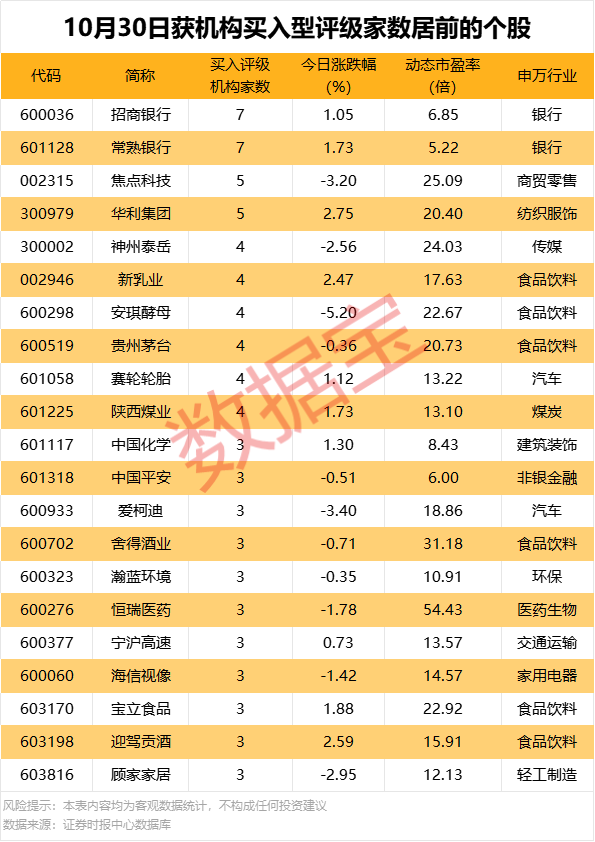
Market Overview - The three major A-share indices collectively retreated on October 30, with the Shanghai Composite Index falling below the 4000-point mark. The market turnover reached 24,642.94 billion yuan, an increase of over 170 billion yuan compared to the previous trading day. More than 1200 stocks closed higher, with 62 stocks hitting the daily limit up [1]. Institutional Ratings - A total of 436 buy ratings were issued by institutions today, covering 304 stocks. China Merchants Bank and Changshu Bank received the most attention, each receiving buy ratings from 7 institutions. Among the stocks rated by institutions, 9 stocks have an upside potential exceeding 50%, with Kweichow Moutai having the highest upside potential of 82.23% based on a target price of 2600 yuan [2][3]. Sector Performance - The food and beverage sector was the most favored by institutions, with 26 stocks, including New Dairy and Angel Yeast, making it to the buy rating list. The basic chemicals and electronics sectors also attracted institutional interest, with 25 and 24 stocks respectively [2]. Northbound Capital Flow - In the northbound trading, 13 stocks saw net buying from northbound funds, with Guodun Quantum, Penghui Energy, and Keda Guokai being the top three in terms of net buying amount, each exceeding 120 million yuan. Conversely, Samsung Medical faced a net selling of over 100 million yuan [4][6][7]. Corporate Announcements - China Life Insurance plans to invest 2 billion yuan in a fund investment plan, primarily targeting sectors such as semiconductors, digital energy, and smart electric vehicles. The total fundraising for this plan is 2.01 billion yuan [8]. - QY Technology intends to acquire a 25% stake in Zhongtong Tianhong for 37.5 million yuan, enhancing resource efficiency and reducing procurement costs [8]. - Jiaozuo Wanfang is set to invest approximately 3.8 billion yuan in a project to produce 400,000 tons of recycled aluminum annually, with a focus on various aluminum products [8]. - Trina Solar's subsidiary has signed a sales contract for over 1 GWh of energy storage products, while the company reported a net loss of 1.283 billion yuan for the third quarter [9].

外资加仓A股!QFII,三季度增持至少121股
券商中国· 2025-10-30 14:07
Core Viewpoint - The China Securities Regulatory Commission (CSRC) has officially released the "Optimization Work Plan for Qualified Foreign Institutional Investor (QFII) System," which simplifies the investment preparation process for QFII and provides a green channel for sovereign funds, international organizations, and pension charitable funds [1][7]. Summary by Sections QFII Investment Trends - Since the introduction of the QFII system in 2002, it has become a significant channel for foreign capital entering the A-share market, with different investment styles compared to domestic funds [1]. - As of October 30, 2023, major QFII investors like Morgan Stanley, Abu Dhabi Investment Authority, and others have continued to increase their holdings in A-shares, with at least 121 stocks seeing an increase in shares held [2][4]. Sector Preferences - The most heavily weighted sectors among QFII investments are not semiconductors but rather hardware equipment, machinery, chemicals, electrical equipment, and pharmaceuticals [2]. - Notable increases in holdings include stocks like Nanjing Bank, China West Electric, and Oriental Yuhong, with UBS and Barclays being the most active in increasing their positions [2][3]. Middle Eastern Sovereign Funds - Middle Eastern sovereign funds, such as the Abu Dhabi Investment Authority, tend to have a more concentrated portfolio compared to their Western counterparts, holding fewer stocks [4]. - The Abu Dhabi Investment Authority increased its holdings in several stocks, including Bao Feng Energy and Hengli Hydraulic, while also reducing its stake in others like North Building Materials [4][5]. QFII System Expansion - The recent optimization plan aims to make it easier for qualified foreign investors to enter the Chinese market, with improvements in qualification approval, account opening, and fund transfer processes [7]. - The CSRC aims to implement these reforms within two years, including the establishment of rules for securities investment consulting services for foreign investors [7].

机构评级榜:7股最受关注 机构集体推荐
Zheng Quan Shi Bao Wang· 2025-10-30 13:13
Group 1 - A total of 407 stocks received buy ratings from institutions today, with 599 buy rating records published [1] - The highest number of buy ratings was for China Merchants Bank and Changshu Bank, each receiving 9 ratings [1] - Among the stocks rated, 182 provided future target prices, with 10 stocks showing an upside potential exceeding 50%, led by Kweichow Moutai with an expected target price of 2600.00 CNY, indicating an upside of 82.23% [1] Group 2 - The average decline for stocks with buy ratings today was 1.36%, underperforming the Shanghai Composite Index [2] - Notable gainers included Foxit Software, Puyuan Precision, and China Foreign Trade, with increases of 15.69%, 14.16%, and 7.40% respectively [2] - Significant decliners included Litong Technology, Tianfu Communication, and Dingtong Technology, with declines of 13.10%, 11.56%, and 10.51% respectively [2] Group 3 - Among the stocks rated by institutions, 406 have reported Q3 earnings, with the highest year-on-year net profit growth recorded by Sanyou Medical at 6198.13 million CNY, a growth of 623.19% [2] - Other companies with significant net profit growth include Huafeng Technology and Beihua Co., with increases of 558.51% and 504.80% respectively [2] Group 4 - The electronics sector was the most favored, with 42 stocks including Shunluo Electronics and Industrial Fulian receiving buy ratings [2] - Other sectors of interest included machinery and basic chemicals, with 37 and 29 stocks respectively receiving buy ratings [2]
海外消费周报:海外教育:教育业务增速触底,优质口碑带动新东方营收增长提速-20251030
Shenwan Hongyuan Securities· 2025-10-30 12:48
Investment Rating - The report maintains a "Buy" rating for the overseas education sector, particularly highlighting New Oriental's revenue growth acceleration driven by its strong reputation [4]. Core Insights - The overseas education business has reached a bottom in growth, with New Oriental's revenue for Q1 FY26 at $1.523 billion, a year-on-year increase of 6.1%. The education segment (including cultural tourism) generated $1.366 billion, up 8.5% year-on-year [9][10]. - New Oriental's Non-GAAP operating profit was $336 million, reflecting an 11.3% increase, with an operating margin of 22%, expanding by 1.1 percentage points year-on-year [9][11]. - The report anticipates a recovery in the overseas examination training and consulting business, projecting growth to resume in the remaining quarters of FY26 [10]. Summary by Sections Overseas Education - The overseas education sector is showing signs of recovery, with New Oriental's Q1 FY26 revenue growth driven by adjustments in service offerings and a focus on high-quality education [9][10]. - The company has adapted its one-on-one tutoring model to a group format to lower costs and has expanded its youth examination training services, which has contributed to resilience in growth [10]. - New business segments, including K9 non-academic training and learning devices, have maintained high growth, with Q1 revenue increasing by 15% to $403 million [10]. Financial Performance - Despite a slowdown in high-margin study abroad services, improvements in the profitability of other segments have offset this decline. Sales and administrative expenses grew at a slower rate than revenue, indicating effective cost control [11]. - The report highlights a shareholder return plan, including a cash dividend of $190 million and a stock buyback of up to $300 million [9]. Market Trends - The education index has underperformed compared to the Hang Seng Index, with a year-to-date increase of 19.3%, lagging behind the index by 8.9 percentage points [8]. - The report suggests a positive outlook for the sector, particularly for companies with strong brand recognition and quality offerings, such as New Oriental and others in the Chinese education sector [14].
10月30日医疗健康R(480016)指数跌2.53%,成份股药明康德(603259)领跌
Sou Hu Cai Jing· 2025-10-30 10:53
Core Viewpoint - The Medical Health R Index (480016) experienced a decline of 2.53% on October 30, closing at 7627.16 points, with a total trading volume of 39.436 billion yuan and a turnover rate of 1.18% [1] Group 1: Index Performance - The index had 8 stocks that rose, with Zai Lab leading at a 2.8% increase, while 42 stocks fell, with WuXi AppTec leading the decline at 8.47% [1] - The top ten constituent stocks of the Medical Health R Index are primarily in the biopharmaceutical sector, with WuXi AppTec holding the largest weight at 14.37% [1] Group 2: Stock Details - WuXi AppTec: Latest price 97.06 yuan, down 8.47%, market cap 289.603 billion yuan [1] - Hengrui Medicine: Latest price 62.88 yuan, down 1.78%, market cap 417.347 billion yuan [1] - Mindray Medical: Latest price 216.69 yuan, down 2.76%, market cap 262.724 billion yuan [1] - United Imaging Healthcare: Latest price 141.03 yuan, down 3.77%, market cap 116.231 billion yuan [1] - Other notable stocks include: - Pien Tze Huang: 177.00 yuan, down 1.02% [1] - Aier Eye Hospital: 12.11 yuan, down 0.49% [1] - Kelun Pharmaceutical: 34.25 yuan, down 1.21% [1] - Changchun High & New Technology: 115.20 yuan, down 2.00% [1] - Fosun Pharma: 28.50 yuan, down 1.42% [1] - New Hope Liuhe: 24.29 yuan, down 0.04% [1] Group 3: Capital Flow - The Medical Health R Index constituents saw a net outflow of 3.222 billion yuan from institutional investors, while retail investors had a net inflow of 2.144 billion yuan [1] - The detailed capital flow indicates that retail investors were more active compared to institutional investors on that day [2]


2025Q3被动和主动权益型公募基金持股分析:电子持仓超过25%之后的行情推演探讨
Shenwan Hongyuan Securities· 2025-10-30 10:13
1. Report Industry Investment Rating No relevant content provided. 2. Core Viewpoints of the Report - The industry allocation has reached historical extremes, with active equity - type public funds in 25Q3 mainly adding positions in ChiNext component stocks and the technology sector, and increasing allocations in communication, media, non - ferrous metals, and power equipment while reducing positions in domestic - demand consumption sectors [4]. - The congestion level of the TMT technology sector represented by electronics has reached a historical high, with the electronic position ratio in 25Q3 reaching 25.7% and the TMT full - industry chain position ratio reaching 40%, and the margin trading balance ratio also hitting new highs [6]. - After the high congestion of the TMT technology sector represented by electronics, the subsequent market and observation indicators need to be discussed, including tracking the fundamentals, the change of PPI, and the trends of industrial capital [7]. - The clues for subsequent style switching are to track PPI and pay attention to the opportunities for the clearance of chips in undervalued reversal - type industries during the bottom - rising stage of inflation [8]. - In the context of the upsurge in index - based investment, the scale of ETFs remains high, and the equity positions of fixed - income + funds have increased [9]. - The net value performance of active equity - type funds shows that the money - making effect has continued to improve under high positions, but as the net value recovers to the cost line, public funds face greater redemption pressure, which is expected to ease with the establishment of a slow - bull market [9]. 3. Summary According to Relevant Catalogs 3.1 Industry Allocation Reaches Historical Extremes - **A - share Plate Allocation**: In 25Q3, active equity - type public funds added positions in the ChiNext and reduced positions in the Main Board and the Science and Technology Innovation Board. The Main Board accounted for 49.1% (down 5 percentage points from 25Q2), the ChiNext accounted for 17.6% (up 3.9 percentage points), and the Science and Technology Innovation Board accounted for 13.7% (up 1.9 percentage points). The configuration coefficients of the ChiNext increased by 0.16, while those of the Main Board and the Science and Technology Innovation Board decreased by 0.05 and 0.26 respectively [13]. - **Hong Kong Stock Allocation**: In 25Q3, the allocation proportion of Hong Kong - connected stocks reached a high and then declined, with the structure shifting from technology to medicine, non - ferrous metals, and new energy. The top five industries with increased allocation proportions in Hong Kong - connected stocks were commerce and trade retail (+6.3%), medicine and biology (+3.3%), non - ferrous metals (+1.7%), power equipment (+0.7%), and real estate (+0.7%). The top three industries with decreased allocation proportions were social services (-2.3%), communication (-2.1%), and light manufacturing (-1.9%) [16]. - **Style Allocation**: In 25Q3, active equity - type public funds added positions in the constituent stocks of the ChiNext Index and the CSI 300, with their configuration coefficients rising by 0.12 and 0.07 respectively. The configuration coefficients of the CSI 500, CSI 1000, and Guozheng 2000 decreased by 0.21, 0.06, and 0.07 respectively [20]. - **A - share Major Category Plate Allocation**: Active equity - type public funds added positions in the technology (TMT) sector, with a configuration coefficient of 1.79 (up 0.22 from 25Q2) and a configuration proportion of 40%. Other sectors were generally reduced in positions [21]. - **First - level Industry Allocation**: In 25Q3, industries with increased positions included communication, power equipment, non - ferrous metals, etc., while industries with reduced positions included household appliances, social services, and automobiles. For example, the position proportion of electronics reached 25.7% (up 6.9 percentage points from 25Q2), and the position proportion of communication reached 9.3% (up 3.9 percentage points) [24]. 3.2 Subsequent Market and Observation Indicators of the Highly Congested TMT Technology Sector Represented by Electronics - **Historical Comparison of Single - Industry Position Ratios**: Since 2010, the maximum position ratio of public funds in a single industry has almost all been around 20%, with a total of 7 times. In 25Q3, the electronic position ratio reached 25.7%, exceeding the experience upper limit of 20% [40]. - **TMT Industry Chain Position Ratio**: In 25Q3, the TMT industry chain position ratio accelerated to 40%, reaching a historical high, but the configuration coefficient was only 1.8, still far from the level in 2015 [41]. - **Leveraged Funds and Market Main - Line Switching**: In the past, when leveraged funds and active equity adjusted positions in resonance and their allocations to a single industry reached high points simultaneously, it was easy to trigger a market main - line switch. Currently, the margin trading balance ratio of the electronics industry has exceeded 15%, setting a new historical high [47]. - **Stock Performance after Position Peaks**: After the industry position ratio reaches its peak, the absolute/relative returns face challenges in 2 - 3 quarters. The position ratio usually takes 3 - 10 quarters to fall from the highest point to the lowest point, and each adjustment will fall from around 20% to around 10% or even single - digit levels [50]. 3.3 ETF Scale Remains High, and the Equity Positions of Fixed - income + Funds Increase - **ETF Situation**: In 25Q3, the total scale of stock - type ETFs exceeded 3.6 trillion yuan, and the proportion of ETF stock - holding market value was 3.8%, up 0.1 percentage point from 25Q2. From July to August, ETFs were generally net - redeemed, and from late August to mid - October, they began to have net inflows. The shares of most broad - based ETFs declined, while the shares of some industry ETFs such as banks, securities, and innovative drugs increased [9]. - **Fixed - income + Funds**: In 25Q3, as the bond market entered a volatile period and the equity market continued to recover, fixed - income + funds increased their equity allocation. The single - quarter stock - holding market value increased by nearly 100 billion yuan, and the equity position increased by 2.4 percentage points to 9.9% [9]. 3.4 Total Perspective: The Money - making Effect of Public Funds under High Positions Continues to Improve, but Public Funds Face Greater Redemption Pressure as the Net Value Recovers to the Cost Line - **Net Value Performance**: Since the beginning of 2025, public funds have maintained high positions, and the money - making effect has continued to improve. The median net value increase of active equity - type public funds since the beginning of 2025 was 26.9%. The overall positions of ordinary stock - type, partial - stock hybrid, and flexible - allocation funds in 25Q3 increased by 0.7, 1.0, and 2.3 percentage points respectively, approaching historical high levels [9]. - **Redemption Pressure**: As the net value recovers to the cost line, public funds face greater redemption pressure. In 25Q3, the net redemption shares of active equity funds further expanded, with new fund issuances of 1.19 billion shares and active equity stock redemptions of 231.9 billion shares, resulting in a single - quarter net redemption of 22 billion shares [9].
【30日资金路线图】有色金属板块净流入约21亿元居首 龙虎榜机构抢筹多股
证券时报· 2025-10-30 10:10
Market Overview - The A-share market experienced an overall decline on October 30, with the Shanghai Composite Index closing at 3986.9 points, down 0.73%, the Shenzhen Component Index at 13532.13 points, down 1.16%, and the ChiNext Index at 3263.02 points, down 1.84% [2] - The total trading volume in the A-share market reached 24645.76 billion yuan, an increase of 1736.45 billion yuan compared to the previous trading day [2] Capital Flow - The main capital in the A-share market saw a net outflow of 765.66 billion yuan, with an opening net outflow of 334.29 billion yuan and a closing net outflow of 132.35 billion yuan [3] - The CSI 300 index recorded a net outflow of 278.84 billion yuan, while the ChiNext saw a net outflow of 358.45 billion yuan and the STAR Market a net outflow of 9.66 billion yuan [5] Sector Performance - Among the primary sectors, only two sectors saw net capital inflows, with the non-ferrous metals sector leading at a net inflow of 21.01 billion yuan [7] - The top sectors with net outflows included electronics with a net outflow of 252.31 billion yuan, machinery with 161.78 billion yuan, and computer sector with 127.12 billion yuan [8] Institutional Activity - The institutional buying activity was noted in several stocks, with notable net purchases in companies like Foxit Software, which saw a rise of 15.69% and a net institutional buy of 7622.96 million yuan [10][11] - Conversely, stocks like Keda Technology experienced significant net selling, with a net outflow of 35881.21 million yuan [10][11] Analyst Recommendations - Recent analyst ratings highlighted several stocks with potential upside, including Jiangxin Home with a target price of 120.00 yuan, representing a 25.00% upside from its latest closing price of 96.00 yuan [12] - Other stocks with favorable ratings include Industrial Fulian and Huanxu Shenzi, with target prices indicating potential increases of 28.25% and 45.91%, respectively [12]