交通运输

Search documents
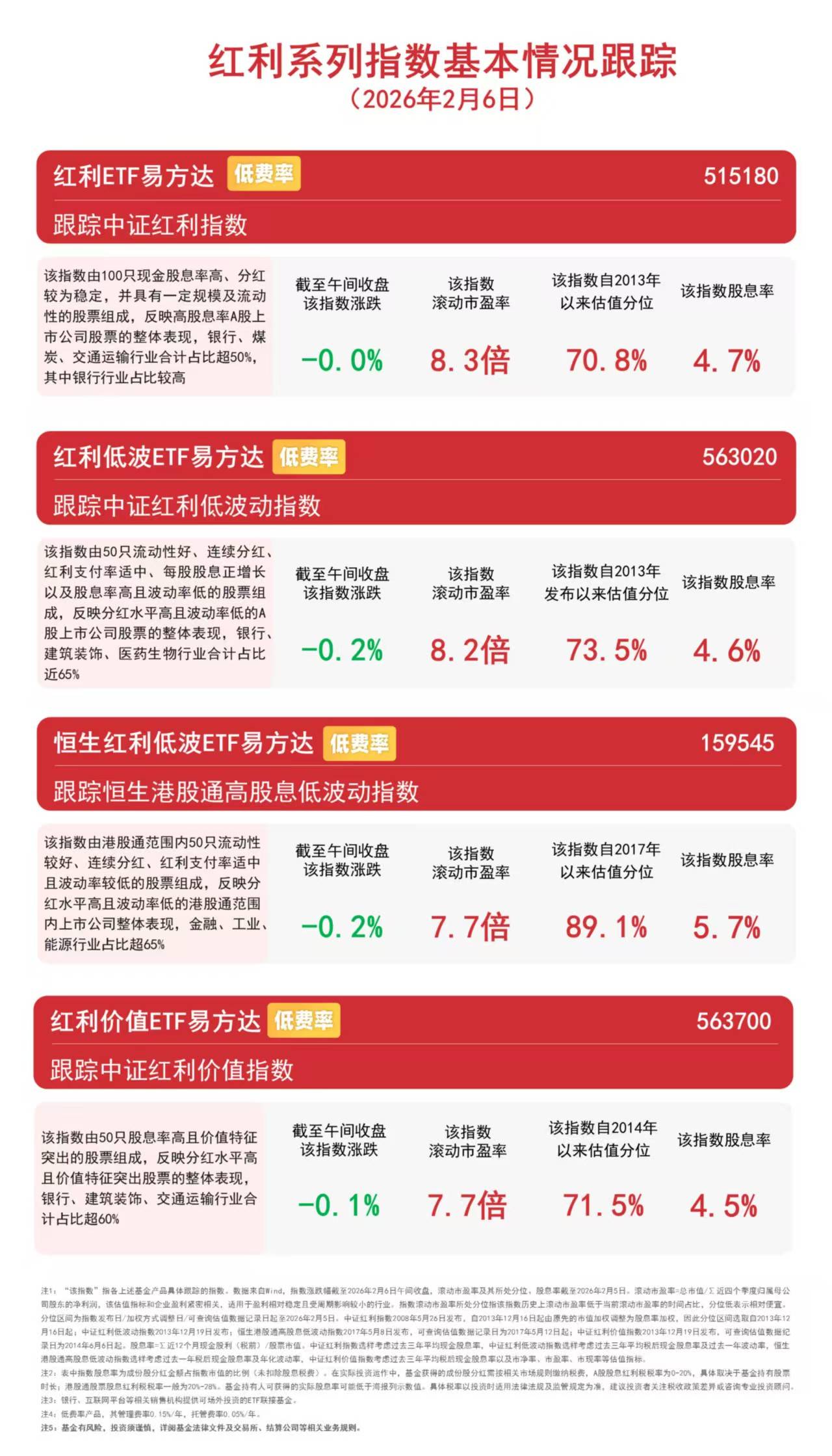
红利板块窄幅震荡,恒生红利低波ETF易方达(159545)半日净申购超5000万份
Sou Hu Cai Jing· 2026-02-06 04:51
Group 1 - The core indices, including the CSI Dividend Index and the CSI Dividend Value Index, experienced slight declines of 0.01% and 0.1% respectively at midday [1] - The E Fund's high dividend low volatility ETF (159545) saw a net subscription exceeding 50 million units, indicating strong investor interest [1] - E Fund is currently the only fund company offering all dividend ETFs at a low management fee rate of 0.15% per year, which supports investors in low-cost allocation to high-dividend assets [1][4] Group 2 - The CSI Dividend Index consists of 100 stocks with high cash dividend yields and stable performance, with banking, coal, and transportation sectors accounting for over 50% of the index [3] - The CSI Low Volatility Dividend Index includes 50 stocks characterized by good liquidity, continuous dividends, and low volatility, with banking, construction, and pharmaceutical sectors making up nearly 65% of the index [3] - The Hang Seng High Dividend Low Volatility Index tracks 50 stocks within the Hong Kong Stock Connect that have good liquidity and moderate dividend payout ratios, with financial and industrial sectors representing a significant portion [3] Group 3 - The CSI Dividend Value Index is composed of 50 stocks that exhibit high dividend yields and value characteristics, with banking, construction, and transportation sectors comprising over 60% of the index [4] - The rolling price-to-earnings ratio for the CSI Dividend Index is 8.3 times, while the CSI Low Volatility Dividend Index has a ratio of 8.2 times, indicating relatively stable valuations [3][4] - The indices have been tracking since 2013 and 2014 respectively, with their valuation percentiles indicating historical performance trends [4]

大盘震荡持续,关注红利板块配置价值,红利国企ETF国泰(510720)盘中微跌
Sou Hu Cai Jing· 2026-02-06 03:59
Core Viewpoint - The market is experiencing ongoing fluctuations, with a focus on the value of dividend sectors, particularly the Guotai Dividend State-Owned Enterprise ETF (510720), which has seen a decline of over 0.5% [1] Group 1: Market Analysis - In the current low-cycle environment, sectors with attractive dividends are worth attention, as PPI and industry profits are at a low point and are expected to recover [1] - There is a focus on industries that are undergoing policy changes in the context of reducing competition, particularly those with supply clearance and profit elasticity [1] Group 2: ETF Overview - The Guotai Dividend State-Owned Enterprise ETF (510720) tracks the Shangguo Dividend Index (000151), which selects high-dividend capable and stable dividend record companies across sectors such as banking, coal, and transportation [1] - The index employs a strict evaluation of constituent stocks based on dividend yield and sustainability, utilizing a cross-industry diversification strategy to effectively control investment risks [1] - The ETF has consistently distributed dividends every month since its listing, achieving a continuous dividend distribution for 22 months [1]
【宏观】2025年我国制造业出海进程如何?——《见微知著》系列第二十九篇(赵格格/周可)
光大证券研究· 2026-02-05 23:08
Core Viewpoint - The report analyzes the current status of China's manufacturing industry going abroad, identifies future leading industries for overseas expansion, and discusses the impact of RMB appreciation on exports and investments [4]. Group 1: Current Trends in Overseas Expansion - The wave of overseas expansion is still on the rise, with a slight increase in China's foreign direct investment expected by 2025, and more small and medium-sized enterprises joining the trend. Policies are aimed at promoting globalization and enhancing external demand while facilitating supply-side reforms [5]. Group 2: Industries with Significant Overseas Revenue Growth - In terms of primary industries, light manufacturing and home appliances have a high proportion of overseas revenue. The electronic and machinery supply chains, as well as service trade, have seen rapid year-on-year growth in overseas revenue. Among secondary industries, electronics and machinery-related sectors show a high overseas revenue share, with notable improvements in competitiveness for the electronic communication, finance, and gaming industries. Industries with high foreign exposure, such as light manufacturing and automotive, have shown relatively better stock performance, and private enterprises are increasingly active in overseas markets, potentially becoming the main contributors to overseas revenue during the 14th Five-Year Plan period [6]. Group 3: High Overseas Gross Margin as a Driving Force - Listed companies exhibit high overseas gross margins due to strong overseas demand, making exports a major contributor to economic growth. Companies are accelerating capacity expansion abroad, leading to increased product value. In the first half of 2025, industries such as computers, pharmaceuticals, beauty care, and machinery equipment reported high overseas gross margins. The difference in gross margins between domestic and overseas operations correlates with revenue structure, with industries like automotive, transportation, and power equipment showing higher overseas gross margins than domestic ones. The average overseas revenue gross margin increased by 0.7 percentage points year-on-year [7]. Group 4: Industry-Specific Overseas Expansion Progress - The report assesses investment trends in different regions such as ASEAN, the United States, and Latin America through forward-looking signals (announcements of foreign investments by listed companies) and mid-term validations (revenue from overseas subsidiaries). Early-stage industries for overseas expansion include machinery equipment, basic chemicals, power equipment/home appliances, food and beverages, and computers. Accelerated expansion industries include electronics, light manufacturing, and automotive [8]. Group 5: Impact of RMB Appreciation on Exports and Investments - Going abroad does not necessarily lead to a decline in export growth. It can stimulate the growth of domestic capital goods and intermediate goods exports, leading to structural adjustments in exports. It also facilitates market expansion for localized production overseas. Innovation is identified as the primary driver for strong export momentum, helping to avoid the middle-income trap. The structural aspects of going abroad are beneficial for upstream equipment investments. Although the capacity expansion of overseas subsidiaries may suppress domestic investment willingness in corresponding sectors, the exploration of overseas markets is favorable for upstream supporting enterprises' capacity expansion and R&D investments [9].

从超4%到1%:俄罗斯经济增速下降,普京表态
Di Yi Cai Jing Zi Xun· 2026-02-05 09:20
Economic Growth and Inflation - Russia's GDP growth for 2025 is projected at 1%, a slowdown from 4.1% in 2023 and 4.3% in 2024, primarily due to measures aimed at reducing inflation [2] - The inflation rate in Russia has decreased to 5.6% in 2025, down from 9.5% in 2024, with a year-to-date annualized inflation rate of 6.4% as of January 26 [3] - The Central Bank of Russia has adjusted the benchmark interest rate, which peaked at 21% in the first half of 2025 and was reduced to 18% in the second half, maintaining a "moderately tight" stance to prevent inflation rebound [3] Factors Contributing to Economic Decline - The ongoing Russia-Ukraine conflict has shifted financial resources towards military spending, limiting investments in production and technology [4] - Long-term impacts of Western sanctions have led to technological blockades, hindering industrial upgrades and weakening the industrial base [4] - High borrowing costs, reduced demand, and increased military expenditures have tightened fiscal conditions, contributing to economic slowdown [5] Sectoral Performance - Key sectors such as transportation, construction, and certain extraction industries, particularly coal, oil, and gas, have underperformed due to the Central Bank's interest rate hikes [5] - Investment growth in Russia has stagnated, with fixed asset investment projected to show zero growth by the end of 2025, marking the end of rapid growth driven by state spending and import substitution [5] Future Economic Outlook - The geopolitical uncertainty poses significant challenges for Russia's economy, with energy exports constrained and international oil prices declining [6] - The government plans to increase the value-added tax rate from 20% to 22% starting in 2026, which is expected to impact consumer prices and inflation [6] - Experts suggest that the continuation of the Russia-Ukraine conflict will likely lead to sustained economic decline unless significant changes occur [7]

高位成立难回本 东方品质消费一年基金不到5年亏6成
Zhong Guo Jing Ji Wang· 2026-02-05 08:09
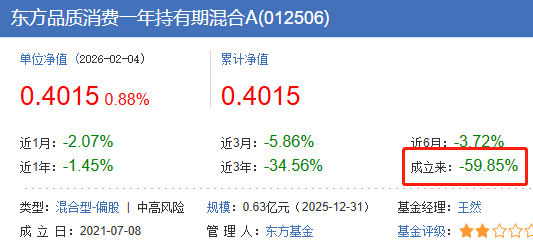
Core Insights - The article discusses the performance of actively managed equity funds established in 2021, revealing that over 50% of these funds are currently at a loss, with significant declines in value for many [1] Fund Performance Summary - A total of 667 actively managed equity funds established in 2021 were analyzed, with approximately 362 funds showing negative returns since inception, representing over 54% of the sample [1] - Among these, 86 funds have experienced declines of over 30%, and 34 funds have seen declines exceeding 40% [1] - The "Oriental Quality Consumption One-Year Holding Period Mixed Fund," established in July 2021, has recorded a cumulative decline of approximately 60.6%, making it one of the worst performers in the sample [1][3] Specific Fund Data - The "Oriental Quality Consumption One-Year Holding Period Mixed Fund A" has a current net value of 0.4015, with a cumulative return of -59.85% since its inception [2] - The fund's performance over the past year shows a decline of -1.45%, and over three years, it has decreased by -34.56% [2] - The fund's top ten holdings include major companies such as Yili Group, Midea Group, and Tencent Holdings, but it has consistently underperformed compared to its peers and the CSI 300 index [3][4] Comparative Performance Analysis - In 2025, the fund's annual return was -0.53%, while the average return for similar funds was 33.12%, and the CSI 300 index returned 17.66% [4] - The fund's ranking among peers has been poor, with significant drops in its position over the years, indicating a consistent underperformance [4][6]
市场大幅回调,红利板块避险价值凸显,红利国企ETF国泰(510720)微跌1%
Sou Hu Cai Jing· 2026-02-05 06:10
Group 1 - The core viewpoint is that high dividend strategies remain attractive in the current year, especially if EPS maintains a growth rate of over 5%, combined with a low interest rate environment, leading to considerable implied returns [1] - High dividend assets benefit from the stability of their business models and are expected to enjoy a certain valuation premium [1] - Factors driving dividend assets include changes in overall market expected returns, the pace of Federal Reserve interest rate cuts, and the fundamental changes in dividend assets themselves [1] Group 2 - The Guotai Dividend State-Owned Enterprise ETF (510720) tracks the State-Owned Dividend Index (000151), which selects high dividend-capable and stable dividend record companies from the market, covering industries such as banking, coal, and transportation, focusing on traditional high dividend sectors [1] - The index employs a strict examination of constituent stocks' dividend yields and sustainability, using a cross-industry diversification strategy to effectively control investment risks and reflect the overall market performance of high dividend companies [1] - According to the fund announcement, the Guotai Dividend State-Owned Enterprise ETF has evaluated dividends monthly since its listing and has achieved continuous dividends for 22 months [1]
浙江:加快构建新型能源体系 建设更高水平生态省
Zhong Guo Huan Jing Bao· 2026-02-05 03:35
Core Viewpoint - The Zhejiang Provincial Party Committee and Government emphasize the importance of a "dual carbon" strategy to drive comprehensive green transformation and establish a new energy system, supporting high-quality development and common prosperity [1] Group 1: Goals and Objectives - By 2030, Zhejiang aims to establish a distinctive new energy system, a modern industrial system, and a modern logistics system, significantly enhancing its dual carbon governance capabilities [2] - The focus will be on "three optimizations and one enhancement," leading the green transformation through dual carbon initiatives [2] Group 2: Key Initiatives - Implementation of green low-carbon development and energy supply stability projects, promoting green power, a robust and secure power grid, and a technology-driven new energy storage system [2] - Development of a modern transportation system, leveraging world-class ports and a strong transportation province, with an emphasis on optimizing logistics networks and promoting the use of new energy vehicles [2][3] Group 3: Environmental and Economic Strategies - Accelerating the upgrade of traditional industries and promoting green low-carbon industries, while enhancing the capacity for carbon sinks through pollution prevention and forest management [3] - Advocating for green buildings and comprehensive energy-saving strategies to foster a culture of low-carbon living and drive the transformation towards a greener economy [3]
研究所日报-20260205
Yintai Securities· 2026-02-05 03:10
Economic Policy and Agricultural Development - The central government's focus for 2026 includes four key tasks in the agricultural sector aimed at enhancing production capacity and quality, providing targeted assistance, promoting stable income growth for farmers, and advancing rural development[2] - The importance of developing new agricultural productivity is emphasized due to the return of migrant workers to rural areas, which can help utilize rural labor and improve income levels[2] - A pilot program for land extension will be implemented in 29 provinces, excluding Guizhou and Tibet, to support rural land management[2] Monetary Policy and Market Liquidity - The central bank conducted a 750 billion yuan reverse repurchase operation at a rate of 1.40%, with a net withdrawal of 302.5 billion yuan on February 4[3] - Current market liquidity is described as neutral and moderately loose, with seasonal tightening expected as the Spring Festival approaches[3] - There is potential for lowering existing mortgage rates to stimulate consumption, as pressures from exchange rates and bank net interest margins have eased[3] Stock Market Performance - On February 4, the Shanghai Composite Index rose by 0.85%, while the Shenzhen Component Index increased by 0.21%, with total trading volume at 24,809.71 billion yuan, down by 632.6 billion yuan from the previous trading day[4] - The ChiNext Index fell by 0.4%, and the STAR 50 Index decreased by 1.2%[4] - The overall A-share market saw a 0.45% increase, with the Hang Seng Index slightly up by 0.05%[4] Bond Market and Interest Rates - The yield on the 10-year government bond was reported at 1.8201%, with a change of +0.24 basis points[4] - Average interbank rates for R001 and R007 were 1.3962% and 1.5554%, respectively[4] Sector Performance - The top-performing sectors included coal (7.58%), construction materials (3.48%), real estate (2.97%), and transportation (2.82%), while sectors like media and telecommunications saw declines of -3.12% and -2.73% respectively[4][25]
周期专场-二月数据解读
2026-02-05 02:21
Summary of Conference Call Notes Industry Overview Real Estate Market - New home sales in core cities are still experiencing negative growth, while the second-hand housing market saw significant increases in transaction volume year-on-year and month-on-month due to early demand for school district properties and supply lagging behind, leading to a rise in both volume and price [1][3] - Anticipation for continued market heat in March, with April's performance dependent on policy support. A potential policy package similar to that of September 24, 2024, could signal a fundamental turning point in core urban areas by the end of 2026 [1][4] - Real estate stocks typically lead the fundamentals by 2-3 quarters, suggesting Q2 may be a good time to increase allocations [4] Construction and Building Materials - The construction and building materials sector is currently in a subdued state, with many projects halted due to the approaching Spring Festival and downstream demand not yet released [6] - Cement prices are continuously declining, with a recent drop of 0.8%. Glass demand is shrinking, and prices remain stable, while manufacturers of consumer building materials are promoting price increases [6][10] - The sector is at historical low levels, presenting opportunities for capital rebalancing [7] Express Delivery Industry - Domestic express delivery business saw a high growth rate of approximately 20% in January, influenced by the timing of the Spring Festival. There is a noticeable divergence in growth rates among leading companies [8] - Jitu Express benefits from the rapid growth of TikTok in Southeast Asia and Latin America, predicting high growth in shipment volume for Q1 due to promotional activities [8] Oil Transportation Industry - Since August 2025, oil transportation rates have significantly increased due to improved supply-demand dynamics and tightening sanctions. The BDTI index has nearly doubled year-on-year as of February 2, 2026 [9][11] - The mid-term outlook suggests continued upward pressure on rates due to geopolitical events and sanctions, providing substantial earnings elasticity for companies in this sector [11] Chemical Logistics - Chemical prices have gradually recovered since late 2025, although they remain at five-year lows. The industry is expected to experience a recovery in trade activity and inventory digestion, leading to improved logistics conditions [12] Civil Aviation - Domestic civil aviation demand is robust, with January passenger volume increasing nearly 9% year-on-year. The Spring Festival period is expected to exceed historical peak levels for passenger volume [13][14] - The average ticket price has increased by 2.4% year-on-year, with a notable rise in pre-sale ticket prices expected in the coming weeks [13][14] Road Transportation - High-speed road freight throughput reached 241 million vehicles in January, marking a year-on-year increase of 22.8%. Predictions indicate significant population movement during the Spring Festival, with a projected increase in passenger volume [15] Key Recommendations - For real estate, focus on companies like China Merchants Shekou, New Town Holdings (A-shares), and China Resources Land (H-shares) [5] - In the construction sector, consider leading firms such as Yuhong, Sankeshu, Tubao, and China Jushi [7] - In the express delivery sector, maintain a watch on leading domestic companies and Jitu Express for overseas delivery [16] - For oil transportation, prioritize companies like China Merchants Energy and COSCO Shipping Energy [11] - In the chemical logistics space, look at companies like Meikewei, Xingtong Co., and Hongtan Wisdom for potential performance rebounds [12] - In civil aviation, monitor the evolving pricing strategies of airlines as they shift towards price control [14]
市值蒸发超万亿!AI次生影响担忧扩散,美股板块轮动加剧
第一财经· 2026-02-05 00:40
本文字数:2725,阅读时长大约4分钟 作者 | 第一财经 樊志菁 随着投资者关注到人工智能技术的快速发展或颠覆某些行业商业模式,同时相关板块的热潮可持续性担忧再次涌现,本周美股部分成长性板块面临巨大 考验,纳指和标普500指数进一步脱离历史高位。 与此同时,资金开始撤出转向工业、运输等避险板块,等待形势进一步明朗。 2026.02. 05 市场抛压加剧 受软件板块与大型科技股走弱拖累,美股本周面临巨大抛售压力。 导火索在于人工智能新贵Anthropic推出全新合规模型对部分行业商业模式的冲击和 威胁。 投资者对大型科技股的集中度风险,以及市场对人工智能的狂热情绪推高板块估值、导致估值泡沫的担忧有所升级。软件股遭遇抛售潮,道琼斯市场数 据显示,道富标普软件与服务交易所交易基金ETF两天下挫近8%,近两周跌幅扩大至15%。 据华尔街两家大型基金的消息人士透露,对冲基金正加大对软件类股的做空押注,成为今年以来该板块遭遇惨烈抛售的一大推手。S3 Partners的数据显 示,随着软件行业总市值蒸发1万亿美元,卖空者今年迄今已从软件类股的交易中斩获240亿美元的暴利。 英伟达CEO黄仁勋在思科的一场活动中驳斥AI引发 ...