信用评级

Search documents
穆迪:稳定币驱动加密化浪潮对新兴市场货币主权与金融稳定构成严峻挑战
Ge Long Hui· 2025-09-28 03:20
Core Insights - Moody's warns that the rise of stablecoin-driven cryptoization poses significant challenges to monetary sovereignty and financial stability in emerging markets [1] - The report highlights the risk of weakened monetary sovereignty as stablecoins, pegged to fiat currencies like the US dollar, proliferate, potentially undermining central banks' traditional control over interest and exchange rates [1] - A shift of personal bank deposits to stablecoins or crypto wallets could lead to deposit outflows from the banking system, affecting liquidity and potentially destabilizing the overall financial system [1] Summary by Category - **Market Trends** - In 2024, the number of global digital asset holders reached approximately 562 million, marking a 33% year-on-year increase [1] - Emerging markets, particularly in Latin America, Southeast Asia, and Africa, are experiencing the fastest growth in digital asset adoption, driven by the need for cross-border remittances, mobile payment demands, and hedging against local currency inflation [1] - **Regulatory Concerns** - Moody's emphasizes the urgency of addressing regulatory gaps to prevent the cryptoization trend from exacerbating monetary and financial security risks in emerging markets [1]
涉3项违法行为,中证鹏元及相关责任人被警告、罚款
Qi Lu Wan Bao· 2025-09-24 02:48
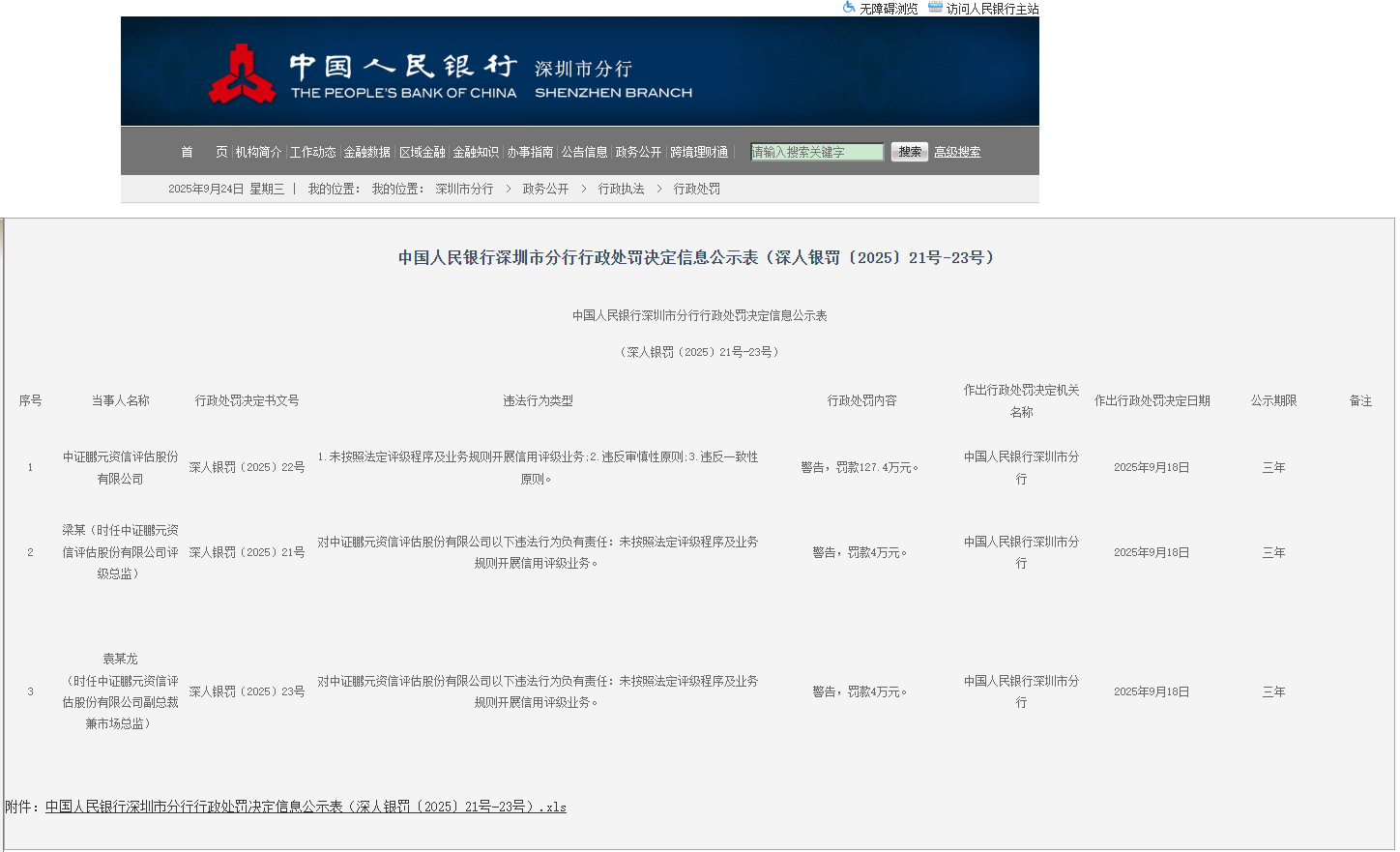
近日,中国人民银行深圳市分行发布行政处罚决定信息公示表(深人银罚〔2025〕21号-23号)。 中证鹏元资信评估股份有限公司(下称"中证鹏元")因1.未按照法定评级程序及业务规则开展信用评级业务;2.违反审慎性原则;3.违反一致性原则。被中 国人民银行深圳市分行警告,罚款127.4万元。 时任中证鹏元评级总监和时任中证鹏元副总裁兼市场总监对中证鹏元上述违法行为负有责任:未按照法定评级程序及业务规则开展信用评级业务。分别被中 国人民银行深圳市分行警告,罚款4万元。 | | | | 中国人民银行深圳市分行行政处罚决定信息公示表(深人银罚〔2025〕21号-23号〕 | | --- | --- | --- | --- | | | | | 中国人民银行深圳市分行行政处罚决定信息公示表 | | | | | (深人银罚(2025) 21号-23号) | | 序号 | 当事人名称 | 行政处罚决定书文号 违法行为类型 | 作出行政处罚决定 行政处罚内容 名称 | | 1 | 中证鹏元资信评估股份 | 1. 未按照法定评级程序及业务规则开展信用评级业务:2. 违反审慎性原则:3. 违反一致性 深人银罚(2025)22号 | ...

《中国地方政府债券蓝皮书(2025)》发布
Zheng Quan Ri Bao Wang· 2025-09-23 13:27
Core Insights - The "Blue Book on Local Government Bonds (2025)" was released, providing a comprehensive review of the local bond market in 2024 and analyzing current development characteristics and challenges [1][2] - The report highlights three main characteristics of local government bonds in 2025: significant increase in new issuance limits, accelerated replacement rhythm, and broader investment areas [1] Group 1 - The local bond market is expected to continue expanding steadily, optimizing its structure and improving efficiency while enhancing market infrastructure [2] - The fiscal and tax system reform will deepen, aiming to clarify the relationship between central and local governments and promote changes in local incentive systems [2] - Local government bonds are positioned as a crucial tool for macroeconomic regulation amidst external pressures, particularly in the context of tariff disputes [1]
法国信用评级再遭下调
Jin Rong Shi Bao· 2025-09-22 06:50
Group 1 - The core viewpoint of the articles highlights the recent downgrades of France's credit rating by international rating agencies, reflecting political and economic uncertainties in the country [1][2] - On September 19, Morningstar DBRS downgraded France's long-term foreign and local currency issuer ratings from "AA (high)" to "AA" due to challenges in fiscal consolidation and increasing political fragmentation [1] - Fitch Ratings had previously downgraded France's long-term foreign and local currency issuer default ratings from "AA-" to "A+" on September 12, citing the weakening ability of the political system to implement large-scale fiscal adjustments [1] Group 2 - The recent political turmoil in France, including the resignation of former Prime Minister Borne and the subsequent appointment of Defense Minister Sébastien Lecornu, has left the fiscal budget plan for 2026 in limbo [2] - France is projected to record the largest fiscal deficit in the Eurozone in 2024, with significant adjustments needed to meet the 2026 budget deficit target of 4.6% of GDP as outlined in the Medium-Term Fiscal Structural Plan (MTFSP) [2] - The public debt-to-GDP ratio in France rose from 98.2% in 2019 to 114.9% in 2020 due to various shocks, and despite some recovery, it only decreased to 109.8% by 2023 [2] Group 3 - Morningstar DBRS indicated that if the French government fails to address structural fiscal imbalances, a further downgrade of the credit rating may occur [3] - A sustained increase in the debt-to-GDP ratio to 125%, especially with a significant rise in interest burdens, could also lead to a downgrade [3] - Conversely, if the government can structurally improve fiscal conditions and reduce the debt ratio, there is potential for an upgrade in the credit rating [3]
法国经济长期疲软态势难改
Jing Ji Ri Bao· 2025-09-21 22:05
Economic Outlook - France's economic growth expectations have slightly improved but remain weak overall, influenced by high domestic debt, political instability, and external geopolitical threats [1][2] - The French central bank forecasts a growth of 0.7% in 2025, up from a previous estimate of 0.6%, but has lowered growth expectations for 2026 and 2027 to 0.9% and 1.1% respectively [1][2] Structural Challenges - The long-term weak performance of the French economy is attributed to structural challenges rather than cyclical downturns, with growth rates hovering between 0.6% and 0.8% this year [2][3] - The political crisis has led to a loss of GDP by 0.1% and 0.3% in 2024 and 2025 respectively, totaling a loss of €12 billion [3] Political Instability - The resignation of former Prime Minister Borne and the appointment of a new Prime Minister has raised concerns about ongoing political instability, which is eroding investor confidence and delaying necessary reforms [2][4] - The political deadlock is expected to persist, especially with the upcoming presidential elections in 2027, limiting fiscal consolidation efforts [4] Debt Burden - France's sovereign credit rating has been downgraded from "AA-" to "A+" due to ongoing political turmoil and unresolved budget issues, with debt projected to rise to 121% of GDP by 2027 [4] - Economists warn that without effective measures, debt could reach 128% of GDP by 2030, posing a risk of a systemic crisis similar to Greece in 2010 [4] External Factors - The unilateral tariff wars initiated by the U.S. have exacerbated France's economic vulnerabilities, contributing to a decline in business investment and consumer confidence [5][6] - France's productivity is lagging behind the Eurozone average, with rising labor costs further impacting competitiveness [6] Need for Strategic Vision - French economists emphasize the necessity for a long-term strategic vision to address current economic challenges, aiming to restore productivity and innovation [6]
这国逾50万人罢工 其中首都约5.5万人 超300人被捕!发生了什么?
Mei Ri Jing Ji Xin Wen· 2025-09-19 00:55
Group 1 - A large-scale strike and protest occurred in France on September 18, with over 500,000 participants nationwide, including approximately 55,000 in Paris, in response to government austerity measures [1][3] - The protests involved workers from various sectors, including transportation, education, electricity, and healthcare, calling for a "fairer" fiscal plan, with reports of violence and property damage during demonstrations in cities like Paris, Lyon, and Rennes [3] - The French government reported over 300 arrests due to the protests, and some cultural sites, such as the Louvre and the Musée d'Orsay, temporarily closed certain exhibition halls [3] Group 2 - On September 12, Fitch Ratings downgraded France's sovereign credit rating from AA- to A+, citing a lack of a credible fiscal consolidation plan supported by a majority [4][5] - France's fiscal deficit for 2024 is projected to reach 5.4% of GDP, with public debt totaling 114% of GDP, contributing to political instability and uncertainty regarding the passage of the 2026 budget [5] - The downgrade may have dual impacts on France's financing environment, with some analysts suggesting limited effects on interest rates due to market expectations, while others warn of potential sell-off pressure on French government bonds, increasing financing costs [5]

布米普特拉北京投资基金管理有限公司:穆迪赞迪称美经济处于“悬崖边缘”
Sou Hu Cai Jing· 2025-09-16 11:05
Core Viewpoint - Moody's Chief Economist Mark Zandi warns that the probability of the U.S. economy entering a recession within the next twelve months has risen to 48%, indicating a concerningly high level of risk [1][5] Economic Indicators - Zandi highlights a significant decrease in U.S. residential building permits as a critical signal of impending economic recession, with current permit approvals nearing the lowest levels seen during the pandemic [1] - The ongoing weak demand from homebuyers and an increase in unsold homes have led builders to substantially reduce their development plans [1] Upcoming Data and Federal Reserve Actions - Zandi advises close attention to the upcoming August loan data to be released on September 17, coinciding with a Federal Open Market Committee (FOMC) meeting where a rate cut is widely anticipated [3] - He suggests that this data may provide the Federal Reserve with additional justification for a rate cut, although he expresses skepticism about the effectiveness of such measures in preventing a recession [3] Overall Economic Outlook - Zandi has repeatedly warned of economic risks, stating that while the probability of recession has not exceeded 50%, the current risk level is historically high and warrants caution [5] - A combination of factors, including a slowdown in the real estate market, tightening credit conditions, and weakened consumer demand, poses a threat to a soft landing for the economy [5] - The effectiveness of potential monetary policy adjustments in countering the current downward pressures remains uncertain, with market participants and economists closely monitoring forthcoming data releases to assess the true trajectory of the U.S. economy [5]


9月15日上期所沪金期货仓单较上一日增加276千克
Jin Tou Wang· 2025-09-15 09:33
Group 1: Gold Futures Market - The total amount of gold futures in Shanghai Futures Exchange is 53,226 kilograms, with an increase of 276 kilograms compared to the previous day [1][2] - The opening price of gold futures on September 15 was 833.82 yuan per gram, reaching a high of 835.34 yuan and a low of 828.42 yuan, with a current price of 831.60 yuan, reflecting a slight increase of 0.10% [1] - The trading volume for the day was 131,159 contracts, while the open interest decreased by 4,918 contracts to 104,349 contracts [1] Group 2: U.S. Economic Indicators - The preliminary consumer confidence index from the University of Michigan for September recorded 55.4, below the market expectation of 58 and the previous value of 58.2, indicating consumer concerns about potential negative developments in the labor market [2] - The U.S. economy is showing signs of significant slowdown, influenced by tariff policies, with expectations of weak growth in Q4 of this year and Q1 of next year, projecting only 1.25% growth in 2026, significantly lower than the 2.8% expected for 2024 [2] - New data indicates that the number of new jobs expected from March 2024 to March 2025 is only half of the initial projections, alongside early signs of weakness in U.S. industrial production [2] Group 3: France's Credit Rating - Fitch Ratings downgraded France's sovereign credit rating from AA- to A+, citing a lack of a credible fiscal consolidation plan supported by a majority [3]
企业都好起来啦?不是AAA发债都拿不出手
3 6 Ke· 2025-09-15 05:17
Core Insights - The AAA-rated bonds dominate the new issuance market, with over 90% of new credit bonds issued in 2025 being AAA-rated, a significant increase of nearly 97% compared to 2016 [1][5] - The decline in market default data has reinforced the "state-owned enterprise belief," with a 73% year-on-year decrease in bond market defaults in the first half of 2025, primarily concentrated in a few bankruptcy restructuring cases [2][9] - The intense competition within the industry has led to a situation where rating agencies feel pressured to provide higher ratings, resulting in a dilution of rating standards [3][11] Market Dynamics - In the first eight months of 2025, 94.22% of new credit bonds issued were AAA-rated, compared to only 47.78% in the same period in 2016, indicating a significant shift in the bond issuance landscape [2][5] - The number of private enterprises issuing bonds has drastically decreased, with only 1% of bond issuers being private companies in 2025, down from 37% in 2016 [2][7] - The market's risk appetite has shifted, with institutional investors primarily favoring high-rated bonds, making it increasingly difficult for lower-rated issuers to access the market [8] Rating Agency Challenges - Rating agencies are facing pressure to maintain their long-term viability, as the low fees for rating services have led to a focus on immediate survival rather than building reputation [4][14] - The competitive landscape has intensified, with many agencies resorting to price wars and rating competitions, which undermines industry standards [11][12] - Regulatory scrutiny has increased, with several agencies facing penalties for non-compliance, highlighting the need for improved governance and adherence to standards [15][16] Future Outlook - Industry leaders emphasize the importance of enhancing compliance and building long-term credibility, suggesting that agencies should invest in talent development and focus on quality over quantity [14][16] - Recommendations for addressing the inflated ratings issue include improving the rating fee model, creating a balanced competitive structure, optimizing regulatory frameworks, and strengthening reputation constraints [16]
企业都好起来啦?不是AAA发债都拿不出手
经济观察报· 2025-09-14 04:34
Core Viewpoint - The article discusses the transformation of the credit rating industry in China, highlighting the overwhelming dominance of AAA-rated bonds in the market, driven by factors such as "state-owned enterprise faith," changes in issuer structure, intense competition, and regulatory reforms [1][6][13]. Group 1: Market Trends - In 2025, AAA-rated bonds accounted for over 90% of new credit bond issuances, a significant increase of nearly 97% compared to 2016 [3][9]. - The proportion of AAA-rated bonds among newly issued corporate bonds reached 85% in the first eight months of 2025, up from 40% in the same period in 2016 [5][10]. - The share of private enterprises in bond issuance has drastically decreased, with only 1% of issuers being private in 2025, down from 37% in 2016 [6][14]. Group 2: Investor Behavior - The decline in market defaults has reinforced the "state-owned enterprise faith," with a 73% year-on-year decrease in bond market defaults in the first half of 2025 [15]. - Investors are increasingly relying on internal rating systems rather than external ratings due to concerns over inflated ratings [11][13]. Group 3: Rating Agency Dynamics - The competitive landscape among rating agencies has intensified, with issuers pressuring agencies to provide AAA ratings, leading to a dilution of rating standards [16][19]. - The number of rating agencies has increased, resulting in a price and rating competition that undermines industry standards [19][20]. - Regulatory scrutiny has intensified since 2021, with multiple agencies facing penalties for non-compliance, highlighting the need for improved governance and compliance within the industry [23][24]. Group 4: Future Outlook - Industry leaders emphasize the importance of maintaining long-term survival and reputation, suggesting that agencies should focus on quality over quantity in their ratings [22][26]. - Recommendations for addressing the inflation of credit ratings include improving the rating fee model, creating a balanced competitive structure, and enhancing regulatory frameworks [26].