
工业

Search documents
元琛科技(688659):中标南京华润热电有限公司采购项目,中标金额为119.23万元
Xin Lang Cai Jing· 2026-01-26 11:15
Group 1 - The company Anhui Yuanchan Environmental Technology Co., Ltd. won a procurement project from Nanjing China Resources Thermal Power Co., Ltd. for a total amount of 1.1923 million yuan [1][2] - Yuanchan Technology (688659.SH) reported a revenue of 630 million yuan for 2024, with a revenue growth rate of 20.11% [2][3] - The net profit attributable to the parent company for 2024 was -61 million yuan, reflecting a net profit growth rate of -139.79% [2][3] Group 2 - In the first half of 2025, the company achieved a revenue of 352 million yuan, with a revenue growth rate of 10.93% [2][3] - The net profit attributable to the parent company for the first half of 2025 was 9 million yuan, with a net profit growth rate of 23.76% [2][3] - The company operates in the industrial sector, with its main product types including catalysts and chemical additives, and special fibers [2][3]

中国天楹(000035):中标红河县住房和城乡建设局采购项目,中标金额为221.85万元
Xin Lang Cai Jing· 2026-01-26 11:09
Core Viewpoint - China Tianying Co., Ltd. has won a bid for a waste transfer project in Honghe County, with a contract amount of 2.2185 million yuan [1][2] Financial Performance - In 2024, the company's operating revenue was 5.667 billion yuan, with a growth rate of 6.46% [1][2] - The net profit attributable to the parent company for 2024 was 280 million yuan, showing a decline of 16.99% [1][2] - For the first half of 2025, the operating revenue was 2.577 billion yuan, reflecting a decrease of 2.72% [1][2] - The net profit attributable to the parent company for the first half of 2025 was 212 million yuan, with a significant decline of 41.25% [1][2] - The return on equity (ROE) for 2024 was 2.60% [1][2] Industry and Product Composition - The company operates in the industrial sector, focusing on products such as semiconductor solar photovoltaic, wind power, environmental machinery, sanitation services, wastewater treatment, system integration services, organic chemical raw materials, and waste heat power generation [1][2] - The main business composition for 2024 includes waste incineration and electricity sales (43.18%), other services (20.53%), urban environmental services (18.46%), and construction services (17.83%) [1][2]

华联期货周报:2025年GDP增长5%,新旧产业分化凸显-20260126
Hua Lian Qi Huo· 2026-01-26 03:31
1. Report Industry Investment Rating - Not provided in the given content 2. Core Viewpoints of the Report - In 2025, China's GDP reached 1,401,879 billion yuan, a year - on - year increase of 5.0% at constant prices, achieving the annual growth target. The quarterly growth rate showed a "high at first and stable later" trend. The tertiary industry was prominent, with the added value of the second and first industries also growing [9]. - The decline in China's real estate development investment intensified in 2025, with the investment in residential properties also facing increasing pressure. The sales side was under greater pressure, and the average price of commercial housing had obvious downward pressure [9]. - In December 2025, the added value of industrial enterprises above the designated size in China increased steadily, with new kinetic energy characteristics in industrial growth and obvious differentiation in traditional industries. Exports showed resilience, and residents' income increased steadily [11]. - In December 2025, China's imports and exports reached a record - high monthly scale. Exports to ASEAN and the EU increased, while exports to the US decreased [97]. - In December 2025, China's manufacturing PMI returned to the expansion range, and the non - manufacturing business activity index also rebounded, but there were significant industry differences [252][260]. 3. Summary of Each Section 3.1 National Economic Accounting - In 2025, China's GDP reached 1,401,879 billion yuan, a 5.0% year - on - year increase at constant prices. The quarterly growth rates from the first to the fourth quarter were 5.4%, 5.2%, 4.8%, and 4.5% respectively. The tertiary industry added value was 808,879 billion yuan, growing 5.4%. The second - industry added value was 499,653 billion yuan, growing 4.5%. The first - industry added value was 93,347 billion yuan, growing 3.9% [9]. 3.2 Industry - In December 2025, the added value of industrial enterprises above the designated size increased by 5.2% year - on - year and 0.49% month - on - month, with an annual growth of 5.9%. Manufacturing was the main growth driver, and new kinetic energy in industrial growth was prominent, while traditional high - energy - consuming sectors were weak. Exports showed resilience [11]. 3.3 Price Index - In December 2025, China's CPI increased by 0.8% year - on - year, and remained flat for the whole year. Food prices increased by 1.1%, and non - food prices increased by 0.8%. PPI decreased by 1.9% year - on - year in December 2025, with a 2.6% decline for the whole year [64][72]. 3.4 Real Estate - In 2025, China's real estate development investment was 827.88 billion yuan, a 17.2% year - on - year decrease. Residential investment decreased by 16.3%. The construction area, new construction area, and sales volume of commercial housing all declined [9][125][129][133]. 3.5 Foreign Trade and Investment - In December 2025, China's total imports and exports were 601.42 billion US dollars, a 6.24% year - on - year increase. Exports were 357.78 billion US dollars, a 6.6% increase, and imports were 243.64 billion US dollars, a 5.7% increase. The trade surplus was 114.14 billion US dollars [97]. 3.6 Fixed - Asset Investment - In 2025, China's fixed - asset investment (excluding rural households) was 4,851.86 billion yuan, a 3.8% year - on - year decrease. Private fixed - asset investment decreased by 6.4%. Investment in the first, second, and third industries showed different trends [117]. 3.7 Domestic Trade - The report shows the trends of service retail sales, catering revenue, and commodity retail, and the year - on - year changes in the retail sales of enterprises above the designated size in various industries [161][163][168]. 3.8 Transportation - The report presents the year - on - year changes in the transportation volume of four types of goods and passengers, and the traffic flow of subways in nine major cities and traffic fixed - asset investment [171][176][179]. 3.9 Banking and Currency - The report analyzes the new social financing scale, social financing scale stock, new RMB loans, and currency liquidity. In December, the M1 - M2 "scissors gap" expanded, reflecting weakening capital activation and weak corporate business and trading willingness [186][197][203]. 3.10 Fiscal and Employment - The report shows the central and local general budget public revenues and expenditures, and the situation of urban new employment and surveyed unemployment rate [235][240][241][245]. 3.11 Business Surveys - In December 2025, China's manufacturing PMI was 50.1%, returning to the expansion range. The non - manufacturing business activity index was 50.2%, also rebounding, but with significant industry differences [252][260]. 3.12 US Macroeconomy - The report provides data on the quarterly changes in the US real GDP annualized quarterly rate, employment, retail sales, and the Fed's asset structure and federal funds rate [267][271][277][279].
河南:2025年多项经济指标增长,争取超千亿政策资金
Sou Hu Cai Jing· 2026-01-26 03:04
Core Insights - The report from the Henan Provincial Government outlines ambitious economic targets for 2025, including a GDP growth target of 5.6% and an industrial value-added growth of 8.4% [1] - The province aims to secure over 100 billion yuan in national policy funds and issue 132.7 billion yuan in local government special bonds for project construction [1] - Henan is focusing on diversifying its overseas markets in response to U.S. trade pressures, with trade in non-U.S. regions showing significant growth [1] Economic Indicators - The industrial investment in Henan is projected to grow by 13.3% in 2025 [1] - The total retail sales of consumer goods are expected to increase by 5.6% [1] - The total import and export value is anticipated to rise by 14.1% [1] - Grain production is forecasted to reach 1,350.97 billion jin [1]
地区生产总值2.67万亿元,比上年增长4.7% 2025年内蒙古经济运行向新向好
Xin Lang Cai Jing· 2026-01-25 09:01
Economic Overview - In 2025, Inner Mongolia's GDP is projected to reach 26,710 billion yuan, reflecting a 4.7% increase from the previous year [1] - The primary industry is expected to contribute 3,037 billion yuan with a growth of 5.0%, the secondary industry 11,293 billion yuan with a growth of 5.5%, and the tertiary industry 12,381 billion yuan with a growth of 4.0% [1] Agricultural Sector - Agricultural production quality and efficiency are set to improve, with a total grain output of 840.7 billion jin, marking a 2.5% increase and achieving "22 consecutive years of bumper harvests" [1] - The area for grain planting is projected to be 10,567 million mu, up by 0.5%, with a per mu yield of 397.8 kg, an increase of 2.0% [1] - Livestock production is expected to reach 3,158,000 tons, growing by 5.0%, with beef and mutton production both exceeding one million tons [1] Industrial Sector - The added value of above-scale industrial output is anticipated to grow by 6.7% in 2025 [2] - Strategic emerging industries, high-tech manufacturing, modern coal chemical industry, and rare earth industries are projected to see significant growth, with increases of 9.4%, 17.5%, 39.6%, and 32.0% respectively [2] - New energy generation is expected to reach 2,562.8 billion kWh, reflecting a growth of 28.8% [2] Service Sector - The added value of the service industry is expected to grow by 4.0%, with wholesale and retail increasing by 4.9%, transportation, storage, and postal services by 5.4%, and accommodation and catering by 2.9% [2] Investment and Consumption - Fixed asset investment (excluding farmers) is projected to grow by 4.0% in 2025 [3] - The total retail sales of social consumer goods are expected to reach 537.55 billion yuan, a 4.3% increase from the previous year [3] - Per capita disposable income is projected to be 41,921 yuan, reflecting a 4.6% increase, with urban residents at 52,829 yuan (3.8% growth) and rural residents at 23,855 yuan (5.8% growth) [3] Overall Economic Outlook - The economy is expected to show steady progress amidst multiple pressures, with internal driving forces gradually strengthening [4] - The region faces complex external environments and ongoing challenges, necessitating enhanced policy effectiveness and market vitality to sustain economic recovery [4]
实现地区生产总值24763.6亿元 2025年成都GDP同比增长5.8%
Si Chuan Ri Bao· 2026-01-25 01:27
Economic Performance - Chengdu's GDP reached 24,763.6 billion yuan in 2025, growing by 5.8% year-on-year at constant prices [1] - The primary industry added value was 541.1 billion yuan, with a year-on-year increase of 3.3% [1] - The secondary industry added value was 6,903.9 billion yuan, growing by 5.4% year-on-year [1] - The tertiary industry added value was 17,318.6 billion yuan, with a year-on-year growth of 6.1% [1] Sectoral Growth - Agricultural production showed positive trends, with total grain output reaching 2.371 million tons, up by 1.1% year-on-year [1] - Industrial economy grew rapidly, with above-scale industrial added value increasing by 7.0% year-on-year, with 25 out of 37 major industries reporting positive growth [1] - High-tech industries accelerated development, with above-scale high-tech manufacturing added value increasing by 8.9% year-on-year [1] - Key industrial products saw significant production increases: new energy vehicles up by 181.0%, lithium-ion batteries up by 33.9%, and integrated circuits up by 23.3% [1] Service Sector Performance - The service sector's added value grew by 6.1% year-on-year, with leasing and business services increasing by 13.6% and information transmission, software, and IT services growing by 9.6% [1] Consumer Market - The total retail sales of consumer goods in Chengdu reached 11,434.1 billion yuan in 2025, growing by 5.5% year-on-year [2] - Urban retail sales amounted to 10,035.0 billion yuan, with a year-on-year increase of 5.4%, while rural retail sales reached 1,399.1 billion yuan, growing by 6.2% [2] - Dining revenue was 1,425.8 billion yuan, up by 5.2% year-on-year, and commodity retail sales reached 10,008.3 billion yuan, increasing by 5.6% [2] - Among commodity retail, above-limit enterprises achieved online retail sales of 1,903.3 billion yuan, growing by 17.6% year-on-year [2]
本市国企资产总额达到32.5万亿元
Xin Lang Cai Jing· 2026-01-24 07:16
Group 1 - The total assets of local state-owned enterprises in Shanghai reached 32.5 trillion yuan in 2025, marking a historical high, with total profit and net profit attributable to shareholders growing by 12.3% and 11.2% year-on-year, respectively, both achieving a five-year high [1] - In 2025, the comparable growth rates for industrial output value, weighted average growth rate of financial industry indicators, and total foreign trade import and export growth in Shanghai were 10.5%, 20.7%, and 7.9% respectively [1] - The total market value of listed companies controlled by local state-owned enterprises in Shanghai reached 3.2 trillion yuan, also a historical high [1] - Over the past three years of deepening state-owned enterprise reform, the total assets, total profit, and net profit attributable to shareholders of local state-owned enterprises in Shanghai increased by 16%, 24%, and 23% compared to 2022, with the market value of listed companies rising by over 42% [1] Group 2 - In 2026, Shanghai's state-owned assets and enterprises will continue to promote quality improvement, efficiency enhancement, and stable growth, aiming for a strong start in the first quarter [2] - The optimization of state asset layout will focus on concentrating resources on advantageous enterprises and key sectors, enhancing the development level of the productive service industry [2] - The implementation of the "AI+" initiative will strengthen the technological innovation role of state-owned enterprises, promoting the application of vertical models and intelligent agents across industries [2] - The operational level of state capital will be enhanced, with reforms in state capital fund management systems and the establishment of a complementary development pattern for municipal and district-level state capital funds [2] - A reasonable distribution of assessment results for enterprise leadership will be implemented, along with the establishment of an unconventional talent introduction system [2] - The construction of a comprehensive regulatory evaluation system will focus on fulfilling strategic missions and enhancing core competitiveness through enhanced collaborative supervision [2] - The responsibility system for party building will be improved with a refined assessment and evaluation index system [2]
海南省2025年GDP达8108.85亿元 同比增长4.0%
Zhong Guo Xin Wen Wang· 2026-01-24 02:12
Economic Growth - Hainan's GDP is projected to reach 810.885 billion yuan in 2025, with a year-on-year growth of 4.0% at constant prices [1] - The primary industry is expected to contribute 164.255 billion yuan, growing by 4.4%, while the secondary industry will add 146.386 billion yuan, with a growth of 1.0% [1] - The tertiary industry is anticipated to generate 500.244 billion yuan, reflecting a growth of 4.6% [1] Agricultural and Industrial Performance - The total output value of agriculture, forestry, animal husbandry, and fishery is projected to be 263.186 billion yuan in 2025, with a year-on-year increase of 4.7% [1] - Industrial growth is accelerating, with a year-on-year increase of 9.9% in the added value of above-scale industries [1] - Equipment manufacturing and high-tech manufacturing sectors are experiencing significant growth, with increases of 103.1% and 28.1%, respectively [1] Service Sector and Tourism - The added value of the service sector is expected to grow by 4.6% year-on-year in 2025 [1] - The tourism market is showing strong performance, with 106.075 million visitors and total tourism expenditure of 225.432 billion yuan, representing growth of 9.1% and 10.5%, respectively [1] Investment and Consumption - Fixed asset investment in Hainan is projected to decline by 16.5% in 2025 [2] - Social retail sales are expected to grow by 5.0%, with significant increases in home appliances (17.6%), communication equipment (56.6%), and automobiles (33.0%), particularly in new energy vehicles, which are expected to grow by 51.3% [2] Trade and Income - The total service import and export value is projected to be 69.255 billion yuan, with a year-on-year increase of 22.1%, while the total goods import and export value is expected to be 276.003 billion yuan, showing a slight decline of 0.7% [2] - Per capita disposable income is expected to reach 36,306 yuan, with a nominal growth of 4.2% and a real growth of 4.3% after adjusting for price factors [2] Long-term Economic Outlook - During the 14th Five-Year Plan period, Hainan's economy is expected to grow at an average annual rate of 5.7%, surpassing the national average by 0.3 percentage points [3] - The economic total is projected to cross three trillion yuan thresholds within five years, exceeding 800 billion yuan [3] - The construction of the Hainan Free Trade Port is entering a new phase, boosting confidence across various sectors and promoting stable economic recovery [3]
多个维度详解2025年经济数据 | 热点观察
Sou Hu Cai Jing· 2026-01-23 12:17
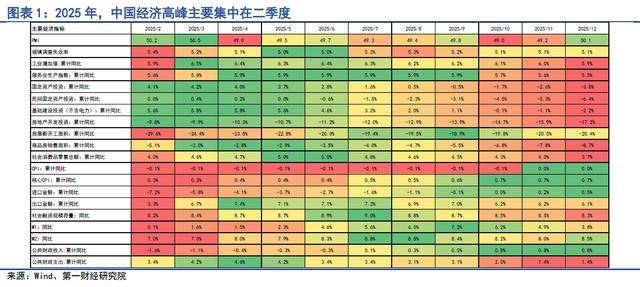
Economic Overview - In 2025, China's GDP grew by 5% year-on-year, meeting the government's target set at the beginning of the year [4][5] - The economic growth showed a "high first, low later" trend, with key indicators peaking in the second quarter [4] - The contribution of the tertiary industry to GDP growth surpassed that of the secondary industry, reflecting a shift towards service-oriented economic structure [4][5] Industry Performance - The manufacturing sector grew by 6.1%, while the information transmission, software, and IT services sector saw an impressive growth of 11.1% [5] - High-tech industries showed significant growth, with industrial robot production increasing by 14.7% and integrated circuit production by 12.9% in December [12][7] - The overall industrial output value increased by 5.9% year-on-year, although it showed a slight decline compared to November [7][9] Investment Trends - Fixed asset investment growth declined to -3.8% by the end of December 2025, with infrastructure investment experiencing its first negative growth in four years at -1.48% [2][11][14] - The decline in investment is attributed to a shift in fiscal policy focus towards social welfare and consumption rather than infrastructure [14] - New policy financial tools were introduced to stimulate investment in key sectors, potentially stabilizing fixed asset investment growth in 2026 [16] Real Estate Market - The real estate sector faced significant challenges, with development investment down by 17.2% and new housing starts down by 20.4% [17][19] - The inventory cycle for residential properties is stabilizing, with a narrow cycle of about 6 months and a broad cycle of 72.6 months [19] - Housing prices have generally declined, with second-hand home prices in major cities falling significantly [19][21] Consumer Behavior - Retail sales growth slowed to 3.7% year-on-year by December 2025, with automotive sales declining by 1.04% [3][22] - Certain consumer categories, such as food and jewelry, experienced high growth rates, indicating potential areas for market recovery [22][24] - Government initiatives aimed at boosting consumption include measures to enhance income and reduce restrictions in various service sectors [24][25]

大连成为中国东北首个GDP破万亿元城市
Zhong Guo Xin Wen Wang· 2026-01-23 07:34
中新社大连1月23日电 (记者 杨毅)2025年,大连市地区生产总值(GDP)10002.1亿元(人民币,下同),按 不变价格计算,同比增长5.7%。大连成为中国东北地区首个GDP突破万亿元城市。 大连市人民政府新闻办公室23日举行新闻发布会,大连市统计局副局长徐杰在会上作上述通报。 分产业看,2025年大连第一产业增加值665.4亿元,同比增长3.6%;第二产业增加值3532.5亿元,增长 7.7%;第三产业增加值5804.2亿元,增长4.8%。 通报称,2025年,大连市工业保持较快增长,全年全市规上工业增加值同比增长11.7%,工业经济保持 两位数增长;服务业保持增长,部分现代服务业增势较好,全年全市服务业增加值同比增长4.8%。 大连成为中国东北首个GDP破万亿元城市 来源:中国新闻网 编辑:付健青 广告等商务合作,请点击这里 本文为转载内容,授权事宜请联系原著作权人 中新经纬版权所有,未经书面授权,任何单位及个人不得转载、摘编或以其它方式使用。 关注中新经纬微信公众号(微信搜索"中新经纬"或"jwview"),看更多精彩财经资讯。 大连市发展和改革委员会副主任于洋介绍,2025年,全市地区生产总值季 ...