
轻工制造

Search documents
84只股涨停 最大封单资金5.53亿元
Zheng Quan Shi Bao Wang· 2025-12-19 08:23
| 600936 | 广西广电 | 4.30 | 6.76 | 2371.18 | 10196.07 | 传媒 | | --- | --- | --- | --- | --- | --- | --- | | 000566 | 海南海药 | 7.24 | 11.37 | 1408.12 | 10194.79 | 医药生物 | | 000639 | 西王食品 | 3.62 | 9.51 | 2733.39 | 9894.87 | 食品饮料 | | 002264 | 新华都 | 9.32 | 11.85 | 954.13 | 8892.49 | 传媒 | | 000417 | 合百集团 | 8.33 | 12.49 | 1018.83 | 8486.86 | 商贸零售 | | 002105 | 信隆健康 | 7.77 | 11.86 | 1080.45 | 8395.08 | 汽车 | | 002501 | 利源股份 | 2.39 | 5.22 | 3204.88 | 7659.66 | 有色金属 | | 600468 | 百利电气 | 7.14 | 6.14 | 1069.54 | 7636.52 | 电力设备 ...


利好!涨停潮
Zheng Quan Shi Bao· 2025-12-19 05:41
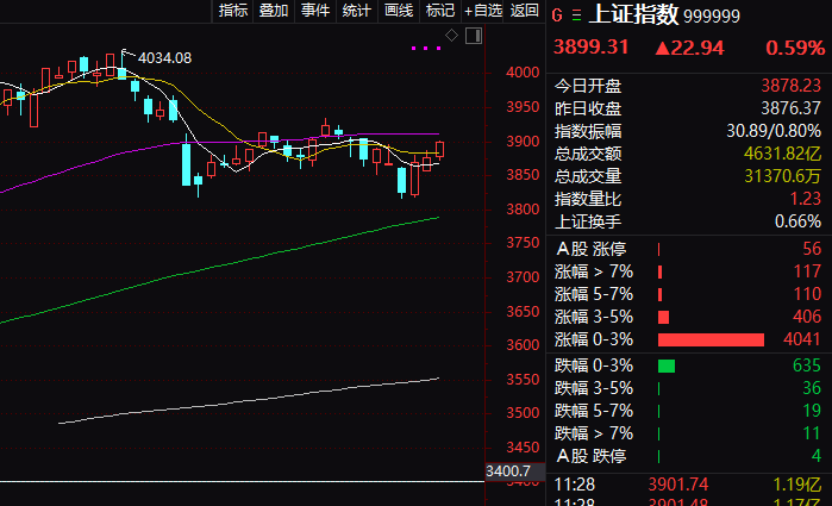
Core Viewpoint - The consumer sector in the A-share market experienced a significant surge, with major indices rising and a notable increase in stock prices within the retail sector on December 19, 2023 [1][2][4]. Group 1: Market Performance - The A-share market showed an overall upward trend, with the Shanghai Composite Index closing at 3899.31 points, up 0.59%, and briefly surpassing 3900 points during the session [2]. - Other major indices also saw gains, with the Shenzhen Component Index rising by 0.93%, the ChiNext Index increasing by 0.99%, and the STAR Market 50 Index up by 0.69% [2]. Group 2: Retail Sector Highlights - The retail sector experienced a substantial increase, with the sector's stocks rising nearly 4% during the session, leading to a wave of stocks hitting the daily limit [4]. - Notable stocks that reached their daily limit included Debon Group, Central Plaza, Shanghai Jiubai, Dalian Friendship, and Dongbai Group, with Debon Group rising by 19.99% to a price of 22.51 [5]. Group 3: New Stock Listing - A new stock, Youxun Co., was listed on the A-share market, experiencing a peak increase of over 450% during trading, although the gain later narrowed [7]. - Youxun Co. specializes in the research, design, and sales of optical communication front-end transceiver chips, which are critical components in optical communication systems [9]. Group 4: Government Initiatives - The Ministry of Commerce and the Ministry of Finance issued a notice to implement pilot programs for new consumption formats in 50 cities, aimed at boosting consumption and enhancing the supply of quality goods and services [6]. - The pilot programs are part of a broader initiative to stimulate consumption and improve living standards, emphasizing the importance of local government involvement in the implementation process [6].

兴证策略:连续三年跑输大盘的行业,哪些有望反转?
Xin Lang Cai Jing· 2025-12-18 11:15
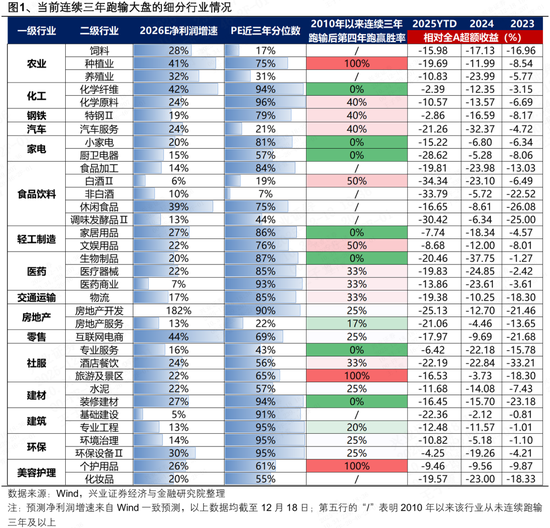
Core Insights - The article highlights that certain cyclical and consumer sectors have underperformed the market for three consecutive years, indicating potential investment opportunities in these areas [1][6]. Industry Analysis - The sectors with the highest expected net profit growth for next year include: - Agriculture (planting, breeding, feed) - Internet e-commerce - Leisure food - Beauty care (personal care products, cosmetics) - Light manufacturing (household goods, entertainment products) - Automotive services - Social services (hotel catering, tourist attractions) - Cement [1][6]. - Historical data since 2010 shows that industries that have underperformed for three consecutive years and then outperformed in the fourth year include: - Food and beverage (leisure food, food processing, seasoning and fermentation products, non-brewed beverages) - Agriculture (breeding, feed, planting) - Beauty care (cosmetics, personal care products) - Infrastructure - Tourist attractions [1][6]. Financial Metrics - Expected net profit growth rates for various sectors by 2026 are as follows: - Planting: 41% - Breeding: 32% - Chemical fiber: 42% - Chemical raw materials: 24% - Automotive services: 24% - Internet e-commerce: 44% - Cement: 22% [2][7]. - The PE (Price to Earnings) ratios over the past three years indicate reasonable valuation levels for several sectors, with notable figures such as: - Planting at 75% - Chemical fiber at 94% - Internet e-commerce at 69% [2][7].
轻工制造行业资金流入榜:顺灏股份、德艺文创等净流入资金居前
Zheng Quan Shi Bao Wang· 2025-12-18 08:48
Market Overview - The Shanghai Composite Index rose by 0.16% on December 18, with 12 industries experiencing gains, led by the banking and coal sectors, which increased by 1.97% and 1.89% respectively [1] - The light industry manufacturing sector saw an increase of 0.86%, while the power equipment and communication sectors faced declines of 2.22% and 1.58% respectively [1] Capital Flow Analysis - The net outflow of capital from the two markets was 32.578 billion yuan, with 8 industries experiencing net inflows [1] - The defense and military industry had the highest net inflow of 2.29 billion yuan, with a daily increase of 0.90%, followed by the banking sector with a net inflow of 0.927 billion yuan [1] Light Industry Manufacturing Sector - The light industry manufacturing sector had a net inflow of 0.555 billion yuan, with 114 out of 158 stocks rising, including 8 stocks hitting the daily limit [2] - The top three stocks with the highest net inflow were Shunhao Co. with 0.573 billion yuan, followed by Deyi Culture and Guangbo Co. with inflows of 0.181 billion yuan and 0.147 billion yuan respectively [2] Light Industry Manufacturing Capital Outflow - The top three stocks with the highest net outflow in the light industry manufacturing sector were Wangzi New Materials with a net outflow of 0.114 billion yuan, followed by Shengxing Co. and Hongbo Co. with outflows of 0.048 billion yuan and 0.039 billion yuan respectively [3]



今日71只个股涨停 主要集中在医药生物、化工等行业
Zheng Quan Shi Bao Wang· 2025-12-18 07:51
Choice统计显示,12月18日,沪深两市可交易A股中,上涨个股有2748只,下跌个股有2232只,平盘个 股有183只。不含当日上市新股,共有71只个股涨停,8只个股跌停。从所属行业来看,涨停个股主要集 中在医药生物、化工、轻工制造、商贸零售、纺织服饰等行业。 (原标题:今日71只个股涨停 主要集中在医药生物、化工等行业) ...
突发!这个板块集体暴动!沪指逆势飘红,资金正杀向全新战场!
Sou Hu Cai Jing· 2025-12-18 04:20
Market Overview - The A-share market shows a typical "strong Shanghai, weak Shenzhen" divergence, with the Shanghai Composite Index rising by 0.16% to 3876.4 points, while the Shenzhen Component Index fell by 0.85% and the ChiNext Index dropped by 1.81% [1] - Total trading volume in both markets exceeded 1.04 trillion yuan, indicating a slight increase in activity, reflecting a phase of intense structural adjustment [1] Sector Performance - The defense and military industry sector led the gains with a 1.69% increase, followed by light industry manufacturing and textile and apparel sectors [1] - Cyclical and defensive sectors, represented by oil and petrochemicals, banks, and non-ferrous metals, also showed strength, contributing to market support [1] - Conversely, technology growth sectors, including power equipment, communications, and electronics, generally retreated, negatively impacting the ChiNext Index [1] AI Health Application Impact - Ant Group's AI health application "Antifufu" has seen explosive growth, surpassing 15 million monthly active users, indicating a significant shift in health management through AI technology [2] - The popularity of AI health applications is expected to optimize the allocation of medical resources and provide retail medical enterprises with traffic benefits, transforming them from "pharmacies" to "health management centers" [2] Future Market Outlook - The market is expected to experience structural opportunities rather than significant single-direction movements, with a central economic work conference setting a tone of "moderate easing" for future policies [2] - Anticipation for the 2026 "spring market" rally is rising, with historical trends suggesting that policy expectations and liquidity could lead to a notable phase of market activity [3] - The future market focus may become more balanced, with technology innovation, particularly in AI, remaining a long-term theme, alongside cyclical industries benefiting from price recovery and high-dividend defensive sectors [3]
【17日资金路线图】两市主力资金净流出超67亿元 电子等行业实现净流入
证券时报· 2025-12-17 12:07
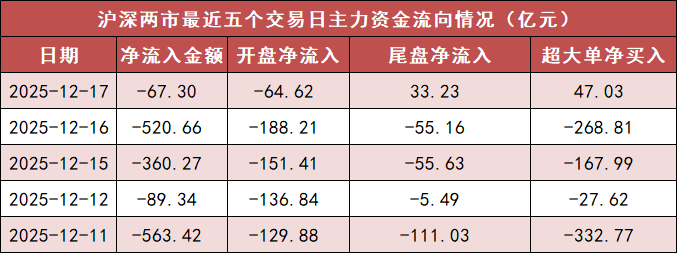
Market Overview - The A-share market experienced an overall increase on December 17, with the Shanghai Composite Index closing at 3870.28 points, up 1.19%, the Shenzhen Component Index at 13224.51 points, up 2.4%, and the ChiNext Index at 3175.91 points, up 3.39% [1]. Capital Flow - The net outflow of main funds in the Shanghai and Shenzhen markets exceeded 67 billion yuan, with an opening net outflow of 64.62 billion yuan and a closing net inflow of 33.23 billion yuan [2]. - Over the last five trading days, the main funds showed a consistent outflow trend, with December 16 recording a net outflow of 520.66 billion yuan [3]. - The CSI 300 index saw a net inflow of 51.45 billion yuan, while the ChiNext index had a net inflow of 40.67 billion yuan on the same day [4]. Sector Performance - The electronics sector achieved a net inflow of 209.83 billion yuan, with a growth of 2.88%, leading the capital inflow among industries [5][6]. - Other sectors with significant net inflows included telecommunications (138.36 billion yuan, up 1.71%) and non-ferrous metals (127.24 billion yuan, up 2.52%) [6]. Individual Stocks - The top stocks by institutional net buying included JuGuang Technology, which rose 17.34% with a net buy of 29,132.28 thousand yuan, and ShenNan Circuit, which increased by 10% with a net buy of 17,344.21 thousand yuan [7][9]. - Conversely, stocks like Guangxin Technology and Tianji Co. saw significant net selling, with net outflows of 12,413.62 thousand yuan and 10,667.31 thousand yuan, respectively [9]. Institutional Focus - Recent institutional ratings highlighted stocks such as Honglu Steel Structure with a target price of 25.27 yuan, indicating a potential upside of 56.76% from its latest closing price of 16.12 yuan [10].

【17日资金路线图】两市主力资金净流出超67亿元 电子等行业实现净流入
Zheng Quan Shi Bao· 2025-12-17 12:06
Market Overview - The A-share market experienced an overall increase on December 17, with the Shanghai Composite Index closing at 3870.28 points, up 1.19%, the Shenzhen Component Index at 13224.51 points, up 2.4%, and the ChiNext Index at 3175.91 points, up 3.39% [1] - The total trading volume for both markets reached 181.11 billion yuan, an increase of 8.70 billion yuan compared to the previous trading day [1] Capital Flow - The net outflow of main funds from the Shanghai and Shenzhen markets exceeded 6.73 billion yuan, with an opening net outflow of 6.46 billion yuan and a closing net inflow of 3.32 billion yuan [2] - Over the last five trading days, the main funds have shown a consistent outflow trend, with the highest outflow recorded on December 16 at 52.07 billion yuan [3] Sector Performance - The CSI 300 index saw a net inflow of 5.145 billion yuan, while the ChiNext index had a net inflow of 4.067 billion yuan on December 17 [4] - The electronics sector led the net inflow with 20.983 billion yuan, followed by the communication sector with 13.836 billion yuan and non-ferrous metals with 12.724 billion yuan [7] Institutional Activity - Notable institutional buying included stocks such as Juguang Technology with a 17.34% increase and a net institutional purchase of 291.32 million yuan, and Shennan Circuit with a 10.00% increase and a net purchase of 173.44 million yuan [11] - Conversely, stocks like Tongyu Communication and Huaren Health saw significant net outflows from institutions, with declines of 10.00% and 13.11%, respectively [11] Analyst Ratings - Analysts have recently rated several stocks positively, including Honglu Steel Structure with a target price indicating a potential upside of 56.76% and Anfu Technology with a potential upside of 26.56% [12]
今日58只个股涨停 主要集中在通信、机械设备等行业
Zheng Quan Shi Bao Wang· 2025-12-17 07:52
(原标题:今日58只个股涨停 主要集中在通信、机械设备等行业) Choice统计显示,12月17日,沪深两市可交易A股中,上涨个股有3480只,下跌个股有1502只,平盘个 股有178只。不含当日上市新股,共有58只个股涨停,27只个股跌停。从所属行业来看,涨停个股主要 集中在通信、机械设备、医药生物、化工、轻工制造等行业。 ...
第一创业晨会纪要-20251217
First Capital Securities· 2025-12-17 04:22
Macro Economic Group - The U.S. non-farm payrolls increased by 64,000 in November, exceeding the expected increase of 50,000, while October saw a decrease of 105,000 [4] - The unemployment rate in November was 4.6%, higher than the expected 4.4%, marking a four-year high [4] - Average hourly wages in November rose by 3.5% year-on-year, slightly below the expected 3.6% [4] Industry Comprehensive Group - Apple plans to significantly expand its smartphone product line, potentially releasing at least seven new flagship models by fall 2027, including the first foldable iPhone expected in fall 2026 [9] - The investment in new energy sources is expected to maintain strong levels next year, with a focus on building smart grids and microgrids [9] - The investment opportunities in the power grid equipment industry are anticipated to grow due to increased investment in energy infrastructure [9] Advanced Manufacturing Group - The largest grid-type lithium-sodium hybrid energy storage station in China has been officially put into operation, with a total installed capacity of 400,000 kW and a green electricity ratio of 98% [12] - This energy storage system can respond to grid load fluctuations and changes in renewable energy output, marking a shift from optional to essential infrastructure for grid resilience [12] - The industry is expected to see improved profitability as the focus shifts from price competition to system service fees [12] Consumer Group - The light manufacturing sector is experiencing structural opportunities, with companies that have established overseas production capacity expected to perform well in 2025 [14] - The U.S. housing market is at a historical low, and the anticipated interest rate cuts are expected to boost housing demand, positively impacting home-related consumption [14] - The outdoor sports category is expected to benefit from the recovery of the real estate chain and consumer upgrade trends, providing growth support for related companies [14]