
金融业

Search documents
2025上市公司ESG发展论坛圆满举办 赋能产业升级与城市高质量发展
Jin Tou Wang· 2026-01-01 01:39
Core Viewpoint - The forum emphasizes the importance of ESG (Environmental, Social, Governance) in driving industrial upgrades and urban innovation, aligning with China's dual carbon strategy and the 14th Five-Year Plan [1][38]. Group 1: Forum Overview - The 2025 ESG Development Forum and the 12th China Urban Innovation High-Quality Development Forum were held in Beijing, focusing on ESG practices and urban innovation [1]. - The event gathered leaders from various sectors including real estate, energy, technology, and finance to discuss core pathways for ESG implementation [1]. - The forum was co-hosted by multiple organizations, highlighting its significance as an influential annual event in the industry [1]. Group 2: Key Speakers and Insights - Notable speakers included former vice president of the China Real Estate Association, Miao Leru, who provided insights on the real estate market outlook for 2026 and the industry's ESG transformation [6]. - Li Xiaolin, chairman of Lindar Group, discussed the symbiotic relationship between social responsibility and high-quality development, emphasizing a cycle of "responsibility empowering development" [8][9]. - Zhang Peng, chairman of Contemporary Real Estate, shared the company's exploration in ESG system construction and highlighted the upcoming IPO of 51WORLD on the Hong Kong Stock Exchange [11]. Group 3: Industry Collaboration and Innovation - The forum featured discussions on the integration of ESG principles into various industries, with a focus on collaborative efforts for high-quality development [30]. - The establishment of the All-Domain Digital Huabiao Industry Development Center was announced, aiming to merge technological advancements with industry resources for enhanced data security and innovation [22][24]. - The event also highlighted the importance of digital transformation in addressing industry pain points and fostering sustainable development [26]. Group 4: Awards and Recognitions - The 12th China Real Estate Huabiao Awards recognized outstanding contributions in various categories, including lifetime achievement and innovation in real estate [35][37]. - Awards were given to companies and individuals who demonstrated excellence in ESG practices and high-quality development, reflecting the industry's commitment to sustainable growth [35][37]. Group 5: Future Directions - The forum concluded with a call for continued collaboration and innovation in ESG practices, positioning it as a key driver for future urban development and industrial upgrades [38]. - The emphasis on ESG as a core competitive advantage for companies and a critical factor for urban development was reiterated, setting the stage for future initiatives [38].


PMI大幅反弹,什么信号
HUAXI Securities· 2025-12-31 09:08
Group 1: PMI Overview - Manufacturing PMI rebounded to 50.1% in December, up 0.9 percentage points from 49.2%, marking the first expansion in eight months and exceeding Bloomberg's expectation of 49.2%[1] - Non-manufacturing PMI also increased to 50.2%, up from 49.5%[1] - The composite PMI for December rose by 1 percentage point to 50.7%, the highest in the second half of the year[5] Group 2: Manufacturing Sector Insights - Key drivers for the manufacturing PMI were production and new orders, with production increasing by 1.7 percentage points to 51.7% and new orders rising by 1.6 percentage points to 50.8%[1] - New export orders improved by 1.4 percentage points to 49.0%, nearing the highest level of the year[2] - Manufacturing purchasing volume increased by 1.6 percentage points to 51.1%, while raw material purchase prices decreased by 0.5 percentage points to 53.1%[2] Group 3: Construction and Services Sector - The construction sector saw a significant rebound, with the business activity index rising by 3.2 percentage points to 52.8%, the highest in the second half of the year[3] - Service sector PMI increased slightly by 0.2 percentage points to 49.7%, remaining below the expansion threshold[3] - New orders in the service sector rose by 1.8 percentage points to 47.3%, indicating some improvement despite overall weakness in consumer-related services[3] Group 4: Price Trends and Economic Outlook - Price trends showed divergence, with manufacturing output prices rebounding by 0.7 percentage points to 48.9%, while service and construction prices fell[4] - The overall economic recovery in December is attributed to increased fiscal spending and positive expectations for the upcoming year, particularly with the 2026 Spring Festival being later in February[4] - The necessity for aggressive monetary policy easing appears to be decreasing, with potential delays in interest rate cuts anticipated[6]
2025年12月中国非制造业经营活动重回扩张区间
Sou Hu Cai Jing· 2025-12-31 07:13
Core Viewpoint - The non-manufacturing business activity index in China rose to 50.2% in December, indicating a recovery in growth and returning to the expansion zone [1][2]. Group 1: Business Activity Index - The non-manufacturing business activity index increased by 0.7 percentage points month-on-month, reflecting an acceleration in business activities compared to the previous month [1]. - The construction industry business activity index saw a significant rise of over 3 percentage points, reaching a six-month high, indicating a boost in investment-related activities [2]. Group 2: Sub-indices Performance - The new orders index, inventory index, employment index, supplier delivery time index, and business activity expectation index all experienced increases ranging from 0.1 to 1.6 percentage points compared to the previous month [1]. - The new export orders index, backlog orders index, input prices index, and sales prices index showed a decline compared to the previous month [1]. Group 3: Market Expectations and Economic Outlook - Market expectations have improved, with the business activity expectation index rising for three consecutive months, indicating a positive shift in demand [2]. - Financial and investment activities are providing strong support for the economy, with the financial industry business activity index and new orders index both increasing for two consecutive months [2]. - The information services sector continues to be active, contributing to the overall stability and quality improvement of the economy [2].
【金工】核心稳固,边际灵活:增量加速与定价权提升下的南向资金配置格局 ——南向资金跟踪(祁嫣然/陈颖)
光大证券研究· 2025-12-30 23:05
Core Viewpoint - Southbound capital has accelerated its expansion, significantly enhancing market pricing power, with cumulative net inflow exceeding 5 trillion HKD since the launch of the Shanghai-Hong Kong Stock Connect, reaching a record high of 6.27 trillion HKD by November 2025, accounting for 13.05% of the total market capitalization of Hong Kong stocks [4][5]. Group 1: Capital Flow and Market Impact - The pace of capital allocation has notably increased, with net buying in the first three quarters of 2025 surpassing the total for 2024, indicating a rare acceleration in allocation rhythm [4]. - Southbound capital's trading volume has risen to over 50% of the total trading volume in the Hong Kong stock market, reflecting its growing influence [4]. - The behavior of capital allocation has shifted from "sentiment overflow" to "value-driven," with southbound capital transitioning from speculative traders to pricing anchors in the Hong Kong market [4]. Group 2: Long-term Evolution of Southbound Capital Allocation - At the primary industry level, the allocation has evolved from a "finance and real estate-dominated" structure to a diversified structure centered on "finance, technology, and consumption," supplemented by healthcare and utilities [5]. - At the secondary industry level, the investment style has shifted from value-oriented to a growth style dominated by technology and new consumption, incorporating defensive and resource factors [5]. - The consistency between net inflow structure and holding changes reaffirms that southbound capital has matured into a forward-looking and stable long-term allocation force, enhancing its impact on the long-term pricing of Hong Kong stocks [5]. Group 3: Southbound Capital Allocation in 2025 - As of November 30, 2025, cumulative net buying of southbound capital has exceeded 1.38 trillion HKD, with a trading share approaching 50%, becoming a crucial support for liquidity and pricing in the Hong Kong stock market [6]. - Core allocations remain stable, with marginal industry rotations observed; finance and non-essential consumption have been the most stable net inflow lines, while information technology and healthcare have provided flexibility and rebalancing [6]. Group 4: Stock-Level Insights - Incremental capital continues to concentrate on high liquidity and fundamentally sound industry leaders, with a slight decrease in the proportion of the top ten and top fifty holdings, indicating a notable internal rebalancing among core assets [7]. - The annual net inflow reflects a long-term preference for core assets, while monthly levels exhibit tactical flexibility around valuation, events, and sentiment [7]. - In November 2025, despite a mild decline in trading volume, the overall accumulation pace remained high, with a net buying of 121.895 billion HKD, primarily in non-essential consumption and finance [7].

全球股市立体投资策略周报 12 月第 4 期:圣诞行情下全球周期板块领涨-20251230
GUOTAI HAITONG SECURITIES· 2025-12-30 06:05
Market Performance - Emerging markets showed stronger performance last week, with MSCI Global up by 1.2%, MSCI Developed Markets up by 1.1%, and MSCI Emerging Markets up by 1.7% [9][12] - Among developed markets, the Taiwan Weighted Index had the best performance at +3.1%, while the French CAC40 Index was the weakest at -0.6% [9] - In the emerging markets, the ChiNext Index performed the best at +3.9%, while the Indian Sensex30 was the weakest at +0.1% [9] Trading Sentiment - Trading volume in the US and Europe decreased due to the Christmas holiday, with the Hang Seng Index's volatility continuing to decline [23] - The Shanghai Composite Index's trading volume increased to 2.51 billion shares and $564.5 billion, while the Hang Seng Index's trading volume decreased to 5.8 billion shares and $24.4 billion [23] - Investor sentiment in Hong Kong improved, with short-selling ratios decreasing to 15.1%, while North American sentiment remained high with the NAAIM Manager Index at 95.1% [23][26] Earnings Expectations - The global energy sector's earnings expectations were significantly revised upwards, while the Hong Kong market's earnings expectations were revised downwards [72] - The Hang Seng Index's 2025 EPS earnings expectation was adjusted from 2063 to 2062, with the energy sector seeing the largest upward revision of +7.1 [72] - In the US market, the S&P 500 Index's 2025 EPS earnings expectation remained stable at 273, with the energy sector also seeing a slight upward revision of +0.4 [72] Economic Expectations - Economic indicators in the US and Europe showed marginal improvement, with the Citigroup US Economic Surprise Index returning to positive territory [72] - The European Economic Surprise Index also saw a slight increase, supported by stable ECB rate policies and reduced geopolitical tensions [72] - In contrast, the Citigroup China Economic Surprise Index declined, influenced by weak industrial profit growth and fluctuating policy expectations [72] Fund Flows - The Federal Reserve's stance on interest rate cuts for 2026 remains divided, with hawkish officials advocating for caution due to inflation concerns [55] - Market expectations indicate that the Fed may cut rates approximately twice in 2026, unchanged from the previous week [55] - Global liquidity trends showed significant inflows into China, the US, South Korea, India, and Europe, with Hong Kong experiencing accelerated capital inflows [66][67]
发展壮大耐心资本大胆资本!深圳重大发布!
Zheng Quan Shi Bao Wang· 2025-12-29 23:36
Core Viewpoint - The Shenzhen Municipal Government has released the full text of the "15th Five-Year Plan" proposal, focusing on economic development strategies and the establishment of a modern industrial system to drive growth and innovation in the region [1][2][3][4][5]. Group 1: Economic Development Strategies - The proposal emphasizes the acceleration of emerging industries, the optimization of traditional industries, and the establishment of Shenzhen as a global advanced manufacturing center [1]. - It aims to promote high-quality development in the service sector, establishing Shenzhen as a significant global industrial financial, consumption, and logistics center [2]. - The plan includes fostering a robust financial system that supports innovation and the real economy while effectively managing risks [2]. Group 2: Technological Innovation - The proposal highlights the importance of artificial intelligence as a key driver of technological revolution and industrial transformation, advocating for high-quality development and application of AI across various sectors [3]. - It calls for the establishment of a leading industrial technology innovation center to enhance productivity and support original innovation and core technology breakthroughs [4]. Group 3: Real Estate Development - The plan outlines strategies for promoting high-quality development in the real estate sector, focusing on affordable housing and improving living conditions for new citizens, youth, and migrant workers [5]. - It aims to create a comprehensive housing supply guarantee system to ensure that individuals can settle and thrive in Shenzhen [5]. Group 4: Regional Coordination and Collaboration - The proposal stresses the importance of regional coordination, enhancing Shenzhen's role as a core engine in the Guangdong-Hong Kong-Macao Greater Bay Area and promoting urban integration with neighboring cities [4].
11月份国民经济延续稳中有进发展态势 - 国家统计局
Guo Jia Tong Ji Ju· 2025-12-29 09:36
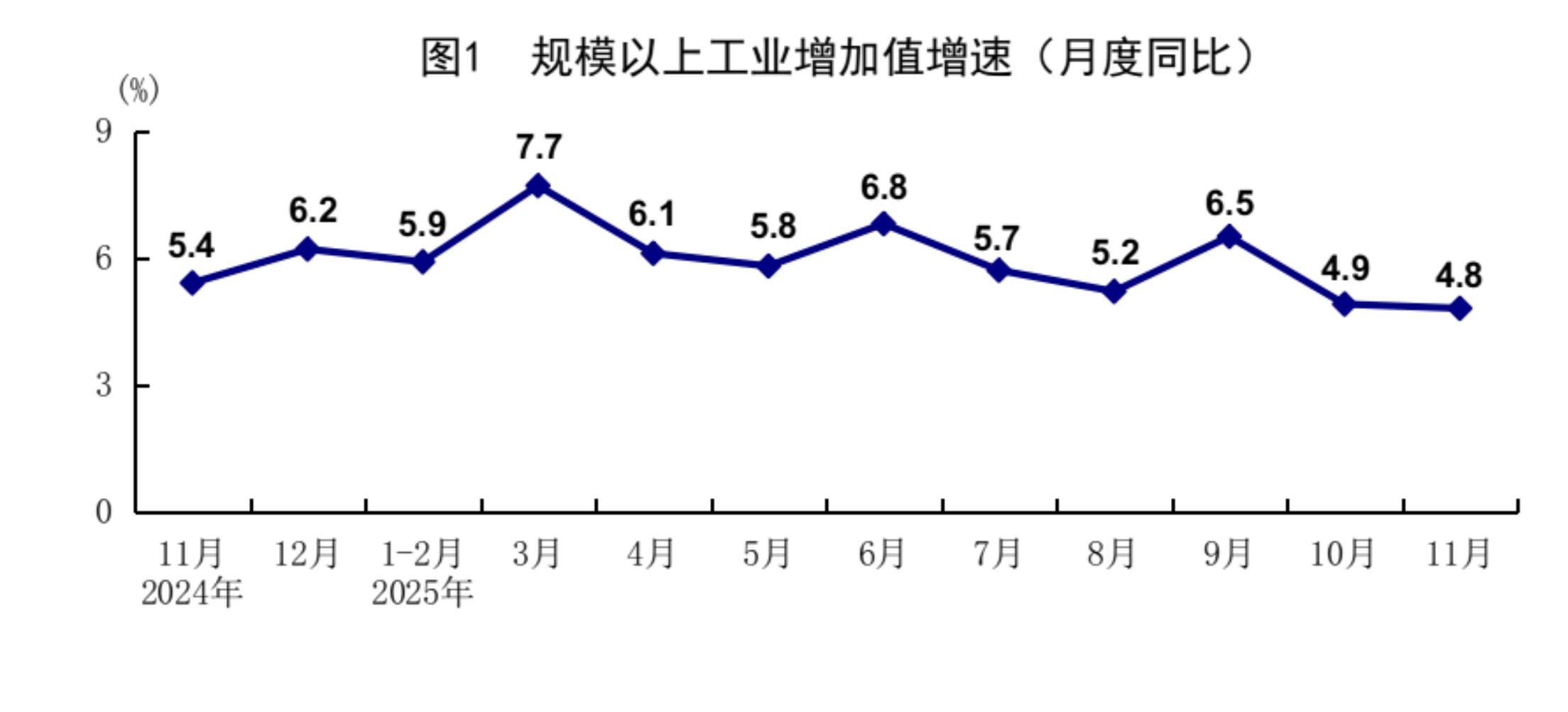
(2025年12月15日) 国家统计局 11月份,在以习近平同志为核心的党中央坚强领导下,各地区各部门认真贯彻落实党中央、国务院决策 部署,坚持稳中求进工作总基调,深入实施更加积极有为的宏观政策,纵深推进全国统一大市场建设, 着力推动高质量发展,生产供给基本平稳,就业形势总体稳定,市场价格继续改善,新质生产力稳步发 展,经济运行延续总体平稳、稳中有进发展态势。 一、全年粮食实现丰收,稳定在1.4万亿斤以上 全年全国粮食产量14298亿斤,比上年增加167.5亿斤,增长1.2%,稳定在1.4万亿斤以上。其中,秋粮 产量10732亿斤,比上年增加163.6亿斤,增长1.5%。全国谷物产量13204亿斤,比上年增加158.4亿斤, 增长1.2%。粮食播种面积增加、单产提高。全国粮食播种面积17.91亿亩,比上年增加134.8万亩,增长 0.1%;粮食单产399.1公斤/亩,每亩产量比上年增加4.4公斤,增长1.1%。 二、工业生产稳定增长,装备制造业和高技术制造业增长较快 11月份,全国规模以上工业增加值同比增长4.8%,环比增长0.44%。分三大门类看,采矿业增加值同比 增长6.3%,制造业增长4.6%,电力、热 ...
国家统计局关于2024年国内生产总值最终核实的公告 - 国家统计局
Guo Jia Tong Ji Ju· 2025-12-29 09:36
Group 1 - The core point of the article is the final verification of China's GDP data for 2024, which shows a total nominal GDP of 13,480.66 billion yuan, a decrease of 10.18 billion yuan from the preliminary estimate, with a year-on-year growth of 5.0% at constant prices, consistent with the preliminary estimate [1][2][4]. Group 2 - The primary industries contributed 91.64 billion yuan with a growth rate of 3.7% [5]. - The secondary industries accounted for 490.305 billion yuan, growing at 6.8% [5]. - The tertiary industries reached 766.125 billion yuan, with a growth rate of 5.1% [5]. - The agricultural sector, including forestry, animal husbandry, and fishery, grew by 4.0% [5]. - The industrial sector, which includes manufacturing, grew by 5.5% [6]. - The construction industry saw a growth of 2.9% [6]. - The wholesale and retail sector grew by 6.5% [6]. - The transportation, warehousing, and postal sector grew by 6.7% [6]. - The accommodation and catering sector grew by 7.0% [6]. - The financial sector grew by 3.7% [6]. - The real estate sector experienced a decline of 2.2% [6]. - The information transmission, software, and IT services sector grew by 11.7% [6]. - The leasing and business services sector grew by 11.1% [6]. - Other industries grew by 3.9% [6].
年终特稿丨2025,澳门的“小城新事”
Xin Lang Cai Jing· 2025-12-28 09:10
转自:中新社 编辑:张俊 来源:中新社 临近岁末,澳门各个景点和商区游人如织,若细心留意,便会发现这座小城的气质正悄然更新。街道 上,"粤Z"车牌车辆明显增多,大湾区"一小时生活圈"有了生动注脚;商场里,非博彩消费占比逐渐攀 升,艺术展览、主题餐饮等构筑起新的消费场域;口岸旁,琴澳跨境学生专车停靠,孩子们无缝往返两 地校园……2025年的澳门,街头巷尾"新事"点点,诉说着这座小城主动求变、加速融入国家发展大局的 深刻转型。适度多元振经济2025年,澳门"1+4"经济适度多元发展策略成效显著,落地有声。一个直观 的信号来自各口岸。截至12月27日,今年访澳旅客累计3941.1万人次,创历史新高。"旅游+"战略成效 斐然——一场演唱会,能带动周边酒店入住率飙升;一项大型体育赛事,街头巷尾的茶餐厅便挤满了各 国观众……"旅游+美食""旅游+盛事""旅游+会展"等成功留住了游客脚步。这一年,澳门加快培育现代 金融新业态,推动债券市场与国际接轨。在中华(澳门)金融资产交易股份有限公司上市的债券规模突破 万亿澳门元,获许可营运的金融机构数量持续增加,助力中小微企业融资渠道多元化。这一年,澳门特 区政府跟进多项高新技术投资 ...
中国人民银行科技司司长李伟:积极稳妥、安全有序推进人工智能金融应用
Xin Lang Cai Jing· 2025-12-28 09:03
Core Insights - Artificial intelligence (AI) is becoming a crucial engine for high-quality development across various industries, particularly in enabling the digital transformation of finance [1][6] - The "14th Five-Year Plan" is concluding, while the "15th Five-Year Plan" is being formulated, marking a year of collaborative innovation between AI and finance [2][7] Group 1: AI in Financial Sector - AI applications in finance are expanding from auxiliary roles to core business functions such as credit risk control, compliance review, and intelligent investment advisory [2][7] - Financial institutions are leveraging AI to enhance operational efficiency while adhering to legal compliance and risk management principles [2][7] - The transition from traditional computing systems to intelligent computing systems is ongoing, with a focus on developing a robust hardware and software ecosystem [2][7] Group 2: Support for AI Development - The reduction in barriers and costs for large model applications, along with significant improvements in logical reasoning and multimodal capabilities, is accelerating AI adoption in finance [3][8] - Continuous advancements in intelligent computing chips are providing a secure and efficient foundation for the digital transformation of finance [3][8] Group 3: Challenges and Governance - There is a need to strengthen governance around technology ethics, address risks of model homogeneity, and tackle inherent flaws in algorithm architectures [3][8] - Data governance and security are facing challenges that require attention as AI applications in finance evolve [3][8] Group 4: Strategic Recommendations - A comprehensive financial technology development plan should be established, emphasizing the integration of AI applications as a core focus for the "15th Five-Year Plan" [4][9] - A robust risk management framework should be developed, including safety standards for AI applications in finance and a human-centered governance model [4][9] - The application level of AI should be enhanced by focusing on key areas such as credit financing, risk control, and marketing services [4][9] Group 5: Industry Collaboration - Collaboration between financial institutions and AI companies should be strengthened through industry associations and joint laboratories to promote innovation and enhance the competitiveness of AI products [5][10]