
军工

Search documents
广东宏大(002683):Q3业绩低于预期,民爆矿服持续增长,军工板块有望进入成长期
Shenwan Hongyuan Securities· 2025-10-24 06:44
Investment Rating - The investment rating for the company is "Outperform" (maintained) [1] Core Insights - The company's Q3 performance was below expectations, with total revenue of 54.01 billion yuan in Q3 2025, a year-on-year increase of 44%, but a quarter-on-quarter decrease of 2% [8] - The company has a strong order backlog exceeding 35 billion yuan in mining services, with significant growth in the Xinjiang and Tibet regions [8] - The defense equipment sector is entering a growth phase, supported by recent acquisitions and partnerships [8] Financial Data and Profit Forecast - Total revenue projections for 2025 are 22.22 billion yuan, with a year-on-year growth rate of 62.8% [2] - The forecasted net profit attributable to shareholders for 2025 is 1.01 billion yuan, reflecting a 13% increase from the previous year [2] - Earnings per share (EPS) are projected to be 1.34 yuan for 2025, with a price-to-earnings (PE) ratio of 29 [2] Market Data - As of October 23, 2025, the closing price of the stock was 38.12 yuan, with a market capitalization of 25.17 billion yuan [3] - The company has a price-to-book ratio of 4.3 and a dividend yield of 1.71% [3] - The stock has experienced a 52-week high of 45.78 yuan and a low of 24.29 yuan [3]

早盘直击|今日行情关注
申万宏源证券上海北京西路营业部· 2025-10-24 05:09
Market Overview - A-shares have been oscillating around the 3900-point mark, with a rebound observed after a period of consolidation, driven by active performance in cyclical sectors such as coal and non-ferrous metals [1] - The impact of tariff events is gradually diminishing, leading to a renewed focus on domestic industrial trends as the 14th Five-Year Plan is set to be finalized [1] Future Outlook - The market is expected to maintain a震荡上行 (oscillating upward) trend, with the tariff event's impact being short-term and not affecting the mid-term trend [2] - Key focuses for October include the finalization of the 14th Five-Year Plan, the disclosure of Q3 reports, and event-driven developments in the technology sector [2] Sector Highlights - The technology sector remains a focal point, with potential for rebound in underperforming areas such as robotics, military industry, and smart vehicles [2] - The domestic semiconductor industry is on an upward trajectory, with attention on semiconductor equipment, wafer manufacturing, materials, and IC design [2] - The military sector is expected to see a recovery in orders by 2025, with signs of bottoming out in mid-term performance [2] - The innovative pharmaceutical sector is anticipated to reach a turning point in fundamentals by 2025, following a period of adjustment [2] - The banking sector is witnessing a recovery in mid-term performance after the impact of loan rate re-pricing, attracting interest from long-term institutional investors due to its dividend yield [2]


特朗普语气突软,开始打感情牌,韩国会晤前想让中再给个机会
Sou Hu Cai Jing· 2025-10-24 04:44
Group 1 - Trump's tone softened during an interview, indicating a potential shift in the U.S.-China relationship as he confirmed a meeting with Chinese leaders in Korea [1][3][24] - The U.S.-China disputes encompass various sectors, including rare earth exports, tariff threats, and agricultural trade, creating significant pressure on bilateral relations [1][4] - Recent U.S. actions, including discussions on rare earth controls and tariff adjustments, reflect internal complexities and pressures within the Trump administration [8][10] Group 2 - China's recent policy on rare earth exports, which includes new export controls, has caused global market reactions, with a 31% decline in China's rare earth exports over three months [12][14] - The rising prices of rare earths are increasing costs for U.S. manufacturing, particularly in electric vehicles and defense sectors, leading to heightened tensions within the U.S. manufacturing industry [19][21] - Trump's acknowledgment of the unsustainability of tariffs and the need for cooperation with China marks a strategic shift, as he balances domestic pressures with international negotiations [24][28]
市场点评报告:四中全会公报强化A股主线
Bank of China Securities· 2025-10-24 02:04
Group 1 - The report emphasizes that the 20th Central Committee's Fourth Plenary Session has set a directional tone for the "14th Five-Year Plan," focusing on structural optimization and high-quality development, indicating that the A-share market is expected to transition from policy support to a new starting point for structural upgrades [1][2] - The meeting's communiqué reiterates the principle of "seeking progress while maintaining stability," aiming for qualitative improvements and reasonable quantitative growth in the economy, with a focus on innovation-driven development and the construction of a domestic circulation system [2][4] - Key sectors identified for future policy resource allocation include advanced manufacturing, artificial intelligence, new energy, new materials, military industry, aerospace, and digital infrastructure, which are expected to benefit from the "14th Five-Year Plan" [2][4] Group 2 - The report highlights the importance of building a strong domestic market and suggests that consumption and service industry upgrades will become another significant policy focus, driven by improving livelihoods, promoting employment, and expanding the middle-income group [2][4] - The emphasis on green transformation and energy revolution indicates that sectors related to green electricity, energy storage, energy conservation, and carbon management may regain policy attention [2][4] - The report suggests that the core significance of the Fourth Plenary Session for the A-share market lies in clarifying medium- to long-term directions and reinforcing structural certainty, with macro policies expected to support an upward shift in the A-share market's operating center [2][4] Group 3 - The report anticipates that the subsequent rollout of the "14th Five-Year Plan" will reshape the investment themes and valuation systems in the capital market, with new productive forces represented by technological self-reliance, green transformation, and domestic demand upgrades becoming the main policy threads for the next five years [2][4] - It is suggested that long-term funds, particularly public funds, insurance capital, and state-owned funds, will increasingly concentrate on industries with strategic support value [2][4] - The report recommends maintaining a medium to high position in the portfolio, focusing on advanced manufacturing, technology hardware, green energy chains, and digital economy sectors in the short term, while also allocating to high-dividend, low-valuation sectors like finance, electricity, and public utilities to balance volatility and returns [2][4]
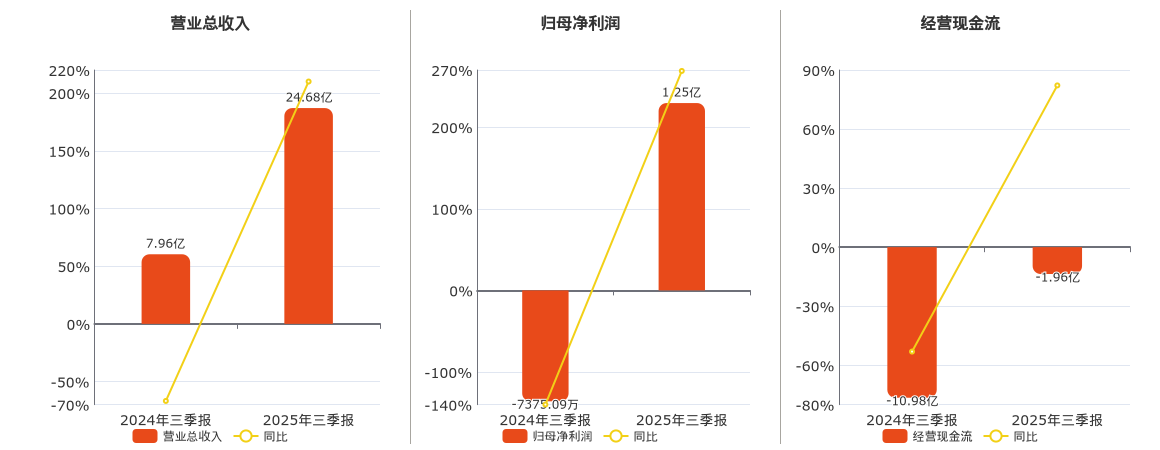
北方导航(600435.SH):2025年三季报净利润为1.25亿元,同比扭亏为盈
Xin Lang Cai Jing· 2025-10-24 01:58
Core Insights - The company reported a significant increase in total revenue and net profit for Q3 2025, indicating strong financial performance [1][3] - The operating cash flow showed improvement, although it remained negative, suggesting potential liquidity challenges [1] Financial Performance - Total revenue reached 2.468 billion, an increase of 1.672 billion compared to the same period last year, representing a year-on-year growth of 210.01% [1] - Net profit attributable to shareholders was 125 million, an increase of 198 million from the same period last year [1] - Operating cash flow was -196 million, an improvement of 902 million compared to the previous year [1] Profitability Metrics - The latest asset-liability ratio stands at 54.60%, a decrease of 0.05 percentage points from the previous quarter [3] - Gross profit margin is reported at 20.32% [3] - Return on equity (ROE) is 4.27%, an increase of 7.10 percentage points year-on-year [3] - Diluted earnings per share (EPS) is 0.08, an increase of 0.13 from the same period last year [3] Efficiency Ratios - Total asset turnover ratio is 0.31 times, an increase of 0.20 times year-on-year, reflecting a growth of 167.69% [3] - Inventory turnover ratio is 2.85 times, an increase of 1.86 times compared to the previous year, representing a growth of 187.63% [3] Shareholder Information - The number of shareholders is 150,500, with the top ten shareholders holding 708 million shares, accounting for 46.86% of the total share capital [3] - The largest shareholder is 北方导航科技集团有限公司, holding 22.4% of shares [3]

聚焦高质量发展,进一步稳固A股慢牛
Huajin Securities· 2025-10-24 00:09
Group 1 - The report emphasizes a shift towards focusing on economic construction during the 14th Five-Year Plan, indicating a heightened urgency for economic growth compared to the previous plan [10][13][19] - Key areas of focus include the development of advanced manufacturing, technological self-reliance, and expanding domestic demand, which are seen as strategic priorities for the 15th Five-Year Plan [2][13][20] - The report anticipates that policies aimed at achieving economic growth targets will likely lead to increased fiscal and monetary support in the fourth quarter [10][18] Group 2 - The report suggests that the A-share market is likely to maintain a slow bull trend, with improving profit expectations driven by policies focused on economic construction and advanced manufacturing [3][15][18] - Short-term market dynamics may also benefit from increased liquidity and a positive outlook on economic growth, which could enhance market risk appetite [3][18][19] - The report identifies specific sectors that may benefit from these trends, including TMT (Technology, Media, and Telecommunications), machinery, and military industries, which are aligned with the modernization of the industrial system [4][19][20] Group 3 - Industries related to new productive forces, such as TMT, machinery, and military sectors, are expected to benefit from policies promoting technological innovation and infrastructure development [4][19][20] - The advanced manufacturing sector, including non-ferrous metals, chemicals, and pharmaceuticals, is highlighted as a key area for growth, driven by national security and environmental sustainability initiatives [20][21][22] - Consumer sectors, particularly those related to social services and retail, are also positioned to gain from policies aimed at boosting domestic demand and improving living standards [22][23]
策略日报:四中全会确定主线-20251023
Tai Ping Yang Zheng Quan· 2025-10-23 15:29
Group 1 - The report emphasizes that the upcoming quarter will see renewed market interest in traditional sectors such as coal, banking, and aquaculture, as indicated by the strong performance of the dividend index [5][18] - The Fourth Plenary Session has established AI as a core focus for the technology sector, alongside military-related themes, which are expected to dominate the market for the next five years [5][10] - The report suggests that the technology sector's high absorption rate and volatility will make it difficult to achieve excess returns, while sectors like coal, banking, and nuclear power are expected to perform well in the fourth quarter [5][18] Group 2 - The report predicts that the bond market will stabilize in the short term but will continue to decline in the long term, with a target near the low point from September 30, 2024 [4][15] - The A-share market is expected to focus on traditional sectors in the upcoming quarter, while the technology sector will be monitored for a potential decrease in absorption rates [10][18] - The report highlights that the U.S. stock market is likely to perform strongly due to anticipated favorable earnings reports, although it may experience low volatility leading up to key meetings [6][23] Group 3 - The report indicates that the onshore RMB has shown strength against the USD, with the central bank guiding the midpoint lower, while the dollar is expected to maintain a strong performance [7][27] - The euro is projected to continue its decline against the dollar, influenced by factors such as Germany's fiscal restructuring narrative and the euro's overvaluation impacting export competitiveness [8][27] - The commodity market is experiencing a positive trend, particularly in oil and new energy sectors, with several domestic commodities showing signs of recovery [8][32]
首席联合解读四中全会
2025-10-23 15:20
Summary of Key Points from the Conference Call Industry or Company Involved - The conference call primarily discusses the **Chinese economy** and its **fifteenth five-year plan (十五规划)**, focusing on various sectors including technology, agriculture, and capital markets. Core Points and Arguments 1. **Focus on Domestic Demand**: The fifteenth five-year plan emphasizes expanding domestic demand through improving living standards and promoting consumption, alongside effective investment and resource allocation [1][6][11]. 2. **Technological Innovation**: China aims to enhance its technological innovation capabilities, with R&D expenditure reaching 26.2% of global spending, second only to the US. The plan prioritizes the application of technological achievements to build a modern industrial system [1][8][20]. 3. **High-Level Opening Up**: The plan stresses the importance of a high-level, autonomous opening up to foster reform and development, particularly in the context of increasing geopolitical competition [1][9][12]. 4. **Impact on Capital Markets**: Although the plan does not explicitly mention financial markets, historical trends indicate that five-year plans significantly influence capital market development. Key investment areas include high-end manufacturing, digital technology, and new consumption [1][12][14]. 5. **Challenges and Achievements of the Fourteenth Five-Year Plan**: The previous plan saw notable achievements in economic and technological strength but faced challenges such as the pandemic and real estate market adjustments, which will be addressed in the new plan [2][3]. Other Important but Possibly Overlooked Content 1. **Cultural and Agricultural Development**: The plan highlights the importance of cultural innovation and modernization in agriculture, focusing on seed industry, smart agriculture, and intelligent machinery as core development areas [4][41]. 2. **Consumer Spending**: The plan aims to stimulate consumer spending by improving income levels and addressing issues like social security and education equity [10][15]. 3. **Balance of Supply and Demand**: The strategy includes aligning new demand with new supply to foster a healthy interaction between consumption and investment [16]. 4. **Opportunities in Emerging Sectors**: The call suggests focusing on emerging sectors such as the "first launch economy," new cultural tourism projects, and the aging population economy, which present significant growth opportunities despite overall economic slowdowns [18]. 5. **Green Transition**: The plan emphasizes a comprehensive green transition, impacting industries like wind and solar energy, with ambitious targets for renewable energy capacity by 2035 [34][35]. This summary encapsulates the key insights from the conference call, providing a comprehensive overview of the strategic directions outlined in the fifteenth five-year plan and its implications for various sectors in the Chinese economy.
俄外交部发言人:美欧对俄新制裁不会产生预期效果
Xin Hua She· 2025-10-23 15:08
Core Viewpoint - The new sanctions imposed by the US and EU on Russia are expected to backfire, causing damage to the EU and global economy instead of achieving their intended effects [1] Group 1: Sanctions Impact - Russia has developed immunity to sanctions over recent years and will continue to advance its economic and political potential despite them [1] - The US government is attempting to force Russia to sacrifice its national interests, but this strategy is unlikely to yield the desired results and may negatively impact global economic stability [1] Group 2: Specific Sanctions - The US announced sanctions against Russia's two largest oil companies, Rosneft and Lukoil, which together account for nearly 50% of Russia's total crude oil exports [1] - The EU has officially implemented its 19th round of sanctions against Russia, which includes 69 new individual sanctions and various economic restrictions, primarily targeting the energy, finance, and military sectors [1]
俄称打击乌能源设施 乌称打击俄两处重要设施
Yang Shi Wang· 2025-10-23 14:11
Core Viewpoint - The ongoing conflict between Russia and Ukraine has escalated, with significant military actions and sanctions impacting the energy and defense sectors of both countries [1] Group 1: Military Actions - The Russian military has conducted large-scale strikes on 144 locations related to Ukraine's military industrial complex, including equipment manufacturing plants and refineries [1] - Ukrainian armed forces have targeted a Russian military factory and a refinery, while also claiming control over a settlement in the Donetsk region [1] Group 2: Sanctions and Economic Impact - The United States has announced sanctions against Russia's two largest oil companies, indicating a tightening of economic measures against Russia [1] - The European Union has implemented its 19th round of sanctions against Russia, which includes a ban on Russian liquefied natural gas entering the European market for the first time [1] - Russia's Foreign Ministry spokesperson stated that the space for further EU sanctions against Russia is nearly exhausted, suggesting potential retaliatory measures from Russia [1]