智能手机

Search documents
雷军斥资超1亿港元增持小米公司股份;盒马旗下平价超市正式开放加盟 | 早资道
Sou Hu Cai Jing· 2025-11-25 01:28
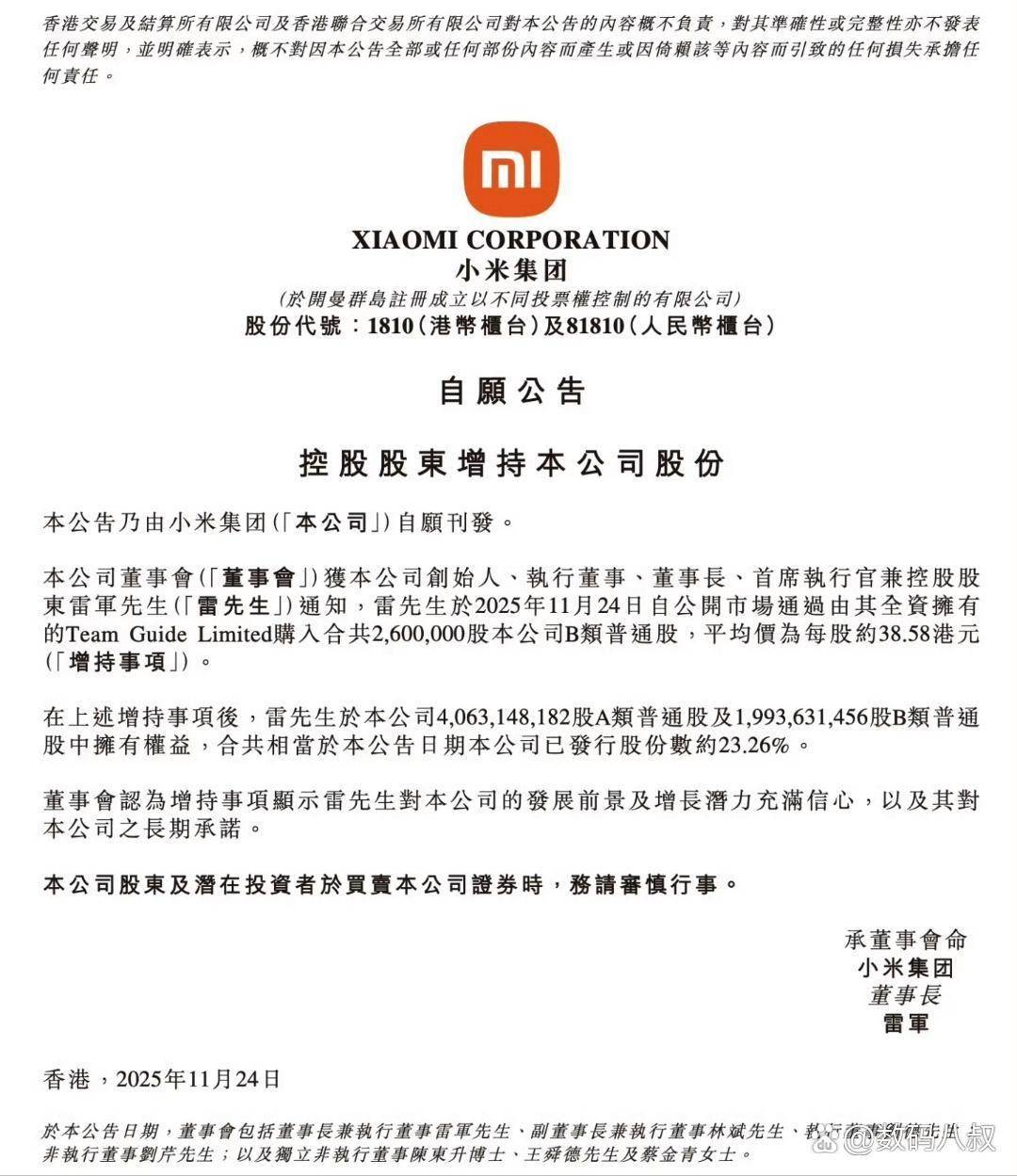
Group 1 - Xiaomi Group's founder and CEO Lei Jun invested over 100 million HKD to increase his stake in the company to 23.26% by acquiring 2.6 million shares [2] - Xiaomi Group repurchased 21.5 million shares on November 20 and 21, with a total expenditure exceeding 800 million HKD [2] Group 2 - Hema's budget community supermarket, Super Box, has officially opened its franchise application channel, with the first batch of cities including Shanghai, Hangzhou, Jiaxing, and Huzhou [3] - The franchise fee for Super Box is set at 50,000 RMB per year, excluding store renovation, equipment, and deposit costs [3] Group 3 - Alibaba's AI assistant Qianwen App achieved over 10 million downloads within a week of its public testing, making it the fastest-growing AI application [4] - The app reached the top three in the Apple App Store free overall rankings just three days after its launch [4] Group 4 - Didi Autonomous Driving and RoboSense have established a partnership for the next-generation Robotaxi model, with RoboSense providing digital lidar perception solutions [5] Group 5 - Doubao Input Method has officially launched, supporting both voice and keyboard input, with enhanced speech recognition and semantic understanding capabilities [6] - The input method supports multiple dialects, including Cantonese and Sichuan dialect, as well as English and mixed Chinese-English input [6]


央行今日开展10000亿元MLF操作;纳指收涨2.69% |盘前情报
2 1 Shi Ji Jing Ji Bao Dao· 2025-11-25 00:57
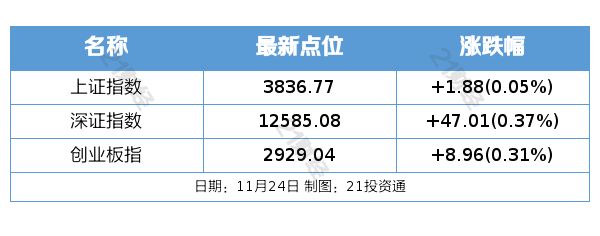
Market Overview - On November 24, the A-share market showed signs of recovery with all three major indices closing in the green. The Shanghai Composite Index rose by 0.05%, the Shenzhen Component Index increased by 0.37%, and the ChiNext Index gained 0.31% [1][2] - The total trading volume in the Shanghai and Shenzhen markets was 1.73 trillion yuan, a decrease of 237.9 billion yuan compared to the previous trading day [1] Sector Performance - The AI application concept stocks experienced a significant surge, with over 4,200 stocks in the market rising. The commercial aerospace sector also saw continued gains [1] - Conversely, lithium mining stocks declined, and computing hardware concepts weakened. The sectors with the highest gains included AI applications and commercial aerospace, while energy metals, Hainan, and gas sectors faced the largest declines [1] International Market - In the U.S. stock market, all three major indices rose on November 24. The Dow Jones Industrial Average increased by 202.86 points (0.44%) to close at 46,448.27 points, the S&P 500 rose by 102.13 points (1.55%) to 6,705.12 points, and the Nasdaq Composite gained 598.92 points (2.69%) to 22,872.01 points [3][4] - In Europe, the market showed mixed results, with the UK FTSE 100 down by 0.05%, the French CAC 40 down by 0.29%, while the German DAX index rose by 0.64% [3][4] - International oil prices increased, with WTI crude oil rising by 1.34% to $58.84 per barrel and Brent crude oil up by 1.29% to $63.37 per barrel [3][4] Key Economic Policies - The People's Bank of China announced a 10 billion yuan MLF operation scheduled for November 25, aimed at maintaining ample liquidity in the banking system [5] Corporate Developments - Huawei is set to launch its Mate80 series and MateX7 products on November 25, with expectations of significant advancements in performance and technology [10] - Alibaba will announce its quarterly earnings on November 25, with a focus on capital expenditure and AI application progress [11] Investment Insights - China Galaxy Securities noted a cautious market sentiment with a "high cut low" characteristic, suggesting a short-term focus on structural adjustments and potential opportunities following recent market corrections [12] - Huatai Securities indicated that the current market adjustment has created a supportive environment, with expectations of improved overseas liquidity and reduced domestic funding pressure [12]

有人被拖欠工资!毫末智行北京总部人去楼空,员工抱着显示器离开;曝ASML为美国监控中国客户!官方否认;雷军斥资超1亿港元增持小米
雷峰网· 2025-11-25 00:32
Group 1 - ASML has denied allegations that it proposed to the US government to monitor its Chinese customers, stating that such claims are misleading and untrue [4][5] - The autonomous driving company Haomo has reportedly ceased operations, leaving its headquarters empty and employees unpaid, with speculation about a failed bet leading to legal issues [7][8] - Xiaomi's founder Lei Jun has invested over HKD 100 million to increase his stake in the company to 23.26%, coinciding with a period of stock buybacks amid market challenges [15][16] Group 2 - The domestic GPU company Moer Thread has launched its IPO with a record issuance price of CNY 114.28 per share, attracting significant investor interest with a subscription rate of 4126.49 times [16][17] - JD Industrial has passed the hearing for its IPO on the Hong Kong Stock Exchange, marking it as the sixth company under JD Group to go public [22][23] - The partnership between GAC and Huawei has led to the launch of a new automotive brand, with GAC's management asserting that there is no risk of homogenization among their various brands [26][27] Group 3 - Apple CEO Tim Cook is reportedly not planning to step down, despite media speculation about a potential transition in leadership [43] - Tesla's Full Self-Driving (FSD) feature has officially launched in South Korea, expanding its global presence to seven countries [44][45] - Nvidia's CEO Jensen Huang has stated that the company has evolved from a gaming GPU manufacturer to a foundational infrastructure provider for AI data centers, marking a significant strategic shift [52]

上证早知道|近1600倍,摩尔线程网下申购遭疯抢;工业富联:未下调业绩目标;阿里巴巴,今日发布财报;450亿元,龙蟠科技大订单
Shang Hai Zheng Quan Bao· 2025-11-24 23:06
Key Points - Alibaba is set to announce its quarterly earnings on November 25, with a focus on capital expenditure and AI application progress [2] - The Qatar Mobile Communications Exhibition MWC25 Doha will take place on November 25-26 at the Doha Exhibition Center [2] - The 2025 Global Digital Business Conference will be held in Shanghai on November 25-26, featuring four main segments: conference forums, business transformation, diverse exhibitions, and application experiences [2] Industry Insights - As of the end of October, China's total installed power generation capacity reached 3.75 billion kilowatts, a year-on-year increase of 17.3%. Solar power capacity grew by 43.8% to 1.14 billion kilowatts, while wind power capacity increased by 21.4% to 590 million kilowatts [4] - The Shanghai Municipal Government has released measures to promote high-quality development in the pharmaceutical industry, focusing on key areas such as cell and gene therapy and brain-computer interfaces [4] - The 2025 Asian General Aviation Exhibition will be held from November 27-30 in Zhuhai, with over 300 companies from 21 countries participating, highlighting the potential of the low-altitude economy [11] Company News - Xiaomi Group's founder and CEO Lei Jun has invested over HKD 100 million to purchase 2.6 million shares at an average price of approximately HKD 38.58 per share, increasing his stake to 23.26% [13] - Industrial Fulian reported that its fourth-quarter operations are proceeding as planned, with no adjustments to profit targets [13] - Longpan Technology announced a supplementary agreement to sell 130,000 tons of lithium iron phosphate cathode materials from 2025 to 2030, with an estimated total sales amount exceeding RMB 45 billion [13] - Unigroup's 800G CPO silicon optical switch product is ready for mass production and commercial delivery, supporting high-speed interconnect needs for AI workloads [14] - Zhaojing Pharmaceutical's investigational product ZG006 has been included in the list of breakthrough therapy varieties by the National Medical Products Administration [15]

华尔街见闻早餐FM-Radio | 2025年11月25日
Hua Er Jie Jian Wen· 2025-11-24 23:01
Group 1 - China and the US leaders discussed the importance of cooperation and the Taiwan issue, emphasizing that Taiwan's return to China is a crucial part of the post-war international order [10] - Japan plans to deploy offensive weapons on islands near Taiwan, which China views as a dangerous move that requires high vigilance [10] - China is launching a space exploration satellite program to investigate the origins of life in the universe, aiming for breakthroughs in various scientific fields [10][28] Group 2 - The US Federal Reserve officials, including Waller and Daly, expressed concerns about the labor market and supported a potential interest rate cut in December [11] - Trump signed an executive order to initiate the "Genesis Project" for artificial intelligence, aiming to transform scientific research and accelerate discoveries [11] Group 3 - OpenAI launched a free shopping search feature using its ChatGPT model, aiming to enhance user experience during the holiday shopping season [14] - Amazon plans to invest up to $50 billion to expand AI computing capacity for the US government, adding 1.3GW of capacity [14] Group 4 - The first domestic GPU company, Moore Threads, saw overwhelming demand for its IPO, with a subscription rate of 0.024% and an offline subscription multiple of nearly 1600 times [12] - Alibaba's AI assistant app, Qianwen, achieved over 10 million downloads in its first week, significantly boosting Alibaba's stock price [13] Group 5 - Morgan Stanley raised its target price for Baidu, citing a significant underestimation of its AI transformation speed and projecting a sixfold increase in Kunlun chip sales next year [19] - WeRide reported a 761% year-on-year increase in revenue from its autonomous taxi service, indicating a growing market for self-driving technology [19]

喜娜AI速递:昨夜今晨财经热点要闻|2025年11月25日
Sou Hu Cai Jing· 2025-11-24 22:21
Group 1 - Two new stocks are available for subscription on the Sci-Tech Innovation Board this week, with "Moore Threads," a domestic GPU company, starting its subscription on November 24 at a price of 114.28 yuan per share, the highest this year, requiring a payment of 57,140 yuan for one lot [2][4] - The A-share market is experiencing increased volatility, with the Shanghai Composite Index declining and only 20% of previously high-performing equity funds remaining profitable, while ETFs have attracted significant capital inflows of 100 billion yuan in the fourth quarter [2] - Domestic fuel prices are set to decrease, with gasoline and diesel prices lowered by 70 yuan and 65 yuan per ton respectively, leading to reduced costs for private car owners and logistics companies [2] Group 2 - Lei Jun has personally invested over 100 million Hong Kong dollars to increase his stake in Xiaomi to 23.26%, while the company has repurchased shares worth over 800 million Hong Kong dollars this month, totaling over 2.3 billion Hong Kong dollars for the year [3] - The Japanese tourism industry is under pressure due to a decline in Chinese tourists following tensions in Sino-Japanese relations, with many Chinese travelers shifting to destinations like South Korea and Thailand [3] - Federal Reserve officials have signaled a dovish stance, with expectations for a rate cut in December, positively impacting market sentiment and leading to a rebound in U.S. tech stocks [3] Group 3 - The initial subscription for "Moore Threads" saw an overwhelming response, with a preliminary subscription multiple of 4,126.49 times, resulting in a final winning rate of 0.03635054% after the implementation of a callback mechanism [4] - Discussions around the AI sector's potential bubble have intensified, with industry experts asserting that the AI industry is still in its growth phase, supported by favorable policies [5] - BYD has launched the Han L model with a post-subsidy price range of 194,800 to 264,800 yuan, featuring significant upgrades in technology and design [5]


雷军持小米集团股比例增加至23.26%。 根据小米官方消息,雷军个人斥资超1亿港元增持小米集团260万股。那么截至目前,雷军持股比例增加至23.26%。 雷总都增加持股了,普通米粉,是不是可以盲买了?
Sou Hu Cai Jing· 2025-11-24 14:40
Core Viewpoint - Lei Jun has increased his stake in Xiaomi Group to 23.26% by investing over 100 million HKD to acquire 2.6 million shares [1] Summary by Categories Company Actions - Lei Jun personally invested over 100 million HKD to purchase 2.6 million shares of Xiaomi Group [1] - As a result of this transaction, Lei Jun's ownership percentage in Xiaomi Group has risen to 23.26% [1] Market Implications - The increase in stake by the CEO may signal confidence in the company's future performance, potentially influencing retail investors' sentiment towards buying Xiaomi shares [1]
雷军斥资超1亿港元,增持小米
Sou Hu Cai Jing· 2025-11-24 14:20
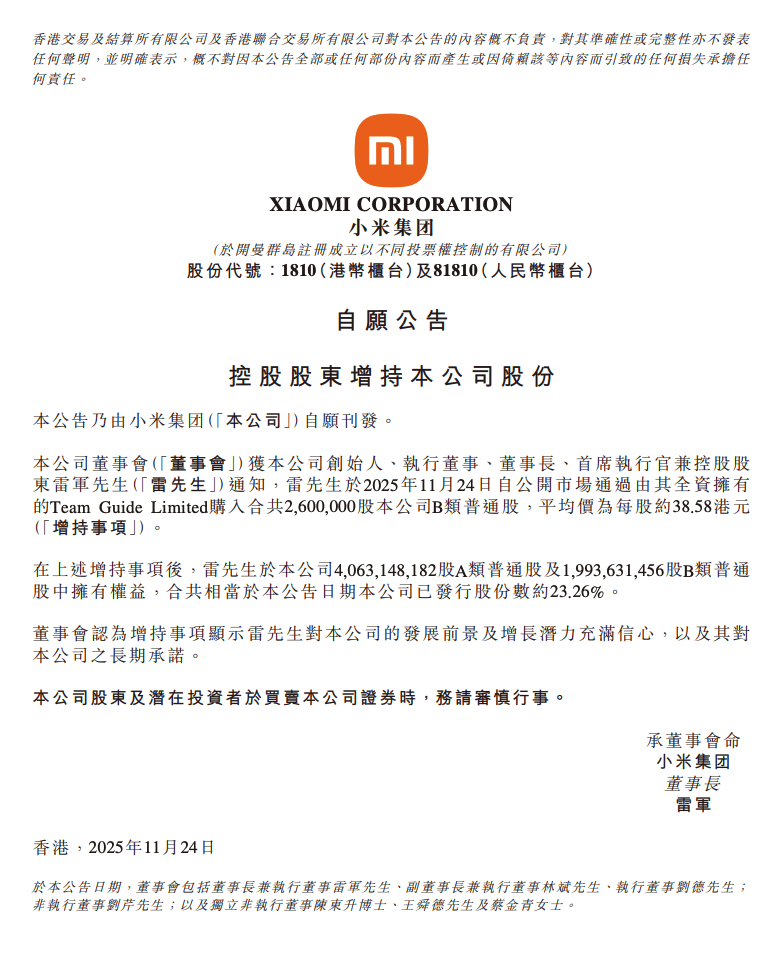
11月24日,小米集团于港交所发布公告披露,小米集团创始人、董事长兼CEO雷军个人斥资超1亿港元增持小 米集团260万股,其个人持股比例增加至23.26%。 小米集团董事会认为,增持事项显示雷军对公司的发展前景及增长潜力充满信心。 图源:港交所 本月,小米集团连续两日大手笔回购公司股票,总金额超8亿港元。今年以来,小米集团累计回购金额已超23 亿港元。 11月18日,小米集团发布业绩公告:2025年第三季度实现营收约1131.21亿元,同比增长22.3%,连续4个季度突 破千亿元;经调整净利润为113亿元,创历史新高,同比增长80.9%。 11月20日,第50万辆小米汽车正式下线,创全球新能源车企50万辆下线的最快纪录。当天,雷军发微博长文表 示:"行胜于言、以行践言,我们会用行动向大家交出更好的答卷。" (流程编辑:U072) ...
荣耀500系列手机发布
Zhong Zheng Wang· 2025-11-24 13:53
Core Points - Honor launched the Honor 500 series smartphones on November 24, featuring significant upgrades in "imaging, performance, battery life, appearance, and experience" to redefine industry standards [1] - The Honor 500 series includes two versions: Honor 500 Super Standard Edition priced at 2699 yuan and Honor 500 Super Pro Edition priced at 3599 yuan, with pre-sales already started and full sales commencing on November 27 [1] - The series incorporates a 2 billion AI ultra-clear portrait foundation, a large 1/1.4-inch sensor, and a 12 million ultra-wide-angle lens, with the Pro version offering a 50 million dual-stabilization telephoto lens [1] - The Honor 500 series supports 27W wired reverse charging for devices like iPhones and features 80W wired fast charging and 50W wireless fast charging in the Pro version [2] - The new MagicOS 10 operating system enhances user interaction and experience [2] - According to IDC, after strategic and product adjustments, Honor's market performance has improved, with approximately 9.9 million units shipped in Q3 2025, ranking fifth in the Chinese smartphone market [2]
AI日报丨诺基亚计划在美国进行40亿美元AI投资,苹果“史上最薄iPhone”初期销量远逊预期
美股研究社· 2025-11-24 13:22
Group 1 - Nokia plans to invest $4 billion in the U.S. for AI research and production to enhance AI network connectivity [5][6] - Goldman Sachs partner Tony Pasquariello notes signs of capitulation among bulls in the U.S. stock market, indicating potential further sell-offs before stabilization [7][8] - Google introduces BigQuery AI, integrating generative AI into user data management, streamlining the machine learning lifecycle without data migration [9] Group 2 - Citic Securities highlights Nvidia's impressive earnings and guidance, along with Google's Gemini 3 model performance, indicating ongoing growth in the AI sector and recommending investment in the AI PCB segment [10] - Apple's iPhone 17 Air, marketed as the "thinnest iPhone ever," has underperformed in initial sales, leading to a production cut due to lower-than-expected demand [12] - Google aims to double its computing power every six months, with a long-term goal of a 1000-fold increase in capacity over the next 4 to 5 years, emphasizing the importance of AI infrastructure [13][14]