
农业

Search documents
敦煌种业股东敦煌供销社拟协议转让2650万股公司股份
智通财经网· 2025-11-14 11:21
Core Viewpoint - Dunhuang Seed Industry (600354.SH) announced a share transfer agreement where its shareholder, Dunhuang Supply and Marketing Cooperative, will transfer 26.5 million shares to Shazhou Energy at a price of 6.44 CNY per share, totaling 171 million CNY [1] Group 1: Share Transfer Details - Dunhuang Supply and Marketing Cooperative holds 29.5689 million shares, representing 5.6022% of the total share capital [1] - The share transfer involves 26.5 million shares, which accounts for 5.0208% of the total share capital [1] - The total consideration for the share transfer is 171 million CNY [1] Group 2: Voting Rights and Agreements - The voting rights corresponding to the transferred shares will continue to be exercised by Jiuquan Steel Group until the transfer is completed, as per a prior agreement [1] - Shazhou Energy intends to delegate the voting rights of the shares it acquires to Jiuquan Steel Group after the transfer is finalized [1] Group 3: Transaction Classification - The share transfer does not constitute a related party transaction and does not trigger a mandatory tender offer [1] - The completion of the share transfer will not result in a change of the controlling shareholder or actual controller of the company [1]

敦煌种业:敦煌市沙州能源开发有限责任公司持股比例拟升至5.02%
2 1 Shi Ji Jing Ji Bao Dao· 2025-11-14 10:09
Core Viewpoint - Dunhuang Seed Industry announced that Dunhuang Shazhou Energy Development Co., Ltd. acquired 26,500,000 shares from Dunhuang Supply and Marketing Cooperative Union, representing 5.0208% of the total share capital of the company [1] Summary by Relevant Categories Shareholding Changes - Prior to this transaction, the acquirer held 0.00% of the company's shares; post-transaction, the holding will increase to 5.02% [1] - The share transfer price was set at 6.44 yuan per share, totaling 171 million yuan for the transaction [1] Funding Source - The funds for this acquisition are sourced from the acquirer's legal self-owned or self-raised capital [1] Future Plans - The acquirer has no plans to increase or decrease its shareholding in the listed company within the next 12 months [1] Regulatory Compliance - The completion of the equity change is subject to the transfer registration procedures with the Shanghai branch of China Securities Depository and Clearing Co., Ltd., indicating that the equity change has not yet been finalized [1]
中牧股份:11月13日召开董事会会议
Mei Ri Jing Ji Xin Wen· 2025-11-14 08:46
Company Overview - Zhongmu Co., Ltd. (SH 600195) announced a temporary board meeting on November 13, 2025, to discuss the proposal to waive the preemptive rights for equity in its controlling subsidiary [1] - As of the report, Zhongmu's market capitalization stands at 8.3 billion yuan [1] Financial Performance - For the fiscal year 2024, Zhongmu's revenue composition is heavily weighted towards agriculture, accounting for 99.56%, while other businesses contribute only 0.44% [1]

国际货币基金组织对毛里塔尼亚经济发展评价积极
Shang Wu Bu Wang Zhan· 2025-11-14 07:35
Core Insights - Mauritania's government has reached a staff-level agreement with the International Monetary Fund (IMF) regarding the fifth economic program review under the Extended Credit Facility (ECF) and the Extended Fund Facility (EFF), as well as the fourth review under the Resilience and Sustainability Fund (RSF) [1] Group 1: Reform Achievements - Mauritania has made significant progress in fiscal discipline, governance capacity, and climate resilience, with all fiscal discipline targets achieved and improvements in monetary and exchange rate policy frameworks [2] - Following the IMF Executive Board's approval, Mauritania will receive 6.44 million Special Drawing Rights (approximately $8.7 million) and an additional 59.44 million Special Drawing Rights (approximately $80.6 million) under the RSF framework [2] Group 2: Economic Performance - Mauritania's economy remains strong, with a projected GDP growth rate of 6.3% in 2024 and stabilization at 4.2% in 2025, driven by the recovery in mining sectors such as gold and iron ore, as well as growth in agriculture and fisheries [3] - Inflation is expected to remain below 2% in 2025 due to prudent monetary policy, and international foreign exchange reserves have surpassed $1.46 billion, providing a substantial buffer against external risks [3] - The medium-term outlook indicates an average annual growth rate of around 5% for Mauritania's economy from 2026 to 2029 [3] Group 3: Structural Reforms - Structural reforms are a key focus of the discussions, with an emphasis on accelerating reforms in anti-corruption and governance, including the establishment of a national anti-corruption agency and the implementation of the Asset and Interest Declaration Law to enhance government transparency and rule of law [4] - Climate resilience initiatives will be introduced under the RSF framework, including an automatic fuel pricing mechanism and a "climate contribution" system to address climate change and free up fiscal space [4] - The central bank has implemented a national financial inclusion strategy to promote electronic payments and system interoperability, facilitating financing opportunities for small and medium-sized enterprises and vulnerable groups [4] - The IMF representative praised Mauritania's progress in public finance, exchange rate flexibility, and governance systems, reaffirming the IMF's continued support for consolidating economic reform achievements [4]
虽迟但到,韩美关税细则说明书公布,韩国经济吃下“定心丸”?
Di Yi Cai Jing· 2025-11-14 06:22
在焦急等待近半个月后,韩国与美国终于就关税协定细则的说明书"虽迟但到"。 据央视新闻报道,韩国总统李在明11月14日宣布,韩国和美国就确定关税及安保协商达成一致。此外, 韩国还将与美国在造船、人工智能和核工业方面"建立新的伙伴关系"。 仅在今年第三季度,现代汽车和起亚汽车集团的数据显示,关税支出就分别达到1.82万亿韩元(约合 12.4亿美元)和1.23万亿韩元。受此影响,现代汽车营业利润同比下降29.2%,起亚汽车则同比大跌 49.2%。因此,韩国产业界认为,尽早确定15%关税税率的生效日期,将直接影响车企未来数月乃至全 年的盈利表现。 根据韩国产业通商资源部长官金 正宽本月4日在国务会议上表示,韩国政府正推动将关税削减追溯 至"提交对美投资基金相关法案的当月1日"生效,也就是11月1日。11月1日后已缴纳的超额关税将予以 退还。 此外,协议细节还显示,韩国承诺的3500亿美元对美投资计划分"两步走",其中的2000亿美元为现金投 资,类似于日本的安排,每年投资上限为200亿美元,投资承诺将在2029年1月前最终敲定。剩余1500亿 美元将用于造船项目。14日,李在明还表示,韩美商定今后持续优化相关制度,争 ...


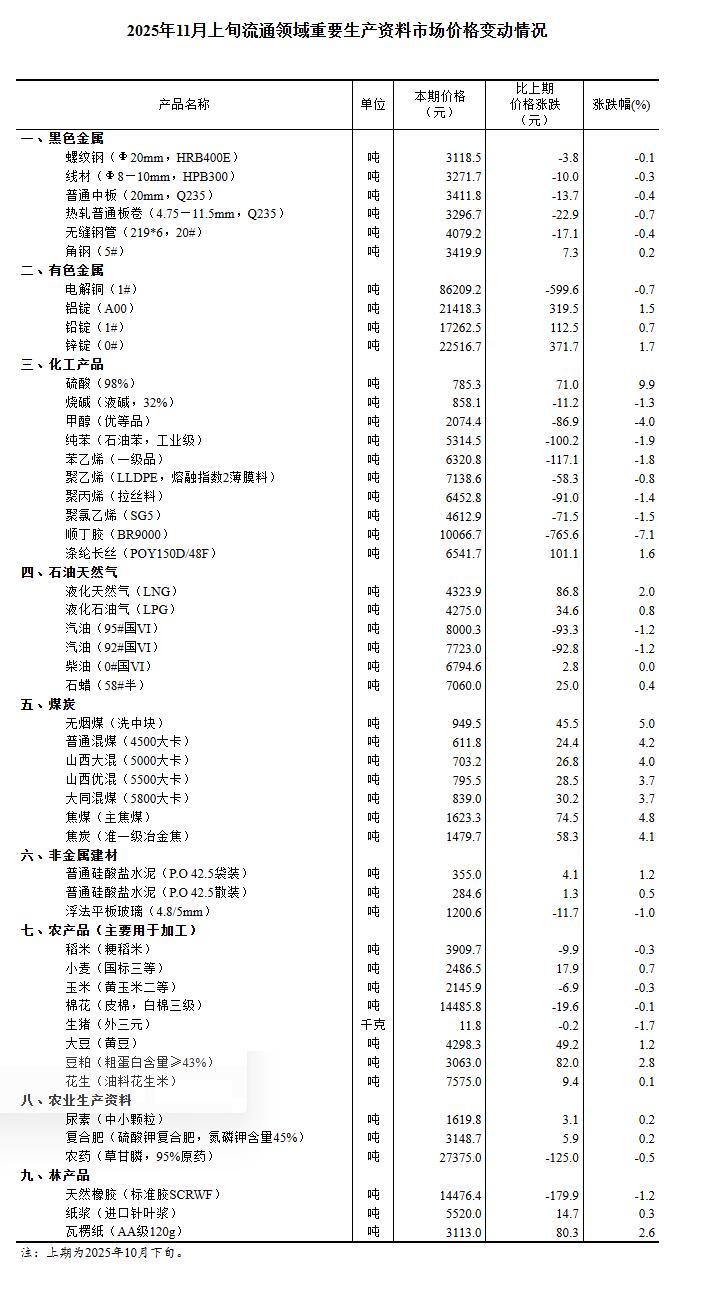
国家统计局:11月上旬流通领域重要生产资料26种产品价格上涨
Zhong Guo Xin Wen Wang· 2025-11-14 03:03
Core Viewpoint - The monitoring of market prices for 50 important production materials across nine categories in the national circulation sector indicates that in early November 2025, 26 products saw price increases, while 23 experienced declines, and 1 remained stable [1]. Price Changes Summary 1. Steel Products - Rebar (Φ20mm, HRB400E) decreased by 3.8 yuan to 3118.5 yuan, a drop of 0.1% - Wire rod (Φ8-10mm, HPB300) fell by 10.0 yuan to 3271.7 yuan, a decrease of 0.3% - Ordinary medium plate (20mm, Q235) dropped by 13.7 yuan to 3411.8 yuan, a decline of 0.4% - Hot-rolled ordinary plate coil (4.75-11.5mm, Q235) decreased by 22.9 yuan to 3296.7 yuan, down 0.7% - Seamless steel pipe (219*6, 20) fell by 17.1 yuan to 4079.2 yuan, a decrease of 0.4% [2]. 2. Non-ferrous Metals - Electrolytic copper (1) decreased by 599.6 yuan to 86209.2 yuan, down 0.7% - Aluminum ingot (A00) increased by 319.5 yuan to 21418.3 yuan, up 1.5% - Zinc ingot (0) rose by 371.7 yuan to 22516.7 yuan, an increase of 1.7% [2]. 3. Chemical Products - Sulfuric acid (98%) increased by 71.0 yuan to 785.3 yuan, up 9.9% - Caustic soda (liquid, 32%) decreased by 11.2 yuan to 858.1 yuan, down 1.3% - Methanol (first grade) fell by 86.9 yuan to 2074.4 yuan, a decline of 4.0% [2]. 4. Energy Products - Liquefied natural gas (LNG) increased by 86.8 yuan to 4323.9 yuan, up 2.0% - Liquefied petroleum gas (LPG) rose by 34.6 yuan to 4275.0 yuan, an increase of 0.8% [2]. 5. Coal - Anthracite (washed medium block) increased by 45.5 yuan to 949.5 yuan, up 5.0% - Ordinary mixed coal (4500 kcal) rose by 24.4 yuan to 611.8 yuan, an increase of 4.2% [2]. 6. Agricultural Products - Rice (Japonica) decreased by 9.9 yuan to 3909.7 yuan, down 0.3% - Wheat (national standard first grade) increased by 17.9 yuan to 2486.5 yuan, up 0.7% [3]. 7. Agricultural Production Materials - Urea (medium and small particles) increased by 3.1 yuan to 1619.8 yuan, up 0.2% - Compound fertilizer (potassium sulfate compound fertilizer, nitrogen-phosphorus-potassium content 45%) rose by 59 yuan to 3148.7 yuan, up 0.2% [3]. 8. Forest Products - Natural rubber (standard rubber SCRWF) decreased by 179.9 yuan to 14476.4 yuan, down 1.2% - Pulp (imported needle leaf pulp) increased by 14.7 yuan to 5520.0 yuan, up 0.3% [3].
广发早知道:汇总版-20251114
Guang Fa Qi Huo· 2025-11-14 01:06
Report Summary 1. Report Industry Investment Rating The provided content does not mention the industry investment rating. 2. Core Views of the Report - **Overall Market**: The A-share market showed a general upward trend on Thursday, with cyclical sectors performing actively and some high-dividend sectors slightly correcting. The bond market was affected by the strong performance of the risk market, and the precious metal market experienced a decline after an initial rise. The shipping index fluctuated, and various commodity futures markets had different trends [2][5][7]. - **Investment Suggestions**: For stock index futures, it is recommended to wait for stabilization and mainly adopt a wait-and-see approach. For bond futures, it is advisable to wait for the release of economic data and consider going long on dips. For precious metals, it is recommended to buy on dips. For various commodity futures, different trading strategies are proposed according to their respective market conditions [4][6][8]. 3. Summary by Directory Financial Derivatives - Financial Futures - **Stock Index Futures**: The A-share market rose across the board on Thursday, with major indices closing in the green. The four major stock index futures contracts also rose, and the basis spread of the main contracts fluctuated narrowly. It is recommended to wait for stabilization and mainly adopt a wait-and-see approach [2][3][4]. - **Treasury Bond Futures**: Treasury bond futures closed down across the board, and the yields of major interest rate bonds mostly rose. The market is currently in a tug-of-war between multiple and short factors, and it is necessary to pay attention to the implementation of the new regulations on bond fund redemption fees and the fermentation of broad monetary policy expectations. It is recommended to go long on dips [5][6]. Financial Derivatives - Precious Metals - **Gold and Silver**: The US government ended its shutdown, and Fed officials were cautious about a December rate cut, causing precious metals to rise initially and then fall. In the medium and long term, precious metals are expected to enter a bull market. It is recommended to buy on dips [7][8]. Financial Derivatives - Container Shipping Index (European Line) - **EC**: The spot price is cold, and the futures market is expected to fluctuate within the range of 1650 - 1850 points. It is recommended to conduct band operations [11][12]. Commodity Futures - Non-ferrous Metals - **Copper**: The liquidity risk has eased, and the copper price is expected to fluctuate strongly. It is recommended to pay attention to the Fed's rate cut rhythm and Sino-US tariff situation [12][13][15]. - **Alumina**: The market is in a state of loose supply and demand, and the price is expected to fluctuate weakly. It is necessary to pay attention to the production reduction trend of high-cost enterprises [15][16][17]. - **Aluminum**: The market shows a strong macro-drive and weak fundamental support. The price is expected to fluctuate widely, and it is recommended to short on rallies [18][20][21]. - **Aluminum Alloy**: The price is expected to maintain a strong and volatile trend, and it is necessary to pay attention to the improvement of scrap aluminum supply and downstream procurement rhythm [21][23][24]. - **Zinc**: The price is expected to fluctuate, and it is recommended to pay attention to the improvement of demand and the change of inventory [24][25][27]. - **Tin**: The supply side remains tight, and the price is expected to fluctuate strongly. It is recommended to hold long positions [27][30][31]. - **Nickel**: The market is in a state of more short-term and long-term factors, and the price is expected to fluctuate weakly. It is recommended to pay attention to macro expectations and Indonesian industrial policies [32][33][34]. - **Stainless Steel**: The market is in a state of weak macro-drive and strong fundamental pressure, and the price is expected to fluctuate weakly. It is recommended to pay attention to macro expectations and steel mill supply [34][36][37]. - **Lithium Carbonate**: The market is in a state of strong supply and demand expectations, and the price is expected to fluctuate. It is recommended to pay attention to the resumption of production of large factories and the marginal change of demand [37][40][41]. - **Polysilicon**: The market is in a state of high price and weak supply and demand, and the price is expected to fluctuate at a high level. It is recommended to pay attention to the establishment of platform companies and the change of demand [41][43]. - **Industrial Silicon**: The market is in a state of supply pressure and cost support, and the price is expected to fluctuate at a low level. It is recommended to pay attention to the implementation of organic silicon production reduction [44][46]. Commodity Futures - Ferrous Metals - **Steel**: The overall demand for five major steel products declined, and steel mills reduced production. The inventory continued to be destocked. It is recommended to short on rallies and hold the long coking coal and short hot-rolled coil arbitrage [47][48][49]. - **Iron Ore**: The iron ore market fluctuated. The global shipment volume decreased, the port arrival volume decreased, and the port inventory increased. It is recommended to wait and see on a single side and partially take profit on the long coking coal and short iron ore arbitrage [50][51]. - **Coking Coal**: The coking coal market showed a low-level volatile trend. The supply is expected to increase, and the demand for replenishment is weak. It is recommended to view it as a volatile market and conduct a 1 - 5 positive spread arbitrage [52][55]. - **Coke**: The coke market showed a low-level volatile trend. The fourth round of price increases was partially implemented, and there is still an expectation of price increases. It is recommended to view it as a volatile market and conduct a 1 - 5 positive spread arbitrage [56][58]. Commodity Futures - Agricultural Products - **Meal**: The domestic soybean meal spot market price was stable with an upward adjustment, and the rapeseed meal market price decreased. It is recommended to pay attention to the repair of crushing margins and the adjustment of the US Department of Agriculture's monthly supply and demand report [59].
中信期货晨报:国内商品期货大面积飘红,沪银继续领涨期市-20251114
Zhong Xin Qi Huo· 2025-11-14 00:38
1. Report Industry Investment Rating - No relevant content provided 2. Core Viewpoints of the Report - In November, the macro environment enters a vacuum period, and major asset classes lack further bullish drivers. The market needs to digest previous gains, so major assets may enter a short - term oscillation period. However, the overall allocation idea in the fourth quarter remains unchanged, and the macro environment is still favorable for risk assets. It is recommended that investors maintain a balanced allocation in major assets in the fourth quarter, continue to hold long positions, and focus on the allocation opportunities of stock indices, non - ferrous metals (copper, lithium carbonate, aluminum, tin), and precious metals. If there is a certain correction in the fourth quarter, appropriate additional allocation can be made [7] 3. Summary According to Relevant Catalogs 3.1 Macro Highlights - **Overseas Macro**: This week, the global macro focus is more on changes in US dollar liquidity. Although the US dollar liquidity seems to be in a short - term tight situation, it will not have a significant impact on major asset prices. There are two factors for the improvement of US dollar liquidity: marginal easing of monetary policy and the normal release of funds in the TGA account once the US government resumes work, which can relieve the short - term pressure on US dollar liquidity to a certain extent [7] - **Domestic Macro**: In October, China's export volume growth was weaker than expected and the previous value, and the month - on - month performance was also weaker than the seasonal average. However, more optimistic information was seen in the October inflation data. In addition, there is a possibility that the October consumption data may slightly exceed expectations [7] - **Asset Views**: In November, the macro environment enters a vacuum period, and major asset classes lack further bullish drivers. The market needs to digest previous gains, so major assets may enter a short - term oscillation period. The overall allocation idea in the fourth quarter remains unchanged, and the macro environment is still favorable for risk assets. It is recommended that investors maintain a balanced allocation in major assets in the fourth quarter, continue to hold long positions, and focus on the allocation opportunities of stock indices, non - ferrous metals (copper, lithium carbonate, aluminum, tin), and precious metals. If there is a certain correction in the fourth quarter, appropriate additional allocation can be made [7] 3.2 Viewpoint Highlights 3.2.1 Financial Sector - **Stock Index Futures**: Driven by technology - related events, the growth style is active. Concerns include the overcrowding of small - cap funds. The short - term outlook is oscillatory upward [9] - **Stock Index Options**: The overall market trading volume has slightly declined. Concerns include the lower - than - expected liquidity in the options market. The short - term outlook is oscillatory [9] - **Treasury Bond Futures**: The bond market continues to be weak. Concerns include policy surprises, better - than - expected fundamental recovery, and tariff factor surprises. The short - term outlook is oscillatory [9] 3.2.2 Precious Metals Sector - **Gold/Silver**: With the easing of geopolitical and trade tensions, precious metals are in a phased adjustment. Concerns include the performance of the US fundamentals, the Fed's monetary policy, and the global equity market trends. The short - term outlook is oscillatory [9] 3.2.3 Shipping Sector - **Container Shipping to Europe**: In the third quarter, the peak season has passed, and there is pressure on loading with no upward drivers. Concerns include the rate of freight decline in September. The short - term outlook is oscillatory [9] - **Steel**: There is limited market driving force, and the market is oscillating at a low level. Concerns include the progress of special bond issuance, steel exports, and pig iron production. The short - term outlook is oscillatory [9] - **Iron Ore**: Pig iron production is stable in the short term, and the market is oscillating. Concerns include overseas mine production and shipment, domestic pig iron production, weather factors, port ore inventory changes, and policy dynamics. The short - term outlook is oscillatory [9] 3.2.4 Black Building Materials Sector - **Coke**: Market sentiment is average, and the market is oscillating at a low level. Concerns include steel mill production, coking costs, and macro sentiment. The short - term outlook is oscillatory [9] - **Coking Coal**: Supply has slightly recovered, and there is an obvious divergence between futures and spot. Concerns include steel mill production, coal mine safety inspections, and macro sentiment. The short - term outlook is oscillatory [9] - **Silicon Iron**: There is still cost support, and attention is paid to the final pricing of steel tenders. Concerns include raw material costs and steel tender situations. The short - term outlook is oscillatory [9] - **Manganese Silicon**: The supply - demand situation is loose, suppressing the market, and the futures price is mainly oscillating at a low level. Concerns include cost prices and overseas quotes. The short - term outlook is oscillatory [9] - **Glass**: The inventory contradiction is intensifying, and both futures and spot prices are falling. Concerns include spot sales. The short - term outlook is oscillatory [9] - **Soda Ash**: The supply - demand situation is still in surplus, and the cost - driven upward movement is limited. Concerns include soda ash inventory. The short - term outlook is oscillatory [9] - **Alumina**: The fundamental situation is still in surplus, and the alumina price is under pressure and oscillating. Concerns include the failure of ore production to recover as expected, the over - expected resumption of electrolytic aluminum production, and extreme market trends. The short - term outlook is oscillatory [9] - **Aluminum**: There is a linkage between stocks and futures, and the aluminum price is oscillating upward. Concerns include macro risks, supply disruptions, and lower - than - expected demand. The short - term outlook is oscillatory upward [9] - **Zinc**: The export window is open, and the zinc price is oscillating at a high level. Concerns include macro - turning risks and the over - expected recovery of zinc ore supply. The short - term outlook is oscillatory [9] - **Lead**: Social inventory has slightly increased, and the lead price is oscillating. Concerns include supply - side disruptions and slow battery exports. The short - term outlook is oscillatory [9] - **Nickel**: Market sentiment has improved, and the nickel price is oscillating. Concerns include unexpected macro and geopolitical changes, Indonesian policy risks, and the failure of supply to be released as expected. The short - term outlook is oscillatory [9] - **Stainless Steel**: Warehouse receipts continue to decline, and the stainless - steel market is oscillating. Concerns include Indonesian policy risks and over - expected demand growth. The short - term outlook is oscillatory [9] - **Tin**: Shanghai tin inventory continues to decline, and the tin price is oscillating. Concerns include the expected resumption of production in Wa State and changes in demand improvement expectations. The short - term outlook is oscillatory [9] - **Industrial Silicon**: The supply in the southwest region has rapidly declined, and the silicon price is oscillating. Concerns include over - expected supply cuts and over - expected photovoltaic installations. The short - term outlook is oscillatory [9] - **Lithium Carbonate**: The resumption of production expectations are fluctuating, and caution is needed for significant price fluctuations. Concerns include lower - than - expected demand, supply disruptions, and new technological breakthroughs. The short - term outlook is oscillatory [9] 3.2.5 Energy and Chemical Sector - **Crude Oil**: The expectation of oversupply is strengthening, and geopolitical disturbances still exist. Concerns include OPEC+ production policies and the Middle East geopolitical situation. The short - term outlook is oscillatory [11] - **LPG**: Refinery out - put has decreased, and the import cost is under pressure. Concerns include the cost progress of crude oil and overseas propane. The short - term outlook is oscillatory [11] - **Asphalt**: The spot price in Shandong has stabilized, and the asphalt futures price is oscillating. Concerns include sanctions and supply disruptions. The short - term outlook is oscillatory [11] - **High - Sulfur Fuel Oil**: The fuel oil futures price is oscillating, and attention is paid to the progress of the Russia - Ukraine conflict. Concerns include geopolitics and crude oil prices. The short - term outlook is oscillatory [11] - **Low - Sulfur Fuel Oil**: The refined oil market is strong, and low - sulfur fuel oil may run strongly. Concerns include crude oil prices. The short - term outlook is oscillatory upward [11] - **Methanol**: The high - inventory situation is suppressing the market, and overseas disturbances are not significant. Methanol is oscillating and consolidating. Concerns include macro - energy and overseas dynamics. The short - term outlook is oscillatory [11] - **Urea**: There is still an increase in production capacity, and the futures price is under short - term pressure. Concerns include the implementation of export quotas and the coal price market. The short - term outlook is oscillatory [11] - **Ethylene Glycol**: The spot market is loose, and there is still production profit. There is little hope of reversing the downward trend in the short term. Concerns include coal and oil price fluctuations, port inventory rhythm, and Sino - US trade frictions. The short - term outlook is oscillatory downward [11] - **PX**: Market sentiment is becoming more rational, and the processing fee is strongly supported under the situation of strong supply and demand. Concerns include significant crude oil price fluctuations and macro abnormalities. The short - term outlook is oscillatory [11] - **PTA**: Market sentiment is flat, and the basis is under pressure. Concerns include significant crude oil price fluctuations and macro abnormalities. The short - term outlook is oscillatory [11] - **Short - Fiber**: The market follows the "buy on dips" pattern, and attention is paid to the conversion between peak and off - peak seasons. Concerns include the purchasing rhythm of downstream yarn mills and the quality of peak - season demand. The short - term outlook is oscillatory [11] - **Bottle Chips**: The market performance is flat, and it passively follows the cost. Concerns include the implementation of bottle - chip enterprise production reduction targets and new device commissioning situations. The short - term outlook is oscillatory [11] - **Propylene**: Inventory still needs time to be digested, and the market is oscillating weakly. Concerns include oil prices and the domestic macro environment. The short - term outlook is oscillatory [11] - **PP**: The support from maintenance is still limited, and PP is oscillating weakly. Concerns include oil prices and domestic and overseas macro environments. The short - term outlook is oscillatory [11] - **Plastic**: Maintenance has decreased, and plastic is oscillating weakly. Concerns include oil prices and domestic and overseas macro environments. The short - term outlook is oscillatory [11] - **Styrene**: There are still concerns about over - inventory, and styrene is oscillating weakly. Concerns include oil prices, macro policies, and device dynamics. The short - term outlook is oscillatory [11] - **PVC**: The weak reality is suppressing the market, and PVC is oscillating weakly. Concerns include expectations, costs, and supply. The short - term outlook is oscillatory [11] - **Caustic Soda**: The market is in a situation of low valuation and weak expectations, and caustic soda is oscillating. Concerns include market sentiment, start - up, and demand. The short - term outlook is oscillatory [11] - **Oils and Fats**: Rapeseed oil continues to lead the oils and fats market, and attention is paid to the USDA report. Concerns include US soybean weather and Malaysian palm oil production and demand data. The short - term outlook is oscillatory upward [11] - **Protein Meal**: The market expects the supply - demand report to be bullish, and soybean meal follows the rise of US soybeans. Concerns include weather, domestic demand, the macro environment, and Sino - US and Sino - Canada trade wars. The short - term outlook is oscillatory [11] - **Corn/Starch**: The short - term supply tension has not been relieved, and the market is oscillating at a high level. Concerns include demand, the macro environment, and weather. The short - term outlook is oscillatory [11] - **Pigs**: The situation of near - term weakness and long - term strength in the pig market continues. Concerns include breeding sentiment, epidemics, and policies. The short - term outlook is oscillatory downward [11] 3.2.6 Agricultural Sector - **Natural Rubber**: Driven by a strong macro environment, the rubber price continues to rise. Concerns include production area weather, raw material prices, and macro changes. The short - term outlook is oscillatory [11] - **Synthetic Rubber**: The market continues to rebound. Concerns include significant crude oil price fluctuations. The short - term outlook is oscillatory [11] - **Cotton**: The cotton price has slightly declined, and the upside and downside space of the 01 contract is expected to be limited. Concerns include demand and inventory. The short - term outlook is oscillatory [11] - **Sugar**: Zhengzhou sugar has rebounded and returned above 5500 yuan/ton. Concerns include imports and Brazilian production. The short - term outlook is oscillatory downward [11] - **Pulp**: The market is dominated by capital, and the long - position advantage remains unchanged. Concerns include macro - economic changes and US dollar - based quote fluctuations. The short - term outlook is oscillatory [11] - **Offset Paper**: The fundamental situation has limited changes, and offset paper is oscillating within a range. Concerns include production and sales, education policies, and paper mill start - up dynamics. The short - term outlook is oscillatory [11] - **Logs**: The port - arrival pressure first increases and then decreases, and logs are oscillating at a low level. Concerns include special port fees, shipment volume, and dispatch volume. The short - term outlook is oscillatory [11]
青海:“十四五”时期累计开行国际货运班列561列
Zhong Guo Xin Wen Wang· 2025-11-13 16:32
Core Points - Qinghai Province has launched a total of 561 international freight trains during the "14th Five-Year Plan" period, expanding its foreign trade network to 113 countries and regions [1] Group 1: Trade and Export Developments - The establishment of the first comprehensive bonded zone in the Qinghai-Tibet Plateau has commenced operations, enhancing the efficiency of cross-border e-commerce in Xining and Haidong [1] - Qinghai's green organic agricultural and livestock products are now exported to over 30 countries and regions, including Vietnam, Thailand, Malaysia, Kazakhstan, Uzbekistan, and Nepal [1] - The province has effectively facilitated the export channels for products such as soda ash, thermal asbestos, polyvinyl chloride, traditional Chinese medicine, and daily necessities, strengthening trade ties with countries involved in the Belt and Road Initiative [1] Group 2: Logistics and Infrastructure - The national logistics hubs in Xining and Golmud are increasingly supporting the province's trade activities, contributing to the stability of the foreign trade supply chain [1] - Since the first China-Europe freight train was launched in 2016, Qinghai has achieved regular operations of international freight trains, with a cumulative total of 580 trains, bolstering the export of products like salt lake chemicals [1]
“十四五”时期山东持续提升金融服务“三农”质效
Xin Hua Cai Jing· 2025-11-13 09:52
Core Viewpoint - The Shandong provincial government is implementing measures to enhance the quality of financial services during the "14th Five-Year Plan" period, focusing on agricultural finance, food production support, and rural financial services to promote rural revitalization and economic stability [1][2][3]. Group 1: Agricultural Financial Support - Financial investment in agricultural industries is steadily increasing, with a focus on enhancing credit support for well-known local agricultural products. By the end of September 2025, the balance of inclusive agricultural loans in the region is expected to reach 962.09 billion, doubling from the end of 2020 [1]. - Significant improvements in financial support for grain production have been noted, with loans in key grain sectors reaching 53.44 billion, an increase of 16.79 billion or 45.82% since the beginning of the year [2]. Group 2: Rural Financial Services - Financial services in county and rural areas are rapidly developing, achieving full coverage of banking institutions in townships and basic financial services in administrative villages. By the end of September 2025, the loan balance in monitored counties is projected to reach 6.44 trillion, an increase of 1.71 trillion or 36.15% from the end of 2022 [2]. - Small loans for poverty alleviation are being fully utilized, with 59,600 households benefiting from a total loan amount of 2.625 billion, an increase of 224 million since the end of 2020 [3].