
汽车

Search documents
新春消费亮点纷呈 市场活力持续迸发
Sou Hu Cai Jing· 2026-02-24 03:42
Core Viewpoint - The consumption market in Kunming has shown strong vitality during the Spring Festival, driven by various promotional activities and government initiatives, resulting in a significant increase in sales and consumer engagement [4][5][8]. Group 1: Consumption Growth - During the Spring Festival, the sales revenue of key monitored enterprises in Kunming increased by 5% year-on-year, indicating a successful start to the new spring consumption season [4]. - The trial of the prize invoice system in Kunming has led to over 38,000 winners and more than 6.2 million yuan in prizes distributed, directly driving over 64 million yuan in consumption [5]. - Sales of daily consumer goods saw a remarkable year-on-year increase of 30.5% during the holiday period, reflecting strong consumer resilience [5]. Group 2: Government Initiatives - The Kunming municipal business system has implemented a series of consumption promotion measures, including trade-in programs, consumption vouchers, and prize invoices, to stimulate consumer enthusiasm [4][6]. - The city has actively coordinated various commercial sectors to participate in the provincial consumption voucher program, enhancing the effectiveness of promotional policies [4]. Group 3: Innovative Consumption Experiences - Kunming has focused on upgrading large-scale consumption and innovating consumption scenarios, launching various activities to enhance consumer experiences, particularly in the automotive and home appliance sectors [6]. - The city has organized promotional events that combine government subsidies with merchant discounts, effectively stimulating demand for smart home and digital products [6]. Group 4: Cultural and Tourism Integration - Major commercial districts in Kunming have transformed their spaces into cultural showcases, launching activities that promote deep integration of commerce, culture, and tourism [7]. - Events such as art exhibitions and cultural performances have been organized to create a vibrant cultural atmosphere, enhancing the overall consumer experience [7]. Group 5: Visitor Engagement - The influx of visitors to Kunming has increased significantly, with certain commercial areas recording daily foot traffic exceeding 50,000, indicating a robust recovery in tourism and leisure spending [8]. - The integration of cultural and commercial activities has effectively extended visitor stay durations and diversified consumption demands [8].


国新证券每日晨报-20260224
Guoxin Securities Co., Ltd· 2026-02-24 03:37
国内市场综述 缩量整理 震荡回调 周五(2 月 13 日)大盘缩量整理,震荡回调。截至收 盘,上证综指收于 4082.07 点,下跌 1.26%;深成指 收于 14100.19 点,下跌 1.28%;科创 50 下跌 0.72%; 创业板指下跌 1.57%,万得全 A 成交额共 19989 亿元, 较前一日有所下降。 行业方面,30 个中信一级行业有 29 个下跌,其中电 有色金属、石油石化及建材跌幅居前,仅有国防军工 小幅上涨,概念方面,中航系、半导体设备及通用航 空等指数表现活跃。 海外市场综述 美国三大股指全线收跌,IBM 跌超 13% 周一(2 月 23 日),美国三大股指全线收跌,道指跌 1.66%,标普 500 指数跌 1.04%,纳指跌 1.13%。IBM 跌超 13%,美国运通跌逾 7%,领跌道指。万得美国科 技七巨头指数跌 0.99%,微软跌超 3%,特斯拉跌近 3%。 纳斯达克中国金龙指数跌 0.95%,金山云跌近 9%。 新闻精要 1. 《求是》杂志发表习近平总书记重要文章《当前经 济工作的重点任务》 2. 中国 1 月金融数据:M2 同比增 9%,社融规模增量 为 7.22 万亿元定 ...
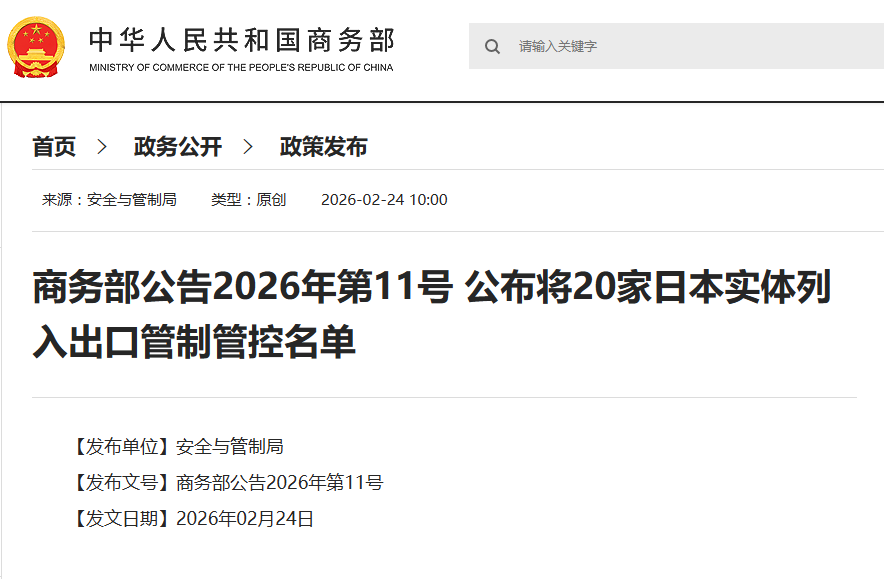
商务部将20家日本实体列入出口管制管控名单,将20家日本实体列入关注名单
Jin Rong Jie· 2026-02-24 03:14
Core Points - The Ministry of Commerce of China has announced export control measures against 20 Japanese entities involved in enhancing Japan's military capabilities, including Mitsubishi Heavy Industries and Subaru Corporation [1][3][10] - The measures include a ban on exporting dual-use items to these entities and a prohibition on foreign organizations and individuals transferring or providing such items to them [1][3][10] Group 1: Export Control Measures - The announcement includes a list of 20 entities, such as Mitsubishi Heavy Industries Shipbuilding Co. and Kawasaki Heavy Industries Aerospace Systems Company, which are now subject to export restrictions [2][3] - Exporters must immediately cease any ongoing activities related to these entities and can only apply for special export permissions under specific circumstances [1][3] Group 2: Focus List - An additional list of 20 Japanese entities, including Subaru Corporation and Fujitsu Defense & National Security, has been created due to the inability to verify the end users and end uses of dual-use items [3][9] - Exporters are prohibited from applying for general licenses or obtaining export certificates through registration for these entities, and must submit risk assessment reports for individual license applications [3][8] Group 3: Regulatory Context - The measures are framed as necessary to prevent Japan's "re-militarization" and nuclear ambitions, emphasizing that they are lawful and targeted at specific entities [10] - The Ministry of Commerce assures that these actions do not affect normal economic and trade relations between China and Japan, and compliant Japanese entities need not worry [10]
中低收入国家企业层面的气候变化适应(英)2026
Shi Jie Yin Hang· 2026-02-24 03:05
Investment Rating - The report does not explicitly provide an investment rating for the industry. Core Insights - Firms in low- and middle-income countries (LMICs) face significant challenges due to climate change, which affects their operations and profitability through various mechanisms such as reduced labor productivity and disrupted supply chains [3][4] - Despite the theoretical incentives for firms to adapt to climate change, market frictions in LMICs often inhibit these adaptation efforts [4][5] - The evidence indicates that while firms are attempting to adapt to climate change, they encounter barriers such as limited information and financial constraints [5][6] Summary by Sections 1. Introduction - Climate change disproportionately impacts LMICs, leading to increased temperatures and extreme weather events that affect firm operations and economic growth [3] 2. Analytical Framework - The framework focuses on how firms combine capital, labor, and other inputs to maximize profits while adapting to climate change [7][8] 3. Firm Expectations About Climate Change - Firms often underestimate weather-related risks, which can lead to inadequate preparation for climate impacts [12][13] - Survey evidence shows that many firms are aware of climate risks but may not accurately assess their vulnerability [14][15] 4. Demand - Weather shocks can increase demand for certain firms, particularly in sectors closely tied to weather outcomes [23][24] - Extreme weather often leads to lower sales due to a combination of reduced demand and productivity [25][26] 5. Labor - Climate change significantly impacts labor availability and productivity, with weather-driven migration redistributing labor across regions [30][31] - Labor productivity declines with increasing temperatures, with estimates showing a consistent reduction across various LMIC contexts [39][40] 6. Capital - Firms must consider both physical risks to capital from climate events and the financial implications of climate change when making investment decisions [51][52] - Evidence suggests that firms may upgrade capital when rebuilding after disasters, but the ability to do so varies significantly across contexts [54][58]
资讯早间报:隔夜夜盘市场走势-20260224
Guan Tong Qi Huo· 2026-02-24 03:04
Report Summary 1. Report's Industry Investment Rating No relevant information provided. 2. Core Viewpoints - Global financial markets are affected by multiple factors including geopolitical tensions, tariff policies, and corporate earnings, leading to significant fluctuations in various asset classes. For example, the US stock market declined due to Trump's tariff plan and EU's suspension of the trade - agreement approval, while the precious metals market rose due to increased risk - aversion [5][6]. - The energy market is influenced by the Iran - US nuclear negotiation, with expectations of increased Iranian oil supply putting downward pressure on oil prices [7]. 3. Summary by Directory Overnight Night - Market Trends - **Stock Markets**: US major indices (Dow, S&P 500, Nasdaq) fell, with IBM and American Express leading the decline. European indices (DAX, CAC40, FTSE 100) also closed lower. The reasons include Trump's tariff plan and EU's suspension of trade - agreement approval [5]. - **Precious Metals**: COMEX gold and silver futures rose due to increased risk - aversion from geopolitical tensions, tariff policy changes, and other factors [6]. - **Energy**: US crude oil and Brent oil futures fell as the Iran - US nuclear negotiation showed signs of progress, increasing the expectation of more Iranian oil supply [7]. - **Base Metals**: Most London base metals declined, except for LME tin which rose [7]. Important News Macro News - Shanghai Export Container Settlement Freight Index for European routes dropped 2.1%. The US will stop collecting certain illegal tariffs. There is still a risk of US military strikes against Iran. India postponed a trade delegation plan. China is assessing the impact of US tariff rulings and urges the US to cancel unilateral tariffs. The EU suspended the approval of a trade agreement with the US. The Trump administration is considering new "national security tariffs" [9][11]. Energy Futures - Saudi Aramco sold condensate oil. Methanol supply in Southeast Asia is restricted due to planned maintenance. Goldman Sachs and Morgan Stanley have different forecasts for oil prices, with Goldman Sachs raising price forecasts for Q4 2026 and 2027, and Morgan Stanley expecting a short - term increase followed by a decline [14][16][18]. Metal Futures - The US energy storage market is expected to grow 21%. Lebanon may sell part of its gold reserves. UBS is positive on gold, with a target price of $6200/ounce [20][21]. Black - Series Futures - China's iron ore arrivals decreased, but global iron ore shipments increased. Vietnam plans to build a large - scale steel plant. The blast furnace capacity utilization rate of Chinese pig - iron enterprises decreased, and inventory increased [23][25]. Agricultural Products Futures - Malaysian palm oil production and exports decreased in February. Argentina's soybean moisture conditions improved, and the production forecast remains unchanged [27][28]. Financial Markets Financial - 143 companies have submitted IPO applications in the Hong Kong stock market in 2026. Deloitte predicts a better performance in the Hong Kong IPO market this year [30]. Industry - Payment transactions on Chinese New Year's Eve increased. The real - estate market may show more stabilization signals. China's AI governance system is maturing [31]. Overseas - The US may adjust tariff application methods and continue steel - aluminum tariffs. The Fed has about 75 basis - points to reach the neutral rate. India plans to invest $200 billion in AI. The Australian central bank may tighten policy. UK unemployment reached a new high [32][34][35]. International Stock Markets - US and European stock markets rose, while the Japanese market fell. High - end companies made significant stock - position adjustments. The UK may adjust accounting rules to attract Chinese companies. Australia simplifies corporate governance rules. Some companies announced major transactions or reported good earnings [36][38][41]. Commodities - Precious metals, oil, and most base metals futures fell due to factors such as progress in the Iran - US nuclear negotiation and reduced risk - aversion [43]. Bonds - US Treasury yields had mixed changes. Japanese bonds rose, and the 2029 fiscal - year bond issuance may increase [45]. Foreign Exchange - The US dollar index rose slightly, and most non - US currencies fell [46]. Upcoming Economic Data and Events - **Economic Data**: Include Japan's trade balance, UK's inflation and housing - price index, US's new - home construction, and other data [48]. - **Events**: New Zealand's central - bank rate decision, European Central Bank officials' speeches, and the Fed's release of meeting minutes [50]. - **Market Closures**: Chinese, South Korean, and Vietnamese stock markets are closed due to the Spring Festival [52].






马斯克让特斯拉越来越不单纯了
Sou Hu Cai Jing· 2026-02-24 02:59
Core Viewpoint - Elon Musk's ambitions for Tesla and his broader business empire are evolving, with a shift towards robotics and AI, indicating a potential end of an era for traditional electric vehicles and a new milestone in industrial history [2][4]. Group 1: Tesla's Strategic Shift - Tesla plans to cease production of Model S and Model X by the end of Q2 2025 to allocate resources for the production of Optimus robots, which Musk sees as the future growth drivers alongside autonomous vehicles [4]. - The electric vehicle market is becoming increasingly saturated, leading to intensified competition and shrinking profit margins, prompting Musk to redefine Tesla's mission to "create incredible wealth" [4][11]. - In 2025, Tesla's global deliveries of electric vehicles are projected to decline by 8.56% year-on-year, marking a second consecutive year of decline [5]. Group 2: Financial Performance - Tesla's total revenue for 2025 was $94.827 billion, a decrease of 2.83% year-on-year, marking the first annual revenue decline in the company's history [11]. - The automotive segment generated $69.526 billion in revenue, down 9.79% year-on-year, with a gross margin of 17.8% [13]. - The net profit for Q4 2025 was $840 million, a significant drop of 60.47% year-on-year, with the annual net profit at $3.794 billion, down 46.79% [11]. Group 3: Market Dynamics and Competition - Tesla's Model 3 and Model Y continue to lead in several markets but face fierce competition from Chinese brands, with a year-on-year sales decline of 6.97% [7]. - The company plans to double its capital expenditure to approximately $20 billion by 2026, focusing on AI and robotics development [12]. - The shift towards AI and robotics is seen as a response to the evolving competitive landscape, where Tesla aims to transition from an automotive company to an "embodied AI company" [12]. Group 4: Geopolitical Implications - Musk's ambitions extend beyond business, with potential implications for national security, as Tesla and SpaceX engage in projects that may have military applications [19][21]. - The integration of Tesla, SpaceX, and AI initiatives reflects a strategy that intertwines commercial interests with national defense considerations, particularly in the context of U.S.-China relations [19][22]. - The expansion of SpaceX's Starlink satellite constellation raises concerns about space security and the dual-use nature of commercial technologies [22][24].


全指现金流ETF鹏华(512130)涨超2%,油运贵金属强势领涨
Sou Hu Cai Jing· 2026-02-24 02:41
Group 1 - During the Spring Festival, overseas precious metals and crude oil prices collectively rose, with spot gold touching $5200 per ounce and WTI crude oil futures for March contracts increasing by 1.9%, while Brent crude oil futures for April contracts rose by 1.86% [1] - The current oil market is driven by geopolitical risks rather than supply and demand, with expectations of high volatility in prices over the next month due to the unclear situation between the US and Iran [1] - Companies with oil and gas resources and those in the offshore oil and gas service engineering sector are recommended for attention as they may benefit from the high industry prosperity [1] Group 2 - As of January 30, 2026, the top ten weighted stocks in the CSI All Share Free Cash Flow Index (932365) include China National Offshore Oil Corporation, Gree Electric Appliances, SAIC Motor, China Aluminum, COSCO Shipping Holdings, TCL Technology, Muyuan Foods, Silver Nonferrous Metals, Baosteel, and Chint Group, collectively accounting for 51.19% of the index [2]




高股息资产作为长期底仓的配置逻辑依然坚固,聚焦自由现金流ETF(159201)配置价值
Mei Ri Jing Ji Xin Wen· 2026-02-24 02:25
Core Viewpoint - The A-share market opened significantly higher on the first trading day of the Year of the Horse, with the National Index of Free Cash Flow rising over 2.5%, led by stocks such as Silver Nonferrous, Furuitec, and Fenghuo Communication [1] Group 1: Market Performance - The largest free cash flow ETF (159201) has seen a continuous net inflow of funds totaling 1.732 billion yuan over the past nine days [1] - The latest share count of the free cash flow ETF reached 10.627 billion shares, with a total scale of 13.839 billion yuan [1] Group 2: Investment Strategy - Tianfeng Securities believes that historically, small-cap growth styles tend to outperform after holidays, and this trend may still be evident this year, although its strength may be constrained by two factors: the strong performance of large-cap growth stocks in a favorable industry environment and the enduring logic of "high dividend" assets as a long-term investment strategy [1] - The free cash flow strategy introduces a new paradigm for value investing, characterized by the ability to provide direct cash returns to investors and ensuring the sustainability and scale of dividends, serving as the foundation for corporate dividend payments [1] Group 3: ETF Composition - The free cash flow ETF (159201) samples the entire A-share market, with the top three industries being automotive, oil and petrochemicals, and nonferrous metals, indicating a larger market capitalization [1] - The Cash Flow 500 ETF (560120) samples the CSI 500, with the top three industries being nonferrous metals, basic chemicals, and steel, indicating a focus on mid and small-cap stocks [1]
车企造船、动画公司“做”手术,跨界成功关键是什么
Ren Min Ri Bao· 2026-02-24 02:23
Group 1 - The core idea of the news highlights the trend of cross-industry development, where companies leverage their existing strengths to enter new markets and create innovative solutions [2][3][4] - A well-known automotive company has successfully ventured into shipbuilding, producing the first domestically certified electric inland vessel, showcasing cost reduction and innovation [2][3] - Companies in various sectors, such as animation and traditional industries like coal, are finding ways to adapt and thrive by utilizing their foundational technologies and expertise to explore new opportunities [3][4] Group 2 - The concept of "small materials being used for great purposes" is emphasized, indicating that companies can effectively apply their core competencies to meet market needs in different industries [3][4] - The importance of finding "points of fit" for successful cross-industry ventures is discussed, where companies must align their strengths with industry demands to create value [3][4] - The news also points out that cross-industry thinking can lead to industrial upgrades, encouraging traditional industries to innovate and develop new productive forces [4][5] Group 3 - The integration of macro policies and regional perspectives is essential for fostering cross-industry collaboration and economic growth, as seen in initiatives like the high-speed rail network and regional industrial clusters [5] - Companies are encouraged to step out of their comfort zones and embrace challenges in unfamiliar territories to drive innovation and success [5] - The narrative suggests that cross-industry efforts can lead to new opportunities and a vibrant economic landscape, emphasizing the need for strategic clarity and innovative tactics [5]