
有色金属

Search documents
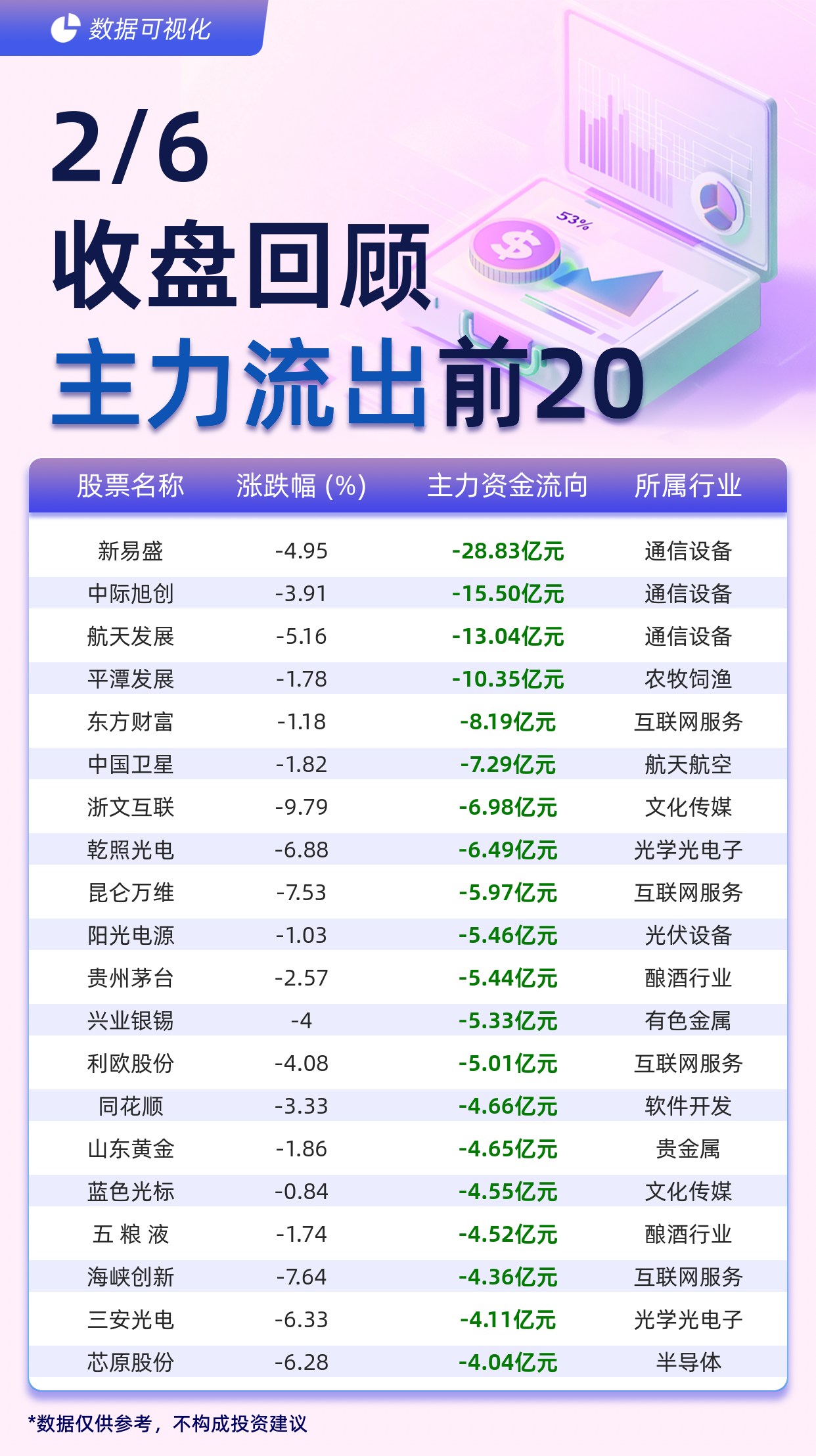
主力个股资金流出前20:新易盛流出28.83亿元、中际旭创流出15.50亿元
Jin Rong Jie· 2026-02-06 07:29
Group 1 - The main stocks with significant capital outflows include Xinyi Technology (-28.83 billion), Zhongji Xuchuang (-15.50 billion), and Aerospace Development (-13.04 billion) [1] - The sectors affected by the capital outflows primarily include communication equipment, internet services, and optical electronics [2][3] - The largest percentage decline in stock prices was observed in Zhejiang Wenlian, which fell by 9.79% [2] Group 2 - Other notable stocks with substantial capital outflows include Guizhou Moutai (-5.44 billion), Sunshine Power (-5.46 billion), and Sanan Optoelectronics (-4.11 billion) [1][3] - The overall trend indicates a negative sentiment in the market, particularly in the communication equipment and internet service sectors [2][3] - The data reflects a broader market trend of capital withdrawal, impacting various industries including agriculture, aerospace, and cultural media [1][2]


汇添富中证细分有色金属产业主题ETF发起式联接C(019165)低成本布局有色行业向上机遇,2025年我国有色金属企业工业增加值增长6.9%
Xin Lang Cai Jing· 2026-02-06 07:26
Group 1 - The core viewpoint of the news highlights the growth and performance of the non-ferrous metal industry in China, with significant increases in production, investment, and trade [2] - As of February 6, 2026, the non-ferrous metal industry theme index (000811) rose by 0.25%, with notable increases in constituent stocks such as Hunan Gold (9.94%) and Guocheng Mining (5.67%) [1] - The non-ferrous ETF Huatai-PineBridge increased by 0.32%, with a remarkable annual growth of 109.34% as of February 5, 2026 [1] Group 2 - In 2025, China's non-ferrous metal enterprises saw an industrial added value growth of 6.9%, with total production exceeding 8 million tons, reaching 8,175 million tons, a 3.9% increase year-on-year [2] - Fixed asset investment in the non-ferrous metal industry grew by 4.9%, surpassing the national industrial investment growth rate by 2.3 percentage points, with mining sector investments soaring by 41.0% [2] - The total import and export trade of non-ferrous metals reached $412.24 billion, marking a 12.4% increase from the previous year [2] Group 3 - The Huatai-PineBridge non-ferrous metal industry theme ETF (019165) has shown a maximum monthly return of 20.81% since its inception, with a one-year Sharpe ratio of 3.44 [3] - The fund has a maximum drawdown of 15.91% over the past year, ranking 2 out of 5 in its category, indicating relatively low risk [3] - The fund manager, Dong Jin, has 15.6 years of experience and has achieved a return of 82.96% since taking office on March 21, 2025 [3] Group 4 - The Huatai-PineBridge non-ferrous metal industry theme ETF (019165) offers a flexible mechanism with no subscription fees, which is particularly beneficial in the volatile non-ferrous metal sector [4] - This mechanism significantly reduces transaction costs for investors, allowing them to capture segment profits without being eroded by subscription and redemption fees [4]
资产配置月报202602:如何衡量黄金的交易拥挤度?
Guolian Minsheng Securities· 2026-02-06 07:25
Investment Rating - The report maintains a neutral to optimistic outlook for the equity market in February 2026, indicating a continued recovery in economic sentiment [26][27]. Core Insights - The report highlights that the recent significant drop in gold prices is attributed to a combination of short-term negative events and the inherent fragility of market structures, despite the long-term bullish outlook for gold remaining intact [9][16][25]. - The analysis suggests that managing positions based on gold's trading congestion can enhance returns while mitigating risks during periods of high volatility [21][25]. - The report emphasizes a favorable outlook for various sectors, particularly non-ferrous metals, basic chemicals, telecommunications, and renewable energy, while also identifying potential opportunities in sectors experiencing recovery from previous downturns [99]. Summary by Sections 1. Measuring Gold Trading Congestion - The report discusses the recent decline in gold prices, with a notable drop of 9.2% on January 30 and 13.2% on February 2, 2026, indicating a significant market reaction to external factors [13][16]. - It identifies that the trading congestion in gold was at a high level prior to the drop, suggesting that the market's speculative positions were vulnerable to negative news [19][25]. 2. Major Asset Quantitative Insights - **Equities**: The sentiment is neutral to optimistic, with a recovery in financial and industrial sectors, and analysts expect stronger net profits in sectors like non-ferrous metals and construction [26][27]. - **Interest Rates**: The report predicts a rise in the 10-year government bond yield by 6 basis points to 1.88% in February, driven by factors such as economic growth and inflation [44][50]. - **Gold**: All four factors analyzed (economic, employment, fiscal, and external debt) are currently favorable for gold, maintaining a bullish outlook [54][57]. - **Real Estate**: The pressure index for the real estate sector has increased slightly, indicating rising supply-side pressures while demand remains stable [64][66]. - **Overseas Markets**: The report notes a potential turnaround in trade conflicts, particularly between India and the US, which could enhance the attractiveness of Indian equities [68][78]. 3. Style Quantitative Insights - The market is expected to continue expanding, with recommendations for growth-oriented and profitability-focused investment styles [80][81]. - There is a specific emphasis on small-cap and growth stocks, with historical data suggesting that small-cap stocks tend to outperform in February [87][96]. 4. Industry Allocation Quantitative Insights - The report recommends a diversified industry allocation strategy, highlighting sectors such as non-ferrous metals, basic chemicals, telecommunications, and renewable energy as key areas for investment [99].
资产配置月报202602:如何衡量黄金的交易拥挤度?-20260206
Guolian Minsheng Securities· 2026-02-06 06:41
- The report introduces a structured static factor model for predicting 10Y government bond yield movements, utilizing four macroeconomic factors: economic growth, inflation, debt leverage, and short-term interest rates[44][50][53] - The model has achieved a historical prediction accuracy of approximately 70% since 2006, with a sample-out accuracy of 68% since 2023[47][50] - For February 2026, the model forecasts a 6BP increase in the 10Y government bond yield to 1.88%, driven by upward trends in all four macroeconomic factors[50][53] - A structured static factor model is also applied to gold price movements, incorporating four key factors: US economy, US employment, US fiscal policy, and US external debt[54][57] - The gold model has demonstrated a historical prediction accuracy of 65% since 2008, with a sample-out accuracy of 78% since 2023[54][55] - The report highlights that fiscal and employment factors are currently supporting gold price increases, while economic and external debt factors show mixed signals[57][60] - A quantitative strategy for managing gold positions based on trading congestion is proposed, using two metrics: 40-day price deviation rate and SHFE gold implied volatility (IV)[19][21] - The strategy suggests reducing portfolio exposure to 40% when the 40-day price deviation rate exceeds 9% and SHFE gold IV surpasses 30%, achieving an excess return of 53.4% and improving the Sharpe ratio from 1.26 to 1.62 during backtesting from 2020 to February 2026[21][19] - The report recommends a multi-dimensional industry allocation strategy combining "win-rate and odds" and "clearance reversal" approaches, with industries such as non-ferrous metals, basic chemicals, and steel being highlighted[99][102][115]
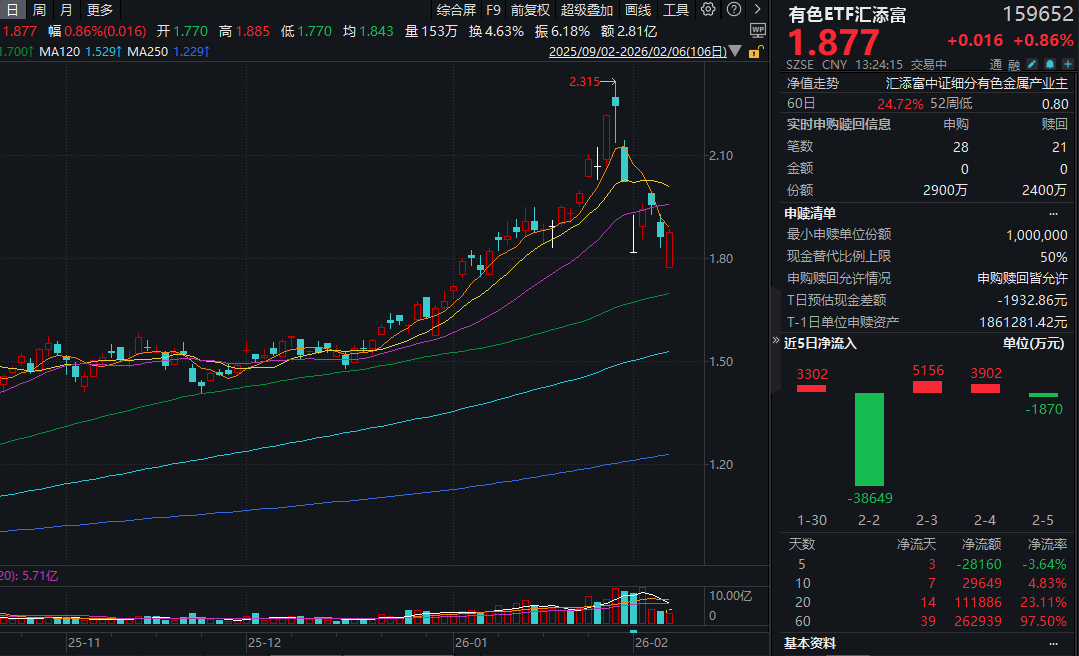
现货黄金反弹!湖南黄金涨停,有色ETF汇添富(159652)翻红涨1%,盘中资金涌入!近10日“吸金”近3亿元!
Xin Lang Cai Jing· 2026-02-06 06:35
Group 1 - Spot gold and silver experienced a "V-shaped" rebound, with gold increasing by 1% and silver rising over 2% after initial declines of more than 2% and 8% respectively [1] - The non-ferrous sector saw a corresponding rise, with the ETF Huatai-PineBridge (159652) gaining nearly 1% and attracting nearly 10 million yuan in net inflows during the session, totaling close to 300 million yuan over the past 10 days [1] - The China Securities Galaxy believes that the recent price corrections in gold and silver are normal profit-taking actions after reaching historical highs, which may help to release overheated market sentiment [2] Group 2 - In January, the China Logistics and Purchasing Federation reported that the commodity price index rose for the ninth consecutive month, reaching a three-and-a-half-year high, with a month-on-month increase of 6.3% to 125.3 points [3] - Among 50 monitored commodities, 33 saw price increases, with lithium carbonate, refined tin, and refined nickel leading with month-on-month increases of 48.4%, 20.2%, and 19.5% respectively [3] - The non-ferrous metals price index rose significantly by 9.9% month-on-month, driven by factors such as international monetary policy and geopolitical influences [3] Group 3 - Recent pricing logic for non-ferrous metals is shifting from short-term supply and demand to broader macroeconomic factors, benefiting from ongoing fiscal expansion and liquidity in major economies [4] - The copper market is characterized by both supply and demand constraints, with limited new mine production and ongoing supply disruptions, while demand is driven by energy transition and AI industries [4] - The non-ferrous sector is highlighted as having significant investment value due to favorable macroeconomic conditions, with the Huatai-PineBridge ETF (159652) being recommended for its comprehensive exposure to various metal sectors [4][5] Group 4 - The Huatai-PineBridge ETF (159652) has a leading concentration of core strategic commodities such as copper, gold, aluminum, lithium, and rare earths, with a top five stock concentration of 38% [8] - The ETF's index has shown superior performance since 2022, with a cumulative return leading its peers and a lower maximum drawdown, indicating a better investment experience [10] - The index's price increase is driven by earnings rather than valuation expansion, with a current PE ratio of 26.27, down 52% from five years ago, suggesting a favorable valuation [10]

改节奏不改方向!机构:仍然看好有色
券商中国· 2026-02-06 06:34
Core Viewpoint - The non-ferrous metals market is entering a high volatility phase, influenced by factors such as the Federal Reserve's interest rate narrative and profit-taking activities, leading to significant price fluctuations in precious and non-ferrous metals [2] Group 1: Market Dynamics - Recent price volatility in metals like gold, silver, copper, aluminum, lead, and zinc is attributed to the Federal Reserve's interest rate changes and profit-taking [2] - Market institutions suggest that the non-ferrous metals sector will experience a phase of reduced volatility in trading, maintaining its overall direction, supported by strong fundamentals in the latter part of Q1 [2][6] - The current non-ferrous cycle is characterized by a backdrop of de-globalization, reshaping of overseas manufacturing, and unconventional inventory accumulation, differing from traditional monetary cycles and potentially extending over a longer time frame [2][6] Group 2: Influencing Factors - The nomination of Kevin Warsh as the Federal Reserve Chairman has been identified as a catalyst for increased market volatility, with his hawkish stance leading to significant asset adjustments [3] - Concerns regarding the effectiveness of the "de-dollarization" narrative, geopolitical risk premiums, and rapid price increases driven by liquidity are contributing to market uncertainties [3][4] - The recent sharp declines followed by rebounds are seen as a result of macroeconomic shocks and structural adjustments, rather than a fundamental change in the metal market's logic [4] Group 3: Long-term Outlook - Institutions remain optimistic about the non-ferrous metals sector, expecting a resurgence of upward momentum by mid-year, contingent on stable macroeconomic expectations [6] - The fundamental drivers of low supply, strong demand, and significant inventory accumulation remain unchanged, with expectations of a robust performance in metal prices following short-term corrections [6] - Key investment opportunities in the non-ferrous sector are identified, with gold, copper, and aluminum as primary choices, alongside smaller metals like rare earths, natural uranium, and tin [6]



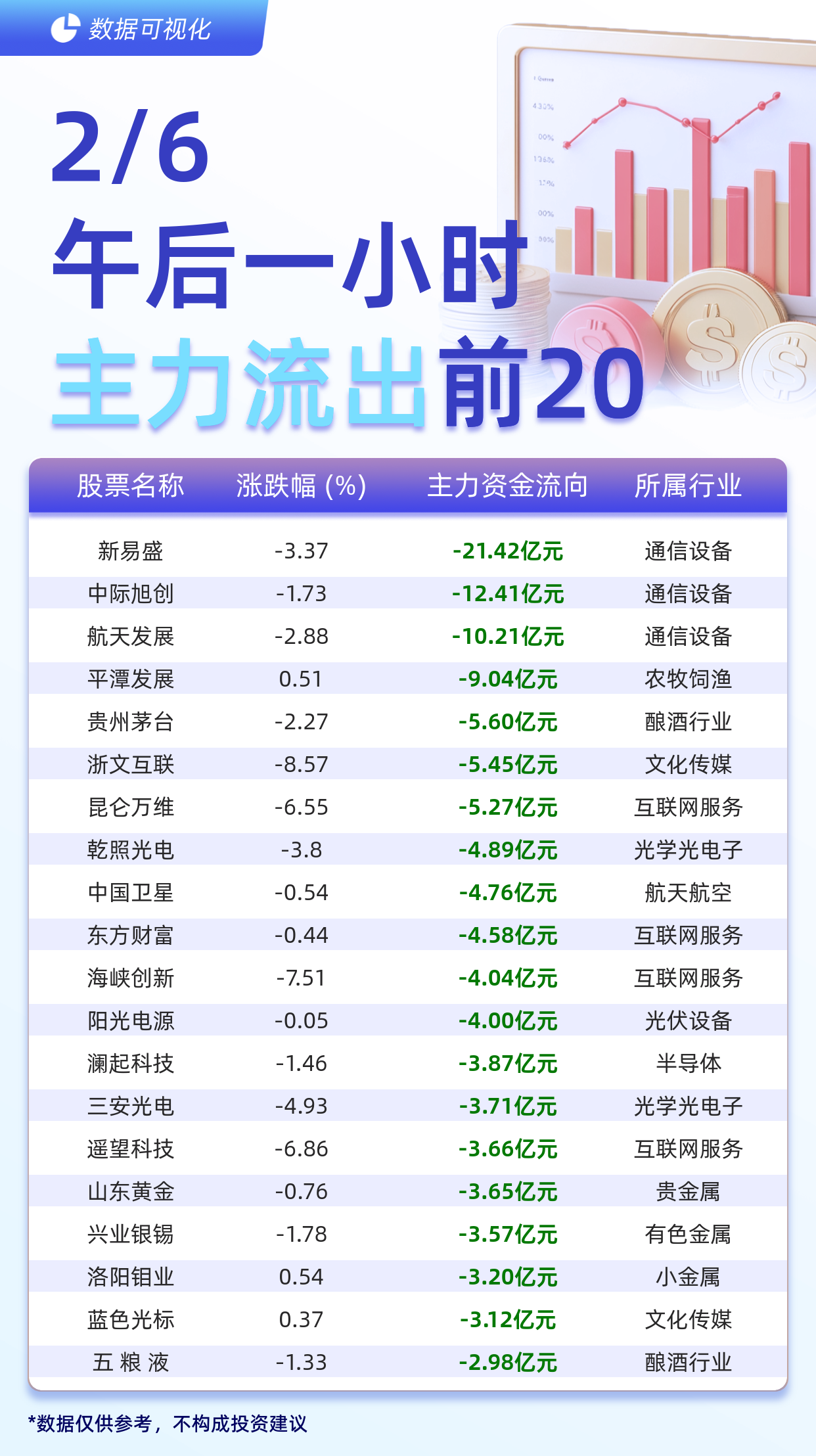
主力个股资金流出前20:新易盛流出21.42亿元、中际旭创流出12.41亿元
Jin Rong Jie· 2026-02-06 06:27
Main Points - The main focus of the news is on the significant outflow of capital from various stocks, highlighting the top 20 stocks with the largest capital outflows as of February 6, with New Yisheng leading at -21.42 billion yuan [1][2][3] Group 1: Stock Performance - New Yisheng experienced a capital outflow of -21.42 billion yuan, indicating a strong sell-off in the communication equipment sector [1][2] - Zhongji Xuchuang saw a capital outflow of -12.41 billion yuan, also within the communication equipment industry [1][2] - Aerospace Development had a capital outflow of -10.21 billion yuan, reflecting investor sentiment in the communication equipment sector [1][2] - Pingtan Development reported a capital outflow of -9.04 billion yuan, indicating challenges in the agriculture and animal husbandry sector [1][2] - Kweichow Moutai faced a capital outflow of -5.60 billion yuan, suggesting potential concerns in the liquor industry [1][2] Group 2: Sector Analysis - The communication equipment sector is notably affected, with three companies (New Yisheng, Zhongji Xuchuang, and Aerospace Development) among the top outflows [1][2] - The liquor industry, represented by Kweichow Moutai, shows a significant outflow, which may indicate market volatility or changing consumer preferences [1][2] - The internet services sector is also impacted, with companies like Kunlun Wanwei and Dongfang Caifu experiencing outflows of -5.27 billion yuan and -4.58 billion yuan respectively [1][2][3] Group 3: Additional Stocks - Other notable stocks with significant outflows include Sunshine Power (-4.00 billion yuan) in the photovoltaic equipment sector and Sanan Optoelectronics (-3.71 billion yuan) in the optical and optoelectronic sector [1][3] - The precious metals sector, represented by Shandong Gold, saw an outflow of -3.65 billion yuan, indicating potential investor caution [1][3] - The cultural media sector, with companies like Zhejiang Wenlian and Blue Focus, also faced outflows of -5.45 billion yuan and -3.12 billion yuan respectively, reflecting market dynamics in this industry [1][3]



股指期货日度数据跟踪2026-02-06-20260206
Guang Da Qi Huo· 2026-02-06 06:26
沪深 300 较前收盘价上涨-28.26 点,银行,食品饮料等板块对指数向上拉动明显,电子,电力设备,有色金属等板块对指数向下拉动明显。 上证 50 较前收盘价上涨-10.23 点,食品饮料,银行,医药生物等板块对指数向上拉动明显,电力设备,电子,有色金属等板块对指数向下拉动明显。 图 3:中证 1000 各板块对指数贡献的涨跌点数 股指期货日度数据跟踪 2026-02-06 一、指数走势 02 月 05 日,上证综指涨跌幅-0.64%,收于 4075.92 点,成交额 9469.89 亿元,深成指数涨跌幅-1.44%,收于 13952.71 点,成交额 12292.31 亿元。 中证 1000 指数涨跌幅-1.69%,成交额 4409.65 亿元,其中开盘价 8121.51,收盘价 8068.08,当日最高价 8154.56,最低价 8027.62; 中证 500 指数涨跌幅-1.84%,成交额 4352.78 亿元,其中开盘价 8203.06,收盘价 8146.11,当日最高价 8224.78,最低价 8081.43; 沪深 300 指数涨跌幅-0.6%,成交额 5504.33 亿元,其中开盘价 4664 ...
金融工程日报:沪指缩量下跌,光伏、有色金属领跌-20260206
Guoxin Securities· 2026-02-06 05:57
- The report does not contain any quantitative models or factors for analysis
低开高走!有色金属ETF天弘(159157)盘中净流入超2.3亿份深市同标的第一
Mei Ri Jing Ji Xin Wen· 2026-02-06 05:55
Group 1 - The core viewpoint of the articles highlights the rising value of non-ferrous metals, driven by multiple favorable factors including supply-side contraction policies, new demand dynamics, economic cycle resonance, global deflation expectations, and concerns over dollar credit risks [1][2] - The non-ferrous metal ETF Tianhong (159157) saw a significant inflow of over 230 million shares on its first trading day, indicating strong market interest and a high turnover rate of 22.95% [1] - Morgan Stanley noted a potential exacerbation of supply-demand mismatches in the copper market, while domestic copper inventories are beginning to deplete, and downstream operating rates are recovering [1] Group 2 - Zhongtai Securities emphasized the strategic nature of non-ferrous metals amid geopolitical tensions, with rising technology stocks reinforcing demand expectations [2] - Various metals are experiencing a rotational upward trend, with minor metals showing particularly strong performance, reflecting a resonance between macro sentiment and industrial fundamentals [2] - The Ministry of Industry and Information Technology, along with eight other departments, issued a growth stabilization plan for the non-ferrous metal industry last year, setting a positive tone for industry development [1]