石化

Search documents
亚洲石化业探索可持续发展新路径
Zhong Guo Hua Gong Bao· 2025-05-26 02:34
Core Insights - The Asian petrochemical industry is currently facing significant challenges due to persistent supply surplus and global economic downturn caused by U.S. tariffs, which are seen as major obstacles to industry development [1] - Geopolitical factors, energy transition, and sustainability trends are reshaping demand patterns and industry dynamics in the petrochemical sector [1] Group 1: Industry Challenges - Supply surplus, cost volatility, and regulatory changes are major challenges confronting the petrochemical industry [1] - The ongoing weak demand has led many chemical companies globally to close factories, with Europe being particularly affected [1] - Without large-scale factory closures, the oversupply of polyolefins may persist until the mid-2030s, putting many chemical companies at risk of survival [1] - A potential turning point for the petrochemical industry may occur around 2027-2028 [1] Group 2: Opportunities for Development - Despite challenges, there are opportunities for growth in the Asian petrochemical industry through plastic recycling and innovation [2] - Developing sustainable polyolefin businesses presents new opportunities, especially for integrated polyolefin producers who can leverage existing assets for greater value [2] - The industry can reduce environmental impact and meet stringent regulatory requirements by adopting diverse production models [2] - Key methods for achieving polyolefin recycling include mechanical recycling, pyrolysis, and using bio-based feedstocks [2] Group 3: Regional Disparities in Sustainable Development - Asia is lagging behind Europe in sustainable polyolefin development, with Europe aiming for over 13 million tons of sustainable polyolefin production by 2040 [3] - Dispersed policies in Asia hinder the growth of sustainable polyolefins, despite interest from markets like India, Japan, and South Korea [3] - Coordinated regulations and improved infrastructure are essential for market growth in sustainable polyolefins in Asia [3] - If Asia adopts the EU's recycling content targets, it could unlock over 18 million tons of sustainable polyolefin demand by 2040 [3] - Challenges such as regulatory uncertainty, high costs, and inadequate infrastructure still impede the widespread adoption of alternative materials and sustainable polyolefins [3]
像爱护孩子一样爱护装置——记全国劳动模范、福建古雷石化生产运行部化工三部经理刘海峰
Zhong Guo Hua Gong Bao· 2025-05-26 02:24
Core Viewpoint - Liu Haifeng, a manager at Fujian Gulei Petrochemical Co., Ltd., has been recognized as a "National Labor Model" for his significant contributions to the company's ethylene project and his commitment to safety and innovation in chemical production [2][4]. Group 1: Professional Achievements - Liu Haifeng has been involved in the construction, commissioning, and stable operation of the million-ton ethylene project, demonstrating a strong sense of responsibility and technical expertise [3][4]. - He led his team to propose over 1,300 rectification suggestions during the design phase of the polypropylene unit, earning respect from patent holders [3]. - Liu has successfully implemented 15 projects aimed at reducing losses and increasing efficiency, generating over 300 million yuan in economic benefits [7]. Group 2: Safety and Operational Excellence - Under Liu's leadership, the chemical department has identified and rectified over 1,900 issues through safety observations and hazard assessments, achieving four consecutive years of accident-free production [5]. - Liu emphasizes the importance of addressing problems immediately to prevent potential risks, reflecting a proactive safety culture within the company [5]. Group 3: Innovation and Product Development - Liu established a new product development team to create customized and differentiated products, resulting in the development of 13 new products that enhance market competitiveness [8]. - The new products, characterized by high melt index, rigidity, and transparency, have found applications in various sectors, including medical, food, and paper industries, contributing to significant economic benefits [8]. - Liu advocates for increased technological innovation to address the structural oversupply in the polypropylene market, aiming to maintain a competitive edge [8].

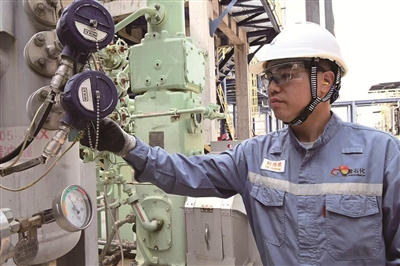
成本支撑仍存 PTA或震荡偏强运行
Qi Huo Ri Bao· 2025-05-26 01:43
Group 1 - Short-term PTA is expected to show a strong oscillating trend due to cost-driven factors, increased export stocking, and improved terminal demand [1][3] - The recent PX price has risen significantly, with the PX and naphtha price spread (PXN) exceeding $260 per ton, leading to improved profitability for industry players [1] - PTA social inventory decreased to 3.7316 million tons, down by 149,700 tons week-on-week, continuing a downward trend since March [1] Group 2 - The operating rate of downstream polyester is expected to remain around 91% to 92%, with a slight decline in production due to weak demand and inventory accumulation [2][3] - New production capacities from companies like Hong Kong Petrochemical and Helen Petrochemical are expected to be launched between June and August, potentially leading to inventory accumulation in July [2] - The overall supply-demand structure for PTA remains favorable, supported by strong cost support and continued foreign purchasing [1][3]
《制造业绿色低碳发展行动方案(2025—2027年)》审议通过,聚焦碳足迹核算标准制定等三大领域
中国有色金属工业协会硅业分会· 2025-05-26 01:17
Core Viewpoint - The article emphasizes the importance of promoting green and low-carbon development in the manufacturing industry, highlighting the need for technological innovation, traditional industry transformation, and the establishment of a comprehensive support system for enterprises [1][2]. Group 1: Focus Areas of the Action Plan - The action plan will focus on three main areas: carbon footprint accounting standards for industrial products, the establishment of a new solid waste comprehensive utilization system, and the promotion of clean low-carbon hydrogen applications in the industrial sector [2]. - It aims to accelerate the development of carbon footprint accounting standards for key products such as steel, electrolytic aluminum, lithium batteries, and new energy vehicles, facilitating the reduction of carbon emissions throughout the product lifecycle [2]. - The plan will also address the comprehensive utilization of waste materials, particularly focusing on used power batteries and photovoltaic components, to prepare for the upcoming retirement peak [2]. Group 2: Key Strategies - Strengthening green technology innovation and application is a core direction of the action plan, aiming to fundamentally change manufacturing processes to reduce energy consumption and environmental pollution [3]. - The plan emphasizes the transformation of traditional industries, which are crucial yet challenging for green low-carbon development, by optimizing production equipment and processes to enhance energy efficiency and reduce emissions [4][5]. - For emerging industries, the plan advocates for high-standard green development, promoting clean energy use and resource recycling from the outset, particularly in sectors like new energy vehicles and photovoltaics [6]. Group 3: Technical and Policy Support - The action plan highlights the need for common technology breakthroughs, which are essential for supporting the green low-carbon development of the manufacturing sector, alongside the establishment of standardized practices [7]. - Optimizing policies and establishing a robust service system are crucial for creating a favorable environment for green transformation, including financial incentives and support services for enterprises [8].
石化行业未来:以高端化差异化走出“内卷”困境
Zhong Guo Chan Ye Jing Ji Xin Xi Wang· 2025-05-25 22:22
Core Viewpoint - The petrochemical industry in China is facing increasing external challenges, with a significant decline in profits and a need for high-quality development through innovation, structural optimization, and green transformation [1][2]. Group 1: Industry Challenges - The petrochemical industry is experiencing a supply-demand imbalance, leading to a continuous decline in product prices, with profits dropping by 20.7% in 2023 and projected to decrease by another 8.8% in 2024 [2][3]. - Despite the overall profit decline, the oil and gas sector saw revenue growth of 1.5% and profit growth of 12.4%, while the chemical sector's revenue grew by 4.6% but profits fell by 6.4% [2][3]. - The industry is characterized by aggressive investment in capacity expansion despite losses, exacerbating the oversupply situation and increasing risks [2][4]. Group 2: Future Development Strategies - The industry is advised to focus on high-end and differentiated new projects, optimizing downstream product structures to mitigate oversupply risks [5][6]. - Emphasis is placed on advancing green and low-carbon development, encouraging investment in green technologies and processes to enhance competitiveness and sustainability [6][10]. - The transition towards a petrochemical powerhouse involves reducing reliance on crude oil, diversifying raw materials, and enhancing product value through innovation and technology [7][8]. Group 3: Specific Product Insights - The production of propylene is expected to grow by 9.1% in 2024, but demand is not keeping pace, leading to price declines and industry-wide losses [3][4]. - Synthetic resin production, particularly nylon 66, is projected to increase significantly, yet actual consumption growth is expected to be much lower, resulting in potential losses [4][9]. - The chemical new materials sector faces challenges with a self-sufficiency rate of only 49% for high-end polyolefins, indicating a need for technological advancements and capacity improvements [9][10].
国泰海通|宏观:出口反弹,内需分化
国泰海通证券研究· 2025-05-25 13:39
Group 1 - The core viewpoint of the article highlights a period of tariff easing, leading to a rebound in exports while domestic demand shows increasing divergence [1] Group 2 - High-frequency data indicates a mixed performance in consumption, with strong automobile sales [1] - Investment in infrastructure is accelerating, while real estate sales show marginal improvement amidst a sluggish land market [1] - Exports are rebounding rapidly, supported by resilient overseas demand, with port data and export freight rates rising quickly due to concentrated shipments from previously accumulated inventories [1] Group 3 - Production is exhibiting a trend of industry divergence, with a rebound in the photovoltaic production index, while the operating rates in sectors like steel and petrochemicals are declining [1] - Coal inventories are decreasing from high levels, and there is an accelerated reduction in steel inventories [1] Group 4 - Price performance is generally subdued, with most high-frequency indicators related to CPI and PPI showing a downward trend [1] - In terms of liquidity, the US dollar index has significantly declined, while the Chinese yuan continues to appreciate [1]

国泰海通 · 晨报0526|宏观、海外策略、产业
国泰海通证券研究· 2025-05-25 13:39
Macro - Export has rebounded while domestic demand shows divergence, with strong automobile sales and accelerated infrastructure investment, but real estate sales are marginally improving amidst a sluggish land market [1] - High-frequency data indicates a rapid rebound in imports and exports, supported by resilient overseas demand and a recovery in port data and export freight rates due to concentrated shipments from previously accumulated inventories [1] - Production is exhibiting industry-specific trends, with a rebound in the photovoltaic production index, while the operating rates in sectors like steel and petrochemicals are declining [1] - Coal inventories are decreasing from high levels, and steel inventories are being reduced at an accelerated pace [1] - Price performance is generally moderate, with most high-frequency indicators for CPI and PPI trending downwards [1] - The liquidity environment is characterized by a significant drop in the US dollar index and a continuous appreciation of the Chinese yuan [1] Overseas Strategy - The article reviews the asset price movements during four periods of trade friction easing between the US and China from 2018 to 2019, highlighting the uncertainty surrounding trade negotiations [3][4] - Each easing period had varying durations and was often interrupted by unilateral actions from the US, indicating the unpredictable nature of trade negotiations [3] - The first easing period in May 2018 lasted only 10 days, with US stock performance showing volatility, while Chinese A-shares faced downward pressure due to dual challenges from tariffs and financial deleveraging [4] - The December 2018 easing lasted over four months, during which A-shares and Hong Kong stocks briefly rebounded before declining again, while US stocks benefited from rising expectations of Federal Reserve rate cuts [4] - The June 2019 easing lasted about one month, with A-shares initially rising but later experiencing declines due to renewed trade tensions [4] - The October 2019 easing saw a significant initial rise in both US and Chinese stock markets, but subsequent performance diverged [4] Industry - The article discusses the significance of tritium as a fuel for nuclear fusion, highlighting recent policy shifts in the US and Germany towards advanced nuclear technologies [8] - Tritium is described as a scarce resource necessary for nuclear fusion, contrasting with uranium, which is mined [8] - The fusion reaction involves deuterium and tritium, releasing energy and neutrons, with deuterium being abundant and sourced from seawater, while tritium must be artificially produced [8] - The process of generating tritium involves neutron multiplication using beryllium spheres and subsequent reactions with lithium, emphasizing the importance of tritium factories for recovery and purification [8]

制造业绿色低碳转型如何突破?国常会发布新行动方案
Nan Fang Du Shi Bao· 2025-05-24 07:11
Group 1 - The State Council of China has approved the "Manufacturing Green Low-Carbon Development Action Plan (2025-2027)", emphasizing the need for green technology innovation and the promotion of advanced green technologies [1] - The plan aims to accelerate the deep green transformation of traditional industries and promote the green development of emerging industries, focusing on clean energy and resource recycling [1] - As of the end of 2024, China has cultivated 6,430 green factories, accounting for over 20% of the total manufacturing output value, with significant investments in green low-carbon transformation projects exceeding 250 billion yuan [1] Group 2 - Despite progress in green development, China's manufacturing sector still faces challenges such as the need to improve green technology levels and optimize industrial structure [2] - The Ministry of Industry and Information Technology plans to establish a green low-carbon development mechanism and develop carbon footprint accounting standards for key products like steel and new energy vehicles [2] - There is a focus on the comprehensive utilization of waste materials, including used power batteries and photovoltaic components, to prepare for the upcoming retirement peak [2]

《制造业绿色低碳三年行动方案》出炉
Huan Qiu Wang· 2025-05-24 02:20
Group 1 - The core viewpoint of the article emphasizes that green development will become the core driving force for promoting high-quality economic development in China, as indicated by the approval of the "Manufacturing Green Low-Carbon Development Action Plan (2025-2027)" [1][3] - The meeting highlighted the necessity of advancing green low-carbon development in the manufacturing sector, accelerating green technology innovation, and promoting the application of advanced green technologies [3] - The government plans to focus on key products such as steel, electrolytic aluminum, lithium batteries, and new energy vehicles, and will develop carbon footprint accounting standards while preparing for the comprehensive utilization of retired products like used power batteries and photovoltaic components [3] Group 2 - Establishing a horizontal ecological protection compensation mechanism is crucial for enhancing ecological environment protection and promoting regional collaborative development [4] - The meeting called for a comprehensive, clear, and efficient horizontal ecological protection compensation mechanism, which will facilitate the interaction between ecological product supply areas and beneficiary areas [4] - The discussion on the revision of the Food Safety Law reflects the government's high emphasis on food safety issues, providing a stronger legal guarantee for ensuring the safety of food for the public [4]
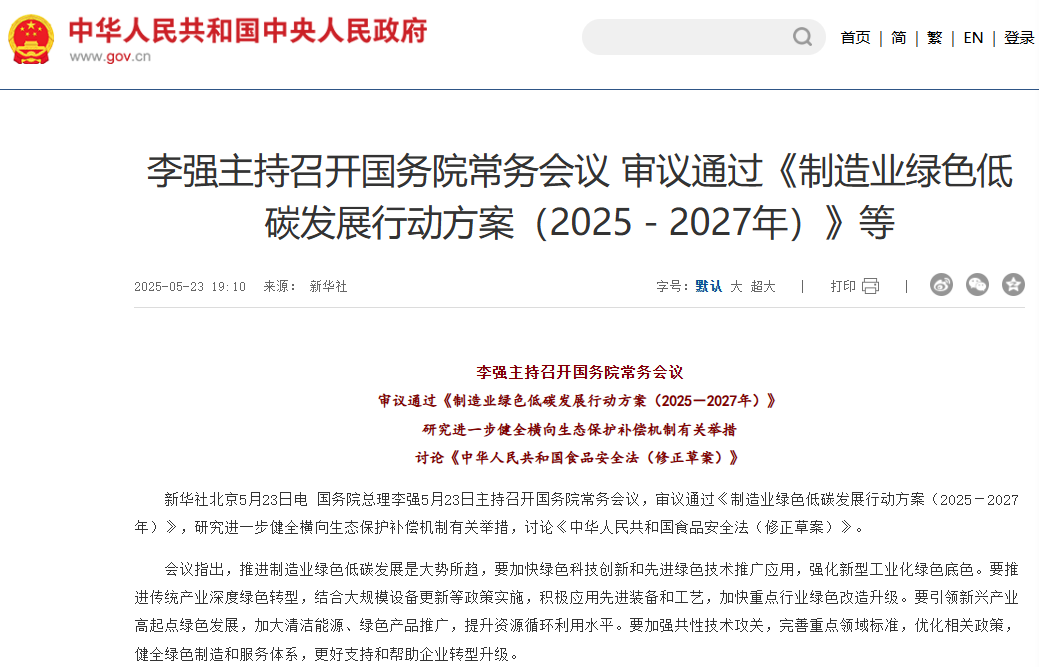
国常会,最新部署!
券商中国· 2025-05-23 15:16
Core Viewpoint - The article emphasizes the importance of promoting green and low-carbon development in the manufacturing industry, highlighting the need for technological innovation and the establishment of effective ecological compensation mechanisms [2][3]. Group 1: Green Low-Carbon Development - The State Council has approved the "Manufacturing Green Low-Carbon Development Action Plan (2025-2027)", focusing on deep green transformation of traditional industries and high-start green development of emerging industries [3][4]. - Key industries such as steel, electrolytic aluminum, lithium batteries, and new energy vehicles will be prioritized for green transformation, with efforts to establish carbon footprint accounting standards [4]. - The plan aims to enhance resource recycling and promote clean energy and green products, supported by policies for equipment upgrades and technological advancements [3][4]. Group 2: Ecological Protection Compensation Mechanism - The meeting discussed the establishment of a comprehensive horizontal ecological protection compensation mechanism, which is crucial for ecological environment protection and regional collaborative development [2][5]. - The mechanism will focus on clear responsibilities, diverse methods, and efficient governance, promoting interaction between ecological product supply areas and beneficiary areas [5]. - The article mentions the implementation of the "Ecological Protection Compensation Regulations" in June 2024, which establishes basic rules for ecological protection compensation in China [5][6].