
创新药

Search documents
ETF及指数产品网格策略周报-20251125
HWABAO SECURITIES· 2025-11-25 09:06
Group 1: Overview of Grid Trading Strategy - The essence of "grid trading" is a high buy low sell strategy, which does not predict market trends but utilizes natural price fluctuations within a certain range to generate profits, making it suitable for frequently fluctuating markets [3][12] - Characteristics of suitable grid trading targets include: selecting on-market targets, stable long-term trends, low trading costs, good liquidity, and high volatility, with equity ETFs being relatively appropriate for grid trading [3][12] Group 2: Analysis of ETF Grid Strategy Targets - The Hang Seng Innovation Drug ETF (520500.SH) focuses on China's innovative drug pipeline, which ranks second globally, with significant policy support enhancing commercialization and internationalization opportunities [3][13] - The Military Industry ETF (512560.SH) is expected to benefit from a new round of military procurement cycles driven by the "14th Five-Year Plan" and increasing defense budgets, which are projected to reach 1.81 trillion yuan in 2025, a 7.2% increase year-on-year [4][14] - The Wine ETF (512690.SH) is characterized by price fluctuations within a certain range and is currently at a historical low valuation, making it suitable for grid strategies, with a daily average fluctuation of 1.77% as of November 21, 2025 [5][17] - The Sci-Tech Chip Design ETF (588780.SH) aims to capitalize on the AI and domestic substitution trends, focusing on the design segment of the chip industry, which is crucial for technological independence and security [6][18]
员工分了18亿
投资界· 2025-11-25 08:38
Core Viewpoint - The article highlights the success story of United Imaging Healthcare, showcasing how employee stock ownership plans have enabled employees to realize significant financial gains, reflecting a broader trend of wealth creation in the A-share market [2][9]. Group 1: Company Overview - United Imaging Healthcare was founded in 2011 by alumni Xue Min and Zhang Qiang, aiming to break the foreign monopoly in high-end medical equipment, and has filled a gap in domestic high-end medical imaging equipment [2][6]. - The company went public on the STAR Market in 2022, achieving a market capitalization of approximately 1,100 billion [2][6]. Group 2: Employee Stock Ownership - Recently, five employee stock ownership platforms of United Imaging Healthcare collectively reduced their holdings by 1,337,000 shares, valued at 1.82 billion [3][5]. - The employee stock ownership plan has benefited over 800 individuals, with an average payout of at least 2 million per person after the recent share reduction [5]. Group 3: Investment and Returns - The article discusses the long-term investment returns for early investors, with notable returns from angel investments made in 2012, leading to significant financial gains for institutional investors [8]. - The trend of wealth creation is not limited to United Imaging Healthcare, as other companies like Century Huatong and Ailisi are also rewarding employees through stock options and share reductions, indicating a broader movement in the A-share market [9][10].


长城基金汪立:从再平衡到再配置,回调或是再次布局机会
Xin Lang Ji Jin· 2025-11-25 08:10
Group 1 - The A-share market experienced a significant pullback last week, with major indices generally declining. Sectors such as banking and consumer goods showed relatively smaller declines, while media and military industries, which had previously corrected, remained stable. This indicates a continued structural differentiation in the market, with small-cap growth styles under pressure and value and dividend sectors performing relatively well, reflecting intensified competition for funds amid declining risk appetite [1] Group 2 - Domestic economic indicators such as industrial production, consumption, and investment growth rates slowed down in October compared to September. This was influenced by holiday timing and high base effects from last year's policy stimulus, leading to short-term fluctuations in data. The pressure on domestic and external demand still requires policy support, with the need for further implementation of existing policies and timely introduction of new measures [2] - Credit performance from both enterprises and households has been relatively weak, with social financing growth continuing to decline due to reduced government bond issuance. However, new policy financial tools are gradually showing effects, which may support corporate loans. The Ministry of Finance announced the allocation of 500 billion yuan from local government debt limits, which may help stabilize social financing data in the last two months of the year [2] Group 3 - The debate over the AI valuation bubble is intensifying, causing fluctuations in the US stock market. However, data shows that the current Nasdaq index growth and valuation levels are significantly lower than during the tech bubble period from 1995 to 2000. Core companies are also showing accelerated profit releases, with stronger valuation and profit quality compared to that period [3] Group 4 - Following the market pullback in October, the overall financing and trading volume has significantly decreased. However, as various risk factors begin to stabilize, the market is expected to enter a phase of emotional recovery, with increased demand for industry rebalancing and fund reallocation. Factors supporting this include the dovish stance from the Federal Reserve, the necessity for policy intervention to boost growth in light of weak real estate and consumption data, and the current A-share market's adjustment levels approaching historical averages [4] - Emerging technology is expected to remain a key investment theme, with a focus on undervalued consumer sectors and brokerage firms. Specific areas of interest include internet, semiconductor, media, power equipment, and innovative pharmaceuticals in the technology sector, as well as consumer goods, hotels, airlines, and retail in the consumer sector. The financial sector is also highlighted as a crucial area for stabilizing the market and benefiting from increased asset management demand [4]
资金持续涌入,恒生医药ETF获得连续9日申购
Sou Hu Cai Jing· 2025-11-25 07:35
Core Viewpoint - The Hong Kong stock market's innovative drug sector has experienced significant volatility recently due to changes in overseas liquidity expectations, with substantial capital inflow as evidenced by the continuous subscription of the Hang Seng Pharmaceutical ETF (159892) for nine consecutive days, reaching a recent high in fund shares [1] Macro Environment - Recent dovish signals from Federal Reserve officials have boosted expectations for interest rate cuts, which may lead to sustained liquidity improvements in the Hong Kong stock market during the Fed's rate-cutting cycle [1] Industry Outlook - According to Industrial Securities, the current sector's prosperity is sustainable, with the trend of "innovation + internationalization" in the innovative drug industry remaining unchanged. After a short-term adjustment, the elasticity of the innovative drug sector has further increased [1] - Positive trends are observed in the innovative drug industry chain across investment and financing data, orders, and performance metrics [1]
四川创新药数量位居中西部第一
Si Chuan Ri Bao· 2025-11-25 07:07
Core Insights - Sichuan province ranks first in the number of innovative drugs in the central and western regions of China [1] - The 2025 Sichuan Province Innovative Drug and Medical Device Supply and Demand Matching Event attracted over 400 representatives from various sectors [1] - A supply list was released, covering 657 product varieties across five sub-industries, while the demand list indicated a need for 4,977 medical devices [1] Group 1: Event Overview - The event was co-hosted by the Provincial Health Commission and the Economic and Information Technology Department [1] - The theme of the event was "Upholding Clinical Value and Innovative Integrated Development" [1] - 16 key enterprises showcased their latest research and development achievements, focusing on innovative drugs and high-end medical devices [1] Group 2: Product Supply and Demand - The supply list includes chemical drugs, traditional Chinese medicine, biological drugs, and medical devices [1] - The demand list specifies nine categories of medical equipment required by hospitals in the province [1] - The total demand for medical devices amounts to 4,977 units [1] Group 3: Industry Development - Sichuan has integrated the pharmaceutical and health sector into its six key industries for development [1] - A comprehensive policy support system has been established, covering research support, clinical transformation, hospital usage, and insurance coverage [1] - The province has launched 10 Class I innovative drugs and 33 Class II and III innovative medical devices, ranking seventh nationally [1]
国证国际港股晨报-20251125
Guosen International· 2025-11-25 06:20
Group 1: Market Overview - The Hong Kong stock market experienced a rebound, with the Hang Seng Index rising by 1.97%, the Hang Seng China Enterprises Index increasing by 1.79%, and the Hang Seng Tech Index climbing by 2.78% [2] - Northbound capital saw a net inflow of HKD 8.571 billion, with Alibaba, Tencent, and Kuaishou being the most actively traded stocks [2] - The technology sector showed significant growth, driven by positive news from various tech companies, including Alibaba's AI assistant app surpassing 10 million downloads in its first week [3][4] Group 2: Company Analysis - Haiwei Co., Ltd. - Haiwei Co., Ltd. is a leader in China's capacitor film market, established in 2006, with a market share of 10.9% in capacitor base films as of 2024 [7] - Revenue projections for Haiwei are expected to reach RMB 330 million in 2024, with a net profit of RMB 86.42 million, despite a slight decline in early 2025 [7] - The company benefits from strong R&D capabilities, a diversified product portfolio, and an experienced management team [9] Group 3: Industry Outlook - The Chinese capacitor base film market is projected to grow at a CAGR of 19.7%, increasing from 46,000 tons in 2019 to 113,000 tons by 2024, and expected to reach 224,000 tons by 2029 [8] - The market for capacitor base films used in electric vehicles is anticipated to grow from 48,000 tons in 2025 to 87,000 tons by 2029, with a CAGR of 16.2% [8] - The market for capacitor base films in new energy power systems is expected to grow from 34,000 tons in 2025 to 80,000 tons by 2029, with a CAGR of 23.6% [8]
近4900股上涨,A股高开高走,科技龙头全线反弹,光库科技20CM涨停
2 1 Shi Ji Jing Ji Bao Dao· 2025-11-25 04:16
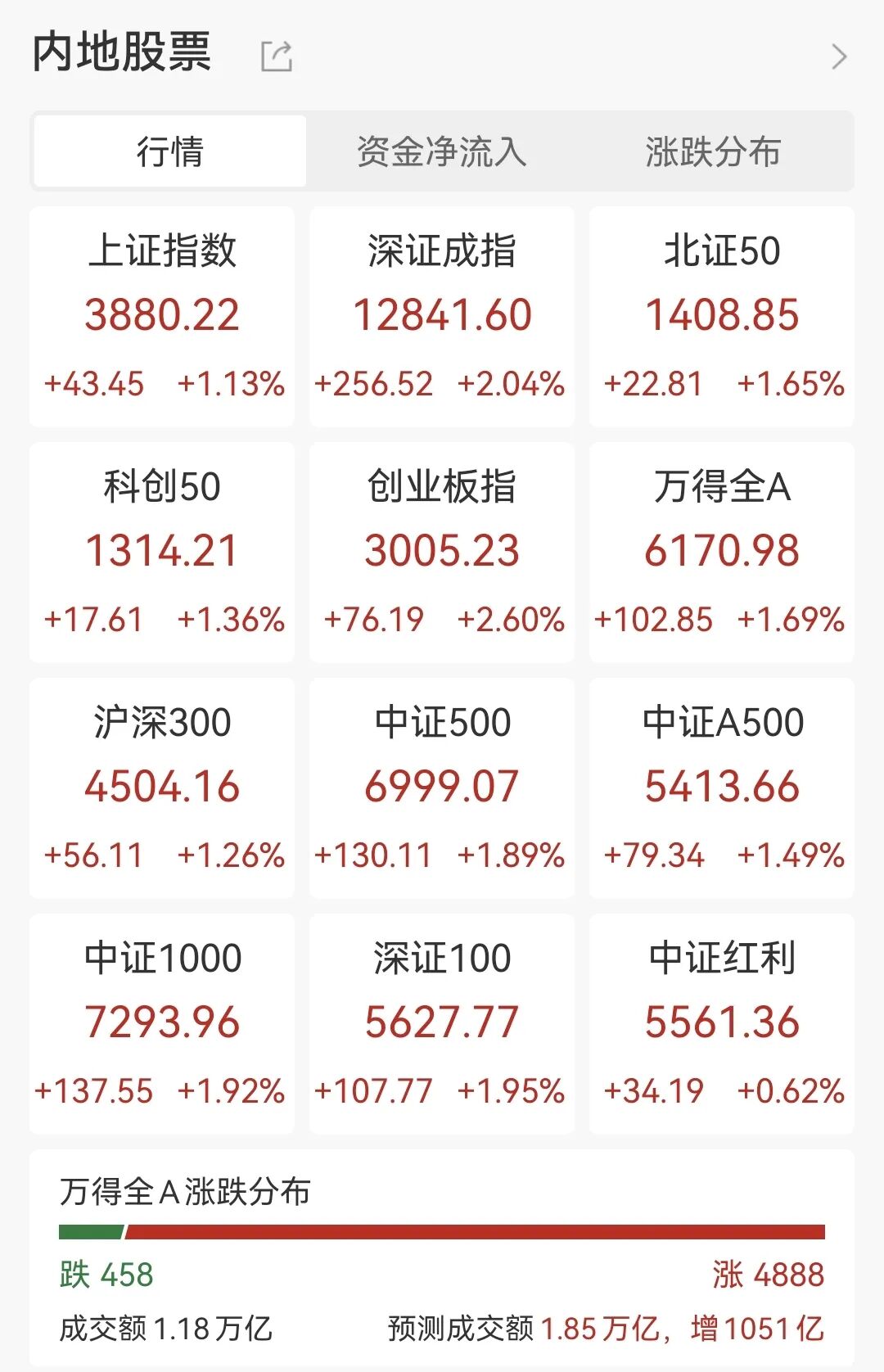
Market Overview - On November 25, A-shares saw all three major indices open higher and continue to rise, with the Shanghai Composite Index up over 1.13%, the Shenzhen Component Index up 2.04%, and the ChiNext Index rising over 2.6% to surpass 3000 points [1][2] - Nearly 4900 stocks in the market were in the green, indicating a broad-based rally [1] Sector Performance - The AI hardware sector experienced a strong rebound, with the CPO concept surging, and related sectors such as fiberglass, liquid cooling, and copper-clad boards also seeing significant gains [3] - The innovative drug index saw a strong rally, with constituent stocks generally rising, including North University Medicine hitting the daily limit [3] - The CPO concept index rose over 10%, with several stocks like Dekeli and Changguang Huaxin reaching the daily limit of 20% [3] - AI application stocks remained active, with companies like Shida Group achieving four consecutive trading limits [4] Hong Kong Market - The Hong Kong stock market also opened higher, with the Hang Seng Index up 0.74%, the Hang Seng Tech Index up 1.38%, and the Hang Seng China Enterprises Index up 0.87% [5] - Alibaba Health continued its upward trend, rising nearly 5% on the day and showing a cumulative increase of 81.33% for the year [8] Notable Stocks - Xiaomi Group rose nearly 5% following news of Lei Jun increasing his stake by over 100 million HKD [7] - Baidu Group saw an increase of over 7% [7] - Zijin Mining rose nearly 3% as gold prices rebounded, with spot gold prices increasing from $4060/oz to $4150/oz [7]






场内ETF资金动态:昨日航空航天上涨
Sou Hu Cai Jing· 2025-11-25 03:57
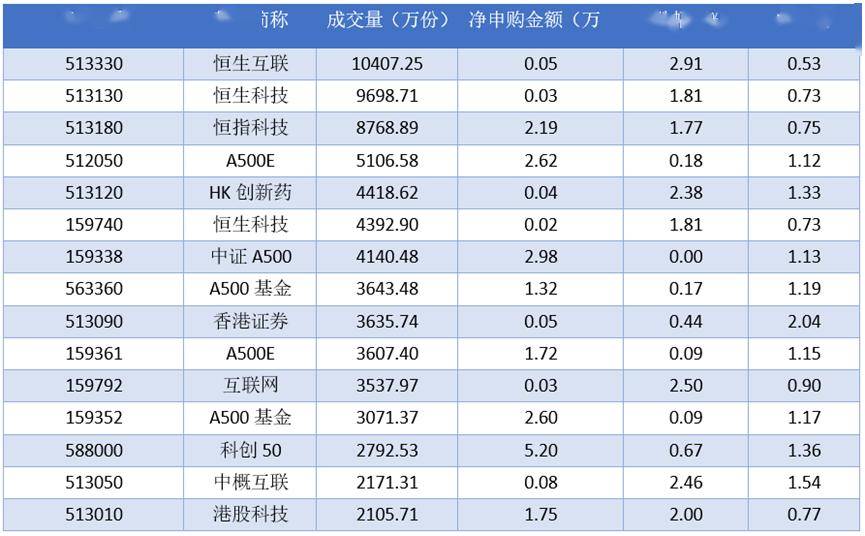
Market Overview - The three major A-share indices experienced slight increases, with the Shanghai Composite Index rising by 1.13% to 3880.22 points, the Shenzhen Component Index increasing by 2.04% to 12841.6 points, and the ChiNext Index up by 2.6% to 3005.23 points [1] ETF Performance - The top-performing ETF on November 24, 2025, was the Aerospace ETF (159227), which saw a gain of 5.01%. Other notable gainers included the Aviation TH (159241) at 4.66%, Aerospace (159208) at 4.64%, and Online Consumption (159725) at 4.50% [1] - Conversely, the ETF with the largest decline was the Sci-Tech Innovation ETF (589580), which fell by 2.14%. Other ETFs with significant declines included the Double Innovation Fund (159783) at 1.88%, Rare Metals (562800) at 1.68%, and Rare Metals (159608) at 1.67% [1] Trading Volume - The ETF with the highest trading volume on November 24, 2025, was the Hang Seng Internet ETF (513330), with a volume of 10,407.25 million shares. Other ETFs with high trading volumes included Hang Seng Technology (513130) at 9,698.71 million shares, Hang Seng Tech (513180) at 8,768.89 million shares, and A500E (512050) at 5,106.58 million shares [1][2] Fund Flows - The ETF with the largest net subscription on November 24, 2025, was the 300ETF (510300), with a net subscription amount of 3.662 billion yuan. Other top net subscriptions included the 50ETF (510050) at 1.529 billion yuan, 500ETF (510500) at 898 million yuan, and CSI 300 (159919) at 742 million yuan [3] - The ETF with the highest net redemption was the Real Estate ETF (512200), with a redemption amount of 384 million yuan. Other ETFs with significant redemptions included the Military Industry Leader (512710) at 212 million yuan, Bank ETF (512800) at 211 million yuan, and Coal ETF (515220) at 206 million yuan [3]
港股科技ETF(513020)连续5日净流入超2.2亿,市场关注流动性支撑与AI产业逻辑
Mei Ri Jing Ji Xin Wen· 2025-11-25 02:55
港股科技ETF(513020)跟踪的是港股通科技指数(931573),该指数从港股通范围内选取具有高流动 性、大市值的科技主题上市公司证券作为指数样本,聚焦互联网、创新药、新能源汽车等核心科技领 域,以反映港股市场优质科技企业的整体表现。 中泰证券指出,港股科技龙头在AI投入加大的背景下,当前估值合理且分红回购增强。在本轮大模型 和C端应用竞争中,真正有能力将AI能力落到产品和商业化上的仍主要集中在头部平台。科技板块受美 股AI龙头影响较强。展望后市,本轮科技行情远未结束,短期回调后有望延续,因美股AI产业基本面 逆转可能性较低,仍会给予港股对标公司较大估值增长空间。当前AI板块发展阶段对应美股2023-2024 年资金从硬件向应用扩散时期,硬件基础设施行情已充分演绎,应用层面刚刚起步,意味着行情远未进 入尾声。 注:如提及个股仅供参考,不代表投资建议。指数/基金短期涨跌幅及历史表现仅供分析参考,不预示 未来表现。市场观点随市场环境变化而变动,不构成任何投资建议或承诺。文中提及指数仅供参考,不 构成任何投资建议,也不构成对基金业绩的预测和保证。如需购买相关基金产品,请选择与风险等级相 匹配的产品。基金有风险, ...
港股创新药概念股表现活跃
Mei Ri Jing Ji Xin Wen· 2025-11-25 02:41
每经AI快讯,11月25日,港股创新药概念股表现活跃,乐普生物、康方生物涨超4%,石药集团、信达 生物、康诺亚涨超3%。 ...