
有色

Search documents
中信期货晨报:国内商品期货大面积上涨,黑色系全面飘红-20250605
Zhong Xin Qi Huo· 2025-06-05 09:48
1. Report Industry Investment Rating No relevant content provided. 2. Core Viewpoints of the Report - Overseas macro: US May ADP employment growth fell short of expectations and the previous value; OECD cut the global growth forecast for the second time this year, slashing the US economic growth forecast from 2.8% to 1.6%. After the China - US tariff relief, US consumer confidence was significantly boosted, but the improvement in the labor market was limited, and the long - term economic resilience still needed to be observed [6]. - Domestic macro: Against the backdrop of the continued implementation of the "rush export/trans - shipment" and "two new" policies, the profits and PMI of manufacturing enterprises generally maintained strong resilience. The trade friction easing and policies supported the overall stability of manufacturing production and operation [6]. - Asset views: For major asset classes, maintain the view of more hedging and more volatility overseas and a structural market in China. Strategically allocate gold and non - US dollar assets. Overseas, even if Trump's tariffs are blocked, it cannot solve the fundamental deficit problem in the US. In China, the growth - stabilizing policy remains steadfast, and the second - quarter economic growth rate is supported by export resilience and the tariff - easing window period. The bond market still has value for dip - buying after the capital pressure eases. The stock market and commodities return to the fundamental logic, showing short - term range - bound fluctuations [6]. 3. Summaries According to Relevant Catalogs 3.1 Macro Essentials - Overseas: US May ADP employment increased by 37,000, lower than the expected 110,000 and the previous value of 62,000. The number of job vacancies in April increased, and the consumer confidence index in May jumped from 85.7 to 98.0, but the labor market improvement was limited [6]. - Domestic: From January to April, the total profit of large - scale industrial enterprises was 2.11702 trillion yuan, a year - on - year increase of 1.4%. The manufacturing PMI in May was 49.5%, up 0.5 percentage points month - on - month [6]. 3.2 Viewpoint Highlights 3.2.1 Macro - Domestic: Moderate reserve requirement ratio and interest rate cuts, and short - term fiscal implementation of established policies [8]. - Overseas: The inflation expectation structure flattened, the economic growth expectation improved, and the stagflation trading cooled down [8]. 3.2.2 Finance - Stock index futures: Focus on local large - consumption hotspots, with market sentiment oscillating [8]. - Stock index options: Volatility declined continuously, and cautious covered call strategies were recommended, with the market oscillating [8]. - Treasury bond futures: Treasury bond futures rose collectively, and the market oscillated [8]. 3.2.3 Precious Metals - Gold/Silver: Due to the better - than - expected progress of China - US negotiations, precious metals continued to adjust in the short term, with the market oscillating [8]. 3.2.4 Shipping - Container shipping to Europe: Attention was paid to the game between peak - season expectations and the implementation of price increases, with the market oscillating [8]. 3.2.5 Black Building Materials - Steel: Pessimistic demand expectations and a downward - moving cost support, with the market oscillating [8]. - Iron ore: Overseas shipments increased, and the price oscillated [8]. - Coke: As the off - season deepened, there was still an expectation of price cuts, with the market oscillating and falling [8]. - Coking coal: Upstream inventory accumulation intensified, and the price remained weak, with the market oscillating and falling [8]. 3.2.6 Non - ferrous Metals and New Materials - Copper: Inventory continued to accumulate, and the copper price oscillated at a high level, with the market oscillating and rising [8]. - Alumina: The event of mining license revocation was not yet finalized, and the alumina contract oscillated at a high level, with the market oscillating and falling [8]. - Aluminum: With the easing of trade tensions, the aluminum price oscillated strongly [8]. 3.2.7 Energy and Chemicals - Crude oil: Supply pressure persisted, and attention was paid to macro and geopolitical disturbances, with the market oscillating [11]. - LPG: Demand remained weak, and PG was in short - term bottom - finishing, with the market oscillating [11]. - Asphalt: The asphalt futures price was overestimated and awaited a decline [11]. - Methanol: Coal prices temporarily stabilized, and methanol oscillated [11]. 3.2.8 Agriculture - Oils: There was an expectation of improvement in China - Canada trade relations, but rapeseed oil still performed weakly, with the market oscillating [11]. - Protein meal: The spot market sentiment cooled down, and the contract price followed the correction, with the market oscillating [11]. - Corn/Starch: The trading was dull, and the futures price oscillated [11]. - Pork: The supply for slaughter increased, and the pork price continued to fall, with the market oscillating and falling [11].
【财经分析】5月中国大宗商品价格指数环比上涨 化工价格指数止跌反弹
Xin Hua Cai Jing· 2025-06-05 04:29
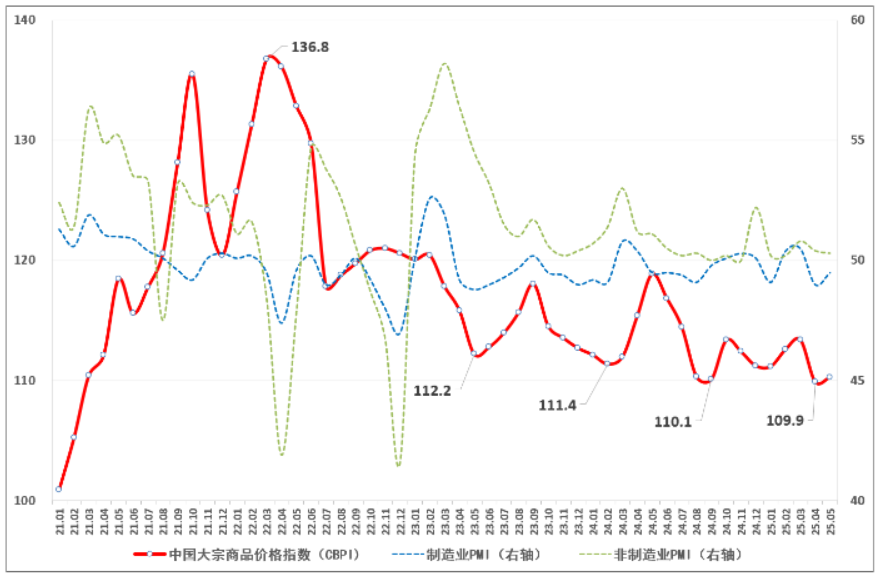
Core Insights - The May 2023 China Commodity Price Index (CCPI) stands at 110.3 points, reflecting a month-on-month increase of 0.3% but a year-on-year decrease of 7.2% [1][3] - The index indicates a stabilization trend in commodity prices, with specific sectors showing varied performance, such as a slight increase in non-ferrous metal prices and a rebound in chemical prices [1][6] Price Index Summary - The non-ferrous price index rose to 127.7 points, up 0.9% month-on-month but down 5.2% year-on-year [3][4] - The agricultural product price index increased to 98.2 points, with a month-on-month rise of 0.5% and a year-on-year increase of 2% [3][4] - The chemical price index rebounded to 102.8 points, up 0.5% month-on-month but down 13.7% year-on-year [3][4] - The black metal price index fell to 78.7 points, down 0.8% month-on-month and down 11.4% year-on-year [3][4] - The energy price index decreased to 96.3 points, down 2.1% month-on-month and down 14.9% year-on-year [3][4] - The mineral price index dropped to 75.6 points, down 2.2% month-on-month and down 8.3% year-on-year [3][4] Commodity Price Movements - Among 50 monitored commodities, 32 (64%) saw price declines while 17 (34%) experienced price increases [4][6] - The top three commodities with price increases were PTA (up 9.5%), ethylene glycol (up 4.6%), and corn (up 4.3%) [4][6] - The largest price declines were observed in industrial silicon (down 10.2%), lithium carbonate (down 10%), and soybean meal (down 9.9%) [4][6] Market Analysis - Analysts attribute the rise in non-ferrous prices to improved demand expectations due to easing US-China tariff policies [5][6] - The agricultural price index's increase is linked to stable downstream consumer demand, with corn prices rising due to increased market demand and short-term supply constraints [6][7] - The overall market sentiment remains cautious due to persistent external uncertainties and insufficient effective demand in certain sectors [1][7]


宝城期货品种套利数据日报(2025 年6月5日)-20250605
Bao Cheng Qi Huo· 2025-06-05 02:49
投资咨询业务资格:证监许可【2011】1778 号 运筹帷幄 决胜千里 宝城期货品种套利数据日报(2025 年 6 月 5 日) 一、动力煤 | 商品 | | | 动力煤(元/吨) | | | --- | --- | --- | --- | --- | | 日期 | 基差 | 5月-1月 | 9月-1月 | 9月-5月 | | 2025/06/04 | -192.4 | 0.0 | 0.0 | 0.0 | | 2025/06/03 | -191.4 | 0.0 | 0.0 | 0.0 | | 2025/05/30 | -190.4 | 0.0 | 0.0 | 0.0 | | 2025/05/29 | -190.4 | 0.0 | 0.0 | 0.0 | | 2025/05/28 | -190.4 | 0.0 | 0.0 | 0.0 | -250 -200 -150 -100 -50 0 50 100 150 450 500 550 600 650 700 750 800 850 900 950 动力煤基差 基差(右) 动力煤现货价:秦皇岛 期货结算价(活跃合约) :动力煤 www.bcqhgs.com 1 杭 ...
5月大宗商品价格指数微涨,信心初现
Huan Qiu Wang· 2025-06-05 02:49
Group 1 - The core viewpoint is that there is a mixed performance in the prices of major commodities in China, with some sectors showing recovery while others continue to decline [1][2][3] - In May, the China Commodity Price Index was reported at 110.3 points, reflecting a month-on-month increase of 0.3%, indicating a slight recovery in the market [3] - Among 50 monitored commodities, 17 showed a month-on-month price increase, with the non-ferrous price index at 127.7 points, up 0.9%, and the chemical price index rebounding by 0.5% [1] Group 2 - Agricultural product prices have risen for five consecutive months, demonstrating resilience in the agricultural sector and its role in stabilizing supply and prices [1] - Conversely, black, mineral, and energy price indices continue to decline, highlighting persistent issues of insufficient effective demand in certain industries [1] - Experts suggest that to solidify economic recovery, the government should increase public investment in infrastructure and services to boost market demand and enterprise orders [2]
【金融工程】股指期货深度贴水,小盘调整压力上升——市场环境因子跟踪周报(2025.06.04)
华宝财富魔方· 2025-06-04 10:33
Investment Insights - The report indicates an increase in the risk of "herding" behavior in the market, suggesting a cautious approach until the risk is released [3][4] - Current market focus remains on defensive sectors such as banking, pharmaceuticals, nuclear power, and new consumption themes, with a recommendation to wait for adjustment pressure to ease before making further investments [4] Stock Market Analysis - In the past week, small-cap growth stocks outperformed, while volatility in both large and small-cap styles increased, indicating instability in market styles [6] - The dispersion of excess returns among industry indices has decreased to a near one-year low, with a slight decline in the proportion of rising constituent stocks [6] - Market activity showed a slight increase in volatility, but turnover rates continued to decline, particularly in the Shanghai Stock Exchange 50, which reached historically low turnover levels [6] Commodity Market Overview - The commodity market displayed divergent trends, with energy and black metal sectors maintaining their momentum, while precious metals and non-ferrous metals showed upward trends [15] - The basis momentum for the black metal sector increased, while agricultural products remained at a low basis momentum [15] - Volatility was high in the energy sector, while other sectors experienced low-level fluctuations [15] Options Market Insights - Implied volatility for the Shanghai Stock Exchange 50 and CSI 1000 showed no significant trend before the Dragon Boat Festival, with long-term contracts experiencing a relative increase in implied volatility compared to short-term contracts [20] - The skew of put options relative to call options for the CSI 1000 maintained an advantage, with a noticeable increase in open interest, indicating market expectations of potential adjustments in small-cap stocks [20] Convertible Bond Market Trends - The convertible bond market saw a slight rebound, with the premium rate for bonds convertible at 100 yuan recovering, although the proportion of low-premium convertible bonds increased slightly [23] - Market transaction volume remained stable, and credit spreads significantly narrowed [23]

市场环境因子跟踪周报(2025.05.30):股指期货深度贴水,小盘调整压力上升-20250604
HWABAO SECURITIES· 2025-06-04 08:13
Quantitative Factors and Models Summary Quantitative Factors and Construction Methods 1. **Factor Name**: Market Style Factor **Construction Idea**: This factor tracks the market's preference for small-cap versus large-cap stocks and growth versus value stocks over the observed period **Construction Process**: - The factor is divided into two dimensions: size (small-cap vs. large-cap) and style (growth vs. value) - The factor measures the relative performance of small-cap stocks compared to large-cap stocks and growth stocks compared to value stocks - Observations include the directional bias (e.g., small-cap preference) and the volatility of these style preferences **Evaluation**: The factor indicates a market preference for small-cap and growth stocks, but with increased volatility, suggesting instability in market style trends [11][12] 2. **Factor Name**: Market Structure Factor **Construction Idea**: This factor evaluates the dispersion and concentration of returns across industries and stocks to assess market structure dynamics **Construction Process**: - Industry excess return dispersion is calculated to measure the spread of returns across different sectors - Metrics such as the proportion of rising constituent stocks and the turnover concentration of the top 100 stocks and top 5 industries are tracked - Changes in these metrics are used to infer market structure stability and concentration trends **Evaluation**: The factor shows a decline in industry return dispersion and a slight increase in stock and industry concentration, indicating a more concentrated market structure [11][12] 3. **Factor Name**: Market Activity Factor **Construction Idea**: This factor measures market activity through volatility and turnover rates **Construction Process**: - Index volatility is calculated to assess market fluctuations - Turnover rates, particularly for indices like the SSE 50, are tracked to gauge trading activity - Observations include changes in these metrics over time **Evaluation**: The factor reveals a slight increase in market volatility but a continued decline in turnover rates, especially for the SSE 50, indicating reduced market activity [11][12] 4. **Factor Name**: Commodity Market Factors **Construction Idea**: These factors analyze trends, momentum, volatility, and liquidity in commodity markets **Construction Process**: - **Trend Strength**: Tracks the continuation of trends in sectors like energy and metals - **Basis Momentum**: Measures the momentum of basis changes, with specific focus on sectors like agriculture and metals - **Volatility**: Assesses the level of price fluctuations in different commodity sectors - **Liquidity**: Evaluates the trading activity and ease of transactions in commodity markets **Evaluation**: The factors highlight strong trends in energy and metals, low basis momentum in agriculture, high volatility in energy, and strong liquidity in energy and metals [23][27] 5. **Factor Name**: Option Market Factors **Construction Idea**: These factors assess market sentiment and risk expectations through option pricing metrics **Construction Process**: - **Implied Volatility**: Tracks the implied volatility of options on indices like SSE 50 and CSI 1000 - **Skewness**: Measures the relative pricing of put options versus call options to infer market sentiment - **Open Interest**: Monitors changes in open interest to gauge market positioning **Evaluation**: The factors suggest stable short-term sentiment but highlight potential downside risks for small-cap stocks based on skewness and rising open interest in put options [33][34] 6. **Factor Name**: Convertible Bond Market Factors **Construction Idea**: These factors analyze valuation and liquidity dynamics in the convertible bond market **Construction Process**: - **Valuation Metrics**: Tracks metrics like the premium rate of bonds near par value and the proportion of low-premium bonds - **Liquidity Metrics**: Monitors trading volume and credit spreads **Evaluation**: The factors indicate a slight recovery in valuation metrics but a rise in low-premium bonds, with stable trading volumes and narrowing credit spreads [35][37] Factor Backtesting Results 1. **Market Style Factor**: - Small-cap preference observed - Growth style preference observed - Increased volatility in both dimensions [11][12] 2. **Market Structure Factor**: - Industry return dispersion decreased - Stock and industry concentration slightly increased [11][12] 3. **Market Activity Factor**: - Market volatility slightly increased - Turnover rates decreased, especially for SSE 50 [11][12] 4. **Commodity Market Factors**: - Strong trends in energy and metals - Low basis momentum in agriculture - High volatility in energy - Strong liquidity in energy and metals [23][27] 5. **Option Market Factors**: - Stable implied volatility for SSE 50 and CSI 1000 - Skewness favors put options for CSI 1000 - Rising open interest in put options for CSI 1000 [33][34] 6. **Convertible Bond Market Factors**: - Premium rates near par value slightly recovered - Proportion of low-premium bonds increased - Trading volumes stable - Credit spreads narrowed [35][37]
午评:创业板指涨超1%,券商、地产等板块拉升,稀土概念活跃
Sou Hu Cai Jing· 2025-06-04 04:10
Market Overview - The stock indices in both markets rose significantly, with the ChiNext Index and North Star 50 Index increasing by over 1%, and nearly 4000 stocks showing gains [1] - As of the midday close, the Shanghai Composite Index rose by 0.43% to 3376.58 points, the Shenzhen Component Index increased by 0.91%, the ChiNext Index rose by 1.22%, and the North Star 50 Index increased by 1.17%, with a total transaction volume of 742.6 billion yuan [1] Sector Performance - Various sectors such as non-ferrous metals, food and beverage, brokerage, real estate, insurance, steel, chemicals, and liquor saw significant gains, while sectors like rare earths, cultivated diamonds, solid-state batteries, and gold concepts were also active [1] Investment Strategy - The company suggests three main lines for investment opportunities: 1. Assets with high safety margins, focusing on dividend-paying sectors that provide stable returns amidst external uncertainties [2] 2. The "technology narrative" in the A-share market, with revised restructuring methods facilitating early-stage tech companies' participation in mergers and acquisitions, indicating technology as a long-term investment focus [2] 3. The consumer sector boosted by policy support, with recent data showing the effectiveness of consumption incentives, highlighting the importance of expanding domestic demand as a long-term strategy [2] Market Sentiment - According to Galaxy Securities, the speed of sector rotation has increased, but the market remains in a volatile pattern without significant volume expansion, primarily engaging in stock-based competition [1] - Despite a recent phase one tariff agreement between China and the US alleviating some trade pressures, uncertainties regarding future policies from the Trump administration persist, suggesting the market may continue to experience fluctuations [1]

量化点评报告:六月配置建议:超配A股价值风格
GOLDEN SUN SECURITIES· 2025-06-03 11:10
Quantitative Models and Construction 1. Model Name: AIAE Indicator for A-shares - **Model Construction Idea**: The AIAE indicator is used to measure the relative valuation of A-shares by comparing the total market capitalization of the CSI All Share Index with the sum of the total market capitalization and total entity debt[10] - **Model Construction Process**: The formula for the AIAE indicator is: $ AIAE = \frac{\text{CSI All Share Total Market Cap}}{\text{CSI All Share Total Market Cap} + \text{Total Entity Debt}} $ As of the end of May, the AIAE indicator for A-shares was 16%, which is at the 35th percentile since 2010, indicating relatively high valuation attractiveness[10] - **Model Evaluation**: The indicator suggests that A-shares still have high payoff potential, though the win rate remains moderate due to macroeconomic uncertainties[10] 2. Model Name: Bond Payoff Indicator - **Model Construction Idea**: This indicator is derived from the expected return spread between long-term and short-term bonds to assess the valuation risk of bonds[11] - **Model Construction Process**: The bond payoff indicator is calculated based on the expected return difference between long-term and short-term bonds. Currently, the indicator is at -2.1 standard deviations, indicating extremely low valuation levels and potential risks in long-term bonds[11] - **Model Evaluation**: The indicator highlights valuation risks in long-term bonds, though the win rate has improved due to monetary easing and weak credit conditions[11] 3. Model Name: Federal Reserve Liquidity Index - **Model Construction Idea**: This index combines quantity and price dimensions to measure the liquidity provided by the Federal Reserve[18] - **Model Construction Process**: The Federal Reserve Liquidity Index is constructed by integrating multiple factors, including net liquidity, credit support, market expectations, and announcement surprises. Currently, the index is at the 20th percentile, indicating relatively loose liquidity conditions[18] - **Model Evaluation**: The index suggests that liquidity conditions are supportive, but potential shifts in Federal Reserve policy could alter the outlook[18] --- Quantitative Factors and Construction 1. Factor Name: Quality Factor - **Factor Construction Idea**: The quality factor is evaluated based on its payoff, trend, and crowding levels, with a focus on long-term stability[19] - **Factor Construction Process**: - Payoff: Currently at 1.3 standard deviations, indicating attractive valuation - Trend: At -0.3 standard deviations, suggesting moderate momentum - Crowding: At -0.8 standard deviations, reflecting low crowding levels The comprehensive score for the quality factor is 2.4, making it a high-priority allocation[19] - **Factor Evaluation**: The factor is attractive for long-term investment due to its favorable valuation and low crowding[19] 2. Factor Name: Growth Factor - **Factor Construction Idea**: The growth factor is assessed based on its valuation, trend, and crowding, with a focus on growth potential[21] - **Factor Construction Process**: - Payoff: At -1.9 standard deviations, indicating low valuation attractiveness - Trend: At 0.4 standard deviations, suggesting moderate momentum - Crowding: At 0.3 standard deviations, reflecting moderate crowding The comprehensive score for the growth factor is -1.6, indicating low allocation value[21] - **Factor Evaluation**: The factor is less attractive due to its low valuation and moderate crowding[21] 3. Factor Name: Dividend Factor - **Factor Construction Idea**: The dividend factor is evaluated for its income-generating potential and stability[24] - **Factor Construction Process**: - Payoff: At 0.02 standard deviations, indicating neutral valuation - Trend: At -1.8 standard deviations, suggesting weak momentum - Crowding: At -1.2 standard deviations, reflecting low crowding The comprehensive score for the dividend factor is 0, indicating no significant allocation value[24] - **Factor Evaluation**: The factor lacks strong investment appeal due to weak momentum and neutral valuation[24] 4. Factor Name: Small-cap Factor - **Factor Construction Idea**: The small-cap factor is assessed for its potential to outperform based on size and market dynamics[26] - **Factor Construction Process**: - Payoff: At -0.3 standard deviations, indicating neutral valuation - Trend: At 0.4 standard deviations, suggesting moderate momentum - Crowding: At 0.5 standard deviations, reflecting moderate crowding The comprehensive score for the small-cap factor is 0, indicating high uncertainty[26] - **Factor Evaluation**: The factor is not recommended due to its high uncertainty and moderate crowding[26] --- Backtesting Results for Models 1. AIAE Indicator for A-shares - Current value: 16% - Percentile since 2010: 35%[10] 2. Bond Payoff Indicator - Current value: -2.1 standard deviations[11] 3. Federal Reserve Liquidity Index - Current value: 20th percentile[18] --- Backtesting Results for Factors 1. Quality Factor - Payoff: 1.3 standard deviations - Trend: -0.3 standard deviations - Crowding: -0.8 standard deviations - Comprehensive Score: 2.4[19] 2. Growth Factor - Payoff: -1.9 standard deviations - Trend: 0.4 standard deviations - Crowding: 0.3 standard deviations - Comprehensive Score: -1.6[21] 3. Dividend Factor - Payoff: 0.02 standard deviations - Trend: -1.8 standard deviations - Crowding: -1.2 standard deviations - Comprehensive Score: 0[24] 4. Small-cap Factor - Payoff: -0.3 standard deviations - Trend: 0.4 standard deviations - Crowding: 0.5 standard deviations - Comprehensive Score: 0[26]
宝城期货品种套利数据日报-20250603
Bao Cheng Qi Huo· 2025-06-03 07:18
Report Overview - The report is the Baocheng Futures Variety Arbitrage Data Daily Report for June 3, 2025, covering multiple sectors including power coal, energy chemicals, black commodities, non - ferrous metals, agricultural products, and stock index futures [1] 1. Power Coal - **Base Price Data**: From May 26 to May 30, 2025, the power coal basis was - 190.4 yuan/ton, and the spreads of 5 - 1 month, 9 - 1 month, and 9 - 5 month were all 0.0 [2] 2. Energy Chemicals 2.1 Energy Commodities - **Base Price and Ratio Data**: From May 26 to May 30, 2025, the INE crude oil basis ranged from - 11.71 to - 2.01 yuan/ton; the fuel oil basis on May 29, 28, and 27 was 73.58, 93.87, and 50.10 yuan/ton respectively; the crude oil/asphalt ratio ranged from 0.1297 to 0.1316 [6] 2.2 Chemical Commodities - **Base Price Data**: From May 26 to May 30, 2025, the basis of various chemical products such as natural rubber, methanol, PTA, etc. showed different values. For example, the natural rubber basis on May 30 was 95 yuan/ton [11] - **Inter - period Spread Data**: The inter - period spreads of various chemical products such as natural rubber, methanol, PTA, etc. in different time intervals (5 - 1 month, 9 - 1 month, 9 - 5 month) also had different values. For example, the 5 - 1 month spread of natural rubber was 85 yuan/ton [11] - **Inter - variety Spread Data**: The inter - variety spreads such as LLDPE - PVC, LLDPE - PP, etc. also had different values on different dates. For example, the LLDPE - PVC spread on May 30 was 2213 yuan/ton [11] 3. Black Commodities - **Base Price Data**: From May 26 to May 30, 2025, the basis of black commodities such as rebar, iron ore, coke, and coking coal showed different values. For example, the rebar basis on May 30 was 169.0 yuan/ton [16] - **Inter - period Spread Data**: The inter - period spreads of black commodities such as rebar, iron ore, coke, and coking coal in different time intervals (5 - 1 month, 9 - 1 month, 9 - 5 month) also had different values. For example, the 5 - 1 month spread of rebar was 6.0 yuan/ton [16] - **Inter - variety Spread Data**: The inter - variety spreads such as rebar/iron ore, rebar/coke, etc. also had different values on different dates. For example, the rebar/iron ore ratio on May 30 was 4.22 [16] 4. Non - ferrous Metals 4.1 Domestic Market - **Base Price Data**: From May 26 to May 30, 2025, the domestic basis of non - ferrous metals such as copper, aluminum, zinc, etc. showed different values. For example, the copper basis on May 30 was 730 yuan/ton [25] 4.2 London Market - **LME Premium and Discount, Shanghai - London Ratio, etc.**: On May 30, 2025, the LME premium and discount, Shanghai - London ratio, CIF price, domestic spot price, and import profit and loss of non - ferrous metals such as copper, aluminum, zinc, etc. were given. For example, the LME copper premium and discount was 51.49, and the Shanghai - London copper ratio was 8.14 [31] 5. Agricultural Products - **Base Price Data**: From May 26 to May 30, 2025, the basis of agricultural products such as soybeans, corn, etc. showed different values. For example, the basis of soybean No. 1 on May 30 was - 37 [39] - **Inter - period Spread Data**: The inter - period spreads of agricultural products such as soybean No. 1, soybean No. 2, etc. in different time intervals (5 - 1 month, 9 - 1 month, 9 - 5 month) also had different values. For example, the 5 - 1 month spread of soybean No. 1 was 49 yuan/ton [37] - **Inter - variety Spread Data**: The inter - variety spreads such as soybean No. 1/corn, soybean No. 2/corn, etc. also had different values on different dates. For example, the soybean No. 1/corn ratio on May 30 was 1.76 [37] 6. Stock Index Futures - **Base Price Data**: From May 26 to May 30, 2025, the basis of stock index futures such as CSI 300, SSE 50, etc. showed different values. For example, the CSI 300 basis on May 30 was 17.83 [47] - **Inter - period Spread Data**: The inter - period spreads of stock index futures such as CSI 300, SSE 50, etc. in different time intervals (next month - current month, current quarter - current month, etc.) also had different values. For example, the next month - current month spread of CSI 300 was - 38.0 [47]
最新报告:2060年我国工业碳排放将比今年下降约95%
Nan Fang Du Shi Bao· 2025-05-30 10:17
Core Insights - The report outlines the future industrial carbon neutrality technology evolution path, projecting that by 2060, China's industrial carbon emissions could drop to 450 million tons, a reduction of approximately 95% from 2025 levels [1] - Four common technologies—raw material substitution, waste recycling, electrification and clean power substitution, and hydrogen substitution—are expected to contribute nearly 80% to industrial carbon neutrality technology emissions reduction [1] Industrial Carbon Neutrality Technology Pathways - Climate change is a significant global challenge, with China's industrial sector accounting for nearly 70% of national emissions, necessitating research into industrial carbon neutrality technologies [2] - The report proposes a three-phase technology development path: - 2025-2035: Large-scale application of low-carbon process technologies, focusing on raw material substitution, waste recycling, and energy efficiency improvements [2] - 2035-2050: Explosive application of disruptive technologies such as hydrogen, electrification, and CCUS, aiming to restructure the industrial system [2] - 2050-2060: Deep application of carbon removal technologies, with CCUS expected to contribute 24% to emissions reduction [2] Sector-Specific Insights - In the steel industry, short-process electric furnace steel and energy efficiency technologies are mature, with hydrogen metallurgy and CCUS in demonstration stages; crude steel production is projected to drop to 700 million tons by 2060 [3] - The cement industry has large-scale applications of raw material and fuel substitution technologies, with CCUS expected to contribute over 50% of emissions reduction by 2050 [3] - The non-ferrous metals sector has mature waste aluminum recycling technologies, with total aluminum production stabilizing at 50 million tons by 2060 [3] - The petrochemical industry is in early application stages for green hydrogen substitution and electrification, with CCUS expected to contribute 23% to emissions reduction by 2060 [3] - The coal chemical industry is in demonstration stages for green hydrogen coupling and electric drive technologies, with CCUS expected to achieve a penetration rate of 50%-60% by 2060 [3] Challenges and Recommendations - Industrial carbon neutrality faces challenges such as low technology maturity, high costs, and insufficient industry chain collaboration [4] - The report recommends planning and deploying a comprehensive set of key industrial carbon neutrality technologies, which could cumulatively reduce carbon emissions by 14%-35% through early deployment [4] - It suggests enhancing the carbon market's incentive role, with expectations of driving 250-350 billion yuan in emission reduction investments by 2027 [4] - The report emphasizes the need for a supportive fiscal and tax policy framework, projecting a cumulative investment of 42 trillion yuan in industrial carbon neutrality from 2025 to 2060 [5]