石化化工

Search documents
中石化启动市值提升专项行动 中金预计化工行业周期拐点有望到来(附概念股)
Zhi Tong Cai Jing· 2025-12-17 00:19
12月16日,中国石化(600028)集团首次上市公司投资者联合交流活动在京举行。 活动上,中国石化上市公司市值提升专项行动启动。 中国石油化工集团有限公司党组成员、总会计师蔡勇表示,专项行动旨在提升投资价值、增强股东回 报。主要包括三方面: 一是将继续提升治理效能,强化上市公司管理,持续完善上市公司常态化管理体系,聚焦战略发展定位 规划,资本运作与市值管理,资本市场人才队伍建设三大核心业务,推动中国石化上市公司长效管理机 制落实落地; 三是将继续优化资本布局,释放板块价值,持续开展并购重组、权益融资等资本运作,在调整产业布 局、助力产业链向高端化和精细化延伸的同时优化上市公司结构,力争"十五五"期间上市公司的市场价 值总体持续提升。 参与启动活动的包括中国石化、石化油服(600871)、中石化炼化工程、上海石化(600688)、石化机 械(000852)、中石化冠德、泰山石油(000554)、岳阳兴长(000819)、四川美丰(000731)等中国 石化集团旗下9家上市公司高管。国资证券监管机构,中央企业、产业伙伴、证券金融基金机构等多家 单位代表出席活动。 中金公司(601995)发布2026年展望称,石 ...

中金:预计化工行业周期拐点有望到来
Di Yi Cai Jing· 2025-12-17 00:05
(文章来源:第一财经) 中金公司研报认为,石化化工行业下行周期已持续约3年半时间,随着行业资本开支持续下降及海外落 后产能加快退出,我们认为行业产能将进入低增长阶段,同时以行业自律为主的反内卷也加快了相关产 品盈利修复。随着供给端利好因素持续累积及新能源等领域需求的快速增长,我们预计化工行业周期拐 点有望到来。 ...
中金2026年展望:预计化工行业周期拐点有望到来
Zheng Quan Shi Bao Wang· 2025-12-17 00:00
人民财讯12月17日电,中金公司发布2026年展望称,石化化工行业下行周期已持续约3年半时间,随着 行业资本开支持续下降及海外落后产能加快退出,研报认为行业产能将进入低增长阶段,同时以行业自 律为主的反内卷也加快了相关产品盈利修复。随着供给端利好因素持续累积及新能源等领域需求的快速 增长,中金公司预计化工行业周期拐点有望到来。 转自:证券时报 ...
中金2026年展望 | 油气化工:曙光已现,景气回暖
中金点睛· 2025-12-16 23:50
Core Viewpoint - The petrochemical industry has been in a downturn for approximately 3.5 years, but with a decline in capital expenditure and the accelerated exit of outdated overseas capacity, the industry is expected to enter a low-growth phase. The self-discipline within the industry is accelerating the recovery of product profitability, and the anticipated growth in demand from sectors like new energy suggests a potential turning point for the chemical industry cycle [2][3][11]. Industry Performance - The chemical price index and profit margins are currently at low levels, with a 10.3% decline in the chemical product price index from early 2025, placing it at the 10.4% percentile since 2012. The profit margin for chemical raw materials and products from January to October 2025 is at 4.14%, the lowest since 2017. The gross and net profit margins for petrochemical companies in Q3 2025 are 15.9% and 4.6%, respectively, also among the lowest in recent years [6][12]. Supply Dynamics - Capital expenditure for petrochemical companies decreased by 18.3% and 10.1% in 2024 and Q1-Q3 2025, respectively. The construction of new projects has also seen a decline, with a 13.2% year-on-year drop in Q3 2025. The growth rate of fixed assets and ongoing projects is at its lowest since Q1 2018, at 6.8% [3][7]. The exit of 11 million tons of outdated capacity in Europe from 2023 to 2024 is expected to alleviate global supply-demand imbalances [7]. Demand Outlook - The demand for chemical products is expected to remain resilient, with a focus on the recovery of the U.S. real estate market. The domestic demand for chemical products is projected to grow, supported by policies aimed at achieving around 5% economic growth in 2026. Early-cycle products like chemical fibers are anticipated to see rapid growth in consumption from 2020 to 2024 [12][14]. Investment Opportunities - The industry is expected to see a turning point, with favorable supply-side factors and rapid growth in demand for materials in the new energy sector. The valuation of chemical companies is currently low, with significant profit growth expected in 2026 for leading companies. The chemical fiber industry, particularly PTA and polyester filament, is expected to experience a cyclical upturn in 2026 [15][25].


工信部出台产业技术基础公共服务平台管理办法
仪器信息网· 2025-12-15 09:07
Core Viewpoint - The article discusses the release of the "Management Measures for Industrial Technology Basic Public Service Platforms" by the Ministry of Industry and Information Technology, emphasizing the importance of these platforms in supporting industrial development and technological innovation [3][8]. Summary by Sections General Principles - The purpose of the measures is to implement the manufacturing power strategy, enhance the industrial support system, and cultivate authoritative and foundational public service platforms for industrial technology [10]. - The service platforms are defined as specialized institutions that provide essential support services across the entire chain of technological innovation activities, from research and development to industrialization [10]. Application - Applicants for service platforms must clearly define their service industry and scope, focusing on key sectors such as equipment, petrochemicals, steel, non-ferrous metals, construction materials, light industry, textiles, food, pharmaceuticals, new information technology, biotechnology, new energy, new materials, and more [13][14]. Basic Requirements - Applicants must have independent legal status and engage primarily in industrial technology basic services, with at least 60% of their business related to this area [14]. - They should have a strong reputation in the industry, a well-established operational mechanism, and a minimum of one year of relevant service experience [14]. - The platforms must also possess high-level professional talent, necessary infrastructure, and technical capabilities, including having equipment valued at no less than 10 million yuan or annual service revenue exceeding 10 million yuan [14]. Review and Publication - The Ministry of Industry and Information Technology will conduct annual reviews of the service platforms, with evaluations based on submitted annual reports and performance assessments [24]. - A third-party organization or expert group will be responsible for reviewing applications and conducting on-site evaluations if necessary [18]. Operation - Service platforms are required to strengthen their institutional norms, adhere to principles of fairness and integrity, and accept government guidance and social supervision [21]. - They must also enhance their operational capabilities, improve service quality, and adapt to industry trends and technological developments [22]. Dynamic Management - The Ministry will implement dynamic management of the service platforms, conducting annual evaluations and comprehensive reviews every three years [24]. - Platforms that fail to meet performance standards or engage in fraudulent activities may be removed from the official list and barred from reapplication for three years [25].

工信部印发重要管理办法
中国能源报· 2025-12-10 08:45
Core Viewpoint - The Ministry of Industry and Information Technology (MIIT) has issued the "Management Measures for Industrial Technology Basic Public Service Platforms" to enhance the foundation of industrial technology and promote new industrialization [1][3]. Group 1: General Principles - The purpose of the measures is to implement the strategy of a manufacturing powerhouse, improve the industrial support system, and cultivate authoritative and forward-looking public service platforms for industrial technology [4]. - The service platforms are defined as specialized institutions that provide technical support services across the entire chain of technology innovation activities, from research and development to industrialization [4]. Group 2: Application Process - Service platform applicants must clearly define their service industry and scope, focusing on key sectors such as equipment, petrochemicals, steel, non-ferrous metals, construction materials, light industry, textiles, food, pharmaceuticals, new information technology, biotechnology, new energy, new materials, and more [5]. - Applicants must meet specific criteria, including having independent legal status, a high level of public credibility, and a minimum of one year of experience in providing industrial technology basic services [6]. Group 3: Review and Publication - The MIIT will delegate third-party professional organizations or form expert groups to evaluate the applications and service capabilities of the platforms [7]. - A list of recommended service platforms will be determined based on the review results and will be publicly announced for five working days [7]. Group 4: Operation - Service platforms are required to strengthen their institutional norms, adhere to principles of fairness and integrity, and continuously improve their operational capabilities and service quality [8]. - Each platform must submit an annual operational report detailing their capacity building and service operations to the MIIT [8]. Group 5: Dynamic Management - The MIIT will implement dynamic management of the service platforms, conducting annual evaluations and comprehensive reviews every three years [9]. - Platforms that fail to meet performance standards may be required to undergo a one-year rectification period and will be removed from the list if they do not improve [9].
化工“稳增长”举措趋于立体化,化工品价格有望随之修复吗?
Sou Hu Cai Jing· 2025-12-10 07:45
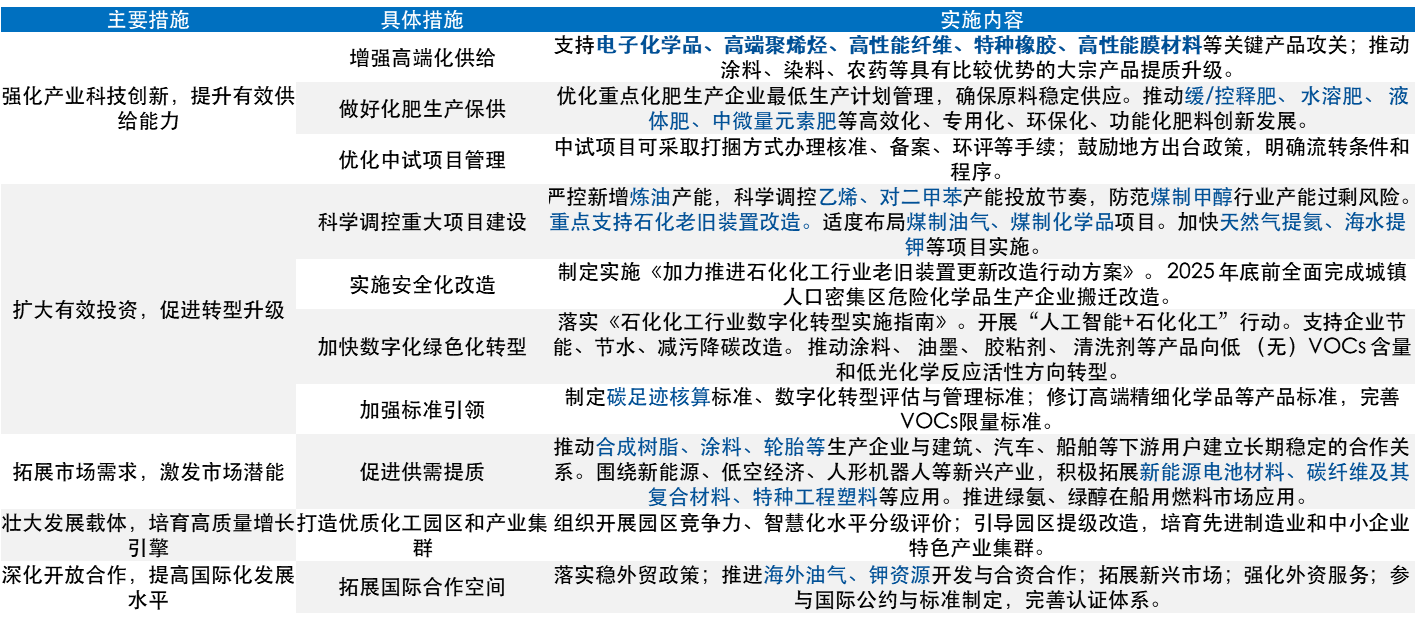
Core Viewpoint - The "anti-involution" and "stabilizing growth" policies have begun to show effects in the petrochemical industry, with signs of price stabilization and recovery in the Producer Price Index (PPI) [1][2]. Group 1: Price Trends and PPI Data - In October, the overall industrial PPI decreased by 2.1% year-on-year, with the decline narrowing compared to September, and a month-on-month increase of 0.1%, marking the first rise of the year [1]. - The PPI decline in key sectors such as the petroleum industry was -5.2%, an improvement of 1.9 percentage points from the previous value, while the chemical industry remained unchanged at -4.4% [1]. - The manufacturing of chemical raw materials and products saw a year-on-year decline of -5%, with a slight improvement of 0.2 percentage points from the previous value [1]. Group 2: Policy Measures for Industry Growth - The "Stabilizing Growth Work Plan for the Petrochemical Industry (2025-2026)" aims to enhance high-end supply and promote technological innovation, focusing on sectors like electronic chemicals and high-performance fibers [2][3]. - The plan emphasizes a systematic approach, balancing quantity and quality, to optimize supply-demand dynamics and drive high-quality development [2]. - Key measures include controlling new refining capacity, optimizing existing production through upgrades, and implementing safety improvements across the industry [3][6]. Group 3: Capacity Management and Optimization - The policy framework includes a three-pronged management system focusing on controlling new capacity, reducing existing capacity, and managing production processes to achieve supply-demand balance [3][6]. - The plan aims to curb excessive structural risks by regulating the scale and timing of new capacity for critical raw materials like ethylene and paraxylene [3][6]. Group 4: Quality Enhancement Directions - The strategy targets four key areas for enhancing industry competitiveness: high-end development, green initiatives, safety improvements, and digital transformation [7][9]. - High-end development focuses on shifting the competitive landscape from cost and scale to technology and added value, addressing the challenges of low-end product competition [7]. - Green initiatives aim to promote low-carbon processes and circular economy practices, with a focus on developing standards for carbon footprint accounting [9][11]. Group 5: Market Outlook and Investment Opportunities - The petrochemical sector is expected to accelerate its transformation, with capital expenditures declining and older facilities being phased out, leading to improved supply-side conditions [12]. - The PPI and inventory trends are anticipated to show positive changes by 2025, with potential demand growth in new materials and technologies by 2026 [12]. - Investment tools such as chemical industry ETFs are available, providing exposure to leading companies in the petrochemical and basic chemical sectors [13].
工信部印发产业技术基础公共服务平台管理办法
Zhong Guo Xin Wen Wang· 2025-12-10 07:26
Core Viewpoint - The Ministry of Industry and Information Technology (MIIT) has issued the "Management Measures for Public Service Platforms for Industrial Technology Foundation" to accelerate new industrialization and strengthen the foundation of industrial technology [1]. Group 1: General Principles - The measures aim to implement the strategy of a manufacturing powerhouse, improve the industrial foundation support system, and cultivate authoritative and forward-looking public service platforms for industrial technology [2]. - The public service platforms are defined as specialized institutions that provide essential support services for technology innovation activities across the entire chain from research and development to industrialization, focusing on key areas of industry [2]. Group 2: Application Process - The application for service platforms is voluntary and based on a recommendation system, with a focus on key industries such as equipment, petrochemicals, steel, and new technologies like artificial intelligence and quantum information [4]. - Applicants must meet specific criteria, including having independent legal status, a significant portion of their business (over 60%) related to industrial technology services, and a strong reputation within the industry [5][6]. Group 3: Review and Publication - The MIIT will guide and manage the service platforms, with provincial departments responsible for the creation and recommendation of platforms in their regions [3]. - A third-party professional organization or expert group will evaluate the applications and service capabilities, leading to the publication of a recommended list of service platforms [7][8]. Group 4: Operation and Management - Service platforms are required to enhance their operational capabilities, improve service quality, and adapt to industry trends while ensuring compliance with government guidelines [9]. - Platforms must submit an annual operational report detailing their service capabilities and objectives, and any changes in management or service scope must be reported to the relevant authorities [9][10]. Group 5: Dynamic Management - The MIIT will conduct regular performance evaluations of the service platforms, with annual evaluations and comprehensive reviews every three years [10][11]. - Platforms that fail to meet evaluation standards or engage in misconduct may be removed from the official list and barred from reapplication for three years [12].
工信部印发《产业技术基础公共服务平台管理办法》
Zheng Quan Shi Bao Wang· 2025-12-10 06:52
Core Viewpoint - The Ministry of Industry and Information Technology (MIIT) has revised and issued the "Management Measures for Public Service Platforms of Industrial Technology Foundation" to accelerate the advancement of new industrialization and strengthen the foundation of industrial technology [1] Group 1: Key Industries and Fields - The service focus industries and fields include equipment, petrochemical, steel, non-ferrous metals, building materials, light industry, textiles, food, pharmaceuticals, new generation information technology, biotechnology, new energy, new materials, new energy vehicles, instruments and meters, safety and emergency, civil explosives, civil aviation, shipbuilding and marine engineering, green environmental protection, artificial intelligence, metaverse, brain-computer interface, quantum information, and new energy storage [1] Group 2: Service Scope - The main service scope includes metrology and testing, standard verification and testing, quality reliability testing and inspection, certification and accreditation, industrial information, intellectual property, and technology achievement transformation [1]
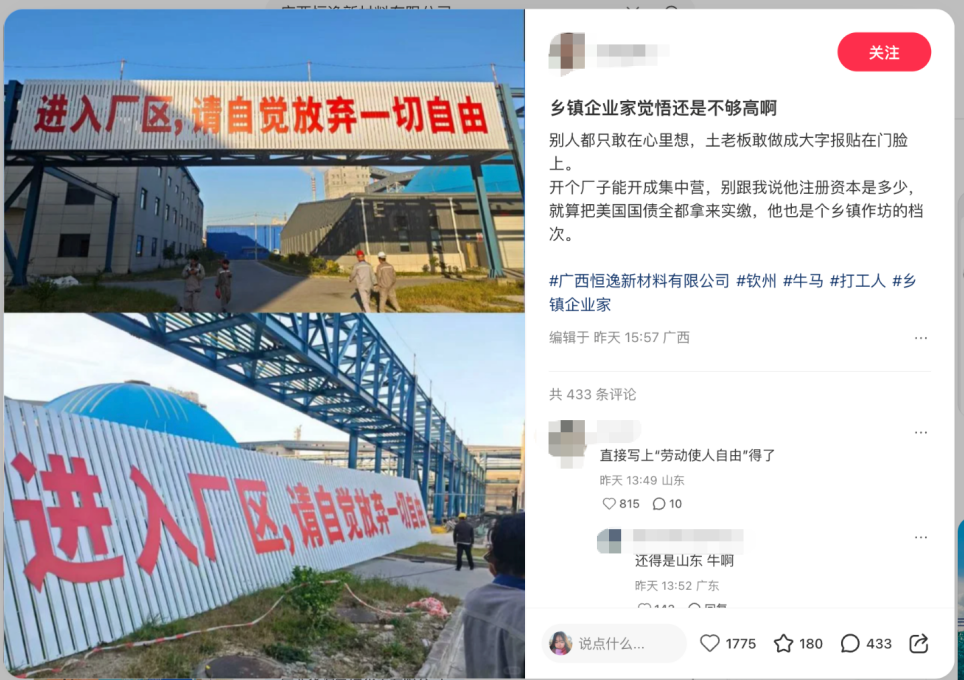
恒逸石化被曝标语“进厂区请放弃一切自由”,网友吐槽
Feng Huang Wang Cai Jing· 2025-12-02 05:36
Core Viewpoint - A controversial slogan displayed at a factory, "Please give up all freedom upon entering the factory," has sparked significant online discussion, highlighting issues of personal rights versus collective regulations in industrial settings [1][3]. Company Overview - The company involved is Guangxi Hengyi New Materials Co., a subsidiary of Hengyi Petrochemical (A-share listed company 000703), with a reported insured employee count of 690 as per the 2024 business report [3]. - Hengyi Petrochemical reported a revenue of 451.8 billion yuan, ranking 54th in the "2025 China Top 500 Enterprises" [4]. Project Development - The "Qinzhou Project," which involves an integrated production capacity of 1.2 million tons of caprolactam and polyamide, has recently achieved full process connectivity and entered the trial production phase [4]. Market Performance - As of December 2, Hengyi Petrochemical's stock price was 8.21 yuan per share, with a market capitalization of 29.6 billion yuan [5].