AI芯片

Search documents
食用油、预制菜:吃顿好饭,这么难? | 新刊发售
Di Yi Cai Jing Zi Xun· 2025-11-14 03:04
Core Insights - The debate between Luo Yonghao and Jia Guolong highlights the confusion surrounding the definition of "pre-made dishes" in the Chinese restaurant industry, reflecting a gap in understanding between industry practitioners and consumers [1][2][3] - The evolution of the Chinese dining industry from a "blue ocean" to a "red ocean" is marked by increased competition and changing consumer perceptions, making pre-made dishes a key tool for scaling Chinese restaurant brands [3][4] Industry Overview - The restaurant industry was thriving 20 years ago with freshly cooked dishes being popular due to low costs and high profits, while pre-made dishes were primarily associated with Western fast-food chains like McDonald's [3] - The shift towards central kitchens is seen as essential for modernizing the restaurant industry, allowing for reduced labor and space requirements, decreased waste, and improved efficiency, aligning with fast-paced lifestyles [3][4] - The "Xibei incident" has exposed a significant disconnect between how businesses view central kitchens as a pre-processing step and how consumers categorize anything that is not freshly cooked as "pre-made dishes," leading to a crisis of trust [3][4] Consumer Behavior - The essence of Chinese cuisine lies in its "wok energy" and cultural significance, which pre-made dishes struggle to replicate, indicating a complex relationship between modern dining practices and traditional culinary values [4] - The ongoing discourse around food choices and dining experiences is fueled by recent controversies, such as the Xibei pre-made dish dispute, which has sparked public interest and debate [6]
一财主播说 | 上交所:科创板有望涌现一批世界级明星科技企业
Xin Lang Cai Jing· 2025-11-13 06:50
Core Viewpoint - The Shanghai Stock Exchange (SSE) aims to cultivate a batch of world-class technology companies through the STAR Market, which serves as a testing ground for capital market innovations [1] Group 1: STAR Market Developments - The STAR Market has already seen notable companies such as Semiconductor Manufacturing International Corporation (SMIC), BeiGene, and Cambricon Technologies, indicating its potential to attract leading tech firms [1] - The STAR Market allows unprofitable companies, red-chip enterprises, and those with special equity structures to list, creating a dedicated financing channel for innovative tech companies [1] Group 2: Policy Innovations - The SSE has continuously improved its institutional offerings, introducing the "1+6" policy combination for issuance and expanding the fifth set of listing standards to include cutting-edge fields like artificial intelligence and commercial aerospace [1] - Regulatory reforms, known as the "Eight Articles of Science," have been implemented to optimize the merger and acquisition mechanisms within the STAR Market [1]
拆解6000亿寒武纪的跃升逻辑
Zhong Guo Jing Ying Bao· 2025-11-07 21:39
Core Viewpoint - The surge in the stock price of Cambrian (688256.SH) reflects a significant shift in the A-share market from traditional consumer sectors to technology-driven growth sectors, highlighting the market's high expectations for China's tech industry and a deep transformation in valuation logic [4][19][22] Group 1: Catalysts - The explosive demand for AI computing power, driven by the global AI boom initiated by technologies like ChatGPT, has significantly increased the demand for high-end AI chips, which are now seen as scarce resources [5][6] - In China, the "AI+" strategy and accelerated digital transformation across industries have led to a surge in demand for AI computing power, with predictions indicating that the market share of domestic computing power will rise from 17% in 2023 to 55% by 2027 [6][7] - The geopolitical landscape, particularly the U.S. export controls on advanced chips, has made the development of a self-sufficient AI computing industry a necessity, prompting government support for the semiconductor sector [6][7] Group 2: Internal Logic - Cambrian's stock price surge is underpinned by its impressive financial performance, with a reported revenue of 2.881 billion yuan in the first half of 2025, a staggering increase of 4300% year-on-year, and a net profit of 1.038 billion yuan, marking a turnaround from previous losses [10][11] - The company has significantly improved its cash flow, with a net cash flow of -29.3 million yuan in the first three quarters of 2025, a drastic reduction from -1.81 billion yuan in the same period the previous year [11][12] - Cambrian's technological advancements, including the development of its latest chip, the SiYuan 590, which achieves 80% of the performance of NVIDIA's A100, have bolstered its market credibility and competitive edge [14][15] Group 3: Market Dynamics - Cambrian's stock price has benefited from a shift in market valuation logic, where technology stocks are increasingly favored, leading to significant inflows of capital and heightened interest from institutional investors [15][21] - The company has been included in multiple key indices, which has further attracted passive investment and contributed to its stock price increase [15][21] - The stock's volatility has raised concerns about potential overvaluation, with a dynamic P/E ratio exceeding 500 times, indicating a speculative bubble [21][22]


AI泡沫论调席卷全球之际 资金悄然回流苹果(AAPL.US)“安全避风港”
智通财经网· 2025-11-07 01:37
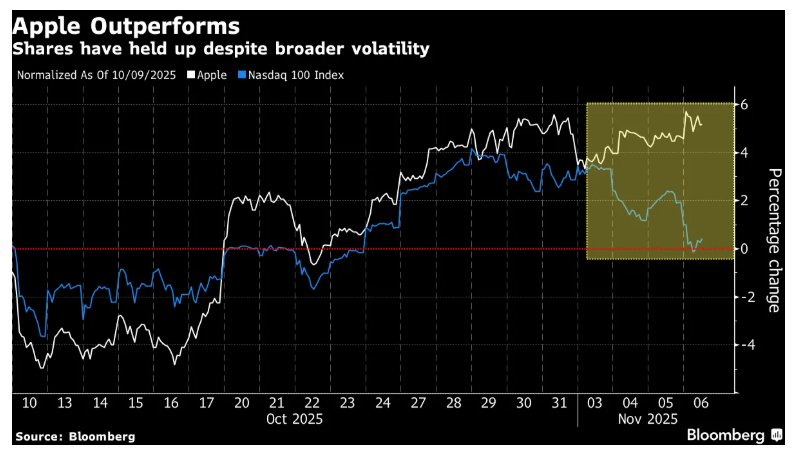
Core Viewpoint - A significant sell-off in tech stocks has impacted popular AI companies, but Apple has shown resilience, maintaining a stable stock price and market capitalization amidst market volatility [1][2]. Group 1: Apple’s Performance - Apple’s stock price has only decreased by 0.14% while the Nasdaq 100 index fell by 1.9%, indicating its relative strength during market downturns [1]. - Over the past month, Apple’s stock has increased by over 5%, contrasting with the Nasdaq 100 index's less than 1% increase [1]. - Apple’s market capitalization is approximately $4 trillion, making it the second-largest company after Nvidia, which recently surpassed $5 trillion [1]. Group 2: Market Sentiment and AI Bubble Concerns - The market is experiencing fears of an AI bubble, leading investors to retreat from speculative AI stocks, while Apple’s strong cash flow and stability are attracting attention [3][5]. - Analysts believe that the current market is in the early stages of a potential AI bubble, with valuations not reaching extreme levels seen during the 2000 internet bubble [5]. - Concerns about high leverage financing for AI data centers are prevalent, but analysts from UBS and Societe Generale suggest that significant risks are not imminent [5]. Group 3: Apple’s Strategic Positioning - Apple’s recent performance is partly due to its strong cash flow and a solid balance sheet, which have historically provided stability during market turbulence [2]. - Despite a lack of direct involvement in the AI investment frenzy, Apple’s stock has shown resilience, with a year-to-date increase of 8.4%, compared to the Nasdaq 100 index's nearly 20% rise [6]. - Apple is planning to invest approximately $1 billion annually to purchase an AI model from Google, which is seen as a strategic move to enhance its Siri voice assistant [7]. Group 4: Future Growth Opportunities - Analysts are optimistic about "physical AI" as a potential growth engine for Apple, with projections suggesting that its planned robotics series could generate around $130 billion in revenue by 2040 [8]. - The integration of AI and robotics could position Apple as a leading player in the physical AI market, leveraging its extensive device ecosystem and proprietary technology [8]. - The potential market share for Apple in the robotics sector could reach 22% by 2040, similar to its current share in the smartphone market, significantly impacting its future stock value [8].

寒武纪股价再超茅台 它距离成为英伟达有多远?
Di Yi Cai Jing· 2025-11-06 11:51
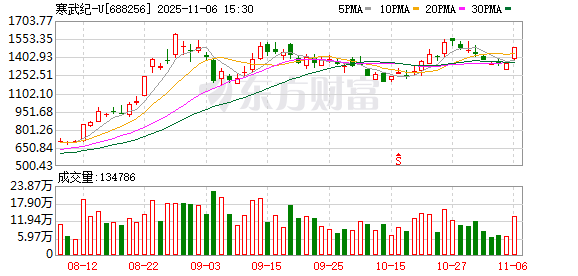
Core Insights - Cambricon has experienced a significant surge in stock price, surpassing Kweichow Moutai to become the highest-priced stock in A-shares, with a peak of 1448 CNY per share on November 6, 2023 [2] - The company reported a remarkable revenue of 17.27 billion CNY for Q3 2025, marking a year-on-year increase of 1332.52%, and a net profit of 5.67 billion CNY, achieving profitability for four consecutive quarters [2] - Cambricon's revenue for the first half of 2025 reached 28.81 billion CNY, a staggering increase of 4347% year-on-year, with a net profit of 10.38 billion CNY, marking its first profitable quarter since its inception [2][5] Company Performance - The stock price of Cambricon has seen a dramatic rise since August 2023, leading to increased public interest in the company's capabilities and future stock performance [2] - The company has transitioned from a period of significant losses to a phase of rapid growth and profitability, with a notable reduction in losses by 2024 [3] - Cambricon's financial turnaround has been attributed to the growing demand for AI chips, particularly in the context of the AI boom and the restrictions on foreign chip manufacturers [20][40] Market Position and Strategy - Cambricon is often compared to Nvidia, although it focuses on specialized neural processing units (NPU) for deep learning, while Nvidia primarily develops general-purpose graphics processing units (GPU) [3] - The company has shifted its strategic focus from partnerships with Huawei to developing its own cloud and edge computing chips, following the end of their collaboration [5][12] - Cambricon's revenue structure has evolved, with a significant portion now coming from intelligent computing cluster systems, which have replaced IP licensing as the main revenue source [18][19] Technological Development - The company has made significant advancements in AI chip technology, with its fourth-generation cloud computing chip, the SiYuan 590, achieving performance metrics comparable to Nvidia's A100 [5][26] - Cambricon's chips are designed to be compatible with mainstream AI frameworks and large models, enhancing their appeal to potential customers [27] - The company has invested heavily in software development, recognizing that software optimization is crucial for the success of its hardware products [27] Future Outlook - Cambricon's market capitalization has exceeded 600 billion CNY, with a dynamic price-to-earnings ratio significantly higher than that of Nvidia, indicating strong investor expectations for continued growth [29] - The company is poised to capitalize on the increasing demand for AI inference chips as the market shifts from model training to deployment [21] - Cambricon's financial health has improved, with a net cash flow from operating activities turning positive for the first time, and a recent fundraising plan approved to support its growth initiatives [28]
161万亿存款冻僵中国经济?房地产熄火后,普通人赚钱的机会藏在这三个领域
Sou Hu Cai Jing· 2025-11-05 19:51
Group 1: Economic Overview - The total savings of Chinese citizens surged from 70 trillion to 161 trillion over five years, with an average increase of nearly 65,000 yuan per person, indicating a significant accumulation of wealth that is not flowing into the consumer market [1][3] - The M2 money supply has exceeded 335 trillion, significantly surpassing the reasonable level of twice the GDP, leading to a blockage of 65 trillion yuan in the banking system, which directly impacts consumer spending and investment [3][5] - The real estate market, once a cornerstone of household wealth, has seen prices decline by an average of 30% in first-tier cities, causing families to prioritize cash reserves over investments [3][5] Group 2: Challenges Facing the Economy - The decline in the real estate sector is attributed to three major challenges: the fading demographic dividend, obstacles to globalization, and the unsustainable land finance model [5] - The birth rate has plummeted from 17.86 million in 2016 to 9.54 million in 2024, with a total fertility rate of 1.1, which is lower than Japan's [5] - The shift in consumer confidence is evident as young people face employment pressures, with over 60% earning less than 6,000 yuan per month, leading to a cautious approach towards spending [1][3] Group 3: Policy Responses and Opportunities - The government aims to stimulate the economy through technology innovation, domestic demand, and deepening reforms, with an annual investment of 1 trillion yuan in technology via long-term special bonds [5][7] - The potential for domestic consumption is significant, with 400 million middle-income individuals having a service consumption rate of only 46%, compared to 68% in the U.S. [7] - The real estate transformation presents new opportunities, with projects like affordable housing and urban renewal expected to generate nearly 2 trillion yuan in investments annually [7][8] Group 4: Shifts in Wealth Allocation - There is a notable shift in wealth allocation among Chinese households, moving from a focus on real estate to seeking new investment avenues in the stock market, particularly in technology sectors [8][10] - The capital market reforms have positioned the stock market as a vital funding source for innovative enterprises, redirecting funds from real estate to emerging sectors like AI and low-altitude economy [8][10] - The housing market dynamics are changing, with a focus on proximity to urban centers and newer properties becoming critical factors for homebuyers, while older properties face depreciation risks [10]

AI泡沫恐慌突袭亚太市场!日韩股市闪崩,韩股触发熔断!
Sou Hu Cai Jing· 2025-11-05 03:09
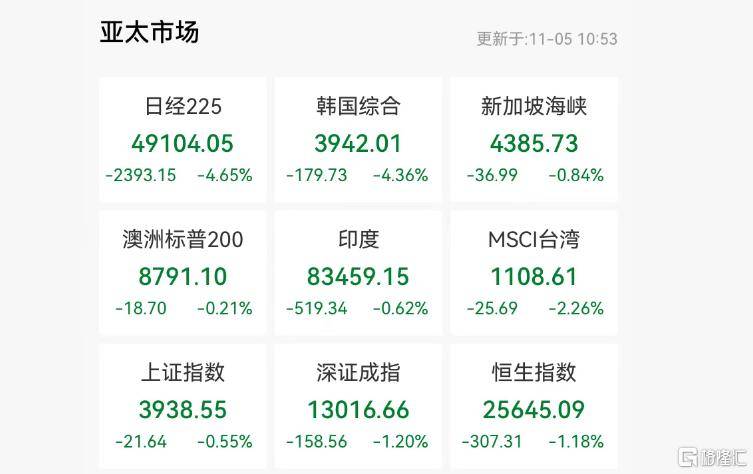
Market Overview - The Asia-Pacific markets experienced a sudden downturn, with significant declines in the Japanese and South Korean stock markets, leading to a drop in Taiwan and Hong Kong stocks [1][2] - The KOSPI index in South Korea fell over 5%, while the Nikkei 225 index dropped more than 4%, with major tech stocks like SK Hynix and Samsung Electronics also suffering losses [4][6] Technology Sector Impact - The technology sector, particularly semiconductor and AI chip companies, was heavily impacted, with major players facing substantial declines [1][4] - Prior to the downturn, the KOSPI index had seen a remarkable increase of nearly 70% year-to-date, and the Nikkei 225 index had risen approximately 23% [6][7] Market Sentiment and Factors - Market sentiment shifted due to several factors, including a strengthening US dollar, declining high-valuation tech stocks, mixed signals from Federal Reserve officials regarding interest rate cuts, and ongoing trade uncertainties [7][8] - Concerns over a potential AI bubble burst have led to a broader market sell-off, with the US stock market also experiencing significant declines [9][12] Notable Stock Movements - In the US market, major tech stocks such as Tesla and Nvidia saw declines of over 5% and 3% respectively, while Apple was the only stock to show a slight increase [10][11] - Michael Burry's significant short positions on AI-related stocks have raised concerns about the sustainability of valuations in the AI sector [12][14] Analyst Predictions - Major financial institutions like Goldman Sachs and Morgan Stanley have warned of potential market corrections, predicting declines of 10% to 20% in the coming months [14][16] - Analysts suggest that the current market lacks short-term catalysts for recovery, particularly ahead of Nvidia's upcoming earnings report [17]



2025年第43周:数码家电行业周度市场观察
艾瑞咨询· 2025-11-05 00:07
Group 1: Travel Industry Insights - The rise of AI travel assistants is marked by platforms offering smart itinerary planning and real-time suggestions to address traditional travel pain points [3] - AI assistants like Tongyi Qianwen and Ctrip AI excel in transportation, accommodation, and attraction planning, but still lack in dining recommendations and time management [3] - The commercial potential of AI travel assistants lies in transaction closure, data-driven recommendations, and content operations, although scaling monetization will take time [3] Group 2: AI and Gaming Market - The application of generative AI in gaming is rapidly increasing, with an 800% surge in related games on Steam, and an expected 20% share of new game releases this year [4] - Major companies like Tencent and NetEase are accelerating their investments in AI-native games, which are categorized into four types: enhancement, auxiliary development, research, and strategy [4] - Despite early-stage technology, AI has significantly improved development efficiency, contributing to revenue growth for companies like Tencent and 37 Interactive Entertainment [4] Group 3: Surgical Robotics Market - Domestic surgical robots are gaining traction, with a market share of 48.89% for laparoscopic robots in 2024, challenging foreign brands like Da Vinci [5] - Price advantages (30%-40% lower than imports) and policy support (medical insurance coverage in 28 provinces) are accelerating the replacement process [5] - Challenges include reliance on imported core components and the need for technological breakthroughs to transition from price competition to technological leadership [5] Group 4: Smart Bathroom Market - The smart toilet market is experiencing growth driven by policies like "old-for-new" exchanges and mandatory certifications, with a year-on-year growth exceeding 30% [6] - Consumer demand is shifting from mere availability to quality, prompting companies to innovate in health, comfort, and smart technology [6] - Despite growth, the industry faces challenges such as insufficient user awareness and inconsistent service standards [6] Group 5: Home Appliance Market Dynamics - The national subsidy policy has injected vitality into the home appliance market, with 300 billion yuan allocated for the fourth quarter [7] - However, market growth is sluggish, and the diminishing marginal effects of policies may lead to a decline in sales for products like air conditioners and refrigerators [7] - Companies need to shift focus from price competition to product value, service innovation, and technological upgrades to navigate the post-subsidy era [7] Group 6: AI in Entertainment - The introduction of AI actress Tilly Norwood has sparked controversy in Hollywood, with strong opposition from the industry regarding the use of actor data without consent [8] - The situation highlights the conflict between technology and traditional industries, raising concerns about AI's impact on employment and artistic value [8] Group 7: Global Smart Companionship Market - The global smart companionship market is projected to exceed $140 billion by 2030, with China and Singapore as key markets [9] - Experts emphasize the importance of user experience, cultural adaptation, and ethical governance in the development of AI products [9] Group 8: AI Glasses Market - The AI glasses market is experiencing rapid growth, with a 54.9% increase in global shipments, particularly in China, but faces high return rates of 30%-50% due to functionality issues [11] - The industry struggles with a lack of unified standards and challenges in balancing performance, weight, and battery life [11] Group 9: Robotics Industry Trends - The robotics industry is entering a rapid development phase, with companies collaborating to accelerate technology implementation [12] - The competition is shifting from technological rivalry to ecosystem collaboration, although challenges remain in mass production and cost control [12] Group 10: Washing Machine Market Innovations - The focus on partitioned washing machines is growing, driven by consumer health care demands and strategic initiatives from leading brands [13] - Companies are expected to innovate around user health needs and technology to gain a competitive edge in the market [13] Group 11: Electric Vehicle Industry - The two-wheeled electric vehicle sector is undergoing a smart transformation, with AI technology enhancing user experience [15] - However, challenges such as functionality gaps and safety concerns persist, necessitating a focus on core user pain points [15] Group 12: AI in Healthcare - The healthcare sector is a key focus for AI applications, with policies driving the integration of AI in precision diagnosis and health management [16] - Companies like Neusoft are leveraging large model technology to improve efficiency, although challenges related to data quality and standardization remain [16] Group 13: AI Toys Market - The AI toy market is rapidly evolving, combining IP with AI features to enhance companionship and educational value [17] - Despite high market interest, issues such as high return rates and poor user experience need to be addressed for commercial success [17] Group 14: AI Glasses in Tourism - AI glasses have gained popularity during the recent holiday season, used for photography and navigation, but face challenges in comfort and battery life [19] - Major tech companies are entering the market, but the glasses must overcome integration issues with smartphones to achieve widespread adoption [19] Group 15: AI Investment Trends - OpenAI is forming partnerships with tech giants to enhance AI infrastructure, leading to significant market capitalization growth [20] - However, the aggressive investment strategy poses risks, as it relies on long-term returns from AI technologies [20] Group 16: Robotics in Hospitality - CloudMinds Technology has become the first publicly traded company focused on service robots, achieving a market share of 6.3% in the hotel sector [23] - Despite revenue growth, the company faces challenges related to profitability and market competition [23] Group 17: Automotive Industry Challenges - Mercedes-Benz is facing declining sales in China, prompting a partnership with ByteDance to integrate AI technology into new electric models [24] - The collaboration aims to enhance user experience but faces stiff competition from local manufacturers [24] Group 18: AI and Robotics Collaboration - The collaboration between Huawei's Seres and ByteDance aims to advance the development of intelligent robots in the automotive sector [25] - The market for humanoid robots is expected to grow rapidly, with Chinese companies playing a significant role [25] Group 19: AI in Lithium Battery Sector - ByteDance is entering the lithium battery market, leveraging AI to accelerate research and development [31] - The company aims to reduce costs and create an ecosystem that integrates energy storage solutions [31] Group 20: Autonomous Driving Investments - Didi has secured significant funding for its autonomous driving initiatives, focusing on L4 technology and commercial operations [32] - The company aims to leverage its extensive network to enhance its position in the autonomous driving market [32] Group 21: Semiconductor Industry Performance - TSMC reported a revenue of $33.1 billion, driven by demand for AI chips and advanced manufacturing processes [28] - The company maintains a strong position in the AI chip supply chain, benefiting from increased capital expenditures [28]

亚马逊与英伟达市值各增千亿美元
财联社· 2025-11-04 00:28
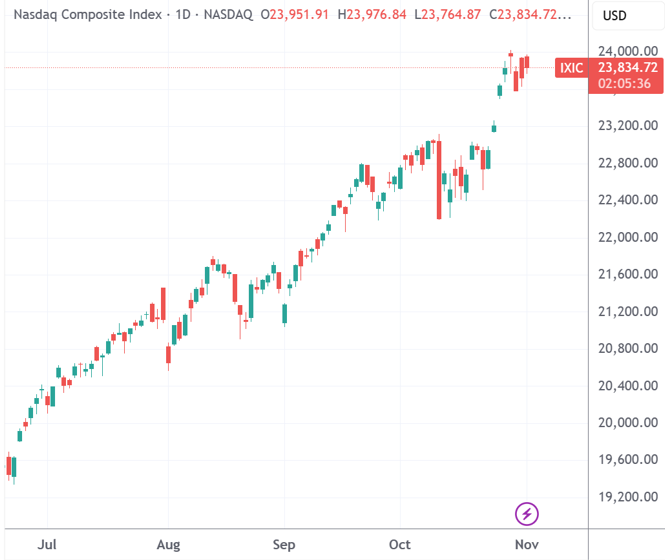
Core Viewpoint - The article highlights a mixed sentiment in the U.S. stock market at the beginning of November, traditionally a strong month for stocks, with significant AI-related deals driving some gains while broader market weakness persists [1][6]. Group 1: Market Performance - The S&P 500 index rose by 0.17% to 6851.97 points, while the Nasdaq Composite increased by 0.46% to 23834.72 points. In contrast, the Dow Jones Industrial Average fell by 0.48% to 47336.68 points [1]. - Despite the overall index gains, over 400 stocks in the S&P 500 were down during the trading session, indicating underlying market weakness [5]. Group 2: Major Corporate Deals - Amazon Web Services (AWS) announced a $38 billion computing power contract with OpenAI, marking a significant partnership within the tech sector [3]. - Microsoft signed a $9.7 billion computing power contract with Australian cloud service provider IREN, and Lambda also secured a "multi-billion dollar" contract with Microsoft [5]. - Google issued $17.5 billion in bonds in the U.S. market, following a €6.5 billion bond issuance in Europe, with strong investor demand reported [5]. Group 3: Stock Movements - Amazon's market capitalization increased by $104.5 billion, equivalent to approximately ¥743.7 billion [4]. - Nvidia shares rose by 2.17%, while other tech giants like Apple and Microsoft saw slight declines [10]. - The semiconductor sector experienced gains, with Micron Technology rising by 4.88% amid rumors of Samsung pausing DDR5 contract quotes [11]. Group 4: Historical Context - November has historically been the best-performing month for U.S. stocks, with an average gain of 2.6% when the S&P 500 has risen over 10% in the first ten months of the year [8][9].


美股指数涨跌不一,AI巨头唱独角戏,亚马逊、英伟达市值各增千亿美元
Feng Huang Wang· 2025-11-03 22:46
Core Points - The market shows signs of concern despite a strong start to November, traditionally known as a strong month for US stocks, with the S&P 500 index rising by 0.17% and the Nasdaq Composite by 0.46%, while the Dow Jones Industrial Average fell by 0.48% [1] - Amazon AWS announced a $38 billion computing power contract with OpenAI, marking a significant partnership within the "Big Seven" tech companies [2] - Microsoft signed a $9.7 billion computing power contract with Australian cloud service provider IREN, and Lambda also secured a multi-billion dollar contract with Microsoft [5] - Nvidia's stock rose over 2%, contributing to a market capitalization increase of over $100 billion, driven by news of chip exports to the UAE [5] - Google issued $17.5 billion in bonds in the US market, following a €6.5 billion issuance in Europe, receiving approximately $90 billion in orders [5] - Despite the S&P 500 index reaching new highs, over 400 stocks in the index declined during the trading session, indicating a divergence between index performance and market breadth [5] - Historical data shows November has been the best-performing month for US stocks over the past 30 years, with an average gain of 2.6% when the S&P 500 is up over 10% year-to-date [6][7] Company Performance - Amazon's market capitalization increased by $104.5 billion, equivalent to approximately ¥743.7 billion, following the announcement of its contract with OpenAI [2] - Nvidia's stock rose by 2.17%, while other major tech stocks like Apple and Microsoft saw slight declines [8] - Tesla's stock increased by 2.59%, while other companies like Meta and Berkshire Hathaway experienced declines [8] - Chinese concept stocks showed mixed performance, with the Nasdaq Golden Dragon China Index rising by 0.26% [9] Other Industry News - The US electric vehicle market faced a significant drop in sales due to the expiration of federal purchase subsidies, with Hyundai reporting an 80% drop in sales for its Ioniq 5 and 71% for the Ioniq 9 [10] - Kimberly-Clark's stock fell by 14.57% after announcing a $48.7 billion acquisition of Kenvue, while Kenvue's stock rose by 12.32% [11] - Tesla's sales in Europe continued to decline, with a reported 89% drop in Sweden and 86% in Denmark, although there was slight growth in France [12] - Berkshire Hathaway's third-quarter report indicated a $1.2 billion decrease in the value of its Apple holdings, suggesting potential further reductions in its stake [13]