制造业

Search documents
陕西武功,服务制造业推动实体经济发展
Jin Rong Shi Bao· 2025-12-16 05:04
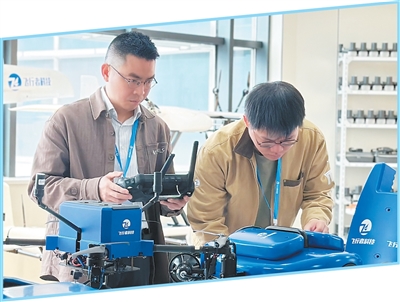
Group 1 - The core viewpoint of the article highlights the efforts of Shaanxi Agricultural Credit Union Wugong Branch to meet the financing needs of small and micro manufacturing enterprises in the region, thereby promoting the development of the local real economy [2] Group 2 - The focus is on the concentration of small and micro enterprises in the manufacturing sector within the jurisdiction of the credit union [2] - The article illustrates the proactive approach taken by the credit union's customer managers in engaging with local businesses, such as Shaanxi Boxin Cold Drawing Technology Co., Ltd [2]

1—11月 江西省规模以上工业增加值同比增长7.6%
Zheng Quan Shi Bao Wang· 2025-12-16 04:50
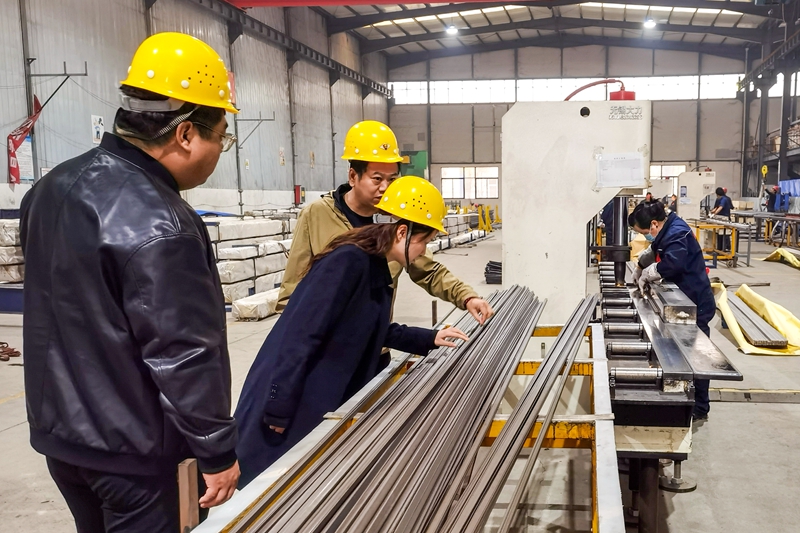
人民财讯12月16日电,据江西统计,1—11月份,全省规模以上工业增加值同比增长7.6%。分三大门类 看,采矿业增加值同比下降5.1%,制造业增长8.4%,电力、热力、燃气及水生产和供应业增长2.7%。 分经济类型看,国有控股企业增加值增长1.7%;股份制企业增长8.2%,外商及港澳台商投资企业增长 2.8%;私营企业增长7.4%。分行业看,38个大类行业中有23个行业增加值实现增长,增长面为60.5%。 其中,汽车制造业,计算机、通信和其他电子设备制造业,有色金属冶炼和压延加工业分别增长 21.4%、13.0%、12.5%。 ...
明年将发债支持国补,摩尔线程回应拿钱理财
Xin Lang Cai Jing· 2025-12-16 04:45
Group 1 - The Ministry of Finance plans to issue 150 billion yuan of special long-term bonds in 2024 to support consumer subsidies for vehicle trade-ins and related appliances, with an additional 300 billion yuan expected in 2025 [1][17] - The "national subsidy" policy has positively impacted domestic consumption over the past two years, leading to a significant increase in sales, with over 25 trillion yuan in sales generated from trade-in programs benefiting over 360 million people [1][17] - The coverage of the "national subsidy" policy is expected to continue expanding, particularly for durable consumer goods like refrigerators and televisions [1][17] Group 2 - In November, the average sales prices of residential properties in 70 major cities showed a month-on-month decline, with first-tier cities down by 0.4% and second and third-tier cities down by 0.3% and 0.4% respectively [3][18] - The introduction of "home purchase interest subsidy" policies in several cities has led to a short-term increase in new home transactions, with some cities reporting over a 15% month-on-month growth in sales [3][18] - The real estate market is experiencing a downturn, with new home prices remaining relatively stable due to high-quality listings, while second-hand homes are seeing more aggressive price reductions [3][18] Group 3 - In November, the industrial added value for large-scale enterprises grew by 4.8% year-on-year, with a month-on-month increase of 0.44%, while the growth rate for the manufacturing sector was 4.6% [5][20] - High-tech manufacturing sectors, such as 3D printing and industrial robotics, showed significant growth, with production increases of 100.5% and 20.6% respectively [5][21] - The overall industrial growth rate has slowed, with traditional manufacturing sectors like cement and steel continuing to decline, indicating a need for structural adjustments in the economy [5][21] Group 4 - Vanke has faced challenges in extending a 2 billion yuan bond, with all proposed extension plans failing to meet the required approval threshold [7][22] - The company is in a precarious financial situation, with a potential default looming if an agreement with bondholders is not reached within the grace period [7][22] - Vanke's reliance on state-owned shareholders for support has diminished, raising concerns about its ability to navigate its financial difficulties independently [7][23] Group 5 - iRobot has filed for Chapter 11 bankruptcy protection, indicating severe financial distress despite being a pioneer in the robotic vacuum market [9][24] - The company has seen a significant decline in market share due to increased competition from lower-cost Chinese manufacturers and slow product innovation [9][25] - iRobot's financial situation is dire, with liabilities exceeding 500 million dollars and cash reserves dwindling to 24.8 million dollars [9][24] Group 6 - Samsung is reportedly in discussions with AMD regarding a potential partnership for 2nm chip manufacturing, aiming to enhance its position in the high-end semiconductor market [11][26] - Despite previous attempts, Samsung has struggled to gain a significant share in the high-end chip market due to issues with process maturity and yield rates [11][26] - The collaboration with AMD could provide Samsung with leverage in negotiations with other clients, particularly in the context of increasing demand for AI chips [11][26]


中国经济_年末疲软或推动 2026 年政策前置-China Economics Year-End Weakness Likely to Prompt Front-Loaded Policies in 2026
2025-12-16 03:30
Summary of Key Points from the Conference Call Industry Overview - **Industry**: Chinese Economy - **Key Focus**: Economic indicators and policy outlook for 2026 Core Insights and Arguments 1. **Economic Weakness**: Domestic economic indicators showed unexpected weakness in November, with retail sales increasing only 1.3% YoY, and investment contraction continuing at double digits, marking the lowest levels since the COVID outbreak in 2020 [1][4][15] 2. **Industrial Production**: Industrial production growth slowed to 4.8% YoY, the slowest pace since August 2024, indicating pressure on the supply side despite a rebound in exports [4][24] 3. **Investment Trends**: Fixed Asset Investment (FAI) growth was weaker than expected at -2.6% YoY YTD, with property investment contracting further to -29.9% YoY, indicating a deepening property downturn [15][18] 4. **Retail Sales Dynamics**: Retail sales growth has decelerated for six consecutive months, primarily due to the fading impact of trade-in subsidies and a higher base from the previous year [11][12] 5. **Policy Response**: Policymakers have committed to measured support for 2026, with expectations of front-loaded policies, including property support measures and potential rate cuts in January [6][10] 6. **GDP Growth Forecast**: The GDP growth target for 2026 is set at around 5%, with incremental fiscal funds of approximately RMB 1 trillion, likely a ceiling based on leadership tone [6][10] Additional Important Insights 1. **Consumer Confidence**: Consumer confidence has declined, reflecting the overall economic sentiment and potential impacts on future spending [18] 2. **Sector Performance**: While exports-oriented sectors showed some resilience, domestic demand weakness has eroded their strength, particularly in the automotive sector [28] 3. **Service Sector Stability**: Retail services sales remained stable, with a slight increase of 5.4% YoY in the first 11 months of 2025, indicating some resilience in service consumption [11] 4. **Trade-in Subsidies Impact**: The impact of trade-in subsidies has faded, contributing to a significant decline in auto sales by -8.3% YoY, which was the largest drag on overall retail sales [11][12] 5. **Investment in Manufacturing**: Manufacturing investment showed early signs of stabilization, with a cumulative reading of 1.9% YoY YTD, although monthly contraction narrowed to -4.5% YoY [27] This summary encapsulates the critical insights from the conference call regarding the current state of the Chinese economy, highlighting both challenges and potential policy responses moving into 2026.
11月宏观数据分析:11月经济数据继续走弱,内需不足是主要制约
Xi Nan Qi Huo· 2025-12-16 02:02
Report Industry Investment Rating No relevant information provided. Core Viewpoints - In November 2025, the macro - economic data continued to decline, and the recovery momentum remained weak. The manufacturing PMI rebounded but was still below the boom - bust line. Industrial production, consumption, and fixed - asset investment growth rates all continued to weaken, and the real estate market was still in a downward trend. Domestic effective demand was insufficient, and the economy faced many challenges [3]. - The implementation of more proactive macro - policies is required to expand domestic demand and optimize supply, promoting both qualitative improvement and reasonable quantitative growth of the economy. "Expanding domestic demand and anti - involution" will be long - term and important policy measures [3]. - The financial market is in a state of "weak reality, strong expectation", and market sentiment is continuously improving. Despite the twists and turns, the macro - economy and asset prices in 2025 are expected to continue the upward - repair trend [3]. Summary by Directory 1. Manufacturing PMI - In November, the manufacturing PMI was 49.2%, up 0.2 percentage points from the previous month, but still below the boom - bust line. Large - scale enterprise PMI decreased, while medium and small - scale enterprise PMIs increased [4]. - Among the 5 classification indexes of manufacturing PMI, the supplier delivery time index was above the critical point, the production index was at the critical point, and the new order index, raw material inventory index, and employment index were below the critical point [4]. - The non - manufacturing business activity index was 49.5% in November, down 0.6 percentage points from the previous month. The construction industry business activity index increased, while the service industry business activity index decreased [7]. 2. CPI and PPI - In November 2025, the national CPI increased by 0.7% year - on - year and decreased by 0.1% month - on - month. The PPI decreased by 2.2% year - on - year and increased by 0.1% month - on - month. The core inflation continued to improve [8][10]. - The anti - involution policy has achieved continuous results, and the PPI is in an upward - repair trend. The PPI year - on - year growth rate is expected to turn positive in 2026 [12]. 3. Import and Export - In November, China's total import and export value was 549.03 billion US dollars, with a year - on - year growth of 4.3%. Exports were 330.35 billion US dollars, up 5.9% year - on - year, and imports were 218.67 billion US dollars, up 1.9% year - on - year, with a trade surplus of 111.68 billion US dollars [13]. - Exports to the EU rebounded significantly, while exports to the US were gradually replaced by those to ASEAN. China's exports have shown strong resilience, and the real risk for foreign trade lies in the potential decline in global demand [16]. 4. Credit and Money Supply - At the end of November 2025, the stock of social financing scale was 440.07 trillion yuan, with a year - on - year growth of 8.5%. The growth rates of both M1 and M2 declined, and the M1 - M2 gap narrowed [18][23]. - Resident and enterprise credit demand was weak. Resident short - term and long - term loans decreased significantly, and enterprise short - and long - term loans were at a low level, with a significant increase in bill financing [19][21]. 5. Industrial Production, Consumption, and Investment - In November, the added value of large - scale industries increased by 4.8% year - on - year and 0.44% month - on - month. The total retail sales of consumer goods increased by 1.3% year - on - year, but the growth rate continued to decline, especially in sectors such as home appliances, furniture, and automobiles [24][26]. - From January to November, national fixed - asset investment (excluding rural households) decreased by 2.6% year - on - year, with declines in private fixed - asset investment, real estate development investment, and infrastructure investment [28]. 6. Real Estate Market - From January to November, the sales area and sales volume of new commercial housing decreased by 7.8% and 11.1% year - on - year respectively, and the decline accelerated in November. Real estate new construction, construction, and completion also decreased [31][33]. - The real estate market is in the process of bottoming out and transforming. Although there are fluctuations, the year - on - year decline in sales and prices is narrowing, and the de - stocking effect is emerging. The first half of 2026 is expected to be a critical period for the real estate market to stop falling and stabilize [38].
证监会最新发声;我国首批L3级自动驾驶车型获准入许可……盘前重要消息一览
证券时报· 2025-12-16 00:13
Key Points - The article discusses recent developments in the Chinese financial and industrial sectors, highlighting regulatory measures and economic indicators that may impact investment opportunities and market stability [4][5][6]. Group 1: Regulatory Developments - The China Securities Regulatory Commission (CSRC) held a meeting to discuss the implementation of measures from the Central Economic Work Conference, emphasizing the need to enhance market stability and promote high-quality listed companies [4]. - The State Administration of Foreign Exchange (SAFE) also convened to ensure the stable operation of the foreign exchange market, focusing on maintaining the RMB exchange rate and international balance of payments [4]. Group 2: Economic Indicators - In November, the industrial added value of large-scale enterprises in China grew by 4.8% year-on-year, with a month-on-month increase of 0.44%. The cumulative growth for the first eleven months was 6.0% [5]. - The growth rates for different sectors in November included mining at 6.3%, manufacturing at 4.6%, and electricity, heat, gas, and water production and supply at 4.3% [5]. Group 3: Market Trends and Company News - The number of cities with rising new home prices increased in November, with Hefei and Xiangyang showing the highest growth rates [6]. - The Ministry of Industry and Information Technology announced the first batch of L3 conditional autonomous driving vehicle permits, marking a significant step towards commercialization in designated areas [6]. - The National Energy Administration projected that by 2025, total power generation capacity will exceed 3.8 billion kilowatts, with a year-on-year growth of 14% [6]. Group 4: Company-Specific Developments - Muxi Co., Ltd. will be listed on the Sci-Tech Innovation Board on December 17 [9]. - Aerospace Electronics plans to invest 727 million yuan to gain control of its subsidiary, Aerospace Rocket Company [12]. - TCL Technology intends to purchase a 10.77% stake in Shenzhen Huaxing Semiconductor for 6.045 billion yuan [21].


11月工业高端化势头明显 3D打印设备产量翻番
2 1 Shi Ji Jing Ji Bao Dao· 2025-12-15 23:36
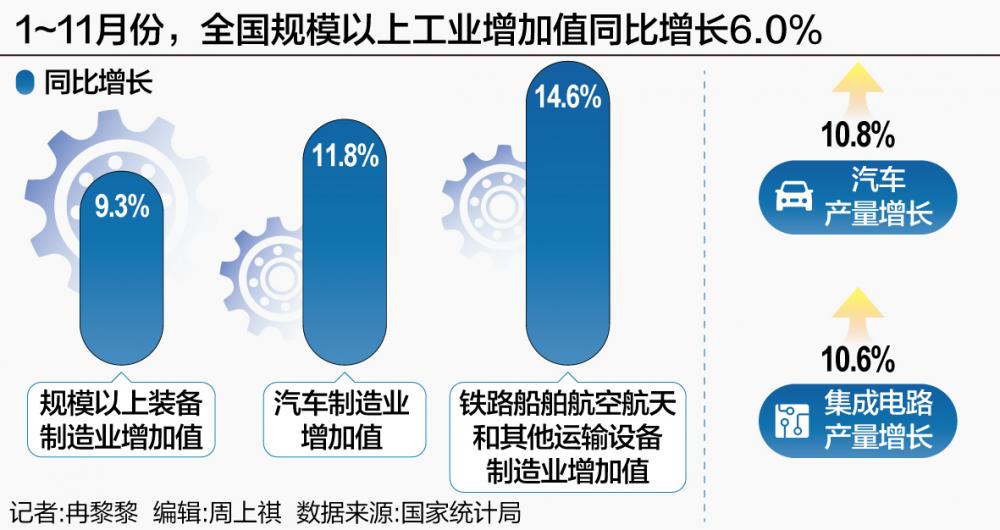
Core Viewpoint - In November, the industrial added value of enterprises above designated size in China experienced a year-on-year real growth of 4.8%, indicating a stable industrial production environment and ongoing industrial upgrading supported by new policies [1][2][5]. Group 1: Industrial Performance - The industrial added value increased by 0.44% month-on-month in November, with a cumulative year-on-year growth of 6.0% from January to November [5][9]. - The mining industry saw a year-on-year growth of 6.3%, manufacturing grew by 4.6%, and the electricity, heat, gas, and water production and supply industry increased by 4.3% in November [5][6]. - The growth rate of industrial added value in November decreased by 0.1 percentage points compared to October, while the month-on-month growth rate accelerated by 0.27 percentage points [6][9]. Group 2: High-tech and Equipment Manufacturing - The high-end development of the industrial sector is evident, with the added value of equipment manufacturing and high-tech manufacturing growing by 7.7% and 8.4% year-on-year, respectively [6][7]. - The cumulative added value of equipment manufacturing accounted for 36.4% and high-tech manufacturing for 16.9% of the total industrial added value [6][7]. - Notable product growth includes 3D printing equipment, industrial robots, and new energy vehicles, with year-on-year increases of 100.5%, 20.6%, and 17.0%, respectively [8]. Group 3: Market Demand and Policy Impact - Policies such as "two highs" and "two new" have effectively stimulated market demand, leading to increased production and supporting industrial growth [2][7]. - In the first eleven months, the added value of equipment manufacturing grew by 9.3%, while high-tech manufacturing increased by 9.2%, indicating strong demand in these sectors [7][9]. - The overall industrial production remains stable, with ongoing optimization and upgrading of industries, contributing to economic stability [2][9].
畅通国民经济循环 为实体经济“舒筋活血”
Xin Hua Ri Bao· 2025-12-15 23:19
Group 1: Logistics Cost and Economic Efficiency - Logistics is identified as the "muscle and sinew" of the real economy, connecting production and consumption, and it is essential to effectively reduce logistics costs to enhance core competitiveness and improve economic efficiency [1] - Jiangsu province has the lowest logistics costs among coastal provinces in China, with a logistics cost to GDP ratio of 12.7% in the first three quarters of 2025, which is 1.3 percentage points lower than the national average [1] - During the 14th Five-Year Plan period, reducing logistics costs is a key measure to facilitate the circulation of the national economy and support the responsibilities of being a major economic province [1] Group 2: Development of Logistics Hubs - Jiangsu has established 10 national logistics hubs and 8 national-level demonstration logistics parks, the highest number among all provinces in China [1] - The development of logistics hubs in Jiangsu will transition from linear channel nodes to a networked and interconnected model, enhancing cross-regional integration and resource allocation capabilities [1] - The province aims to promote a "logistics hub + industrial cluster" model to create logistics hub economic zones with significant industrial agglomeration advantages [1] Group 3: Integration of Industry and Logistics - Jiangsu is a major manufacturing and logistics province, with a focus on deep integration between logistics and manufacturing, leading to the emergence of competitive third-party logistics and cross-border e-commerce platforms [2] - The modern service industry in Jiangsu is evolving towards high-end, green, and international standards, transforming logistics from a "cost center" to a "value center" [2] - The province will accelerate the construction of an ecosystem for industrial and supply chains, promoting new business models that integrate logistics with supply chain management [2] Group 4: Smart Logistics and Data-Driven Transformation - Jiangsu is the only province in China focusing on smart logistics as part of a comprehensive reform pilot to reduce costs and increase efficiency, with 15,000 regulated logistics enterprises generating vast amounts of data daily [3] - The development of smart logistics in Jiangsu is entering a new phase characterized by the deep application of artificial intelligence and large models [3] - The province will promote the integration of digital technology across all logistics scenarios and establish a logistics data sharing and open market [3]
秦朔朋友圈:怎样才能办好自己的事——年终经济漫谈之三 || 大视野
Xin Lang Cai Jing· 2025-12-15 23:14
Group 1 - The core strategy for China is to focus on self-reliance and internal development, regardless of external changes [2][29] - China's manufacturing sector has become a solid foundation for its economy, demonstrating resilience and competitiveness [3][30] - The trade surplus has exceeded $1 trillion this year, indicating China's capability and confidence in facing external challenges [4][32] Group 2 - There is a significant oversupply in the market, particularly in commercial real estate, leading to rising vacancy rates and declining rental prices [35][36] - Major cities are experiencing increased vacancy rates in commercial properties, with some areas exceeding 20% [35] - The mismatch between supply and demand is evident, especially for small and medium enterprises that require smaller operational spaces [36][37] Group 3 - The current economic model is criticized for focusing on supply-side expansion without adequate consideration for actual market demand [39][40] - Experts highlight that many industries face a situation where demand growth lags behind supply growth, leading to price declines and business difficulties [11][40] - The need for a shift in growth strategy is emphasized, advocating for a balance between supply and demand [41][42] Group 4 - The central government is expected to assist local governments in managing debt and financial challenges, but there is a caution against over-reliance on central support [43][44] - The emphasis on "investing in both material and human resources" suggests a future focus on enhancing social welfare and human capital [46][47] - There is a call for a more balanced approach to investment, ensuring that human needs are prioritized alongside material investments [48][49]

聚四方之才 建开放之港(前沿观察)
Ren Min Ri Bao· 2025-12-15 22:52
Core Viewpoint - Hainan Province is actively reforming its talent system to attract high-level professionals and foster innovation, particularly in the context of the upcoming full closure of the Hainan Free Trade Port on December 18, 2023 [4][7]. Group 1: Talent Attraction and Innovation - Hainan has implemented the "Million Talents into Hainan" initiative to create a more open talent mechanism, attracting numerous professionals to innovate and start businesses in the region [4][5]. - The establishment of key parks and national-level innovation platforms has provided effective carriers for high-end talent, focusing on leading and future industries [5][6]. - The province aims to build a "talent-rich island" and a "technology innovation island," aligning with national standards for high-level talent and resource aggregation [7]. Group 2: Supportive Environment for Researchers - The establishment of the National Key Laboratory for Tropical Crop Biotechnology in the Sanya Yazhou Bay Science and Technology City has attracted researchers like Lv Peitao, who benefit from a supportive research environment and funding [6][8]. - Hainan's government has introduced a unified talent service platform and various support measures, such as the "Tianya Talent Card," to address housing, medical, and other concerns for high-level talent [10][11]. Group 3: Policy Reforms and Economic Growth - The introduction of the "Skill Free Trade Port" action plan aims to break the traditional focus on academic qualifications, allowing skilled workers to enjoy equal benefits [12][13]. - Hainan has reformed its talent evaluation system to include market-oriented indicators, recognizing over 76,000 high-level talents across five categories [13][14]. - The province has decentralized authority in talent evaluation and resource allocation, enabling companies to directly recognize high-level talent based on their contributions [14].