
家电

Search documents
长株潭好物乐购汇16日启幕,“高颜值”家电最高直降千元 | “工”筑精品 惠享万家
Chang Sha Wan Bao· 2026-01-09 13:25
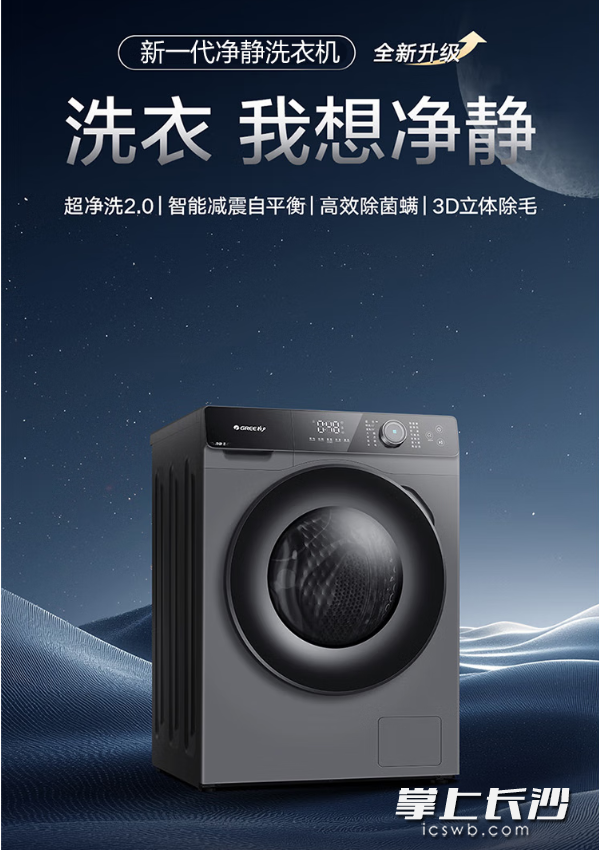
Group 1 - The "National Subsidy" policy for replacing old home appliances has been fully implemented, leading to the "Shared Plan" event in Changsha from January 16 to 18, focusing on consumer demand for New Year goods [1] - Gree, a leading company in the smart home appliance industry in Changsha, will showcase a special exhibition over 100 square meters featuring various products including refrigerators, washing machines, air conditioners, and small appliances [1] - Gree's new generation washing machine addresses common consumer pain points such as dehydration vibration and stubborn stains, utilizing smart vibration reduction technology for quiet operation and AI one-button washing mode for convenience [1] Group 2 - The Gree Jinghong refrigerator BCD-549WPSC will be featured at the event, equipped with a deep-freezing technology that reaches -33°C to preserve nutrients and a three-temperature zone for flexible food storage [3] - The refrigerator also includes an ion deodorization feature with a 99.9% antibacterial rate, ensuring cleanliness and freshness inside the unit [3] - Gree will present the latest "Cool and Clean" variable frequency air conditioner, which features a high-temperature self-cleaning system and operates at a low noise level of 18 decibels for a comfortable living experience [5] Group 3 - The event will offer significant discounts on popular products due to the combination of the "National Subsidy" policy and manufacturer promotions, with prices for the washing machine dropping from 3099 yuan to 2479 yuan, the refrigerator from 4999 yuan to 3999 yuan, and the air conditioner from 2899 yuan to 2464 yuan [7] - The Changsha event aims to provide high-quality and cost-effective consumer choices for citizens preparing for the New Year, enhancing the festive atmosphere [7]



2025年12月中国物价数据解读:物价回升的背后:补贴和输入性因素
ZHONGTAI SECURITIES· 2026-01-09 11:25
Group 1: CPI and PPI Trends - In December 2025, China's CPI increased from 0.7% to 0.8% month-on-month, while PPI rose from -2.2% to -1.9% year-on-year[2] - The CPI reached a new high since February 2023, with a month-on-month increase of 0.2%, consistent with the seasonal average of the past three years[2] - Among eight categories, only transportation and communication, and other goods and services showed significant month-on-month increases, at 0.0% and 2.8% respectively[2] Group 2: Factors Influencing CPI - The rise in transportation costs is attributed to constraints on price reductions in the automotive industry due to anti-involution measures[2] - Subsidies for "old-for-new" vehicle exchanges and corporate subsidies may have led to an overestimation of transportation costs in the CPI[2] - The decline in oil prices has narrowed, with transportation fuel costs showing a month-on-month decrease of -1.1%, compared to a three-year average of -3.6%[2] Group 3: Other Notable Increases - The category of other goods and services saw a month-on-month increase of 2.8%, significantly higher than the three-year average of 0.2%[2] - The year-on-year increase for this category was 17.4%, driven primarily by rising prices of precious metals[2] - The household appliances category experienced a year-on-year increase of 5.9%, indicating a discrepancy between consumer perception and actual price data due to subsidies[2] Group 4: PPI Insights and Future Outlook - The transmission of upstream price increases to downstream consumer goods remains weak, with downstream living goods showing zero month-on-month change for several months[2] - The coal mining and washing industry reported a year-on-year decline of -15.7%, the only major industrial sector with a double-digit drop[2] - Looking ahead, CPI is expected to decline significantly in January 2026 due to the Spring Festival effect, but may return to above 1% thereafter[2]
重回4100点,后市怎么走?最新研判
Zhong Guo Ji Jin Bao· 2026-01-09 11:11
【导读】沪指时隔10年重回4100点,多家基金公司研判后市 2026年首个交易周,A股迎来"开门红"! 2026年A股市场或有望逐步迈向深化阶段 从中长期维度看,永赢基金认为,本轮行情本质上仍处于自2024年9月启动的上涨市格局中,并且相较 于历史水平,当前市场或仍存在较大的演绎空间,市场情绪也尚未到达过热状态。随着基本面修复从点 向面逐步扩散,并伴随居民资金持续入市,2026年A股市场有望逐步迈向深化阶段。 今日(1月9日),市场震荡拉升,上证指数时隔10年重新站上4100点,深证成指涨超1%。两市成交额 突破3万亿元,全市场超3900只个股上涨,连续2日超百股涨停。板块方面,仅银行、非银金融下跌,传 媒、综合、国防军工等涨幅靠前。 多位业内人士认为,开年来,市场表现强劲,主要受到资金面、政策面与产业趋势三重积极因素的共同 驱动。展望后市,市场内在的上升趋势较为明确,行情有望在震荡中延续,投资上应紧密关注政策发力 与产业景气方向。 多重利好叠加 沪指时隔10年重回4100点 1月9日,三大指数继续上涨,沪指回到4100点上方,信达澳亚基金高级市场研究分析师刘翀表示,从成 交量来看,市场情绪较高,A股"春季躁 ...
山西2026年家电以旧换新、数码和智能产品购新补贴政策来啦
Xin Lang Cai Jing· 2026-01-09 10:25
Group 1 - The core announcement is that Shanxi Province will launch a subsidy program for replacing old home appliances and purchasing new digital and smart products starting January 9, 2026 [1] - The subsidy standard is set at 15% of the final sales price after all discounts, with a maximum subsidy of 1,500 yuan for home appliances and 500 yuan for digital and smart products per item [1] - Subsidy qualifications will be issued weekly through the "Yunshanfu" platform, with specific time frames for both online and offline transactions [1] Group 2 - Each consumer is limited to one subsidy per category for six types of home appliances and four types of digital and smart products during the policy implementation period [1]
跨入新年,海尔智家令人耳目一新
Quan Jing Wang· 2026-01-09 09:29
Core Viewpoint - Haier Smart Home showcases its global expansion and localization strategies through a recent video, emphasizing its broad and deep market presence across various regions [1][3][5] Group 1: Global Reach - The video highlights Haier's brand activities and performance across six major regions: Europe, North America, Australia/New Zealand, Southeast Asia, South Asia, and the Middle East/Africa, demonstrating extensive global coverage and deep localization [3] - In the mature European market, Haier ranks first among Chinese companies in overall market share for white goods, with top positions in major channels for heating and cooling [3] - In Southeast Asia, a high-potential emerging market, Haier also holds the number one position in overall white goods market share, with specific leadership in air conditioning in Thailand and its AQUA brand in Indonesia [3] Group 2: Depth of Localization - Each scene in the video reflects Haier's deep localization efforts, including sponsorships at major sporting events and community engagement through donations and disaster relief initiatives [3] - The brand's localized operations are supported by comprehensive branding strategies tailored to each market, showcasing a commitment to understanding and integrating into local cultures [3] Group 3: Globalization Strategy - Haier's approach to globalization encompasses ten capabilities, including sales, marketing, service, logistics, procurement, research and development, and manufacturing, rather than merely selling products globally [5] - The recent global launch of the three-tub washing machine exemplifies Haier's integrated global capabilities [5] - Haier has been recognized by Euromonitor as the world's leading brand in large home appliance retail volume for 17 consecutive years, reflecting its successful global strategy [5]


美的集团发生大宗交易 成交折价率10.83%
Zheng Quan Shi Bao Wang· 2026-01-09 09:26
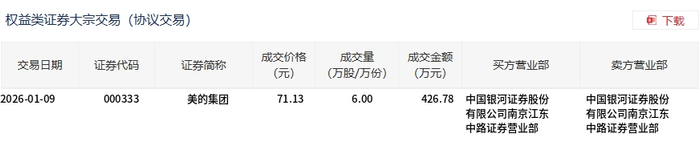
Group 1 - The core point of the article highlights a significant block trade involving Midea Group on January 9, with a transaction volume of 60,000 shares and a total transaction value of 4.2678 million yuan, executed at a price of 71.13 yuan, which represents a discount of 10.83% compared to the closing price of the day [1][1][1] Group 2 - In the last three months, Midea Group has recorded a total of 7 block trades, accumulating a total transaction value of 35.6526 million yuan [1] - The closing price of Midea Group on the day of the report was 79.77 yuan, reflecting an increase of 0.94%, with a daily turnover rate of 0.50% and a total trading volume of 2.719 billion yuan [1][1] - Over the past five days, the stock has increased by 2.07%, with a total net inflow of funds amounting to 427 million yuan [1][1] - The latest margin financing balance for Midea Group stands at 5.233 billion yuan, having increased by 66.33 million yuan over the past five days, representing a growth rate of 1.28% [1][1]

0.2%!12月CPI环比由降转涨 年末促消费政策效应持续显现
Zhong Guo Jing Ying Bao· 2026-01-09 09:09
Core Insights - The Consumer Price Index (CPI) increased by 0.8% year-on-year and 0.2% month-on-month in December 2025, while the Producer Price Index (PPI) decreased by 1.9% year-on-year but increased by 0.2% month-on-month, indicating a mixed economic outlook [1][9]. CPI Analysis - The rise in CPI is attributed to three main factors: increased prices of vegetables and fruits due to prior rainy weather, the effectiveness of year-end consumption promotion policies leading to higher prices for appliances, mobile phones, and cars, and a significant increase in gold prices, which boosted industrial consumer goods prices [2][3]. - The month-on-month CPI increase was primarily driven by rising prices of industrial consumer goods excluding energy, which rose by 0.6%, contributing approximately 0.16 percentage points to the CPI increase [3]. - The core CPI, excluding food and energy, rose by 1.2% year-on-year, maintaining above 1% for four consecutive months, reflecting sustained consumer demand and effective consumption policies [3]. PPI Analysis - The PPI's month-on-month increase of 0.2% in December 2025 marks the third consecutive month of growth, driven by improved supply-demand dynamics in certain industries and rising prices in the non-ferrous metals sector [6][7]. - Key industries such as coal mining and processing, lithium-ion battery manufacturing, and new energy vehicle production showed price increases, indicating a positive trend in industrial pricing [7]. - Year-on-year, the PPI decreased by 1.9%, but the decline is narrowing, with macroeconomic policies positively impacting certain industry prices, particularly in the digital economy and green transition sectors [9].
2026科技春晚开幕:AI与机器人站上舞台中央,这些产业迎来新机遇
Xin Lang Cai Jing· 2026-01-09 09:00
Group 1: CES 2026 Overview - CES 2026 is taking place in Las Vegas from January 6 to 9, 2026, and is considered a significant event for observing global technology trends [1][11] - The theme of CES 2026 prominently features AI and robotics, with the introduction of the "AI and Quantum Innovation Integration Zone" showcasing cutting-edge technologies [3][13] - Over 4,000 companies are participating in CES 2026, with Chinese companies numbering 942, accounting for approximately 22% of total exhibitors, making China the second-largest participating country [3][13] Group 2: Key Exhibitors and Innovations - TCL is a major presence at CES 2026, showcasing products like the X11L series and the world's first printed OLED car screen, with a booth area of 2,453 square meters [4][14] - Hisense debuted new RGB-Mini LED technology and the Air Master smart air conditioner, emphasizing its role as an official sponsor of the 2026 World Cup [5][15] - Emerging tech companies like Chase Technology are highlighting a complete product matrix focused on smart home ecosystems, including innovative products like the dual-arm air conditioner X-Wind [7][17] Group 3: Robotics and AI Developments - The cleaning robot sector is seeing significant advancements, with Stone Technology unveiling the G-Rover, a robot capable of autonomously cleaning stairs, marking a shift to three-dimensional space coverage [9][19] - Ecovacs introduced a new brand philosophy aimed at simplifying life through technology, showcasing its full range of products at the event [9][19] - The integration of AI into household appliances and robotics is evolving from mere functionality to system-level capabilities, indicating a clear growth direction for the technology industry in 2026 [11][21]


美的集团今日大宗交易折价成交6万股,成交额426.78万元
Xin Lang Cai Jing· 2026-01-09 08:52
| 权益类证券大宗交易(协议交易) | | | | | | | | 团 下载 | | --- | --- | --- | --- | --- | --- | --- | --- | --- | | 交易日期 | 证券代码 | 证券简称 | 成交价格 | 成交量 | 成交金额 | 买方营业部 | 卖方营业部 | | | | | | (元) | (万股/万份) | (万元) | | | | | 2026-01-09 | 000333 | 美的集团 | 71.13 | 6.00 | 426.78 中国银河证券股份 | | 中国银河证券股份 | | | | | | | | | 有限公司南京江东 | 有限公司南京江东 | | | | | | | | 中终证营业部 | | 中路证券型小部 | | 1月9日,美的集团大宗交易成交6万股,成交额426.78万元,占当日总成交额的0.16%,成交价71.13 元,较市场收盘价79.77元折价10.83%。 ...
12月物价数据解读:工业品涨价支撑通胀回升
Yin He Zheng Quan· 2026-01-09 08:48
CPI Insights - In December, the CPI increased by 0.2% month-on-month (previous value: -0.1%) and rose by 0.8% year-on-year (previous value: 0.7%) [1] - Core CPI also rose by 0.2% month-on-month (previous value: -0.1%) and maintained a year-on-year growth of 1.2% for four consecutive months [1] - The main driver for the food CPI was the seasonal increase in fresh fruit prices, while fresh vegetable prices saw a significant decrease in growth [5] PPI Insights - The PPI increased by 0.2% month-on-month (previous value: 0.1%) but showed a year-on-year decline of -1.9% (previous value: -2.2%) [13] - The structural characteristics of PPI indicate an improvement in overall economic conditions, with the PMI at 50.1% [13] - Rising prices in industrial goods are influenced by geopolitical risks and increased demand in sectors like new energy and AI [2] Market Outlook - The outlook for CPI in 2025 is cautiously optimistic, driven by the upward trend in consumer goods prices due to rising raw material costs [2] - The long-term forecast suggests that pig prices may gradually enter an upward trend in the second half of the year, impacting food CPI [5] - The overall improvement in industrial product prices reflects a recovery in market conditions, supported by various economic policies [13]