食品饮料

Search documents
ETF盘中资讯|“i茅台”成交用户超40万!“茅五泸汾洋”集体上攻,机构喊话白酒配置机会!
Sou Hu Cai Jing· 2026-01-12 02:33
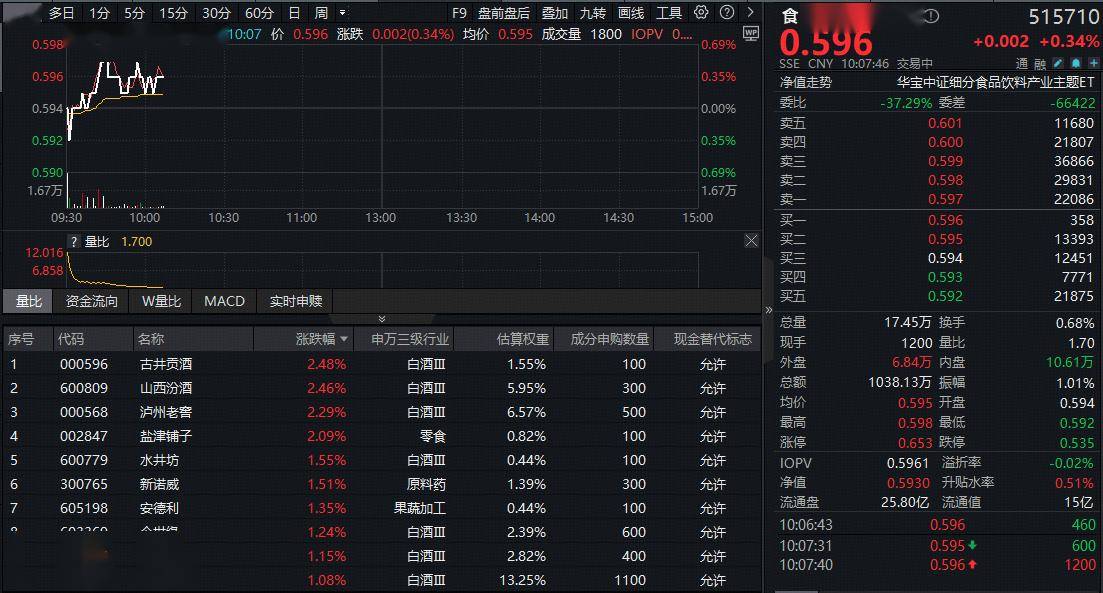
Group 1 - The food and beverage sector is experiencing an upward trend, with the Huabao Food and Beverage ETF (515710) showing a price increase of 0.34% as of the report time [1] - Major liquor stocks such as Shanxi Fenjiu, Luzhou Laojiao, and Gujing Gongjiu have surged over 2%, while Wuliangye and Yanghe have increased by more than 1% [1] - Kweichow Moutai has implemented a strategy to stabilize the market by directly reaching consumers through its iMoutai platform, which has gained over 2.7 million new users [1] Group 2 - Guizhou Moutai's recent dealer communication emphasized three principles: preventing speculation, adapting supply and demand, and stabilizing the market [2] - The current valuation of the food and beverage sector is at a historical low, with the PE ratio of the Huabao ETF at 20.16, indicating a favorable entry point for investors [2] - The white liquor industry is expected to reach a turning point as major companies like Moutai and Wuliangye implement market strategies ahead of the Spring Festival [3] Group 3 - The iMoutai platform's launch of the full range of Moutai products is expected to stabilize prices and improve market management [3] - The Huabao Food and Beverage ETF primarily invests in leading high-end and mid-range liquor stocks, with significant allocations to brands like Moutai, Wuliangye, and Luzhou Laojiao [3] - Investors can also consider the Huabao Food and Beverage ETF linked fund for exposure to core assets in the food and beverage sector [3]







【IPO前哨】爷爷的农场赴港:业绩连增之下,有哪些风险点?
Sou Hu Cai Jing· 2026-01-12 02:27
Core Viewpoint - The recent warming trend in the Hong Kong IPO market is highlighted by significant first-day gains for several new stocks, including Grandpa's Farm International Holdings, which has submitted its prospectus for listing on the Hong Kong Stock Exchange [2]. Group 1: Company Overview - Grandpa's Farm operates under an offshore structure established in 2015, with its founders launching their business in Guangzhou. The company has evolved to include a range of baby food and family food products [3]. - The company has expanded its product offerings significantly, with its SKU count projected to grow from 158 at the end of 2023 to 269 by the third quarter of 2025 [5]. Group 2: Market Position and Growth - According to Frost & Sullivan, Grandpa's Farm ranks second in the Chinese baby food market by total transaction value in 2024, achieving the highest compound annual growth rate from 2022 to 2024 among the top five companies [5]. - The company is also ranked first in the organic baby food segment by total transaction value in 2024 [5]. Group 3: Financial Performance - Revenue has shown steady growth, increasing from 622 million RMB in 2023 to 875 million RMB in 2024, representing a 40.6% growth. The first three quarters of 2025 saw revenue reach 780 million RMB, a 23.2% year-on-year increase [6]. - Adjusted net profit for 2023, 2024, and the first three quarters of 2025 was 75.91 million RMB, 103.21 million RMB, and 90.08 million RMB, respectively, indicating growth despite a slight decline in adjusted net profit margins [6][7]. Group 4: Revenue Sources - The majority of revenue comes from baby food products, accounting for 79.6% in 2023, which is projected to decrease to 53.6% by the first three quarters of 2025, indicating a diversification in revenue sources [7][8]. Group 5: Expenditure and Investment - Sales and distribution expenses have been increasing, with a rise from 32.3% of revenue in 2023 to 36.3% in the first three quarters of 2025. This growth rate exceeds that of revenue [10]. - The company relies heavily on e-commerce platforms for sales, with e-commerce service and promotion costs making up 66.3% to 72.3% of total sales and distribution expenses over the years [10][11]. Group 6: Manufacturing and Supply Chain - Grandpa's Farm utilizes an OEM model, sourcing products from 62 manufacturers to optimize production capabilities and manage costs [12]. - The company is also establishing its own factory in Guangzhou to enhance production capabilities and quality control [13]. Group 7: Fundraising and Future Plans - The company plans to use the net proceeds from its IPO to enhance product development, invest in supply chain improvements, strengthen brand marketing, expand sales networks, and for general corporate purposes [14].

麦格理:升康师傅控股(00322)目标价至15港元 维持“跑赢大市”评级
Zhi Tong Cai Jing· 2026-01-12 02:27
Core Viewpoint - Macquarie maintains an "Outperform" rating for Master Kong (00322), believing that the new management will focus on strict cost management and revenue recovery, leading the company to achieve sustainable growth starting in 2026 [1] Financial Projections - Macquarie has raised its earnings forecasts for Master Kong for 2025, 2026, and 2027 by 2.1%, 2.1%, and 2.0% respectively, based on confidence in strict operating expense control [1] - The target price for Master Kong has been increased from HKD 14.7 to HKD 15, reflecting a 2% upward adjustment, while maintaining a 15x price-to-earnings ratio for 2026 [1] Dividend Expectations - The expected dividend returns for Master Kong are attractive, with dividend yields projected at 7% for 2025 and 8% for 2026 [1] Sales and Profit Outlook - Sales for the second half of 2025 are expected to see a slight year-on-year increase of 0.1%, driven by a 3% growth in instant noodle business, which offsets a 1.5% decline in beverage sales [1] - Operating profit is anticipated to grow by 13.4% year-on-year, primarily benefiting from strict cost control strategies and favorable raw material price trends [1] Market Dynamics - Following the price increase of instant noodle products in July 2024, the low base effect is expected to manifest, leading to positive sales growth for instant noodles in the second half of 2025, with expectations of continuation until the end of the year [1] - Due to declining raw material prices, the gross margin for the second half of 2025 is expected to expand by 0.7 percentage points year-on-year [1]

2026年新能源车年度策略
GOLDEN SUN SECURITIES· 2026-01-12 01:09
Group 1: Macro Insights - The U.S. job market showed good performance in December, with non-farm employment slightly below expectations but an unemployment rate better than expected, indicating overall stability [4] - CPI has risen for four consecutive months, reaching the highest level since March 2023, while PPI has also shown signs of recovery, suggesting a potential upward trend in prices for 2026 [4][16] - The overall market sentiment is influenced by various macroeconomic indicators, with a focus on liquidity, economic performance, and valuation metrics [8][9] Group 2: New Energy Vehicles - The domestic new energy vehicle market continues to thrive, with projected sales for 2026 expected to reach 1,515 million units in China, reflecting a 15% year-on-year increase [17] - The demand for batteries and materials is expected to improve, with a significant increase in global battery demand anticipated [17][19] - Investment recommendations include focusing on key players in the battery sector such as CATL and other midstream material companies [19] Group 3: Wind Power Industry - The domestic wind power demand is steadily increasing, with expectations for offshore wind projects to accelerate as planning progresses [20] - The profitability of domestic wind turbine manufacturers is expected to improve, driven by price increases and export opportunities [20][21] - Investment suggestions include major turbine manufacturers and component suppliers, highlighting the potential for growth in the offshore wind sector [20] Group 4: Real Estate and REITs - The real estate market remains cautious, with land transaction volumes declining but at a slower rate, indicating a potential stabilization [12] - C-REITs have shown positive performance in the secondary market, with specific sectors like municipal water and data centers performing well [27] - Investment strategies focus on identifying quality projects with growth potential in high-demand urban areas [27] Group 5: Chemical Industry - Haohua Technology is positioned as a leading platform in new materials, benefiting from high demand in specialty chemicals and refrigerants [28][29] - The company has seen significant profit growth driven by rising prices in fluorinated chemicals, with expectations for continued upward momentum [29] - Investment recommendations emphasize the potential for growth in commercial aerospace and high-end electronic materials [29][32]


诺德基金罗世锋:2026年A股市场值得关注 行情或由估值修复向基本面驱动转变
Zhong Guo Jing Ji Wang· 2026-01-12 00:46
Core Viewpoint - The A-share market is expected to show an overall upward trend in 2025, driven by policy support, liquidity, and fundamentals, with significant structural differentiation in performance across sectors [1] Group 1: Market Performance - Major A-share indices saw substantial increases in 2025, with the Shanghai Composite Index, CSI 300 Index, and ChiNext Index rising by 18.4%, 17.7%, and 49.6% respectively [1] - The total market capitalization of A-shares at the end of 2025 is approximately 123 trillion RMB, an increase of 24.54 trillion RMB or about 25% from the end of 2024 [1] Group 2: Sector Performance - The A-share market exhibited clear structural differentiation, with strong performances in technology, high-end manufacturing, and non-ferrous metals, while consumer sectors lagged [2] - The best-performing sectors included non-ferrous metals and telecommunications, with gains of 94.7% and 84.7% respectively, while food and beverage and coal sectors declined by 9.7% and 5.3% [2] - The market structure reflects varying industry prosperity and indicates a profound change in China's economic structure, with technology manufacturing becoming a driving force [2] Group 3: Economic Outlook - The Chinese economy is expected to maintain a moderate recovery in 2026, with a deepening trend of structural transformation and upgrading [3] - Policies aimed at boosting consumption are anticipated to be introduced, addressing weak domestic demand and consumer confidence [3] Group 4: Corporate Earnings - In the first three quarters of 2025, the overall revenue growth for A-shares was 1.29%, and profit growth was 4.0%, indicating a stabilization trend in corporate earnings [4] - The return on equity (ROE) for listed companies has stabilized for four consecutive quarters, with a slight improvement noted in Q3 2025 [4] Group 5: Sector Focus - The technology and advanced manufacturing sectors, particularly artificial intelligence, are still in the early stages of development, with significant potential for future growth [5] - The consumer sector faces challenges due to weak domestic demand and demographic shifts, but long-term investment appeal is emerging [6] - The outbound industry chain shows strong competitiveness, with exports performing well, supported by China's robust industrial system and engineer advantages [7]
1月12日投资早报|天普股份今日起复牌,德福科技终止收购卢森堡铜箔100%股权,金种子酒2025年度经营业绩将出现亏损
Xin Lang Cai Jing· 2026-01-12 00:37
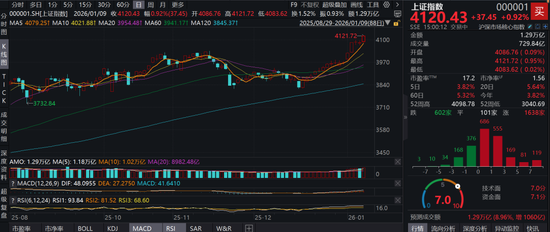
Market Performance - On January 9, 2026, the A-share market saw all three major indices close higher, with the Shanghai Composite Index at 4120.43 points, up 0.92%, the Shenzhen Component Index at 14120.15 points, up 1.15%, and the ChiNext Index at 3327.81 points, up 0.77%. Over 3900 stocks rose, with a total trading volume of 3.12 trillion yuan, an increase of 320 billion yuan from the previous trading day [1] - The Hong Kong stock market experienced fluctuations but closed higher, with the Hang Seng Index up 0.32% or 82.48 points, ending at 26231.79 points, and a total trading volume of 245.13 billion HKD. For the week, the Hang Seng Index fell 0.41%, the Hang Seng China Enterprises Index fell 1.31%, and the Hang Seng Tech Index fell 0.86% [1] - On the same day, U.S. stock indices also closed higher, with the Dow Jones Industrial Average rising by 237.96 points or 0.48% to 49504.07 points, the Nasdaq up 191.33 points or 0.81% to 23671.35 points, and the S&P 500 up 44.82 points or 0.65% to 6966.28 points, marking new historical highs for both the Dow and S&P [1] Important News - The National Business Work Conference held on January 10-11, 2026, emphasized eight key areas for the national business system, including enhancing service consumption, optimizing the implementation of the old-for-new policy, and promoting digital, green, and health consumption to stimulate market vitality [2] - The conference also highlighted the need to improve the modern market and circulation system, promote trade innovation, attract foreign investment, and deepen bilateral and multilateral economic cooperation while ensuring risk prevention and management [2] Healthcare Sector - The National Healthcare Security Administration announced the initiation of a pilot program for the "Personal Medical Insurance Cloud" on January 11, 2026, aimed at constructing a smart healthcare management model covering the entire population and lifecycle. The pilot will run from February to December in selected regions [3] - The initiative will integrate core data from medical institutions and wearable health devices, creating a multidimensional personal health profile for insured individuals, which includes health records and financial information related to medical expenses [3]

4100点、16连阳,春季行情来了?
吴晓波频道· 2026-01-12 00:30
Core Viewpoint - The article discusses the recent bullish trend in the A-share market, highlighting a significant increase in trading activity and investor sentiment, particularly in the context of a "spring market rally" that has historical precedence [10][21]. Market Performance - As of January 7, the margin trading balance in the A-share market reached 26,047 billion yuan, marking a historic high [4]. - The Shanghai Composite Index achieved a rare "16 consecutive days of gains," setting a record for the longest winning streak in its history [6][21]. - From early December to January 9, the Shanghai Composite Index rose approximately 5.26%, while the Shenzhen Component Index and the ChiNext Index increased by about 7.41% and 7.58%, respectively [8]. Investor Behavior - There is a noticeable increase in discussions about stocks among the public, indicating heightened interest in the market [5]. - The influx of new investors is evident, with 2.5967 million new accounts opened in December 2025, a year-on-year increase of 30.55% [8]. Economic Indicators - The Producer Price Index (PPI) and Consumer Price Index (CPI) showed positive signs, with December 2025 recording the best performance of the year [11]. - The CPI increased by 0.8% year-on-year, indicating a return to positive growth [11]. Sector Performance - In 2025, the non-ferrous metals sector led the industry with a remarkable annual increase of 94.73%, while the food and beverage sector saw a decline of 9.69% [9]. - The aerospace equipment sector experienced a significant rise of approximately 146%, with many commercial space stocks seeing gains exceeding 100% [9]. Future Outlook - The article suggests that the current market rally may signal a new phase for the stock market, with expectations for continued strength in technology sectors and a gradual recovery in traditional industries [20][22]. - The anticipated "spring market" may extend into 2026, with a focus on technology innovation and consumption recovery as key investment themes [22][23]. - The article emphasizes the importance of patience and strategic investment in quality stocks, particularly as regulatory measures against financial misconduct are expected to tighten [27].

特朗普被曝正考虑多个干涉伊朗方案;商务部:深入实施提振消费专项行动;“死了么”App创始人发声| 每经早参
Mei Ri Jing Ji Xin Wen· 2026-01-11 23:43
Group 1 - The National Business Conference held in Beijing from January 10 to 11 emphasized eight key areas for the national business system to focus on by 2026, including boosting consumer spending and enhancing the modern market and circulation system [4] - The "832 platform," aimed at promoting agricultural products from poverty-stricken areas, has achieved a cumulative transaction volume exceeding 60 billion yuan since its establishment [6] - The "Personal Medical Insurance Cloud" pilot program is set to be launched by the National Medical Insurance Administration from February to December, aiming to create a new model for smart medical insurance management [5] Group 2 - The "Dead or Not" app has gained significant popularity, ranking first in the paid software category on the Apple App Store, with a development cost of only over 1,000 yuan and plans to sell 10% of the company for 1 million yuan [9] - The "Gou Buli" steamed bun brand has registered an English trademark "GO BELIEVE" to enhance market recognition and appeal to foreign customers [10] - Google co-founders have moved their business entities out of California to avoid potential wealth taxes, indicating a trend of wealthy individuals relocating to areas with more favorable tax policies [11]

沪指暴力16连阳!机构:热度有望延续,中信看好资源和传统制造
Xin Lang Cai Jing· 2026-01-11 23:37
Core Viewpoint - The A-share market is experiencing a significant upward trend, with the Shanghai Composite Index breaking through 4100 points and achieving a historical 16 consecutive days of gains, driven by sectors such as commercial aerospace, controllable nuclear fusion, brain-computer interfaces, humanoid robots, and resource stocks [1][11]. Group 1: Market Trends - The current market rally is attributed to concentrated inflows from previously cautious funds, with a notable focus on thematic stocks and small-cap stocks rather than traditional allocation strategies [3][13]. - Short-term market sentiment remains high, with no signs of weakening emotional indicators, suggesting that the upward trend in thematic and small-cap stocks may continue until after the Two Sessions [3][13]. - The market is currently characterized by a high level of trading activity, with a significant increase in transaction volume, indicating strong investor confidence [16]. Group 2: Sector Recommendations - Analysts recommend focusing on sectors with high cost-performance ratios, particularly those benefiting from external demand recovery, such as gaming, duty-free, batteries, engineering machinery, and agricultural chemicals [4][14]. - The commercial aerospace sector is highlighted as a key area for investment, with expectations of continued upward momentum despite potential short-term profit-taking pressures [19]. - The resource sector, particularly traditional manufacturing, is advised for increased allocation, with a focus on enhancing pricing power [3][13]. Group 3: Future Outlook - February is anticipated to be a favorable period for the market, with historical data suggesting that significant trading volumes often lead to sustained upward trends [16]. - The market is expected to enter a phase of basic performance evaluation after the annual report disclosures in January, which may provide opportunities for investors to capitalize on growth potential [17]. - The overall sentiment indicates that the upward potential in the market outweighs the risks, with a focus on sectors that align with long-term growth trends, such as AI and semiconductor industries [20].
雀巢大中华区销售额有机增长率跌6.1% 召回中国市场71个批次婴儿配方奶粉
Chang Jiang Shang Bao· 2026-01-11 23:33
Core Viewpoint - Nestlé is conducting a global recall of certain infant formula products due to potential contamination with Bacillus cereus, a bacteria that can cause foodborne illness, affecting multiple countries including China [4][5]. Group 1: Recall Details - On January 6, Nestlé China announced a voluntary recall of 71 batches of infant formula, including 41 batches imported from Europe and 30 batches sold in mainland China [1][6]. - The recalled products include various brands such as "Nestlé BEBA Supreme" and "Wyeth启赋未来" [1][6]. - The recall is a precautionary measure, and as of now, no adverse health reports related to the products have been received [2][5]. Group 2: Market Impact and Performance - Nestlé's sales in the Greater China region have seen a decline, with an organic growth rate of -6.1% for the first three quarters of 2025, and -10.4% in the third quarter [3][8]. - The company is shifting its strategy from a "channel-driven" model to a "demand-driven" approach, as stated by the new CEO, Mark Schneider [3][8]. - From 2019 to 2024, sales in the Greater China region dropped from 6.913 billion Swiss francs to 5.558 billion Swiss francs, with only one year of positive growth [8]. Group 3: Strategic Changes - The new CEO has emphasized the need to address previous sales strategies that relied heavily on channel expansion and inventory pressure, which led to unsustainable practices [8]. - Recent management changes have been made to improve operations, including the appointment of a new head for the dairy business to oversee e-commerce and retail channels [8]. - The company remains committed to long-term development in China, focusing on local innovation and quality products for consumers [9].