零售

Search documents
中国连锁加盟商业发展白皮书2026
Hong Can Chan Ye Yan Jiu Yuan· 2026-01-31 09:42
Investment Rating - The report does not explicitly provide an investment rating for the chain franchise industry in China Core Insights - The scale of China's chain franchise industry is approaching 3 trillion yuan, with the "brand invitation" model gradually becoming the mainstream of the industry [7][21] - The industry has undergone five stages of development, transitioning towards compliance, professionalism, and ecological upgrades [8] - The rise of professional and super franchisees is reshaping the market, with a focus on standardized and regulated franchise processes [9][18] - The shift from a "quick franchise" model to a "brand invitation" model emphasizes long-term value and operational quality [33] Summary by Sections 1. Industry Overview - China's chain franchise industry is nearing a scale of 3 trillion yuan, with the brand invitation model becoming the mainstream [7] - The industry has evolved through five stages: exploratory, initial, regulatory, mature, and brand invitation era, reflecting changes in policy, technology, and market demand [8] 2. Current State of Franchise Operations - Franchisees are increasingly focusing on meticulous management, with a trend towards multi-brand strategies [46] - Approximately 90% of market participants operate two or more brands, indicating a diversification strategy [46] - The majority of franchisees (63.1%) focus on a single industry, emphasizing deep exploration of niche markets [48] 3. Characteristics of Franchisee Groups - The report highlights the emergence of professional and super franchisees as the dominant groups in the market [9] - Franchisees prefer to manage their stores independently, with a significant portion of the restaurant industry adopting self-management models [60] 4. Case Analysis - The timing of entry and store models are critical for franchisee success, with a need for multi-dimensional evaluation in popular sectors [44] 5. Franchise Operation Strategies - Key factors for investment effectiveness include product selection, site selection, and operational fit [5] 6. Industry Trends - The industry is witnessing parallel developments in digitalization and refined operations, with supply chain integration and differentiated niche markets becoming new competitive paths [5][18] - The supply chain's maturity is reducing information asymmetry between sectors, leading to intensified competition and shorter franchise store lifecycles [35]
聚焦民生关切与产业升级 一批国家标准2月1日正式施行
Xin Lang Cai Jing· 2026-01-31 09:10
Core Points - A series of important national standards will be implemented starting February 1, aimed at guiding and regulating the development of emerging and future industries, promoting the application of results and standards, protecting consumer rights, and ensuring public safety [1] Group 1: Software and Communication Standards - The Software Process Capability Maturity Model (GB/T 45989—2025) establishes a framework for software process capability, enhancing management levels and promoting the sustainable development of the software industry in China [2] - The 5G Mobile Communication Network Security Technical Requirements (GB/T 46462—2025) set forth security architecture and requirements for access, network security, user privacy protection, and safety services, enhancing communication security capabilities [3] Group 2: Energy and Technology Standards - The Energy Metering Equipment Allocation and Management Guidelines (GB 17167—2025) outline mandatory requirements for energy metering equipment, aiming to improve energy management and economic efficiency in energy-consuming units [4] - The Guidelines for the Transformation of Scientific and Technological Achievements into Standards (GB/T 33450—2025) provide guidance for analyzing and assessing the feasibility of transforming technological achievements into standards, promoting integration with innovation [5] Group 3: Educational and Health Standards - The National Standard for Student Physical Health Testing Equipment (GB/T 19851.12—2025) defines requirements and testing methods for physical health testing equipment, ensuring quality and safety in school sports equipment [6] - The General Technical Requirements for Student Nap Desks and Chairs (GB/T 46016—2025) establish standards for nap furniture in schools, addressing the needs of non-boarding students and promoting their health [7] Group 4: Consumer and Safety Standards - The Guidelines for the Design of Elderly Furniture (GB/T 46015—2025) provide design principles and considerations for furniture aimed at elderly users, enhancing their quality of life and safety [8] - The Barcode Symbol Placement Requirements (GB/T 14257—2025) standardize barcode placement on products, improving data collection efficiency in the supply chain [10] - The Consumer Experience Center Construction and Service Guidelines (GB/T 46705—2025) and the Comparative Testing Requirements for Consumer Goods (GB/T 46708—2025) aim to enhance product quality and service levels through objective evaluations [11] - The Elevator Safety Requirements (GB/T 24803.2—2025) establish safety parameters for elevators, providing a technical basis for safety evaluations [12] - The Basic Requirements for Earthquake Rescue Teams (GB/T 46578—2025) outline capabilities and training requirements for rescue teams, improving disaster response effectiveness [13]
宁夏发布提醒告诫!违反明码标价最高罚5000元
Sou Hu Cai Jing· 2026-01-31 09:06
Core Viewpoint - The market supervision authority has issued a warning to all operators and industry associations to ensure price stability during the Spring Festival, emphasizing the importance of fair pricing and consumer rights protection [1][2]. Group 1: Price Regulation and Compliance - Operators are required to strictly adhere to the Price Law of the People's Republic of China, ensuring fair, legal, and honest pricing practices [3]. - Malicious hoarding and price gouging during the holiday period are strictly prohibited, and collusion to manipulate market prices is not allowed [3]. - Industry associations are urged to guide operators in standardizing pricing behavior and to refrain from organizing price hikes or monopolistic practices [3]. Group 2: Specific Pricing Guidelines - Retailers, supermarkets, and farmers' markets must provide accurate product information and ensure proper labeling [4]. - Service providers in sectors such as dining, accommodation, and beauty must clearly indicate service items and pricing, prohibiting any undisclosed fees [5]. - Tourist attractions must comply with government pricing regulations and cannot arbitrarily increase ticket prices or add new charges [5]. Group 3: Online Transactions and Price Commitments - Online platform operators must fulfill price commitments, ensuring that displayed prices match promotional information and are updated promptly [6][7]. - Hotels and accommodations are not allowed to refuse price commitments or raise prices without valid reasons, and deceptive pricing practices are forbidden [7]. Group 4: Enforcement and Penalties - The warning mandates immediate self-inspection and correction of non-compliant behaviors by operators and industry associations [8]. - Market supervision departments will intensify price behavior inspections during the Spring Festival, with severe penalties for violations, including fines up to 500,000 yuan for price fraud and 3 million yuan for price gouging [8]. - The authority encourages public supervision and reporting of price violations through various channels [8].
【展望二〇二六】满足人民群众消费新期待
Jing Ji Ri Bao· 2026-01-31 05:13
Core Viewpoint - The Chinese market is undergoing significant regulatory changes in 2026, impacting competition in the food delivery and retail sectors, with a shift from aggressive price wars to a focus on service quality and consumer trust [1][2][3]. Group 1: Regulatory Changes - The State Council's Anti-Monopoly Committee announced investigations into the food delivery platform market and the alleged monopolistic behavior of Ctrip, indicating increased regulatory scrutiny [1][2]. - The Ministry of Finance and the State Taxation Administration will eliminate VAT export rebates for solar products starting April 1, 2026, reflecting a broader regulatory tightening [1]. - The market supervision authority released a list of major cases related to "involution" competition, highlighting ongoing efforts to address unfair practices in various industries [1][2]. Group 2: Market Dynamics - The competitive landscape in the food delivery sector is shifting from a "burning money" model to a focus on optimizing user experience and sustainable business practices [2][3]. - Major platforms are transitioning from merely delivering food to providing a broader range of retail services, indicating a strategic pivot towards becoming comprehensive retail infrastructures [4][5]. - The competition is expected to evolve into a "full-scenario retail war," integrating offline experiences, supply chain efficiency, and product quality [4][5]. Group 3: Consumer Behavior - Consumers are increasingly rejecting "involution" products characterized by extreme price cuts, signaling a demand for better quality and service [6][7]. - The market is anticipated to segment into two layers: one focused on efficiency and cost-effectiveness, and another on emotional and personalized experiences [8][12]. - The rise of local and individual creators is fostering a diverse ecosystem, enhancing consumer engagement and satisfaction [12][14]. Group 4: Food Safety and Transparency - Regulatory efforts are shifting from reactive measures to proactive prevention in food safety, aiming for a comprehensive regulatory framework to ensure consumer trust [9][10]. - New standards and regulations are being developed for pre-packaged food, emphasizing transparency and accountability in the food supply chain [9][10]. - The implementation of traceability systems and enhanced monitoring is expected to improve food safety and consumer confidence [10][11].



多彩集市透着浓浓年味藏着经济活力 品质升级助力“年经济”焕彩焕新
Yang Shi Wang· 2026-01-31 04:30
Group 1 - The "Qihao Market" in Chaoyang District, Beijing, has become a popular destination for consumers seeking traditional New Year goods from various regions of China [1][2] - The market recently underwent upgrades, integrating shopping, dining, and lifestyle services, making it a new choice for citizens during the Spring Festival shopping season [2] - The market emphasizes hometown flavors, featuring high-quality products from different cities, allowing workers from other regions to enjoy familiar tastes in Beijing [4] Group 2 - In Kashgar, Xinjiang, the dried fruit market is experiencing a sales peak ahead of the Spring Festival, with a variety of products like almonds, raisins, and walnuts available [6][7] - Stores in Kashgar report increasing business, with many customers purchasing dried fruits in bulk, and some shops offering one-stop services for selection, packaging, and shipping [9] Group 3 - In Lanzhou, Gansu, flower buns featuring "horse" elements have become popular for the Spring Festival, with local artisans creating intricate designs [11][12] - The production of these flower buns involves multiple steps, and they are designed to symbolize good fortune during family gatherings [14] Group 4 - The "Longxingli" New Year market in Tonghua, Jilin, has opened, combining Northeast customs, intangible cultural heritage, and unique commerce to provide a rich cultural experience [16][18] - The market features over 70 stalls offering a wide range of New Year goods, fulfilling the one-stop shopping needs of citizens [18][21] Group 5 - In Liaocheng, Shandong, a lively market showcasing local customs has opened, featuring various New Year decorations and traditional crafts [26][28] - The market includes interactive activities such as gourd carving and sugar painting, allowing visitors to engage with local traditions while shopping [32] Group 6 - Various New Year markets across Jiangxi are bustling with activity, offering local delicacies and performances that immerse visitors in regional culture [36][38] - In Yichun, local markets provide opportunities for residents and tourists to taste local snacks and participate in traditional craft-making activities [40][42]

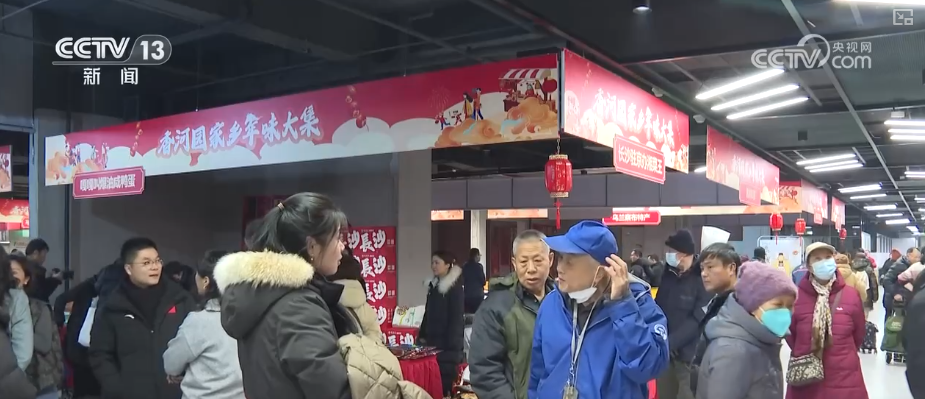
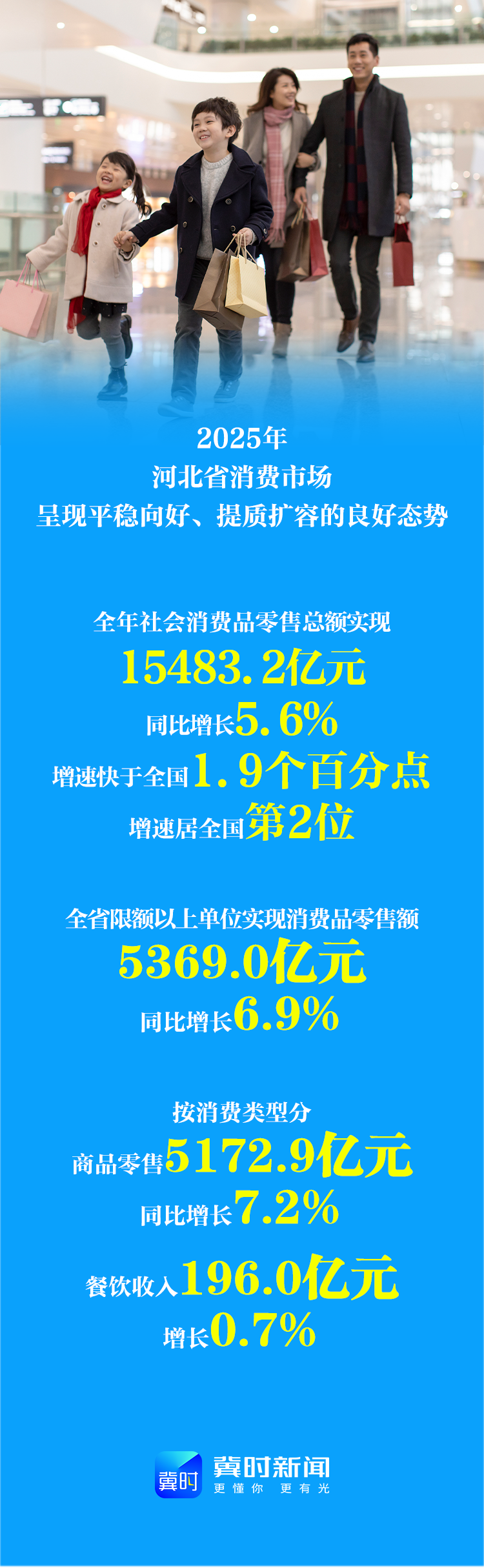
图说2025年经济数据丨增速全国第二!河北社会消费品零售总额超1.5万亿
Xin Lang Cai Jing· 2026-01-31 04:02
Group 1 - The total retail sales of consumer goods in the province reached 1,548.32 billion yuan, with a year-on-year growth of 5.6%, outpacing the national growth rate by 1.9 percentage points, ranking second in the country [4] - Retail sales of goods amounted to 536.9 billion yuan, growing by 6.9% year-on-year, with retail sales of goods at 517.29 billion yuan increasing by 7.2% and catering revenue at 19.6 billion yuan growing by 0.7% [4] - The retail sales of grain and oil food products increased by 19.3% year-on-year, with specific categories such as grain and oil up by 21.8%, meat and poultry by 6.9%, aquatic products by 21.7%, vegetables by 13.3%, and dried and fresh fruits by 23.6% [7] Group 2 - The province's consumer goods replacement program received 17.238 billion yuan in subsidies, driving total sales of 128.033 billion yuan, with retail sales of household appliances and audio-visual equipment growing by 12.6% and furniture by 36.3% [9] - Retail sales of new energy vehicles increased by 7.8% year-on-year, reflecting a growing demand for digital and intelligent products [11] - Retail sales of smartphones surged by 55.2%, while energy-efficient products with levels 1 and 2 saw a remarkable growth of 91.6%, and sales of computers and related products increased by 57.9% [12] Group 3 - The province's express delivery business volume exceeded 10 billion pieces, making it the fourth province in the country to achieve this milestone, with rapid development in e-commerce and online sales activities [15] - The online retail sales target for the province is set to reach 510.06 billion yuan by 2025, with an expected growth rate of 8.9% [15]
1月制造业PMI回落至49.3% 超3成企业反映利润下降
Di Yi Cai Jing· 2026-01-31 03:43
Group 1: Manufacturing Sector Overview - In January, the manufacturing PMI fell to 49.3%, a decrease of 0.8 percentage points from the previous month, indicating fluctuations in manufacturing operations [4][5] - The new orders index for January was 49.2%, down 1.6 percentage points, reflecting a tightening of market demand due to seasonal factors and changes in export environments [4][5] - The production index remained in the expansion zone at 50.6%, despite a decline of 1.1 percentage points, suggesting continued overall expansion in manufacturing production [5] Group 2: Price Levels and Economic Conditions - The purchasing price index for raw materials rose to 56.1%, and the factory price index increased to 50.6%, marking the first time in nearly 20 months that the factory price index exceeded the critical point [5] - The proportion of manufacturing enterprises reporting insufficient market demand decreased to 54.9%, down 9.4 percentage points, indicating a stabilization in market demand [5] - Analysts suggest that the overall economic climate is affected by seasonal fluctuations, high previous month bases, and ongoing adjustments in the real estate market [6] Group 3: Non-Manufacturing Sector Insights - The non-manufacturing business activity index for January was 49.4%, a decline of 0.8 percentage points, primarily due to a decrease in the construction sector [9] - The service sector showed relative stability, with the service business activity index slightly declining by 0.2 percentage points, remaining around 49.5% [10] - The business activity expectation index for the service sector rose to 57.1%, indicating an optimistic outlook, particularly for consumption-related services during the upcoming Spring Festival [10]
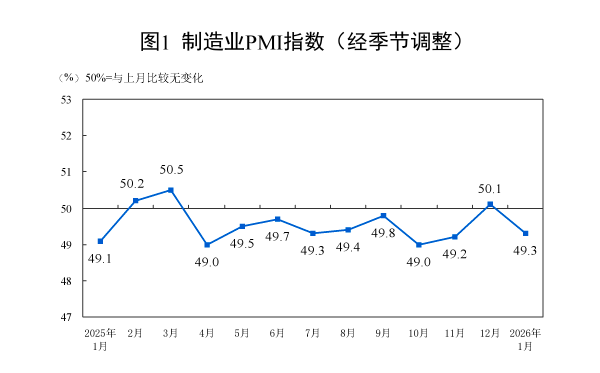
1月制造业PMI回落至49.3%,超3成企业反映利润下降
Di Yi Cai Jing· 2026-01-31 03:39
Core Viewpoint - The manufacturing sector in China is experiencing a decline in economic activity, as indicated by the drop in the Purchasing Managers' Index (PMI) below the growth threshold, reflecting insufficient market demand and the need for stronger economic recovery measures [1][4][6]. Manufacturing Sector - The manufacturing PMI for January is reported at 49.3%, a decrease of 0.8 percentage points from the previous month, indicating fluctuations in manufacturing operations [4]. - New orders index fell to 49.2%, down 1.6 percentage points, suggesting a tightening of market demand [4]. - The production index remains in the expansion zone at 50.6%, but has decreased by 1.1 percentage points, indicating a slowdown in manufacturing production growth [5]. - The prices of raw materials and finished products are rising, with the raw material purchase price index at 56.1% and the factory price index at 50.6%, marking the first time in nearly 20 months that the factory price index has risen above the critical point [5][6]. - Over 34% of manufacturing companies reported a decline in profits, highlighting concerns regarding profitability amid rising raw material costs [6]. Non-Manufacturing Sector - The non-manufacturing business activity index is at 49.4%, down 0.8 percentage points, with the construction sector experiencing a significant decline [9]. - The service sector remains relatively stable, with a slight decrease in the service business activity index to around 49.5% [10]. - The service industry shows optimistic expectations, with a business activity expectation index of 57.1%, indicating a positive outlook for the upcoming Spring Festival consumption [10].
9点1氪|特朗普宣布下任美联储主席提名人选;广东连续8年成为第一生育大省;“黑白颠周媛”被立案调查
3 6 Ke· 2026-01-31 01:21
Group 1 - Trump nominates Kevin Warsh as the next Federal Reserve Chairman, replacing Jerome Powell [2] - Warsh, who joined the Fed in 2006, initially held a hawkish stance on monetary policy but has shifted to support Trump's tariff policies and faster rate cuts [2] - The nomination process requires Senate approval following the President's selection [3] Group 2 - Guangdong has maintained its position as the top province for births in China for eight consecutive years, with a birth rate of 7.82‰ and a natural population growth of 290,000 in 2025 [3] - The province's GDP reached 14.58 trillion yuan in 2025, accounting for over 10% of the national economy [3] Group 3 - Kimi's overseas revenue has surpassed domestic revenue, with a fourfold increase in global paid users following the release of the K2.5 model [4] - The K2.5 model has gained significant traction, ranking third on Openrouter, behind Claude Sonnet 4.5 and Gemini 3 Flash [4] Group 4 - The latest Forbes China Rich List shows Zhang Yiming, Zhong Shanshan, and Ma Huateng in the top three positions, with Lei Jun ranking tenth with a wealth of $30.4 billion [5] - Jack Ma follows Lei Jun with a wealth of $29.6 billion [5] Group 5 - Sora, an AI video generation app developed by OpenAI, has seen a 45% drop in mobile downloads and a 32% decrease in consumer spending [7] - The app previously reached the top of the Apple App Store but is now experiencing significant user attrition [7] Group 6 - Apple is prioritizing the production of high-end iPhone models for 2026 due to marketing strategy adjustments and supply chain constraints [7] - The company plans to delay the release of standard models [7] Group 7 - Morgan Stanley predicts gold prices could rise to $8,000 to $8,500 in the coming years, driven by retail investors seeking to hedge against stock market declines [7] - However, there are warnings about potential short-term risks due to overbought conditions in gold and silver [7] Group 8 - Xiaomi's SU7 Ultra sales have plummeted to 45 units in December 2025, down from over 3,000 units in March [12] - The model, which was launched in February 2025, is part of Xiaomi's high-end automotive strategy [12] Group 9 - Vanke reported an expected loss of approximately 82 billion yuan for 2025, a significant increase from the previous year's loss of 49.48 billion yuan [22] - The company faces substantial operational pressures and historical burdens [22] Group 10 - 360 expects a net profit of 213 million to 318 million yuan for 2025, marking a turnaround from previous losses [22] - The anticipated profit increase is attributed to gains from long-term equity investments [22] Group 11 - Light Media forecasts a net profit of 1.5 billion to 1.9 billion yuan for 2025, representing a year-on-year growth of 413.67% to 550.65% [23] - The increase is driven by the success of the film "Nezha: Birth of the Demon Child" and related IP operations [23] Group 12 - Adidas reported preliminary revenue growth in the fourth quarter, with revenues reaching 6.08 billion euros, up from 5.97 billion euros the previous year [24][25] - The company plans a stock buyback of 1 billion euros following the revenue increase [25] Group 13 - New Yi Sheng expects a net profit increase of 231.24% to 248.86% for 2025, driven by growth in high-speed product demand [26] - The company anticipates a net profit of 9.4 billion to 9.9 billion yuan [26] Group 14 - Western Gold expects a net profit increase of 46.78% to 69.23% for 2025, attributed to increased sales and prices of gold products [26] - The projected net profit is between 425 million and 490 million yuan [26] Group 15 - Duyue City anticipates a net loss of 2.1 billion to 2.7 billion yuan for 2025, although this is an improvement from the previous year's loss of 2.977 billion yuan [27] - The loss is linked to adjustments in pricing strategies and potential asset impairments [27] Group 16 - Yiteng Medical has completed nearly 100 million yuan in Series A financing, aimed at advancing high-end CT tube development [28] - The funding round was led by Honghui Fund with participation from other investors [28] Group 17 - In Situ New Materials has completed several million yuan in angel round financing, with funds directed towards capacity expansion and technology development [29] - The financing was led by Chery Group's venture capital platform [29]
欲望失控的Z世代,海绵宝宝成性幻想对象了?
36氪· 2026-01-31 01:21
Group 1 - The article discusses the emerging trend of "Clear-coding" in dating among Generation Z, emphasizing direct communication about expectations and boundaries from the start of relationships [6][8] - The report highlights a revival of "office romances" as dating apps become less appealing, with over 70% of users feeling exhausted by the swiping culture [8] - A new social gathering trend called "admin night" is gaining popularity, where friends meet to tackle personal administrative tasks together, reflecting a shift in social interactions [12][14] Group 2 - Lululemon's new campaign for the 2026 Spring Festival showcases a blend of Eastern aesthetics and the theme of finding new experiences within repetition, appealing to diverse demographics [18][20] - Alo Yoga plans to open two flagship stores in Beijing and Shanghai, indicating confidence in the high-end lifestyle market in China, while also facing potential challenges in adapting to local consumer preferences [23][25] - MUJI's new flagship store in Chengdu integrates local cultural elements into its design and product offerings, aiming to resonate with the community and enhance customer experience [26][28] Group 3 - Pinterest's 2026 trend forecast predicts a shift towards "Gummy Aesthetic" and "Glamoratti," reflecting a desire for comfort, boldness, and personal expression in various lifestyle sectors [30][32] - The article notes the rise of unique IPs, such as G-Dragon's cat Zoa, which combines fashion and storytelling, aligning with current consumer interests in personalized and relatable content [33][35] - Pornhub's annual report reveals evolving sexual preferences, with a notable increase in searches related to diverse sexual identities and fantasies, indicating a broader acceptance of non-traditional relationships [36][39] Group 4 - The return of GQ magazine, now titled "Elite GQ," focuses on blending global fashion with Chinese cultural aesthetics, reflecting changes in editorial direction and partnerships [45][47] - The popularity of a new down jacket from Sam's Club, which sold out quickly, highlights a consumer shift towards practicality and value in winter apparel amidst rising prices in the market [53][56] - Alex Honnold's successful free solo climb of Taipei 101 marks a significant achievement in extreme sports, drawing global attention and showcasing the intersection of adventure and media [62][67]