国防军工

Search documents
转债周度专题:下修空间缩窄怎么看?-20250929
Tianfeng Securities· 2025-09-29 02:30
1. Report Industry Investment Rating The provided content does not mention the industry investment rating. 2. Core Viewpoints of the Report - The overall convertible bond downward - revision gaming space has gradually narrowed this year. With the upward trend of the equity market, the number of low - parity convertible bonds has decreased, and the number of convertible bonds triggering downward - revision, proposing downward - revision, and actually undergoing downward - revision has shown a downward trend. However, as the number of convertible bonds entering the put - back period and approaching maturity increases, the gaming opportunities for downward - revision may relatively increase, and the focus should be on the individual bond's downward - revision willingness [1][10]. - Against the background of the narrowing overall downward - revision gaming space, attention should be paid to the opportunities of underlying assets related to the fundamental expectations of the underlying stocks of convertible bonds and relatively low valuations. For equities, grasp the structural opportunities in the technology - growth direction and focus on the underlying assets with strong performance certainty in pro - cyclical and anti - involution beneficiary industries. Also, pay attention to low - price and low - premium varieties among high - rating and large - cap convertible bonds [2][20]. - The A - share market is expected to have a good allocation cost - performance ratio in terms of risk premium. The convertible bond supply is shrinking, and there is certain support on the demand side. Attention should be paid to the downward - revision gaming space, be vigilant against the forced - redemption risk, and appropriately focus on the short - term gaming opportunities of near - maturity convertible bonds. Industries worthy of attention include popular themes, domestic demand - oriented sectors, and high - dividend sectors under the Chinese - characteristic valuation system [23]. 3. Summary According to Relevant Catalogs 3.1. Convertible Bond Weekly Special Topic and Outlook 3.1.1. How to View the Narrowing Downward - Revision Space? - This week, three convertible bonds (Jingke Convertible Bond, Lanfan Convertible Bond, and Yong 22 Convertible Bond) underwent downward - revision. Since September, the total number of actually downward - revised convertible bonds has slightly increased compared to August. The number of convertible bonds proposed for downward - revision in September is the same as that in August, and the willingness for downward - revision may have marginally increased [10]. - In general this year, the downward - revision gaming space has gradually narrowed. The proportion of convertible bonds with a parity in the (0, 80] range has decreased from 40.7% at the beginning of the year to 22.2%. The number of convertible bonds triggering downward - revision, proposing downward - revision, and actually undergoing downward - revision has shown a downward trend. The willingness for downward - revision has not significantly increased since the peak in February [10]. - In the future, with the shrinking number of convertible bonds meeting the downward - revision conditions, the focus should be on the individual bond's downward - revision willingness. Although the equity market may have short - term adjustments, the overall upward expectation is still strong. The number of convertible bonds meeting the downward - revision conditions may remain relatively low, but the gaming opportunities for downward - revision may increase due to the increasing number of convertible bonds entering the put - back period and approaching maturity. It is recommended to screen potential downward - revision targets and pay attention to factors affecting the gaming returns of downward - revision [18]. - Against the background of the narrowing overall downward - revision gaming space, attention should be paid to the opportunities of underlying assets related to the fundamental expectations of the underlying stocks of convertible bonds and relatively low valuations. Focus on the structural opportunities in the technology - growth direction, such as AI computing power, semiconductors, and humanoid robots. Also, pay attention to pro - cyclical and anti - involution beneficiary industries [20]. - Attention should be paid to low - price and low - premium varieties among high - rating and large - cap convertible bonds. Since the end of August, some "fixed - income +" funds have redeemed, causing short - term pressure on high - rating and large - cap convertible bonds. As market sentiment stabilizes, funds may flow back, and attention should be paid to signs of the shift in capital allocation preferences [21]. 3.1.2. Weekly Review and Market Outlook - This week, the A - share market fluctuated upward. Different sectors showed different performances on each trading day [22]. - In terms of the stock market outlook, the A - share market still shows good allocation cost - performance in terms of risk premium. The domestic economic fundamentals are expected to gradually recover, and the weak resonance between economic fundamentals and capital flows is expected to start. - In the convertible bond market, considering the impact of refinancing policies, there is certain support on the demand side under the background of shrinking supply. The opportunity cost of convertible bonds is relatively low, but the current overall valuation is at a relatively high level, so attention should be paid to the callback risk. In terms of terms and conditions, attention should be paid to the downward - revision gaming space, be vigilant against the forced - redemption risk, and appropriately focus on the short - term gaming opportunities of near - maturity convertible bonds. Industries worthy of attention include popular themes, domestic demand - oriented sectors, and high - dividend sectors under the Chinese - characteristic valuation system [23]. 3.2. Weekly Tracking of the Convertible Bond Market 3.2.1. The Equity Market Closed Higher - This week, the main equity market indices closed higher. The Wind All - A Index rose 0.25%, the Shanghai Composite Index rose 0.21%, the Shenzhen Component Index rose 1.06%, and the ChiNext Index rose 1.96%. The market style was more inclined to large - cap growth. Among the small - cap indices, the CSI 1000 Index fell 0.55%, and the STAR 50 Index rose 6.47% [27]. - Seven Shenwan industry indices rose, and 24 industries fell. The power equipment, non - ferrous metals, and electronics industries led the market with increases of 3.86%, 3.52%, and 3.51% respectively. The social services, comprehensive, and commercial retail industries ranked among the top three in terms of decline, with declines of 5.92%, 4.61%, and 4.32% respectively [31]. 3.2.2. The Convertible Bond Market Closed Higher, and the Whole - Market Conversion Premium Rate Rose - This week, the convertible bond market closed higher. The CSI Convertible Bond Index rose 0.94%, the Shanghai Convertible Bond Index rose 1.01%, the Shenzhen Convertible Bond Index rose 0.85%, the Wind Convertible Bond Equal - Weighted Index rose 0.63%, and the Wind Convertible Bond Weighted Index rose 0.93% [33]. - The average daily trading volume of the convertible bond market decreased this week. The average daily trading volume was 78.919 billion yuan, a decrease of 2.882 billion yuan compared with last week, and the total trading volume for the week was 394.597 billion yuan [33]. - At the industry level of convertible bonds, 21 industries closed higher, and 8 industries closed lower. The electronics, national defense and military industry, and power equipment industries ranked among the top three in terms of increase, with increases of 3.14%, 3.13%, and 1.66% respectively. The communication, coal, and social services industries led the decline. At the corresponding underlying stock level, 12 industries closed higher, and 17 industries closed lower. The electronics, non - ferrous metals, and steel industries ranked among the top three in terms of increase, with increases of 7.97%, 4.26%, and 3.45% respectively. The pharmaceutical biology, light industry manufacturing, and communication industries led the decline [36]. - Most individual convertible bonds rose this week (270 out of 426). After excluding the closing data of newly listed convertible bonds this week, the top five convertible bonds in terms of weekly increase were Jize Convertible Bond (public utilities, 25.83%), Huicheng Convertible Bond (electronics, 19.41%), Jingda Convertible Bond (power equipment, 18.90%), Anji Convertible Bond (electronics, 13.97%), and Hangyu Convertible Bond (national defense and military industry, 11.00%). The top five convertible bonds in terms of weekly decline were Borei Convertible Bond (pharmaceutical biology, - 33.90%), Jingxing Convertible Bond (light industry manufacturing, - 15.89%), Jingzhuang Convertible Bond (construction and decoration, - 14.04%), Tongguang Convertible Bond (power equipment, - 13.54%), and Tianlu Convertible Bond (building materials, - 13.27%). The top five convertible bonds in terms of weekly trading volume were Liyang Convertible Bond (electronics, 13.473 billion yuan), Huicheng Convertible Bond (electronics, 12.193 billion yuan), Jize Convertible Bond (public utilities, 10.531 billion yuan), Jingxing Convertible Bond (light industry manufacturing, 10.042 billion yuan), and Zhongqi Convertible Bond (building materials, 9.787 billion yuan) [39]. - In terms of price, the median price of convertible bonds increased. The number of absolute low - price convertible bonds (with an absolute price less than 110 yuan) increased by 1 compared with last week, the number of convertible bonds in the price range of 110 - 130 yuan decreased by 17, the number of convertible bonds in the price range of 130 - 150 yuan increased by 12, the number of convertible bonds in the price range of 150 - 200 yuan decreased by 1, and the number of convertible bonds with a price greater than 200 yuan remained unchanged. As of this Friday, the median price of the whole - market convertible bonds was reported at 130.32 yuan, an increase of 0.62 yuan compared with last weekend [42]. - The weighted conversion value of the whole market decreased, and the premium rate increased. The weighted average conversion value of the whole market based on the outstanding bond balance was 100.36 yuan, a decrease of 0.12 yuan compared with last weekend. The whole - market weighted conversion premium rate was 38.89%, an increase of 1.27 percentage points compared with last weekend. The weighted average conversion premium rate for convertible bonds with a parity in the range of 90 - 110 yuan was 25.58%, an increase of 1.90 percentage points compared with last weekend. The median conversion premium rate was 29.05%, an increase of 1.30 percentage points compared with last weekend. In the long - term perspective, the current conversion premium rate for convertible bonds with a parity of 100 yuan is above the 50th percentile level since 2017. The median implied volatility of the whole market was 36.89%, an increase of 2.51 percentage points compared with last weekend. The pure - bond premium rate of debt - biased convertible bonds was 10.00%, an increase of 0.57 percentage points compared with last weekend [45]. 3.2.3. High - Frequency Tracking of Different Types of Convertible Bonds 3.2.3.1. Classification Valuation Changes - This week, there was valuation differentiation in the convertible bond structure. The valuations of convertible bonds with a parity of 80 - 90 yuan and 90 - 100 yuan decreased, while the valuations of most other convertible bonds increased. The valuations of convertible bonds with a rating of A and below decreased, while the valuations of other rated convertible bonds increased. The valuations of convertible bonds in each scale category increased [55]. - Since the beginning of 2024, the conversion premium rates of equity - biased and balanced convertible bonds have both rebounded from the bottom. As of this Friday, the conversion premium rate of equity - biased convertible bonds is above the 35th percentile level since 2017, and the conversion premium rate of balanced convertible bonds is above the 50th percentile level since 2017 [55]. 3.2.3.2. Market Index Performance - All rated convertible bonds rose this week. The AAA - rated convertible bonds rose 0.52%, the AA + - rated convertible bonds rose 1.54%, the AA - rated convertible bonds rose 0.99%, the AA - - rated convertible bonds rose 1.16%, the A + - rated convertible bonds rose 0.69%, and the convertible bonds with a rating of A and below rose 0.06%. Since 2023, the AAA - rated convertible bonds have recorded a return of 17.49%, the AA + - rated convertible bonds have recorded a return of 14.80%, the AA - rated convertible bonds have recorded a return of 20.11%, the AA - - rated convertible bonds have recorded a return of 28.01%, the A + - rated convertible bonds have recorded a return of 28.30%, and the convertible bonds with a rating of A and below have recorded a return of 29.58%. Historically, high - rated AAA convertible bonds have shown stable performance, while low - rated convertible bonds have shown weaker anti - decline properties and greater rebound strength [65]. - All convertible bonds of different scales rose this week. The small - cap convertible bonds rose 0.10%, the small - and medium - cap convertible bonds rose 0.84%, the medium - cap convertible bonds rose 1.16%, and the large - cap convertible bonds rose 0.89%. Since 2023, the small - cap convertible bonds have recorded a return of 29.52%, the small - and medium - cap convertible bonds have recorded a return of 26.75%, the medium - cap convertible bonds have recorded a return of 23.90%, and the large - cap convertible bonds have recorded a return of 17.10% [67]. 3.3. Tracking of Convertible Bond Supply and Terms 3.3.1. This Week's Primary - Market Issuance Plans - Two convertible bonds (Jin 25 Convertible Bond and Yingliu Convertible Bond) have been issued but not yet listed this week. - The number of primary - market approvals this week was five (from September 22 to September 26, 2025). Jinlang Technology's 1.677 - billion - yuan convertible bond issuance plan has been approved by the CSRC [71]. - Since the beginning of 2023 to September 26, 2025, the total number of planned convertible bonds is 103, with a total scale of 161.397 billion yuan. Among them, the number of convertible bonds with the board of directors' resolution passed is 18, with a total scale of 20.669 billion yuan; the number of convertible bonds passed by the general meeting of shareholders is 46, with a total scale of 76.366 billion yuan; the number of convertible bonds accepted by the exchange is 25, with a total scale of 45.629 billion yuan; the number of convertible bonds passed by the listing committee is 8, with a total scale of 5.305 billion yuan; and the number of convertible bonds approved for registration by the CSRC is 6, with a total scale of 13.429 billion yuan [72]. 3.3.2. Downward - Revision and Redemption Clauses - As of September 26, 2025, the tracking of downward - revision and redemption clauses this week is as follows: - Six convertible bonds announced that they are expected to trigger downward - revision. - Six convertible bonds announced that they will not undergo downward - revision, among which Kangyi Convertible Bond, Xinneng Convertible Bond, Guangli Convertible Bond, and Gongtong Convertible Bond announced that they will not undergo downward - revision within six months. - Jingke Convertible Bond, Lanfan Convertible Bond, and Yong 22 Convertible Bond announced the results of downward - revision [75]. - Nine convertible bonds announced that they are expected to trigger redemption. - Two convertible bonds announced that they will not be redeemed in advance. - Two convertible bonds announced early redemption [77][78]. - As of the end of this week, there is still one convertible bond in the put - back declaration period and 20 convertible bonds in the company's capital - reduction settlement declaration period. Attention should be paid to the price changes of convertible bonds and the marginal changes in the company's downward - revision tendency [80].
今年以来定增累计募资7674.51亿元
Zheng Quan Shi Bao Wang· 2025-09-29 01:41
Core Insights - A total of 104 companies have implemented private placements this year, raising a total of 767.45 billion yuan [1][2] Group 1: Fundraising Overview - 104 companies have conducted private placements, with 116 records of fundraising, totaling 98.735 billion shares issued and 767.45 billion yuan raised [1] - The distribution of fundraising by market shows that 20 companies in the Shenzhen Main Board raised 36.01 billion yuan, 44 companies in the Shanghai Main Board raised 664.82 billion yuan, 23 companies in the ChiNext raised 34.18 billion yuan, and 17 companies in the Sci-Tech Innovation Board raised 32.45 billion yuan [1] - The industries with the most companies conducting private placements include electronics (15 companies), power equipment (14 companies), and basic chemicals (12 companies) [1] Group 2: Top Fundraising Companies - The company that raised the most funds is Bank of China, with 165 billion yuan, followed by Postal Savings Bank and Bank of Communications, raising 130 billion yuan and 120 billion yuan respectively [2] - The top fundraising companies and their respective amounts include: - Bank of China: 165 billion yuan [2] - Postal Savings Bank: 130 billion yuan [2] - Bank of Communications: 120 billion yuan [2] - China Construction Bank: 105 billion yuan [2] - Guolian Minsheng: 31.49 billion yuan [2] Group 3: Price Premiums and Discounts - Among the private placements, there are 106 records where the latest closing price exceeds the placement price, with the highest premiums recorded for companies like AVIC Chengfei (961.35%), Robotech (572.80%), and Dongshan Precision (513.97%) [2][3] - Conversely, there are 10 records where the latest price is below the placement price, with the largest discounts seen in companies like Shen High-Speed (-22.77%), AVIC Heavy Machinery (-20.65%), and Bank of Communications (-19.86%) [2][4]



行业比较与配置系列(2025年10月):10月行业配置关注:高景气持续与困境反转的线索
CMS· 2025-09-28 14:01
Core Insights - The report highlights the ongoing high prosperity in certain sectors and the potential for recovery in struggling areas, focusing on industries such as non-ferrous metals, power equipment, machinery, automotive, electronics, and media [2][4][5]. Market Performance and Economic Indicators - In the past month, the market experienced slight fluctuations upward, with the overall indices showing mixed results, particularly in the technology TMT sector and midstream manufacturing, which saw improved prosperity [2][4][17]. - Economic data indicated a general slowdown, with production outpacing demand, and various sectors showing different levels of performance [4][18]. Sector Recommendations - **Non-Ferrous Metals**: Supply disruptions and seasonal demand are expected to drive prices higher, particularly for industrial metals like copper and aluminum, as well as small metals such as rare earths [5][16]. - **Power Equipment**: The solid-state battery industry is advancing, and the solar power sector is benefiting from increased demand and improved pricing structures [5][16]. - **Machinery**: The humanoid robot sector is poised for growth due to domestic technological advancements and supportive policies [5][16]. - **Automotive**: The automotive industry is entering a recovery phase with improved supply-demand dynamics and supportive government policies [5][16]. - **Electronics**: The consumer electronics sector is entering a peak season, driven by innovation and strong demand for AI-related products [5][16]. - **Media**: The gaming sector is experiencing structural recovery, supported by content optimization and AI technology [5][16]. Economic and Sectoral Trends - The report notes that the market is entering a bullish phase, with significant sector rotation expected, particularly in technology-driven areas [4][5][7]. - Analysts have raised profit expectations for several industries, including steel, military electronics, and insurance, indicating a positive outlook for these sectors [7][12]. Trading Dynamics - Recent trading activity has shown a divergence across sectors, with high turnover in consumer electronics and automotive parts, while sectors like oil and gas have seen lower trading volumes [5][7]. - The report emphasizes the importance of monitoring policy impacts and fundamental recovery in the coming months, particularly in technology innovation as a growth driver [7][12].
兴证策略:10月新一轮上行正在蓄势
智通财经网· 2025-09-28 12:20
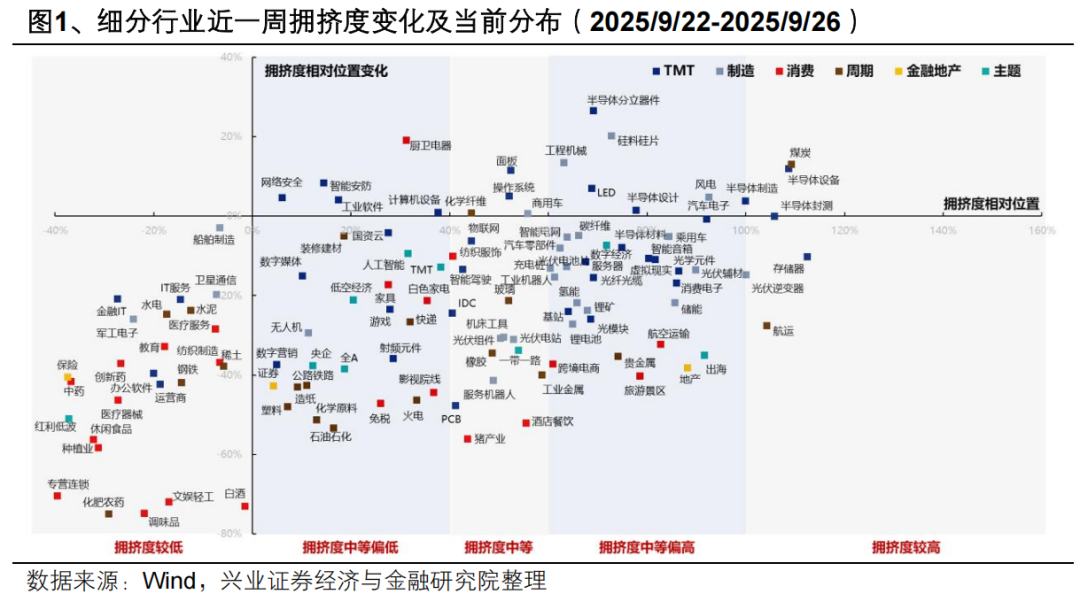
一、10月新一轮上行正在蓄势 我们9月初判断,经历8月以来的上涨加速、结构分化后,未来一段时间市场将处于震荡整固的阶段。但指数波动空间有限,节奏上的波动可以通过结构上 的轮动扩散来应对,并且这种轮动绝非简单基于位置、单纯看重赔率去做高位向低位的"切换",更确切地说是要立足景气逻辑与产业趋势,去挖掘优势风 格及优势主线下机会的"扩散"。 本周市场在节奏上仍处于9月以来震荡整固的波段中,而结构上仍是以强势品种性价比为核心。往后看,我们认为,经历9月以来一段时间的震荡、消化 后,新一轮上行动能正在蓄势,10月市场中枢有望再上台阶: 首先,经历前期震荡波动带来的消化、整固后,当前已有很多板块拥挤度回落至中等或偏低的位置,市场整体拥挤度压力已显著缓解,为新一轮上行蓄 势。 此外,参考历史经验,国庆节后本身也是市场风险偏好抬升的传统躁动窗口,今年重磅会议密集催化下将更加具备抬升的锚点。节前,出于谨慎心理,部 分投资者选择"落袋为安",因此市场整体胜率偏低。而随着假期消费等提振基本面预期的经济数据陆续披露,叠加潜在科技产业进展催化、港美股映射, 市场风险偏好提振下,节后通常存在补涨需求,市场胜率明显提升,结构上也以TMT、 ...

多主题出现见底形态
Huafu Securities· 2025-09-28 12:00
Group 1 - The report emphasizes the establishment of a thematic investment database aimed at identifying high-quality price-volume patterns and monitoring the peak rhythm of popular themes and the adjustment levels of leading stocks [2][9]. - The report highlights that there are currently 125 thematic indices showing a bottoming pattern, with key industries being comprehensive, computer, and defense [12]. - The report notes a decline in trading heat for the humanoid robot and Deepseek themes, with trading heat dropping to 80% and 73% respectively, while the leading stocks are positioned above their 60-day moving average [3][20]. Group 2 - The report outlines two main objectives of the thematic database: to find investment opportunities and to provide warnings for potential peaks [9]. - The report indicates that there are 10 thematic indices that have broken out, primarily in the communication sector, and 2 indices in a main rising pattern, mainly in electronics and basic chemicals [12]. - The report mentions that the trading heat for humanoid robots has decreased by 1.8% for Changsheng Bearing, while Daily Interaction's stock price is up by 7.1% [20].
节前增配大盘价值,成长内高低切
HTSC· 2025-09-28 10:35
Quantitative Models and Construction Methods - **Model Name**: A-Share Multi-Dimensional Timing Model **Model Construction Idea**: The model evaluates the directional judgment of the A-share market using four dimensions: valuation, sentiment, capital, and technical indicators. Valuation and sentiment dimensions adopt a mean-reversion logic, while capital and technical dimensions use trend-following logic. The model combines these dimensions to provide a comprehensive view of market trends [2][9][15]. **Model Construction Process**: 1. The model uses the Wind All A Index as a proxy for the A-share market. 2. Each dimension generates daily signals with values of 0, ±1, representing neutral, bullish, or bearish views. 3. Valuation indicators include equity risk premium (ERP). 4. Sentiment indicators include option put-call ratio, implied volatility, and futures member position ratio. 5. Capital indicators include financing purchase amount. 6. Technical indicators include Bollinger Bands and the difference in the proportion of individual stock trading volume [11][15]. 7. The final multi-dimensional score is calculated as the sum of the scores from the four dimensions, determining the overall market view [9][15]. **Model Evaluation**: The model effectively captures market trends and provides actionable insights for timing decisions [9]. - **Model Name**: Style Timing Model **Model Construction Idea**: The model evaluates timing for dividend and size styles using trend-based indicators and crowding metrics [3][17][22]. **Model Construction Process**: 1. **Dividend Style Timing**: - The model uses three indicators: relative momentum of the CSI Dividend Index vs. CSI All Index, 10Y-1Y term spread, and interbank pledged repo transaction volume. - Each indicator generates daily signals with values of 0, ±1, representing neutral, bullish, or bearish views. - The final score is the sum of the three indicators, determining the overall view on dividend style [17][21]. 2. **Size Style Timing**: - The model uses the crowding degree of small-cap and large-cap styles, calculated based on momentum difference and trading volume ratio between the Wind Micro-Cap Index and CSI 300 Index. - Crowding degree is determined by averaging the top three results of six different window lengths for small-cap and large-cap styles. - High crowding is triggered when small-cap crowding exceeds 90% or large-cap crowding falls below 10%. - In high crowding zones, a small parameter double moving average model is used to capture short-term reversals. In low crowding zones, a large parameter double moving average model is used to follow medium- to long-term trends [22][24][26]. **Model Evaluation**: The model provides effective timing signals for style rotation, especially in different market conditions [22][24]. - **Model Name**: Industry Rotation Model **Model Construction Idea**: The model uses genetic programming to directly extract factors from industry index data, focusing on price-volume and valuation characteristics. It employs a dual-objective genetic programming approach to enhance factor diversity and reduce overfitting [4][29][32]. **Model Construction Process**: 1. The model uses 32 CITIC industry indices as underlying assets. 2. Factors are updated quarterly, and the model rebalances weekly. 3. The dual-objective genetic programming approach evaluates factors using |IC| and NDCG@5 metrics to assess monotonicity and performance of long positions. 4. Factors are combined using a greedy strategy and variance inflation factor to reduce collinearity. 5. The highest-weight factor is constructed as follows: - Perform cross-sectional regression of standardized monthly trading volume against the rolling 4-year percentile of price-to-book ratio (P/B). Take residuals as variable A. - Sum the smallest 9 values of variable A over the past 15 trading days to obtain variable B. - Standardize variable B using z-score, reverse values greater than 2.5, and sum the standardized values over the past 15 trading days [29][33][37]. **Model Evaluation**: The model effectively identifies industry rotation factors with strong monotonicity and performance, while reducing overfitting risks [29][33]. - **Model Name**: China Domestic All-Weather Enhanced Portfolio **Model Construction Idea**: The model adopts a macro factor risk parity framework, emphasizing risk diversification across underlying macro risk sources rather than asset classes. It actively allocates based on macro expectation momentum [5][38][41]. **Model Construction Process**: 1. **Macro Quadrant Division and Asset Selection**: Divide growth and inflation dimensions into four quadrants based on whether they exceed or fall short of expectations. Determine suitable assets for each quadrant using quantitative and qualitative methods. 2. **Quadrant Portfolio Construction and Risk Measurement**: Construct sub-portfolios with equal weights for assets within each quadrant, focusing on downside risk. 3. **Risk Budgeting Model for Quadrant Weights**: Adjust quadrant risk budgets monthly based on "quadrant views" derived from macro expectation momentum indicators, which consider buy-side expectation momentum and sell-side expectation deviation momentum [38][41]. **Model Evaluation**: The model effectively balances macro risks and enhances portfolio performance through active allocation [38][41]. --- Model Backtesting Results - **A-Share Multi-Dimensional Timing Model**: - Annualized Return: 25.23% - Maximum Drawdown: -28.46% - Sharpe Ratio: 1.17 - Calmar Ratio: 0.89 - Year-to-Date (YTD): 40.98% - Last Week's Return: 0.15% [14] - **Style Timing Model**: - **Dividend Style Timing**: - Annualized Return: 16.04% - Maximum Drawdown: -25.52% - Sharpe Ratio: 0.87 - Calmar Ratio: 0.63 - YTD: 21.75% - Last Week's Return: 0.23% [20] - **Size Style Timing**: - Annualized Return: 26.25% - Maximum Drawdown: -30.86% - Sharpe Ratio: 1.09 - Calmar Ratio: 0.85 - YTD: 65.89% - Last Week's Return: 1.07% [27] - **Industry Rotation Model**: - Annualized Return: 32.60% - Annualized Volatility: 17.95% - Sharpe Ratio: 1.82 - Maximum Drawdown: -19.63% - Calmar Ratio: 1.66 - Last Week's Return: 0.27% - YTD: 36.44% [32] - **China Domestic All-Weather Enhanced Portfolio**: - Annualized Return: 11.53% - Annualized Volatility: 6.16% - Sharpe Ratio: 1.87 - Maximum Drawdown: -6.30% - Calmar Ratio: 1.83 - Last Week's Return: 0.66% - YTD: 9.02% [42]
“反内卷”行动初显成效 困境反转概念股走强
Zheng Quan Shi Bao· 2025-09-26 22:35
Market Overview - A-shares experienced slight fluctuations this week, with technology growth stocks performing well, as the ChiNext Index and STAR Market Index reached new highs, while the Shanghai Composite Index and Shanghai 50 Index showed sideways movement [1] - Weekly trading volume decreased to 11.57 trillion yuan, marking a six-week low due to holiday effects [1] Electronic Industry - The electronic sector attracted significant capital, with a net financing purchase exceeding 45.8 billion yuan for the week, marking the 14th consecutive week of net purchases over 10 billion yuan [2] - The electronic industry received a net inflow of over 412 billion yuan from major funds over the week, leading all sectors in net inflow [2] - Other sectors such as power equipment, telecommunications, and computers also saw substantial net purchases, while non-ferrous metals and non-bank financial sectors experienced net selling [2] Wind Power and Chemical Industries - The wind power sector showed strong performance, with the wind power equipment index rising for four consecutive days, reaching a two-and-a-half-year high [3] - The average bidding price for onshore wind turbines increased by 12.8% from 2024 to 2025, indicating a positive trend in the wind power market [3] - The chemical sector also saw collective strength, with new listings and significant price increases in various chemical products, including refrigerants and titanium dioxide [4][5] Future Outlook - Analysts expect certain chemical sub-industries to experience a phase of improvement due to ongoing policy effects, leading to healthier and more sustainable industry development [5] - The technology sector is anticipated to remain a core focus for the market, with structural opportunities expected to arise in the near future [7]
一周活跃股排行榜:40只股换手率超100%
Zheng Quan Shi Bao Wang· 2025-09-26 15:27
Core Insights - The Shanghai Composite Index rose by 0.21% this week, with 40 stocks experiencing a turnover rate exceeding 100% [1] - The electronics sector had the highest number of stocks with turnover rates above 100%, totaling 7 stocks, followed by the computer and machinery equipment sectors, each with 6 stocks [1] High Turnover Stocks - The stock with the highest turnover rate this week was Boliang Optoelectronics, with a turnover rate of 230.74% and a price increase of 6.93%. Institutional investors net sold 189 million yuan, while the stock saw a net outflow of 387 million yuan in main funds [1] - Chuling Information had a turnover rate of 209.40% and a price increase of 20.48%. Institutional investors net bought 6.61 million yuan, with a net outflow of 2.8 million yuan in main funds [1] - Xidian Co. ranked third with a turnover rate of 197.31% and a price increase of 23.07%. Institutional investors net sold 514.15 million yuan, with a net outflow of 4.8 million yuan in main funds [2] Market Performance - Stocks with a turnover rate above 100% averaged a price increase of 5.12% this week, with 23 stocks rising and 17 stocks falling. The top gainers included Xiangrikui, Weiteou, and Jinhua New Materials, with increases of 57.86%, 35.67%, and 29.98% respectively [2] - Among the high turnover stocks, 4 companies released third-quarter earnings forecasts, with C United Dynamics expected to have a net profit of 825 million yuan, representing a year-on-year increase of 44.16% [2]

今天A股“小登”资产纷纷领跌!发生了什么?
Mei Ri Jing Ji Xin Wen· 2025-09-26 07:54
Market Overview - The market experienced fluctuations on September 26, with the Shanghai Composite Index falling by 0.65%, the Shenzhen Component Index by 1.76%, and the ChiNext Index by 2.6% [2] - Over 3,400 stocks declined, and the total trading volume in the Shanghai and Shenzhen markets was 2.15 trillion yuan, a decrease of 224.2 billion yuan compared to the previous trading day [2] Sector Performance - Wind power and insurance sectors showed the highest gains, while gaming, computing hardware, and photolithography sectors faced the largest declines [2][6] - Non-tech sectors led the market, with wind power equipment, chemical fibers, and agricultural chemicals among the top gainers, while sectors like copper cables and gaming saw significant losses [6] Investment Trends - A classification of A-share investors into three categories ("small", "medium", and "old") reflects varying investment focuses, with "small" investors gravitating towards high-growth tech sectors, while "medium" and "old" investors focus on more traditional sectors [3] - The current market sentiment indicates a rotation towards lower-valued sectors as high-flying tech stocks face corrections [5] Wind Power Sector Insights - International firms, including Morgan Stanley, have expressed optimism about China's wind power sector, predicting an average annual new installed capacity exceeding 110 GW during the 14th Five-Year Plan period [10] - The wind power equipment sector is expected to see a profitability turnaround, with key components like gearboxes and blades poised to benefit from recovering demand [10] Chemical Fiber Sector Insights - The chemical industry is witnessing a stabilization of risks, with low valuations and growth opportunities emerging for both established leaders and high-growth newcomers [11] - The sector is expected to benefit from favorable fiscal and monetary policies, leading to an improved supply-demand balance and enhanced profitability [11] Military Equipment Sector Insights - The defense and military sector maintains a high level of activity, driven by domestic needs and international trade opportunities [12] - The ongoing modernization and technological advancements in military equipment are anticipated to provide new growth momentum [12] Market Outlook - Analysts suggest that the market may see improvements post-holiday, with a focus on structural opportunities in the tech sector [5][13] - The current bull market is supported by several factors, including improved market expectations, ongoing capital market reforms, and sustained inflows of long-term funds [14][15][16][18]
A股,突然异动!发生了什么?
中国基金报· 2025-09-26 05:36
【导读】 A 股三大股指低开低走, 消费电子大幅下挫;有色金属板块延续活跃,国防军工拉 涨 中国基金报记者 张舟 9 月 26 日上午, A 股三大股指震荡下挫,创业板指跌超 1% 。截至午间收盘,沪指微跌 0.18%, 深证成指跌 0.79%, 创业板指跌 1.17% 。 | 最高: 3251.88 | 今开: 3222.19 | 成交量: 1.37亿手 | | --- | --- | --- | | 最低: 3191.87 | 昨收:3235.76 | 成交额:3630.95亿 | | 52周最高: 3266.00 | 上涨:401 | 振幅:1.85% | | 52周最低: 1625.66 | 下跌:519 | 总市值:17.57万亿 | 港股方面,上午主要股指集体收跌。截至午间收盘,恒生指数跌 0.65% ,恒生科技指数跌 1.04% 。大型科技股集体低迷,其中小米集团跌超 5% ,阿里巴巴、京东跌近 2% 。 有色金属板块延续活跃 今日上午,有色金属板块延续活跃,中钨高新、腾远钴业均涨超 5% 。 | 序号 名称 | 现价 | 涨跌幅 ▼ 总市值 年初至今 | | --- | --- | --- | ...