矿业

Search documents
上证180ETF指数基金(530280)涨近1%,机构建议关注三条主线
Xin Lang Cai Jing· 2025-12-22 02:26
Core Viewpoint - The recent adjustments in the market have provided investors with opportunities to strategically position themselves for the upcoming "cross-year" market trends, particularly focusing on growth and dividend styles [2]. Group 1: Market Performance - As of December 22, 2025, the Shanghai 180 Index (000010) increased by 0.65%, with notable gains from stocks such as Tuojing Technology (688072) up by 6.39%, China Duty Free Group (601888) up by 6.27%, and Zijin Mining (601899) up by 4.95% [1]. - The Shanghai 180 ETF Index Fund (530280) rose by 0.58%, with the latest price reported at 1.21 yuan [1]. Group 2: Investment Recommendations - The report from China International Capital Corporation (CICC) suggests focusing on three main investment themes: 1. **Growth in AI Technology**: The AI sector is expected to transition into industrial applications, with opportunities in computing power, optical modules, and cloud computing infrastructure, particularly favoring domestic companies. Applications to watch include robotics, consumer electronics, smart driving, and software [2]. 2. **External Demand**: Companies with overseas expansion strategies are seen as reliable growth opportunities, particularly in sectors like home appliances, engineering machinery, commercial buses, power grid equipment, gaming, and non-ferrous metals [2]. 3. **Cyclical Reversal**: Attention is recommended on sectors nearing improvement in supply-demand dynamics or benefiting from policy support, such as chemicals, aquaculture, and new energy [2]. Group 3: Seasonal Trends and Market Catalysts - According to Huatai Securities, the upcoming spring market is anticipated to show positive momentum, driven by potential catalysts such as foreign capital position adjustments post-Christmas, the dense disclosure period for annual reports starting mid-January, and possible reserve requirement ratio cuts in January [3]. - The Shanghai 180 ETF closely tracks the Shanghai 180 Index, which comprises 180 large-cap, liquid stocks from the Shanghai market, reflecting the overall performance of core listed companies [3].





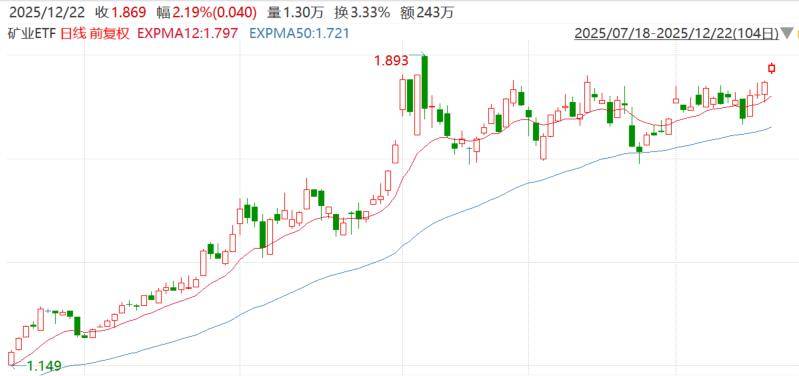
流动性宽松叠加供给约束,金银铜铝价格大涨!矿业ETF(159690)早盘跳涨
Sou Hu Cai Jing· 2025-12-22 02:25
Group 1 - The core viewpoint of the articles highlights the significant rise in precious metals, particularly gold, which reached a historical high on December 22, with spot gold increasing by 1% and COMEX gold rising by approximately 0.6% [1][3] - The A-share precious metals sector showed strong performance, with silver and non-ferrous metals hitting the daily limit, and companies like Hunan Silver, Western Gold, Zijin Mining, Zhongjin Gold, and Chifeng Gold experiencing gains [1] - The recent U.S. CPI data for November showed a year-on-year decline to 2.7%, below the expected 3.1%, which has led to an adjustment in market expectations regarding the Federal Reserve's interest rate cuts in 2026 [3] Group 2 - The increase in liquidity and strong supply constraints are driving commodity prices to challenge phase highs, as noted by CITIC Construction Investment [3] - The importance of basic raw materials for economic development is increasingly recognized by relevant countries, leading to the use of tariffs to secure these products, which exacerbates regional market shortages and further drives prices upward [3] - The mining ETF (159690) tracks the CSI Nonferrous Metals Mining Index, covering various sub-sectors, which helps to effectively diversify the price volatility risk of individual commodities [3] - The demand for resources is expected to have long-term support due to factors such as energy transition (electric vehicles, photovoltaics), AI computing infrastructure, and global easing policies, aiding investors in conveniently positioning for a "new resource cycle" [3]

美联储官员鹰派表态降息,中国国常会部署稳经济工作
Dong Zheng Qi Huo· 2025-12-22 00:41
Report Industry Investment Rating There is no relevant information provided in the content. Core Views of the Report - The Fed's hawkish officials indicate no interest rate cuts, and the dollar will fluctuate in the short term. The U.S. stock market is expected to fluctuate strongly, A-shares may maintain a high-level narrow-range shock in the cross-year market, and the long-term varieties of treasury bond futures are expected to recover moderately. In the commodity market, the prices of various products have different trends and investment suggestions based on their respective fundamentals [13][18][21][23]. Summary by Directory 1. Financial News and Reviews 1.1 Macro Strategy (Foreign Exchange Futures - US Dollar Index) - The Fed's hawkish officials suggest no interest rate cuts, and the dollar will fluctuate in the short term. The investment advice is to maintain the dollar index's shock [13][14]. 1.2 Macro Strategy (US Stock Index Futures) - The inflation data has not soared as expected, and the consumer confidence index has improved slightly. The Fed officials have significant internal differences, and the U.S. stock market is expected to fluctuate strongly. The investment advice is to take a long position [18][19]. 1.3 Macro Strategy (Stock Index Futures) - During the recent macro window period, the A-share market is stable, and the cross-year market may maintain a high-level narrow-range shock. The investment advice is to evenly allocate long positions in each stock index [21][22]. 1.4 Macro Strategy (Treasury Bond Futures) - The central bank conducts reverse repurchase operations, and the probability of a significant decline in ultra-long-term varieties is decreasing. The investment advice is to pay attention to the positive arbitrage opportunities of contracts such as TF2603 [23][25]. 2. Commodity News and Reviews 2.1 Black Metal (Steam Coal) - The price of steam coal is expected to continue to decline, and attention should be paid to possible policy changes after the price reaches 700 yuan [26][27]. 2.2 Black Metal (Iron Ore) - The iron ore price will continue to fluctuate, and the short-term is weak while the medium-term is neutral [28][30]. 2.3 Agricultural Products (Soybean Meal) - The cost and supply-demand side lack positive factors. If there is no major abnormal reduction in South America, the May contract of soybean meal should be shorted on rallies [32]. 2.4 Agricultural Products (Soybean Oil/Rapeseed Oil/Palm Oil) - The oil market is weak. The supply pressure of palm oil in December is still large, and the prices of soybean oil and rapeseed oil are difficult to rise [34][35]. 2.5 Agricultural Products (Cotton) - Although there is no major downward drive in the short term, chasing up should be cautious. Attention should be paid to downstream transmission and macro dynamics [39][40]. 2.6 Agricultural Products (Sugar) - The Zhengzhou sugar price is expected to have limited downward space, but the short-term bearish sentiment is still being released. It is recommended to wait and see [45][46]. 2.7 Black Metal (Rebar/Hot-Rolled Coil) - The steel price is expected to continue to fluctuate, and it is recommended to treat it with a shock mindset [50][51]. 2.8 Agricultural Products (Corn Starch) - The short-term rice-flour price difference may not have the fundamental basis to deviate significantly from the processing fee, and it may widen again after approaching the previous low [52]. 2.9 Agricultural Products (Corn) - Contracts 03 and 05 are expected to maintain a weak shock [53][54]. 2.10 Non-Ferrous Metals (Copper) - Macro factors will support the price in the short term, but the weak short-term fundamentals will limit the upward elasticity. It is recommended to wait and see in the short term [58][59]. 2.11 Non-Ferrous Metals (Industrial Silicon) - The current production cut scale is insufficient to reverse the inventory accumulation pattern. It is recommended to pay attention to shorting opportunities on rallies [62]. 2.12 Non-Ferrous Metals (Polysilicon) - The spot price is expected to be difficult to fall, and new prices need to be transmitted downstream. It is recommended that investors hold positions cautiously [64][66]. 2.13 Non-Ferrous Metals (Nickel) - If cobalt pricing is implemented, long positions can be considered at low levels. If the RKAB is set at 250 million wet tons, the nickel price will rise significantly. Otherwise, shorting on rallies is recommended [68][69]. 2.14 Non-Ferrous Metals (Lithium Carbonate) - In the short term, the strong de-stocking trend and the delay of large factory restart support the bullish sentiment. After the restart, the price may回调, and it is recommended to buy on dips in the medium and long term [73][74]. 2.15 Non-Ferrous Metals (Lead) - In the context of weak supply and demand, the lead price is difficult to have a unilateral market. It is recommended to wait and see [75][76]. 2.16 Non-Ferrous Metals (Zinc) - In the short term, the zinc price will follow the macro and next year's expectations. In the medium term, it is still easy to rise and difficult to fall. It is recommended to buy on dips [77]. 2.17 Non-Ferrous Metals (Tin) - Resource nationalism will bring long-term supply constraints, and inventory accumulation is the main pressure on the short-term price increase. Attention should be paid to the risk of price decline [79][80]. 2.18 Energy and Chemicals (Carbon Emissions) - The EU carbon price is expected to fluctuate in the short term [82][83]. 2.19 Energy and Chemicals (Crude Oil) - The crude oil price is expected to fluctuate weakly in the short term [85][86]. 2.20 Energy and Chemicals (PTA) - The previous long positions of PTA and PX can be held for observation. Attention should be paid to the weak crude oil price and the restart progress of PTA devices [88]. 2.21 Energy and Chemicals (Bottle Chips) - With the commissioning of new devices and the restart of previous maintenance devices, the processing fee pressure of bottle chips may increase [92].
综述|塞尔维亚人士看好塞中“一带一路”合作前景
Xin Lang Cai Jing· 2025-12-21 12:29
本文转自【新华社】; 新华社贝尔格莱德12月20日电 综述|塞尔维亚人士看好塞中"一带一路"合作前景 新华社记者金丹依 中国驻塞尔维亚大使李明指出,近年来,在两国元首战略引领下,中塞经贸务实合作蓬勃发展,双方共 同实施了一大批基建和投资项目,为塞国家建设作出了积极贡献,为两国人民带来了实实在在的利益。 中国政府鼓励更多有实力的中国企业赴塞投资,推动高质量共建"一带一路"。(完) 中方数据显示,2013年至2024年,塞尔维亚对华出口额由2200万美元增至19亿美元,增长约85倍;同一 时期,中国对塞直接投资额由2220万欧元增长至14亿欧元。 中国已成为塞第一大外国直接投资来源地。中企对塞投资涵盖钢铁、基础设施、矿业、能源等多个领 域。河钢斯梅戴雷沃钢厂、紫金博尔铜矿、匈塞铁路等两国合作大项目让塞经济焕发新生机,极大推动 塞现代化进程。 塞尔维亚工商会主席查代日近日接受新华社记者采访时表示,近年来塞对华出口年增长率持续超过 50%,2024年生效的塞中自贸协定为塞尔维亚商品进入中国市场打开了新通道。 查代日特别关注海南自贸港建设进展,认为塞尔维亚企业可借此机遇,积极发掘在热带农业、高端旅 游、医疗健康等领域的 ...
马矿股份主板IPO进入问询阶段
Bei Jing Shang Bao· 2025-12-21 02:07
Group 1 - The core viewpoint of the article is that Fujian Makeng Mining Co., Ltd. has entered the inquiry stage for its IPO on the Shanghai Stock Exchange, aiming to raise approximately 1 billion yuan [1] - The company is primarily engaged in the development and comprehensive utilization of iron ore resources, focusing on the mining and sales of iron ore, iron concentrate, molybdenum concentrate, and limestone [1] - The IPO was accepted on December 4, and the funds raised will be used for the expansion project of the Makeng Iron Mine [1]
综述丨塞尔维亚人士看好塞中“一带一路”合作前景
Xin Hua She· 2025-12-21 01:30
Group 1 - Serbia's economic cooperation with China has achieved significant milestones, with Chinese investments being crucial for Serbia's economic and social development [1] - From 2013 to 2024, Serbia's exports to China increased from $2.2 million to $1.9 billion, an approximately 85-fold growth, while Chinese direct investment in Serbia rose from €2.22 million to €1.4 billion [1] - China has become the largest source of foreign direct investment in Serbia, with investments spanning steel, infrastructure, mining, and energy sectors [1] Group 2 - The Serbian Chamber of Commerce reported that Serbia's annual export growth rate to China has consistently exceeded 50%, with the upcoming Serbia-China Free Trade Agreement opening new avenues for Serbian goods in the Chinese market [2] - Serbia aims to transform from a raw material exporter to a country with modern industry and innovation capabilities, aligning with China's evolving open policy [2] - Cooperation is expanding into higher technology and innovation sectors, with ongoing projects in renewable energy, smart industry, and electric vehicle manufacturing [2] Group 3 - Under the strategic guidance of the leaders of both countries, practical economic cooperation between Serbia and China has flourished, contributing positively to national development and benefiting both peoples [3] - The Chinese government encourages more capable Chinese enterprises to invest in Serbia, promoting high-quality collaboration under the Belt and Road Initiative [3]
港股新基金上演资金突围:提前结募火速建仓 抢筹估值洼地
2 1 Shi Ji Jing Ji Bao Dao· 2025-12-21 00:11
Core Viewpoint - A trend of "counter-market buying" is emerging in the Hong Kong stock market amidst ongoing fluctuations, with institutional investors recognizing the valuation opportunities and actively seizing the market pullback as a layout window [1][4]. Group 1: Fundraising and Investment Trends - Since October 10, at least 15 new Hong Kong-themed funds have announced early fundraising closures, covering various types including passive index funds, equity mixed funds, and QDII funds [2]. - The early fundraising trend is characterized by significantly shortened timelines, with some funds reducing their fundraising periods by over a month [2]. - Newly launched ETFs have established high stock positions quickly, indicating strong bullish signals, with some ETFs reaching stock positions of 69.53% and 63.32% before listing [3]. Group 2: Market Conditions and Valuation - The recent market adjustment has provided a favorable entry point for new funds, as many heavy-weight stocks have seen significant weekly declines while maintaining stable fundamentals [4]. - The Hang Seng Index's price-to-earnings ratio (TTM) is approximately 12 times, and the Hang Seng Tech Index's is about 23 times, both at historical low levels, reflecting institutional recognition of undervalued Hong Kong stocks [5]. Group 3: Market Challenges - The Hang Seng Index has dropped 5.85% and the Hang Seng Tech Index has fallen 18.01% since October 3, indicating a clear market correction [6]. - Factors contributing to the market adjustment include fluctuating liquidity expectations, concerns over the "AI bubble" in the U.S., increased IPO activity, and reduced southbound capital inflows [7][8]. Group 4: Long-term Outlook and Investment Opportunities - Despite short-term pressures, institutions maintain an optimistic long-term outlook for the Hong Kong stock market, predicting a "slow bull" market in 2026 with improved liquidity conditions [9]. - Key investment themes for 2026 include technology and high-end manufacturing, with a focus on sectors such as computing power, semiconductors, and consumer electronics [9]. - High dividend yield assets are also favored in a low-interest-rate environment, with institutions highlighting the value of leading copper and aluminum mining companies [9]. - The innovative drug and biotechnology sectors are seen as having significant investment opportunities due to industry acceleration and favorable policy adjustments [10].
塞尔维亚人士看好塞中“一带一路”合作前景
Xin Lang Cai Jing· 2025-12-20 20:03
中方数据显示,2013年至2024年,塞尔维亚对华出口额由2200万美元增至19亿美元,增长约85倍;同一 时期,中国对塞直接投资额由2220万欧元增长至14亿欧元。 中国已成为塞第一大外国直接投资来源地。中企对塞投资涵盖钢铁、基础设施、矿业、能源等多个领 域。河钢斯梅戴雷沃钢厂、紫金博尔铜矿、匈塞铁路等两国合作大项目让塞经济焕发新生机,极大推动 塞现代化进程。 塞尔维亚工商会主席查代日近日接受新华社记者采访时表示,近年来塞对华出口年增长率持续超过 50%,2024年生效的塞中自贸协定为塞尔维亚商品进入中国市场打开了新通道。 (来源:内蒙古日报) 转自:内蒙古日报 □新华社记者 金丹依 塞尔维亚总统武契奇日前在南部城市尼什视察中国企业投资的汽车零部件制造厂时指出,塞中经贸合作 取得了令两国人民都感到骄傲的伟大成就,中企投资对塞经济社会发展、创造就业岗位至关重要,塞方 将继续为在塞中企运营提供全方位支持。 近年来,中塞两国经贸关系驶入快车道。中国提出的"扩大高水平对外开放""推动共建'一带一路'高质量 发展",在塞尔维亚政商学界引发积极共鸣。塞方人士认为,塞中两国基于相互尊重、互利共赢的合作 模式,不仅为两国人 ...
Silver and Gold are On the Rise. Should Precious Metals ETF Investors Pick GDX or SIL?
The Motley Fool· 2025-12-20 15:14
Core Insights - The article compares two mining ETFs: Global X - Silver Miners ETF (SIL) and VanEck Gold Miners ETF (GDX), highlighting their differences in expense ratios, portfolio breadth, and risk profiles for investors seeking precious metals exposure [2][8]. Expense Ratios and Performance - GDX has a lower expense ratio of 0.51% compared to SIL's 0.65%, making it more cost-effective for investors [3] - Both ETFs have shown a 1-year return of 151% as of December 16, 2025, indicating strong performance in the precious metals sector [3] - GDX offers a lower dividend yield of 0.5% versus SIL's 1.08%, which may attract income-focused investors [3] Portfolio Composition - GDX provides exposure to 56 gold mining companies, primarily large-cap, with significant holdings in Agnico Eagle Mines Ltd, Newmont Corp, and Barrick Mining Corp, reflecting a diversified approach [5] - SIL focuses exclusively on silver miners, holding 39 stocks, with top positions in Wheaton Precious, Pan American Silver Corp, and Coeur Mining Inc, appealing to those seeking direct silver exposure [6] Market Context - Precious metals investing is seen as a hedge against inflation and a means of portfolio diversification, with silver prices recently reaching an all-time high and gold steadily rising [9] - Silver is noted for its higher volatility compared to gold due to its dual role as an industrial metal and a store of value, while gold is primarily viewed as a safe haven during economic or political instability [10] Risk Considerations - Both ETFs are focused on mining companies, which carry specific operational risks that can affect stock performance independently of the precious metals they mine [11]

高盛2026年全球股市展望:更广泛的牛市,更宽泛的AI受益者
华尔街见闻· 2025-12-20 15:09
Core Viewpoint - Goldman Sachs predicts that the global stock market will continue its bull market into 2026, but the index returns will be lower than in 2025, with a broader diversification in the market as AI benefits spread from core tech giants to a wider range of industries [1][2] Economic Environment - The global economy is expected to maintain a comprehensive expansion in 2026, supported by further moderate easing of monetary policy by the Federal Reserve, providing solid support for the stock market [2] Return Expectations - According to regional market capitalization weighting, the expected price return for the global stock market in 2026 is 13%, with a total return including dividends reaching 15%, primarily driven by earnings growth rather than valuation expansion [3][8] Market Cycle Stages - The stock market cycle is categorized into four stages: "Despair" (bear market), "Hope" (valuation-driven rebound), "Growth" (longest phase driven by earnings), and "Optimism" (increased investor confidence leading to valuation rises) [4] Market Trends - The report notes a significant broadening trend in the global stock market in 2025, which is expected to continue into 2026, breaking the previous highly concentrated market structure [9][10] Performance of Major Markets - In 2025, for the first time in nearly 15 years, U.S. stocks underperformed, with total returns in Europe, China, and Asia nearly double that of the U.S. market [10][11] Regional Performance Predictions - In 2026, U.S. stocks are expected to slightly underperform compared to global markets, with the MSCI Asia-Pacific (excluding Japan) and MSCI Emerging Markets indices projected to achieve total returns of 18%, surpassing the expected 15% for the S&P 500 [12] Investment Styles - The U.S. market remains dominated by growth stocks, while non-U.S. markets are seeing better performance from value stocks, indicating a shift from the past decade's growth stock dominance [13] Sector Performance - The trend of broadening returns is evident, with technology and finance leading in 2025, while real estate and healthcare lagged, reflecting the emergence of quality stocks within both growth and value sectors [14] Concentration of Earnings - The contribution of the top seven tech giants to the S&P 500's earnings is expected to decrease from 50% in 2025 to 46% in 2026, with the earnings growth of the remaining 493 companies increasing from 7% to 9%, indicating a further decline in industry concentration [15] AI Benefits Expansion - In 2026, the benefits of AI are expected to spread from core tech giants to a broader range of industries and companies, particularly those that can leverage AI and related technologies to enhance profitability and productivity [16][20] Market Dynamics - The current tech stock enthusiasm is not seen as a bubble, as today's tech giants possess stronger balance sheets and cash flows compared to the 2000 internet bubble [17] Investor Behavior - The correlation of stocks among the five major AI hyperscalers has dropped from 80% to 20%, indicating that investors are becoming more selective about which companies to invest in within the tech sector [18] Cross-Industry Growth - The spillover effects of tech capital expenditures are expected to drive growth in non-tech sectors such as industrials, materials, and finance, creating a cross-industry growth wave termed "AI + Industry" [21]