公用事业

Search documents
今日53只A股封板 美容护理行业涨幅最大
Zheng Quan Shi Bao Wang· 2025-07-01 04:32
| 申万行业 | 行业涨跌(%) | 成交额(亿元) | 比上日(%) | 领涨(跌)股 | 涨跌幅(%) | | --- | --- | --- | --- | --- | --- | | 美容护理 | 1.65 | 40.38 | 20.15 | 锦波生物 | 10.71 | | 银行 | 1.59 | 197.52 | -0.25 | 苏州银行 | 5.24 | | 公用事业 | 1.07 | 214.45 | 88.29 | 华电辽能 | 10.17 | | 医药生物 | 0.91 | 707.25 | 34.60 | 山河药辅 | 19.97 | | 石油石化 | 0.81 | 59.07 | -9.92 | 万邦达 | 2.61 | | 建筑材料 | 0.79 | 66.13 | 32.55 | 再升科技 | 10.10 | | 农林牧渔 | 0.57 | 82.25 | 19.73 | 中宠股份 | 5.62 | | 钢铁 | 0.27 | 39.03 | -7.28 | 柳钢股份 | 9.94 | | 环保 | 0.24 | 86.55 | 5.19 | 雪迪龙 | 9.96 | | 综合 | ...
【盘中播报】沪指涨0.18% 银行行业涨幅最大
Zheng Quan Shi Bao Wang· 2025-07-01 02:58
(原标题:【盘中播报】沪指涨0.18% 银行行业涨幅最大) 注:本文系新闻报道,不构成投资建议,股市有风险,投资需谨慎。 今日各行业表现(截至上午10:28) | 申万行业 | 行业 | 成交额 (亿元) | 比上日 | | 涨跌幅 | | --- | --- | --- | --- | --- | --- | | | 涨跌 | | (%) | 领涨(跌)股 | (%) | | | (%) | | | | | | 银行 | 1.23 | 122.41 | -20.29 | 苏州银行 | 4.33 | | 美容护理 | 1.06 | 26.26 | 1.37 | 锦波生物 | 5.07 | | 公用事业 | 0.89 | 135.58 | 60.30 | 华电辽能 | 10.17 | | 医药生物 | 0.83 | 516.14 | 37.80 | 阳普医疗 | 19.94 | | 建筑材料 | 0.78 | 48.17 | 21.73 | 再升科技 | 10.10 | | 社会服务 | 0.45 | 68.42 | 18.91 | 豆神教育 | 7.84 | | 钢铁 | 0.43 | 27.10 | -11 ...
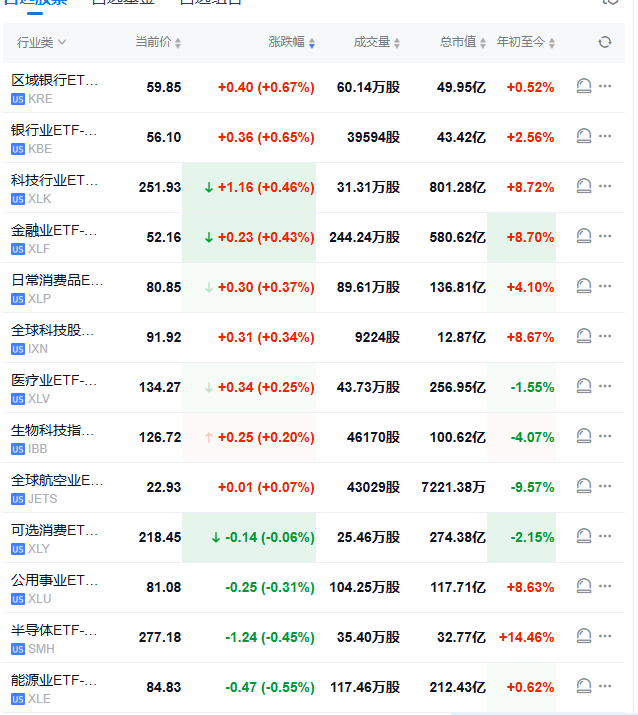
美股盘初,主要行业ETF涨跌不一,区域银行业ETF涨0.67%,银行业ETF涨0.65%,能源业ETF跌0.55%,半导体ETF跌0.45%。
news flash· 2025-06-30 13:40
Core Viewpoint - The performance of major industry ETFs in the U.S. stock market shows mixed results, with regional banks and banking ETFs experiencing gains, while energy and semiconductor ETFs are declining [1]. Group 1: Regional Banks and Banking Sector - Regional bank ETF increased by 0.67%, closing at $59.85, with a trading volume of 601,400 shares and a year-to-date change of +0.52% [2]. - Banking sector ETF rose by 0.65%, reaching $56.10, with a trading volume of 39,594 shares and a year-to-date increase of +2.56% [2]. Group 2: Energy and Semiconductor Sectors - Energy sector ETF decreased by 0.55%, priced at $84.83, with a trading volume of 1,174,600 shares and a year-to-date change of +0.62% [2]. - Semiconductor ETF fell by 0.45%, trading at $277.18, with a volume of 354,000 shares and a significant year-to-date increase of +14.46% [2].

行业ETF风向标丨中证A500指数快速反弹,华泰柏瑞中证A500ETF(563360)规模突破200亿元,跃居同类产品第一
Mei Ri Jing Ji Xin Wen· 2025-06-30 07:07
Core Viewpoint - The A-share market has seen a strong rebound with a significant inflow of funds into ETFs, reaching a total scale of over 4.3 trillion yuan, marking a historical high and a year-to-date increase of 15% [1] Group 1: ETF Performance - The Huatai-PineBridge CSI A500 ETF (563360) has attracted substantial capital, with a net inflow of 11.279 billion yuan over just five trading days, achieving an average daily trading volume of 2.55 billion yuan [1] - As of June 27, 2023, the Huatai-PineBridge CSI A500 ETF's scale surpassed 20.256 billion yuan, making it the largest in its category, with a total share count of 19.898 billion [1] - The fund's share count increased by 2.613 billion shares year-to-date, reflecting a change rate of 15.12% [1] Group 2: Investment Logic - Global allocation funds have reached historical highs in U.S. equities, while China's position remains at the bottom, creating potential for long-term capital inflow into Chinese stocks if macroeconomic conditions continue to improve [2] Group 3: Fund Characteristics - The Huatai-PineBridge CSI A500 ETF offers a low-cost investment option with a management fee of 0.15% per year and a custody fee of 0.05% per year, making it one of the most competitively priced equity index products in the A-share market [3] - The fund has a quarterly dividend assessment mechanism, providing investors with flexible capital management options [3] Group 4: Index Composition - The CSI A500 Index selects 500 securities with larger market capitalizations and better liquidity from various industries, focusing on sectors such as electronics, power equipment, pharmaceuticals, and national defense [4] - The index's major weighted stocks include Kweichow Moutai, CATL, and Ping An Insurance, among others, reflecting a diverse industry representation [5] Group 5: Growth and Dividend Attributes - The CSI A500 Index exhibits superior dividend growth characteristics, with higher levels of dividend yield and a greater proportion of companies distributing cash dividends compared to the broader index [8] - The index includes leading companies across various sectors, which are expected to benefit from China's modernization process and increased market concentration due to government policies [8]

机器学习因子选股月报(2025年7月)-20250630
Southwest Securities· 2025-06-30 04:35
Quantitative Factor and Model Analysis Quantitative Models and Construction 1. **Model Name**: GAN_GRU Model **Model Construction Idea**: The GAN_GRU model combines Generative Adversarial Networks (GAN) for generating realistic price-volume sequential features and Gated Recurrent Units (GRU) for encoding these sequential features into predictive signals for stock selection [2][9]. **Model Construction Process**: - **GRU Component**: - Input features include 18 price-volume features such as closing price, opening price, turnover, and turnover rate [10][13]. - Training data consists of the past 400 trading days' features, sampled every 5 trading days, forming a 40x18 feature matrix to predict the cumulative return over the next 20 trading days [14]. - Data preprocessing includes outlier removal and standardization at both time-series and cross-sectional levels [14]. - The GRU network consists of two layers (GRU(128, 128)) followed by an MLP (256, 64, 64), with the final output being the predicted return (pRet) [18]. - **GAN Component**: - The generator (G) uses an LSTM model to preserve the sequential nature of the input features, while the discriminator (D) employs a CNN to process the two-dimensional price-volume feature "images" [29][32]. - The generator's loss function is: $$ L_{G} = -\mathbb{E}_{z\sim P_{z}(z)}[\log(D(G(z)))] $$ where \( z \) represents random noise, \( G(z) \) is the generated data, and \( D(G(z)) \) is the discriminator's output probability [20][21]. - The discriminator's loss function is: $$ L_{D} = -\mathbb{E}_{x\sim P_{data}(x)}[\log D(x)] - \mathbb{E}_{z\sim P_{z}(z)}[\log(1-D(G(z)))] $$ where \( x \) is real data, \( D(x) \) is the discriminator's output for real data, and \( D(G(z)) \) is the output for generated data [23][25]. - Training alternates between updating the discriminator and generator parameters until convergence [26]. **Model Evaluation**: The GAN_GRU model effectively captures both sequential and cross-sectional price-volume features, leveraging the strengths of GANs and GRUs for stock selection [2][9][29]. --- Quantitative Factors and Construction 1. **Factor Name**: GAN_GRU Factor **Factor Construction Idea**: The GAN_GRU factor is derived from the GAN_GRU model's output, representing the encoded price-volume sequential features as a stock selection signal [2][9]. **Factor Construction Process**: - The factor is derived from the predicted return (pRet) output of the GAN_GRU model [18]. - The factor undergoes industry and market capitalization neutralization, followed by standardization [18]. **Factor Evaluation**: The GAN_GRU factor demonstrates strong predictive power across various industries, with consistent performance in both IC and excess returns [36][40]. --- Model Backtest Results 1. **GAN_GRU Model**: - **IC Mean**: 11.54% - **ICIR**: 0.89 - **Turnover Rate**: 0.83 - **Recent IC**: 8.34% - **1-Year IC Mean**: 11.09% - **Annualized Return**: 37.71% - **Annualized Volatility**: 24.95% - **IR**: 1.56 - **Max Drawdown**: 27.29% - **Annualized Excess Return**: 24.95% [36][37]. --- Factor Backtest Results 1. **GAN_GRU Factor**: - **IC Mean**: 11.54% - **ICIR**: 0.89 - **Turnover Rate**: 0.83 - **Recent IC**: 8.34% - **1-Year IC Mean**: 11.09% - **Annualized Return**: 37.71% - **Annualized Volatility**: 24.95% - **IR**: 1.56 - **Max Drawdown**: 27.29% - **Annualized Excess Return**: 24.95% [36][37].






头部私募仓位高企 中期策略研判更趋积极
Zhong Guo Zheng Quan Bao· 2025-06-29 20:22
□本报记者王辉 头部私募仓位高企 顺时投资权益投资总监易小斌认为,近期,部分外部因素的积极变化为A股运行提供了有利环境,但起 决定性作用的仍然是内部因素。这些因素包括:市场自2024年10月高点以来的累计调整时间已超8个 月,技术面面临突破;国内政策密集出台,直接刺激了券商、金融科技等板块爆发;市场资金面充裕, 核聚变、稳定币、固态电池等热点不断涌现,有效维系了市场人气。易小斌判断,这些内外部积极因素 的中期延续性较强,有利因素不断积聚,预计将推动行情持续发展。 融智投资基金经理夏风光从宏观周期角度分析称,下半年全球主要经济体货币政策的"潜在共振"是关键 变量,美联储重启降息进程的可能性正在增大,这将为国内货币和财政政策打开空间。夏风光表 示:"流动性环境的进一步改善叠加经济回暖,有望进一步推升本轮A股的阶段性趋势行情。" 来自第三方机构私募排排网的最新监测数据显示,截至6月20日,全市场股票私募机构的平均仓位水平 为74.62%,较前一周小幅上升0.37个百分点,这一数值处于今年以来的中等偏高水平。在具体仓位上, 54.31%股票私募机构仓位处于重仓或满仓(仓位大于八成)水平,24.41%股票私募仓位处于中 ...
港股大涨!还能买吗?最新研判
中国基金报· 2025-06-29 13:55
Core Viewpoint - The Hong Kong stock market is expected to exhibit a "volatile upward + structural differentiation" pattern in the second half of the year, driven by macroeconomic policies, technological innovation, and domestic demand recovery [4][25][26]. Group 1: Market Performance in H1 - The Hong Kong stock market showed strong resilience in the first half of the year, with the Hang Seng Index rising over 21% and the Hang Seng Tech Index nearly 20%, leading global markets [2][16]. - Multiple factors contributed to this performance, including domestic monetary easing, fiscal stimulus, and a significant net inflow of over 700 billion HKD from southbound funds [16][18]. - The market experienced two major rallies, driven by technological advancements and a recovery in investor sentiment following geopolitical tensions [17][19]. Group 2: Valuation and Investment Opportunities - Despite the recovery, the overall valuation of the Hong Kong stock market remains attractive compared to historical averages, with the Hang Seng Index's forecasted P/E ratio at 11 times and P/B ratio at 1.2 times [21][22]. - The market is characterized by a "funding boom + asset scarcity" structural trend, with high dividend yield sectors like banking and utilities showing strong performance [10][22]. - Key investment opportunities are identified in technology, new consumption, and innovative pharmaceuticals, with a focus on sectors benefiting from policy support and technological advancements [28][30][31]. Group 3: Outlook for H2 - The market is anticipated to continue its upward trend, supported by policy measures aimed at economic recovery and the ongoing influx of capital [25][26]. - Structural opportunities are expected to emerge in technology and healthcare sectors, with significant growth potential in AI and innovative drug development [24][32]. - The investment focus will likely shift towards growth-oriented industries, with an emphasis on high-quality technology assets and emerging consumer sectors [14][28][33].

A股策略周思考:上证攻坚新高后,怎么看?
Tianfeng Securities· 2025-06-29 10:45
Market Insights - The small-cap crowding index has decreased from 65% to 62.4%, indicating a significant drop in market congestion, approaching levels seen in April 2025 [1][10] - Previous market adjustments occurred when the trading volume decreased alongside rising small-cap crowding, while the current market shows stable inventory levels [1][10] - The current trading volume has remained relatively low, averaging around 1.2 trillion, without signs of overheating during the recovery phase [1][11] Domestic Industry Analysis - In May, industrial enterprise profits reported a year-on-year decline of 9.10%, with cumulative profits from January to May down to -1.10% from a previous 1.40% [3][20] - The inventory of finished goods for large industrial enterprises stood at 6.65 trillion yuan, with a year-on-year growth of 3.50% [3][20] - The People's Bank of China indicated a need for moderately loose monetary policy to support economic recovery amid challenges like insufficient domestic demand [3][31] International Economic Indicators - The U.S. core PCE index rose by 2.68% year-on-year in May, slightly above expectations, indicating inflationary pressures [4][11] Industry Allocation Recommendations - Investment strategies should focus on three main areas: breakthroughs in AI technology, valuation recovery in consumer stocks, and the rise of undervalued dividends [5][11] - The consumer sector is expected to recover due to low valuations, declining interest rates, and policy catalysts, despite a cautious macro narrative [5][11]
600亿美元!“他一直是慷慨的终极榜样”
新华网财经· 2025-06-29 08:32
Core Viewpoint - Warren Buffett converted 8,239 shares of Berkshire Hathaway Class A stock into 12,358,521 shares of Class B stock and donated them to the Gates Foundation and four family charitable organizations, marking his largest annual donation in nearly two decades, totaling $6 billion [1][2]. Group 1: Donation Details - The donation consists of 9,433,839 shares to the Gates Foundation, 943,384 shares to the Susan Thompson Buffett Foundation, and 660,366 shares distributed among the Sherwood Foundation, Howard G. Buffett Foundation, and NoVo Foundation [2]. - The donation is set to be processed by June 30 [2]. Group 2: Buffett's Philanthropic Strategy - Since 2006, Buffett has made annual donations before Thanksgiving, converting Class A shares to Class B shares prior to donations, as part of a "lifetime commitment" to philanthropy [3][4]. - Buffett's plan involves donating 5% of his remaining shares each year to the five foundations, which include the Gates Foundation and four family-run charities [4]. Group 3: Future of the Gates Foundation - Bill Gates announced plans to donate nearly all his wealth through the Gates Foundation over the next 20 years, with the foundation expected to spend over $200 billion by 2045 [6]. - The Gates Foundation, co-founded by Gates and his ex-wife Melinda in 2000, is one of the largest charitable organizations globally, focusing on improving health and productivity [6]. Group 4: Historical Context - The philanthropic actions of Buffett and Gates echo the legacy of Andrew Carnegie, who emphasized the importance of using wealth for the greater good in his essay "The Gospel of Wealth" [7].

1.95亿元资金今日流入纺织服饰股
Zheng Quan Shi Bao Wang· 2025-06-27 09:58
Market Overview - The Shanghai Composite Index fell by 0.70% on June 27, with 18 out of the 28 sectors rising, led by non-ferrous metals and communications, which increased by 2.17% and 1.79% respectively. The textile and apparel sector ranked third in terms of gains [1] - The banking and public utilities sectors experienced the largest declines, with drops of 2.95% and 1.01% respectively [1] Capital Flow Analysis - The main capital flow showed a net outflow of 19.41 billion yuan across the two markets, with 8 sectors seeing net inflows. The communications sector led with a net inflow of 2.579 billion yuan and a daily increase of 1.79%, followed by the electronics sector with a net inflow of 2.435 billion yuan and a daily increase of 0.92% [1] - Conversely, 23 sectors experienced net outflows, with the computer sector leading at 6.630 billion yuan, followed by the defense and military industry with a net outflow of 2.891 billion yuan. Other sectors with significant outflows included basic chemicals, automotive, and electrical equipment [1] Textile and Apparel Sector Performance - The textile and apparel sector rose by 1.23% today, with a net inflow of 195 million yuan. Out of 105 stocks in this sector, 84 stocks increased, including 6 that hit the daily limit, while 17 stocks declined [2] - The top three stocks with the highest net inflow in the textile and apparel sector were Jihua Group with 288.94 million yuan, followed by Feiyada and Jinyi Culture with 165.18 million yuan and 101.35 million yuan respectively [2] - The sector also saw significant outflows, with Wanlima leading at 241.76 million yuan, followed by Bangjie Shares and Nanshan Zhishang with outflows of 35 million yuan and 24.74 million yuan respectively [3]