快时尚

Search documents
新鲜早科技丨OpenAI涉足电商领域;库克再次重组苹果AI团队;Shein美国大涨价
2 1 Shi Ji Jing Ji Bao Dao· 2025-04-29 03:14
Core Insights - OpenAI is entering the e-commerce sector by allowing users to purchase products through ChatGPT, enhancing the online shopping experience with personalized recommendations [2] - Apple is restructuring its teams, moving its robotics team to the hardware department, indicating potential dissatisfaction with AI progress [2] - Shein has raised prices in the U.S. market by up to 377% in response to new small package tariffs, affecting various product categories [3] - Amazon has launched its "Kuiper Project" with the first 27 satellites aimed at providing global broadband services, marking its entry into the competitive space internet market [4] - OPPO has announced a leadership change in its China operations, with the former president stepping down to participate in an executive training program [5] - Chipmaker Chipone has launched a high-performance SoC design platform for automotive applications, supporting advanced driving systems [6][7] - Unigroup plans to list on the Hong Kong Stock Exchange, while Seres has submitted an IPO application, reporting significant revenue growth [8] - China has successfully launched low-orbit satellites for internet services and has become the world's largest nuclear power producer [9] - A new fusion energy device developed by TAE Technologies could potentially increase fusion power output by 100 times [10] - Apple is reportedly developing two special edition iPhones for its 20th anniversary, with production moving to India, which may increase costs [11]

美股三大指数走势分化 新能源车板块普遍走高
Feng Huang Wang Cai Jing· 2025-04-28 14:55
同样是半导体领军股 为什么AMD如此弱势 是否值得左侧抄底? 个股方面,新能源车板块普遍走高,蔚来涨逾5%,理想汽车涨逾3%,极氪涨逾3%。 不要被短期反弹所迷惑!高盛警告:美元正遭遇结构性贬值 Shah认为,虽然目前美国的硬数据仍然坚挺,劳动力市场数据尚未显示出迫在眉睫的预警信号,而进一 步削减关税或达成"贸易协议"的消息可能为短期市场注入缓解情绪。但需警惕的是,风险尚未解除—— 如果我们正走向一段更为严重的增长疲软时期,那么这种疲软可能需要较长时间才会显现。 公司新闻 苹果据称在研发20周年纪念款iPhone:折叠屏、全玻璃机身 价格将大涨 知名科技记者马克·古尔曼当地时间4月27日称,苹果正在开发两款20周年纪念版iPhone,计划于2027年 9月发布,其中一款是可折叠iPhone,另一款可能是以玻璃为中心的Pro版。2017年iPhone发布十周年 时,苹果推出了iPhone X,首次采用全面屏设计,取消Home键。但二十周年款不会像iPhone X那样彻底 改变用户交互方式,而是通过材质和形态的渐进式创新。 凤凰网财经讯 4月28日,美股三大指数涨跌不一,截止发稿,道指涨0.29%,纳指跌0.24 ...
Shein率先上调美国售价,最高涨377%!服装、化妆品成重灾区
智通财经网· 2025-04-28 09:43
Core Viewpoint - The impending tariffs on small packages from China are prompting fast fashion giant Shein to raise prices on its products sold in the U.S., indicating early signs of the trade war's impact on American consumers [1][2][3] Price Changes - Shein significantly increased prices across most product categories, with beauty and health items seeing an average price increase of 51% for the top 100 products, and some items doubling in price [1][2] - Home, kitchen goods, and toys experienced an average price increase of over 30%, with specific items like a 10-pack of kitchen paper towels rising from $1.28 to $6.10, a 377% increase [1][2] - Women's apparel saw an average price increase of 8% [1] Tariff Implications - The U.S. government is set to end the "de minimis" exemption for small packages from mainland China and Hong Kong, leading to potential tariffs of up to 120% on many products from e-commerce platforms like Shein and Temu [2][3] - Following the tariff changes, Shein's prices in the U.S. rose approximately 10% from April 24 to 26, with 30 out of 50 sampled products increasing by over 10% [3] Supply Chain Adjustments - To avoid tariffs, Shein has incentivized some Chinese suppliers to establish production bases in Vietnam, while Temu aims to ship products directly from Chinese factories to U.S. warehouses [3] - The trade war has led to a shift in sourcing, with companies moving production to Southeast Asia to mitigate tariff impacts, particularly affecting countries like Vietnam, Cambodia, and Bangladesh [5][9] Market Dynamics - The U.S. is the largest importer of apparel, with 97% of clothing and footwear sourced from overseas, making American consumers vulnerable to price increases due to tariffs [11] - Major fashion brands like Nike and Adidas are heavily reliant on Asian countries for production, with significant portions of their products sourced from Vietnam and Cambodia [12][13][14] Consumer Impact - A Yale University analysis predicts that consumer spending on footwear will increase by 87% and on apparel by 65% over the next three years due to tariffs, with long-term increases of 29% for footwear and 25% for apparel expected [15]

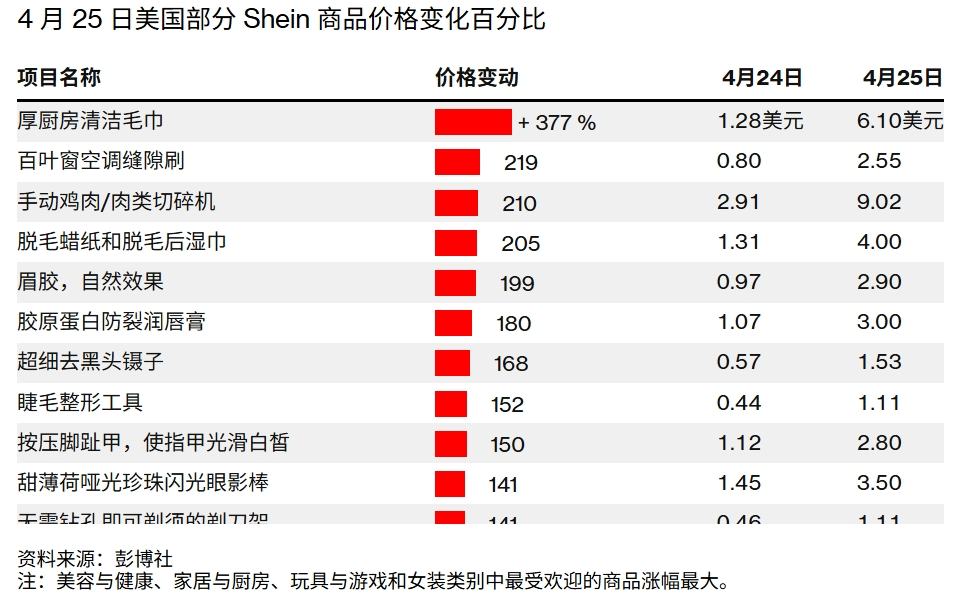
Shein将美国市场部分商品价格最高上调至377%
news flash· 2025-04-27 20:41
Core Insights - Fast fashion giant Shein has raised prices on various products in the U.S. to prepare for the upcoming small parcel tariffs, with significant price increases observed across different categories [1][6] Price Changes Summary - The average price of the top 100 best-selling beauty and health products increased by 51% compared to the previous week, with several items doubling in price [1] - Home, kitchen, and toy products saw an average price increase of over 30%, with a notable 377% rise in the price of a 10-piece kitchen towel set [1][2] - Women's clothing prices rose by 8% [1] Specific Product Price Increases - Significant price hikes were recorded for specific items, including: - Thick kitchen cleaning towels: +377% from $1.28 to $6.10 - Manual meat chopper: +210% from $2.91 to $9.02 - Hair removal wax paper: +205% from $1.31 to $4.00 - Eyebrow gel: +199% from $0.97 to $2.90 [2]
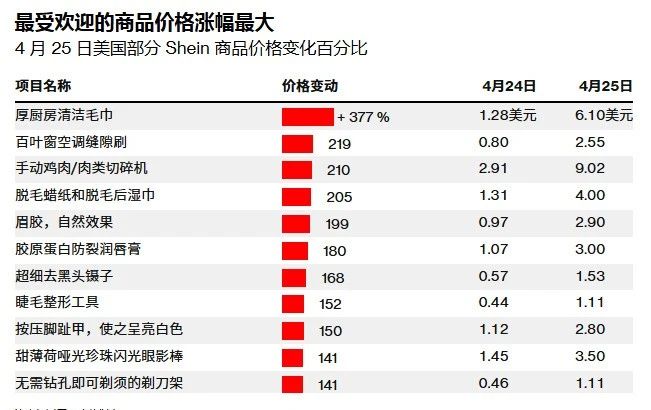
Shein上调美国商品售价迎战关税冲击 部分品类涨幅高达377%
news flash· 2025-04-27 16:07
Core Insights - Shein has raised prices on various products in the U.S. in response to impending tariffs on small packages, indicating the potential impact of trade tensions on American consumers [1] Price Increases by Category - The average price of the top 100 best-selling beauty and health products increased by 51% compared to the previous week, with some items seeing price hikes of over 100% [1] - Home goods and toys experienced an average price increase of over 30%, with a specific example of a 10-piece kitchen towel set seeing a dramatic price surge of 377% [1] - Women's apparel had a relatively modest price increase of 8% [1]
线上吸引力减弱 优衣库更改退货规则引争议
Bei Jing Shang Bao· 2025-04-23 10:04
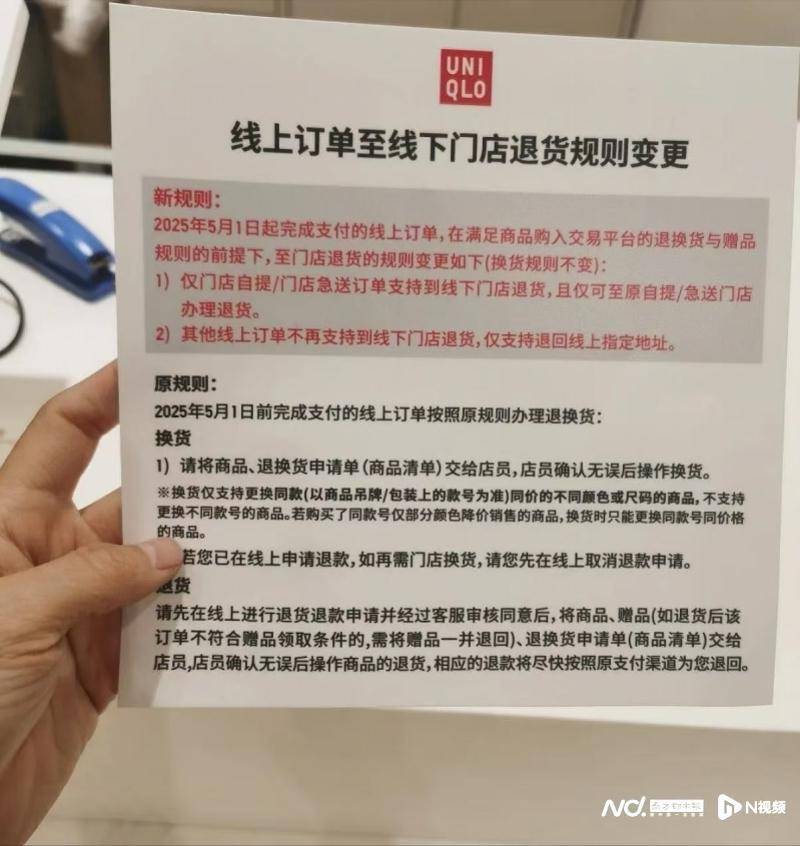
Core Viewpoint - Uniqlo has announced a change in its return policy, effective May 1, which will no longer allow online purchases to be returned in physical stores, leading to consumer dissatisfaction and potential impacts on brand loyalty and sales [1][5][6]. Summary by Sections Return Policy Changes - Starting May 1, all online orders will not be eligible for in-store returns, requiring customers to return items via designated online addresses [1][5]. - The previous return policy allowed for in-store returns, which was a significant advantage for consumers who preferred the convenience of returning items without shipping costs [1][2]. Consumer Reactions - Consumers have expressed dissatisfaction with the new policy, highlighting that it diminishes the convenience of shopping through the Uniqlo app, which previously offered a seamless return process [1][2]. - A long-time customer noted that the lack of shipping insurance for returns on the app could deter future purchases, as customers would have to bear the return shipping costs themselves [2][5]. Industry Context - The change aligns with a broader trend among fast fashion brands, where online purchases typically cannot be returned in physical stores, as seen with competitors like H&M and ZARA [6][7]. - Experts suggest that differentiating return policies by sales channels can help brands manage inventory and streamline operations, but it may also affect consumer trust and brand perception [6][7]. Operational Implications - The new policy may reduce the workload for store employees, who previously managed complex return processes for online orders, but it could also lead to a decline in customer satisfaction and brand loyalty [7][8]. - Analysts believe that the impact on profitability may be minimal, but the change could significantly affect consumer perceptions of the brand's service quality [7][8].
线上买的线下不能退,“优衣库们”缘何不“大方”了?
Sou Hu Cai Jing· 2025-04-23 01:55
Group 1 - Uniqlo has changed its return policy, effective May 1, allowing returns for in-store pickup and express delivery orders only at the original store, while other online orders must be returned to a designated online address [1][3] - Other fast fashion brands like ZARA and H&M have implemented similar return policy changes, indicating a trend among fashion retailers to tighten return policies amid increasing competition in the Chinese market [3][6] - High return rates are eroding profits for major fast fashion companies, with some women's clothing brands experiencing return rates exceeding 50%, highlighting a significant challenge in the industry [5][6] Group 2 - Fast fashion giants, including Uniqlo, are facing performance challenges in the Chinese market, with Uniqlo's revenue in the Greater China region declining by approximately 3% to 361.7 billion yen, and profits down about 9% [6][7] - ZARA's parent company Inditex reported a 7.5% revenue increase to 38.6 billion euros, but the share of revenue from Asia and other regions continues to decline, indicating a shift in market dynamics [7] - H&M is also experiencing difficulties, with a 5% decline in sales in the Asia-Pacific region, leading to accelerated store closures [7][8] Group 3 - Uniqlo is shifting its strategy by slowing down new store openings and focusing on larger flagship stores to enhance customer experience, while also introducing semi-customized services to differentiate itself [8][9] - The fast fashion industry is witnessing intensified price competition, prompting companies to explore new strategies to maintain consumer interest and profitability [8][9]


中资出海四十年:从学徒到全球玩家的进化之路
远川研究所· 2025-04-03 14:01
Core Viewpoint - The article discusses the evolution of Chinese enterprises from passive learners to active players in the global market, highlighting their journey through management awakening, technological innovation, and ecological reconstruction in globalization 3.0 [1][12]. Group 1: Historical Context - In 1988, Procter & Gamble's entry into China marked a significant shift in the local business landscape, introducing advanced brand management and supply chain systems [1]. - The 1990s saw multinational companies like IBM and Microsoft bringing not only technology but also management practices to China, which significantly influenced local companies like Huawei [3]. - After joining the WTO in 2001, Chinese companies began to expand internationally, with early examples like TCL facing challenges due to cultural clashes and management integration issues [4]. Group 2: New Business Models - The internet wave post-2010 led to new business paradigms, with companies like ByteDance and SHEIN leveraging technology and flexible supply chains to achieve rapid growth [6]. - Companies such as 运去哪物流 (Yunquna Logistics) and 联影医疗 (United Imaging Healthcare) have emerged as leaders in their respective fields, showcasing the potential of Chinese innovation on the global stage [7]. Group 3: Future Trends - Current trends indicate a diversification in the internationalization of Chinese enterprises, with companies like 追觅 (Trifo) and 闪极科技 (Shanji Technology) achieving significant market shares in Europe and the U.S. [9][10]. - The article emphasizes the shift from product output to ecological co-construction, with companies like 阿里国际站 (Alibaba International) and 法奥意威 (Fao Yiwei) leading the way in innovative solutions and global collaboration [12]. - The 临港新片区 (Lingang New Area) is highlighted as a strategic hub for Chinese enterprises, focusing on cutting-edge industries and fostering international talent [12][13].



Zara在宜家里卖星巴克
创业邦· 2025-03-30 03:49
Core Viewpoint - Fashion brands are increasingly diversifying their business models by integrating food and beverage services to attract more customers and extend their in-store experience, reflecting challenges in the Chinese market [3][6][7]. Group 1: Zara's New Store Strategy - Zara opened a new flagship store in Nanjing, covering over 2500 square meters and featuring a unique collaboration with local coffee brand UNIUNI, introducing the first Zacaffè in Asia [4][13]. - The store design includes a blend of high-end fashion and local cultural elements, aiming to enhance customer experience and engagement [13][14]. - Despite the grand opening, Zara's performance in China has been declining, with a reduction in store numbers from around 183 to approximately 70 [14][17]. Group 2: Industry Trends and Challenges - The fashion industry is witnessing a trend of integrating dining experiences, with luxury brands like Prada and LV also exploring similar strategies to boost foot traffic and customer retention [6][7][8]. - The overall market for high-end fashion is under pressure, with a notable decline in core consumer groups and a shift towards more affordable alternatives [21][22]. - The Chinese luxury market is experiencing a downturn, with a reported 2% decrease in high-end consumption in 2024, leading brands to rethink their strategies [21][22]. Group 3: Brand Adaptation and Future Outlook - Brands are focusing on larger store formats and multi-functional spaces to attract customers, as seen with plans for LV's expansion in Hong Kong [23][24]. - The rise of local brands and changing consumer preferences are prompting international brands to adapt their strategies in China, emphasizing the importance of local relevance [22][30]. - Despite challenges, companies like Inditex remain committed to the Chinese market, planning further store renovations and expansions to align with local demands [30][31].

一个「女生潮牌」宣布破产
36氪· 2025-03-28 00:08
Core Viewpoint - Forever 21, a fast-fashion women's clothing brand, has filed for bankruptcy for the second time, highlighting the challenges faced by traditional retail in the face of e-commerce competition and changing consumer behavior [4][11][15]. Company Overview - Forever 21 was founded in 1984 by Korean-American couple Do Won Chang and Jin Sook Chang, initially opening a small store in San Francisco with a focus on affordable fashion for young women [7][9]. - At its peak, Forever 21 operated over 800 stores globally, including a prominent location on Nanjing East Road in Shanghai [4][9]. - The brand's revenue exceeded $4 billion by 2015, with ambitions to reach $8 billion by 2017 [10]. Decline Factors - The rise of e-commerce platforms like SHEIN and Temu, coupled with declining foot traffic in U.S. malls, contributed to Forever 21's struggles [5][11]. - The company's failure to adapt to the digital retail landscape and its aggressive physical expansion led to unsustainable costs and ultimately its first bankruptcy filing in 2019 [11][14]. - Despite a brief recovery after being acquired by a consortium in 2020, Forever 21 faced renewed challenges, leading to its second bankruptcy filing in 2023 [13][14]. Financial Situation - As of the latest filing, Forever 21's estimated liabilities range from $1 billion to $10 billion, while its assets are estimated between $100 million and $500 million [15]. - The brand's decline reflects broader trends in the retail sector, where many companies are struggling under the pressures of inflation and changing consumer spending habits [15][18]. Industry Context - The U.S. bankruptcy rate has reached its highest level since the global financial crisis, with significant impacts on sectors like retail, healthcare, and automotive [18]. - The economic environment, characterized by high inflation and rising interest rates, has led to increased financial strain on many businesses, including those in the fast-fashion sector [19][20].