
油脂加工

Search documents
油脂周报:10月前20日马棕大幅增产,油脂短期或震荡偏弱-20251026
Hua Lian Qi Huo· 2025-10-26 13:03
Report Title - The report is titled "Hualian Futures Weekly Report on Oils and Fats: Significant Increase in Malaysian Palm Oil Production in the First 20 Days of October, Oils and Fats May Oscillate Weakly in the Short Term" [1] Report Industry Investment Rating - No industry investment rating is provided in the report Core Viewpoints - In the context of expected continued inventory accumulation at the origin and the postponement of the US biodiesel policy announcement, it is expected that oils and fats will mainly oscillate weakly in the short term [3] Summary by Directory Fundamental Viewpoints - **Soybean Oil**: As of October 18, Brazil had completed 21.7% of soybean sowing, higher than 17.6% in the same period last year. Favorable rainfall in the central - western region of Brazil in the next two weeks is beneficial for sowing. The Sino - US trade relationship is uncertain, and attention should be paid to the trade negotiation progress at the end of this month [3] - **Palm Oil**: From October 1 - 20, 2025, Malaysian palm oil production increased by 10.77% month - on - month, while export growth decreased. It is expected to continue inventory accumulation in October, which is different from the previous expectation of inventory reduction starting in October, being negative for palm oil. After the Diwali festival in October, India's import demand for oils decreased, leading to a worse export outlook. Some Indonesian palm oil producers have reduced fertilizer use and maintenance, and the subsequent impact of this measure needs attention [3] - **Rapeseed Oil**: There are expectations of negotiations between China and Canada, which is negative for rapeseed oil. The Sino - Canadian trade relationship is still uncertain, and attention should be paid to the negotiation situation and China's imports of Canadian rapeseed, Australian rapeseed, and rapeseed oil from other regions. Additionally, the progress of Indonesia's B50 and US biodiesel policies should be monitored [3] Strategy Viewpoints and Outlook - **Unilateral**: The pressure level for palm oil 01 is recommended to refer to 9200 - 9400, and for soybean oil 01, it is 8300 - 8400. For options, it is advisable to buy put options on palm oil at low volatility [5] - **Arbitrage**: It is recommended to wait and see for now [5] - **Outlook**: Key points to watch include national biodiesel policies, the production and export of Southeast Asian palm oil, China's rapeseed import policy, and crude oil prices [5] Industrial Chain Structure - Futures and Spot Markets - Last week, palm oil prices dropped significantly due to a substantial increase in Malaysian palm oil production in the first 20 days of October [14] - The soybean - palm oil spread, rapeseed - palm oil spread, and rapeseed - soybean oil spread all oscillated widely. It is recommended to wait and see for now [17] Supply Side - **Malaysian Palm Oil Monthly Data**: In September, Malaysia's palm oil inventory increased significantly to 2.361 million tons, much higher than expected. Production decreased slightly, but the decline was less than market expectations. Exports increased month - on - month to 1.4276 million tons, in line with market expectations. Apparent consumption was 333,400 tons, a significant decrease from the previous month. This report is negative for the market [30] - **Domestic Soybean and Soybean Oil**: Data on China's imported soybean port inventory, soybean oil import volume, soybean import volume, and imported soybean crushing volume are presented, but no specific analysis is provided [33][34][36] - **Domestic Rapeseed and Rapeseed Oil**: Data on China's imported rapeseed port inventory, rapeseed oil import volume, rapeseed import volume, and imported rapeseed crushing volume are presented, but no specific analysis is provided [43][44][46] - **Domestic Palm Oil**: Data on China's palm oil import volume are presented, but no specific analysis is provided [50] Demand Side - Data on the trading volume of domestic soybean oil, palm oil, rapeseed oil, and the total trading volume of the three major oils are presented, but no specific analysis is provided [54][56][58][60] Inventory - As of October 17, 2025, the commercial inventory of soybean oil in key regions across the country was 1.224 million tons, a decrease of 41,100 tons (3.25%) from the previous week and an increase of 94,000 tons (8.32%) year - on - year. The commercial inventory of palm oil was 575,700 tons, an increase of 28,100 tons (5.13%) from the previous week and an increase of 59,800 tons (11.59%) compared to the same period last year [64] - As of October 17, 2025, the rapeseed inventory of major coastal oil mills was 6,000 tons, a decrease of 12,000 tons from the previous week. The rapeseed oil inventory was 52,000 tons, a decrease of 8,000 tons from the previous week, and the unexecuted contracts were 30,000 tons, a decrease of 11,000 tons from the previous week [67] Disk Import Profit - As of October 24, 2025, the disk import profit of 24 - degree palm oil for the November shipment was - 236 yuan/ton [71]
油脂周报:短期供应偏大,暂时观望-20251025
Wu Kuang Qi Huo· 2025-10-25 13:57
1. Report Industry Investment Rating - Not provided in the given content 2. Core Viewpoints of the Report - Malay and Indonesian palm oil production exceeding expectations suppresses the performance of the palm oil market. The current situation of short - term inventory accumulation due to large supply in palm oil may reverse in the fourth quarter and the first quarter of next year. If Indonesia's current high production cannot be sustained, the time point for inventory reduction may come earlier. However, if Indonesia maintains its recent high - yield record, palm oil will continue to be weak. It is recommended to wait and see for more definite production signals [11][12][13] 3. Summary According to the Table of Contents 3.1 Week - on - Week Assessment and Strategy Recommendation - **Market Overview**: This week, the three major oils fluctuated weakly. The net long positions of foreign capital in the oil market were close to zero. The supply of palm oil in the producing areas remained large, and the export data of Malaysian palm oil did not increase, indicating general downstream demand or high palm oil production. The market expected continuous inventory accumulation in the producing areas, which suppressed the market trend. In Malaysia, the October MPOB monthly report showed that the palm oil inventory accumulated to 2.36 million tons, with a slight decline in production month - on - month and a slight increase in exports. The main reason was the significant decline in domestic apparent consumption, resulting in a year - on - year increase of about 350,000 tons in Malaysian palm oil inventory. In Indonesia, if production cannot be maintained at a high level in the long term and global oil demand is stable, and the production - reduction season will come after the fourth quarter, the expectation of low inventory in Indonesia will continue, supporting palm oil prices in the medium and long term. However, the actual production in Indonesia exceeded expectations, reaching the highest monthly level in recent years. India only stocked palm oil steadily during the stocking season, and the short - term inventory accumulation of palm oil was obvious. In China, the trading volume of soybean oil and palm oil was weak this week, and the spot basis was stable. The total inventory of domestic oils was about 300,000 tons higher than last year, with sufficient supply. Among them, rapeseed oil inventory was 150,000 tons higher than last year, palm oil inventory was 60,000 tons higher than last year, and soybean oil inventory increased by 90,000 tons year - on - year. In the next two months, soybean crushing volume will maintain a slightly declining trend at a high level. Palm oil imports are expected to maintain a slightly lower - than - neutral level, keeping inventory stable. The high price of rapeseed oil slows down the inventory reduction progress. However, due to the high margin for importing Canadian rapeseed, the total inventory of domestic oils shows a downward trend [11] - **Viewpoint Summary**: As mentioned in the core viewpoints, it is recommended to wait and see [11][12][13] - **Trading Strategy**: For unilateral trading, it is recommended to wait and see for more definite production signals. For arbitrage trading, no specific strategy is provided [13] 3.2 Futures and Spot Market - The report presents multiple charts related to the basis of palm oil, soybean oil, and rapeseed oil futures contracts, including the basis of Malaysian palm oil FOB - Malaysian palm oil 2601, the seasonal basis of Malaysian palm oil 01, and the basis and seasonal basis of domestic palm oil, soybean oil, and rapeseed oil 01 contracts, which help analyze the relationship between futures and spot prices [18][20][22] 3.3 Supply Side - **Palm Oil Production and Export**: Charts show the monthly production and export of Malaysian palm oil and the monthly production and export of Indonesian palm oil + palm kernel oil, which help understand the supply situation of palm oil in major producing areas [27][28] - **Other Oilseed Supply**: Charts show the weekly arrival of soybeans, soybean port inventory, monthly import of rapeseed, and monthly import of rapeseed oil, which help analyze the supply of other oilseeds and oils [29][31] - **Palm - Producing Area Weather**: Charts related to precipitation in Indonesian and Malaysian palm - producing areas, NINO 3.4 index, and the impact of La Nina on global climate are presented, which may affect palm oil production [33][34] 3.4 Profit and Inventory - **Inventory Situation**: Charts show the total inventory of domestic three major oils, Indian imported vegetable oil inventory, palm oil commercial inventory, soybean oil main oil mill inventory, rapeseed oil commercial inventory in East China, Malaysian palm oil inventory, and Indonesian palm oil + palm kernel oil inventory, which help understand the inventory status of different oils [40][43][45] - **Profit Situation**: Charts show the near - month import profit of palm oil, the spot crushing profit of imported soybeans in Guangdong, and the average spot crushing profit of rapeseed along the coast, which help analyze the profit situation of different oils [43][45][46] 3.5 Cost Side - **Palm Oil Cost**: Charts show the reference price of Malaysian palm fresh fruit bunches and the import cost price of Malaysian palm oil, which help understand the cost of palm oil [50][52] - **Rapeseed and Rapeseed Oil Cost**: Charts show the CNF import price of rapeseed oil and the import cost price of Chinese imported rapeseed, which help analyze the cost of rapeseed and rapeseed oil [54] 3.6 Demand Side - **Oil Trading Volume**: Charts show the cumulative trading volume of palm oil and soybean oil in the crop year, which helps understand the trading situation and demand of different oils [57] - **Biodiesel Profit**: Charts show the POGO spread (Malaysian palm oil - Singapore low - sulfur diesel) and the BOHO spread (soybean oil - heating oil), which help analyze the profit situation of biodiesel and its impact on oil demand [59]
油脂日报:油脂震荡为主,静待驱动指引-20251023
Hua Tai Qi Huo· 2025-10-23 02:27
1. Report Industry Investment Rating - The investment rating for the industry is neutral [3] 2. Core View of the Report - The prices of the three major oils oscillated yesterday. Currently, the supply and demand of oils remain stable with weak driving forces. However, the macro - environment has changed significantly recently, so the impact of macro - factors on the market needs to be closely monitored [2] 3. Summary by Relevant Catalog 3.1 Futures and Spot Market Conditions - Futures: The closing price of the palm oil 2601 contract was 9,164.00 yuan/ton yesterday, with a环比 change of - 130 yuan (-1.40%); the closing price of the soybean oil 2601 contract was 8,238.00 yuan/ton, with a环比 change of - 56.00 yuan (-0.68%); the closing price of the rapeseed oil 2601 contract was 9,834.00 yuan/ton, with a环比 change of - 30.00 yuan (-0.30%) [1] - Spot: In the Guangdong region, the spot price of palm oil was 9,140.00 yuan/ton, with a环比 change of - 150.00 yuan (-1.61%), and the spot basis was P01 + - 24.00, with a环比 change of - 20.00 yuan; in the Tianjin region, the spot price of first - grade soybean oil was 8,450.00 yuan/ton, with a环比 change of - 70.00 yuan/ton (-0.82%), and the spot basis was Y01 + 212.00, with a环比 change of - 14.00 yuan; in the Jiangsu region, the spot price of fourth - grade rapeseed oil was 10,140.00 yuan/ton, with a环比 change of - 30.00 yuan (-0.29%), and the spot basis was OI01 + 306.00, with a环比 change of + 0.00 yuan [1] 3.2 Market Information Summary - Brazil: The Brazilian Vegetable Oil Industry Association (Abiove) predicts that Brazil's soybean production in the 2025/26 season is expected to reach 178.5 million tons (compared to 171.8 million tons in the previous season). Brazil's soybean exports in 2026 will reach 111 million tons (higher than 109.5 million tons in 2025). The soybean crushing volume in the 2025/26 season will reach 60.5 million tons (higher than 58.5 million tons in the previous season). The soybean meal production in the 2025/26 season will be 46.6 million tons (compared to 45.1 million tons in the previous season). Brazil's soybean meal exports in 2026 will be 24.6 million tons (compared to 23.6 million tons in 2025). Brazil's soybean oil production in 2026 will be 12.1 million tons (compared to 11.7 million tons in 2025). Brazil's soybean oil imports in 2026 will be 125,000 tons, a 25% increase from the previous year [2] - Malaysia: According to data released by the Malaysian Palm Oil Association (MPOA), the estimated palm oil production in Malaysia from October 1 - 20 increased by 10.77%, with a 4.54% increase in the Malay Peninsula, a 21.99% increase in Sabah, a 16.69% increase in Sarawak, and a 20.45% increase in Borneo [2]
五矿期货农产品早报:农产品早报2025-10-23-20251023
Wu Kuang Qi Huo· 2025-10-23 00:38
1. Report Industry Investment Rating No relevant content provided. 2. Core Viewpoints of the Report - For soybeans and soybean meal, the domestic supply has significant pressure, with soybean inventory at a record - high level. There is no immediate improvement in short - term US soybean imports, and the soybean meal de - stocking season provides some support. In the medium term, the global soybean supply is expected to remain loose, so the strategy is to sell on rebounds [2][3]. - For palm oil, the production in Malaysia and Indonesia has exceeded expectations, suppressing the market. There is a possibility that the current high - supply and inventory - building situation may reverse in the fourth quarter and the first quarter of next year. The strategy is to wait and see for clearer production signals [5][7]. - For sugar, the data of sugarcane crushing and sugar production in the central - southern region of Brazil in September is bearish but in line with expectations. With expected increases in production in the Northern Hemisphere and high production in Brazil, the overall view is bearish, and it is recommended to sell on rallies in the fourth quarter [8][9]. - For cotton, the demand during the peak consumption season this year is weak, and there is an expectation of a bumper harvest in the new year, resulting in high selling - hedging pressure. Although the recent increase in new cotton purchase prices has driven up the Zhengzhou cotton price, the upward space is limited [11][12]. - For eggs, the spot price may rebound, but the space is limited due to high supply. The short - term conditions for a significant increase are not met, and the market is expected to bottom out weakly. It is advisable to wait and see [14][16]. - For pigs, the market was previously pessimistic, but the consumption has recovered after the temperature drop. The market may be bullish in the short term but bearish in the medium term due to the post - poned supply pressure. It is recommended to wait for rebounds to sell [18][19]. 3. Summary by Relevant Catalogs Soybeans and Soybean Meal - **Market Information**: Overnight, CBOT soybeans rose. US soybean exports are expected to improve due to recent negotiations with India and Japan. On Wednesday, the domestic soybean meal spot price dropped by 20 yuan, with weak trading and good pick - up. The inventory days of domestic feed enterprises decreased by 0.41 days to 7.93 days last week, and the port soybean inventory and oil - mill soybean meal inventory are both decreasing. MYSTEEL estimates that the domestic oil - mill soybean crushing volume will be 2.3335 million tons this week, up from 2.166 million tons last week. As of October 18, the soybean sowing rate in Brazil was 21.7%, higher than last week (11.1%) but lower than the five - year average (27.7%) [2]. - **Strategy**: Sell on rebounds in the medium term [3]. Fats and Oils - **Market Information**: From October 1 - 20, the export volume of Malaysian palm oil increased, and the production also increased. From January - September 2025, Indonesia's biodiesel consumption increased by nearly 10% year - on - year. Indonesia plans to increase the mandatory biodiesel blending ratio to 50% in the second half of 2026. On Wednesday, domestic fats and oils prices dropped, and the high production in Malaysia and Indonesia is suppressing the market. The international palm oil market is currently balanced, with a tightening expectation in the first quarter of next year. The domestic spot basis is stable at a low level [5]. - **Strategy**: Wait and see for clearer production signals [7]. Sugar - **Market Information**: On Wednesday, the Zhengzhou sugar futures price fluctuated. The spot prices of sugar in Guangxi, Yunnan, and processing factories all dropped. Datagro estimates that the sugar production in the central - southern region of Brazil will reach 43.2 million tons in the next crushing season, an increase of 1.78 million tons. Brazil's national oil company lowered the gasoline price by 4.9%. From the first three weeks of October, Brazil's sugar exports increased by 6% compared to the daily average of the whole month of October last year [8]. - **Strategy**: Sell on rallies in the fourth quarter [9]. Cotton - **Market Information**: On Wednesday, the Zhengzhou cotton futures price fluctuated slightly. The spot price of cotton increased, and the Xinjiang cotton purchase price also rose slightly [11]. - **Strategy**: The upward space of cotton prices is limited [12]. Eggs - **Market Information**: The national egg price was generally stable with slight increases. The supply is normal, and the market sales are average. The egg price is expected to be stable with slight increases in some areas [14]. - **Strategy**: Wait and see as the market is expected to bottom out weakly [16]. Pigs - **Market Information**: The domestic pig price rose yesterday. The enthusiasm of farmers for selling pigs is average, and the market still has a willingness to support prices. However, the digestion of high - priced pigs is difficult, and the enthusiasm for secondary fattening has cooled down. The pig price is expected to rise in some areas and decline slightly in high - price areas [18]. - **Strategy**: Bullish in the short term and bearish in the medium term, sell on rebounds [19].
商品日报(10月22日):原油拉涨沥青涨近3% 贵金属大幅回调
Xin Hua Cai Jing· 2025-10-22 09:54
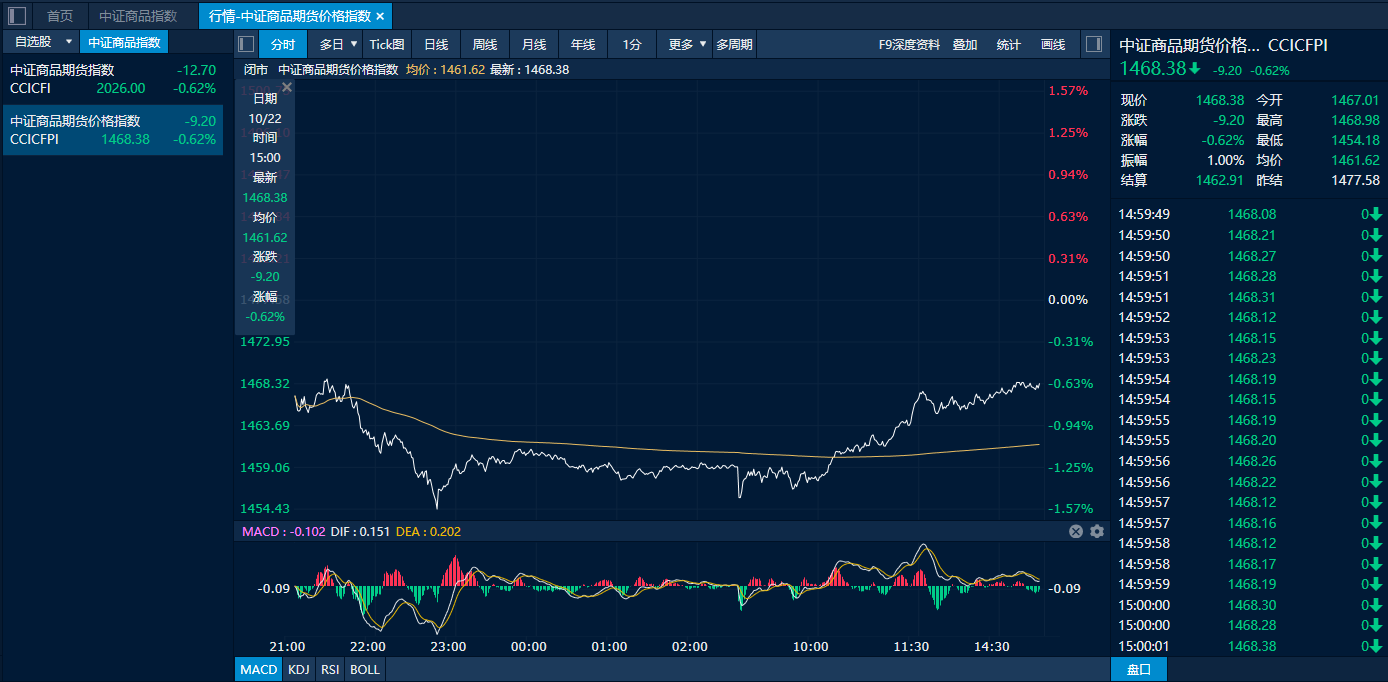
Group 1: Market Overview - The domestic commodity futures market on October 22 showed mixed results, with significant gains in asphalt, SC crude oil, and other contracts rising over 2% [1] - The China Securities Commodity Futures Price Index closed at 1468.38 points, down 9.20 points or 0.62% from the previous trading day [1] Group 2: Oil and Related Products - Crude oil and related products saw a sudden increase, with asphalt leading the market with a 2.95% rise [2] - Despite ongoing supply surplus pressures, geopolitical uncertainties, particularly regarding the U.S. and Venezuela, have provided some support to oil prices [2][3] - The recent data indicates a 26.1% year-on-year increase in asphalt production, but a decrease in capacity utilization suggests easing supply pressure [3] Group 3: Precious Metals - Precious metals experienced a sharp decline, with gold and silver contracts dropping over 3% [4] - The volatility in the gold market has increased significantly, with a 10-day historical volatility reaching 43.4, indicating potential for further fluctuations [4] Group 4: Palm Oil and Other Oils - All three major oilseed products fell, with palm oil leading the decline at 1.69% [5] - The weakening of soybean oil in the overnight market has negatively impacted domestic oilseed prices, with expectations of reduced demand from India contributing to the decline [5]

油脂日报:供需结构稳定,油脂价格震荡-20251022
Hua Tai Qi Huo· 2025-10-22 02:50
Group 1: Report Industry Investment Rating - The investment rating for the industry is neutral [4] Group 2: Core Viewpoints of the Report - The prices of the three major oils fluctuated yesterday. The supply - demand pattern of oils remains stable in the short term, and prices are mainly in a state of fluctuating adjustment [3] Group 3: Market Analysis Summary Futures Prices - The closing price of the palm oil 2601 contract yesterday was 9294.00 yuan/ton, with a month - on - month change of - 24 yuan and a decline of - 0.26%. The closing price of the soybean oil 2601 contract was 8294.00 yuan/ton, with a month - on - month change of - 4.00 yuan and a decline of - 0.05%. The closing price of the rapeseed oil 2601 contract was 9864.00 yuan/ton, with a month - on - month change of - 54.00 yuan and a decline of - 0.54% [1] Spot Prices - The spot price of palm oil in Guangdong was 9290.00 yuan/ton, with a month - on - month change of + 0.00 yuan and an increase of + 0.00%, and the spot basis was P01 + - 4.00, with a month - on - month change of + 24.00 yuan. The spot price of first - grade soybean oil in Tianjin was 8520.00 yuan/ton, with a month - on - month change of + 10.00 yuan/ton and an increase of + 0.12%, and the spot basis was Y01 + 226.00, with a month - on - month change of + 14.00 yuan. The spot price of fourth - grade rapeseed oil in Jiangsu was 10170.00 yuan/ton, with a month - on - month change of - 60.00 yuan and a decline of - 0.59%, and the spot basis was OI01 + 306.00, with a month - on - month change of - 6.00 yuan [1] Market News - ANEC expects Brazil's soybean exports in October to be 7.34 million tons, higher than last week's forecast of 7.31 million tons; soybean meal exports are expected to be 2.09 million tons, higher than last week's forecast of 2.01 million tons; and corn exports are expected to be 6.57 million tons, higher than last week's forecast of 6.46 million tons. A tropical storm "Melissa" has formed in the Caribbean, which is expected to affect eastern Cuba in the next few days and strengthen into a hurricane over the weekend. Haiti has issued a hurricane warning, and Jamaica has issued a tropical storm warning. From October 1 - 20, 2025, the yield per unit area of Malaysian palm oil increased by 1.45% month - on - month, the oil extraction rate increased by 0.24% month - on - month, and the output increased by 2.71% month - on - month [2] Group 4: Figures and Data Sources - The report includes 30 figures related to the prices, production, inventory, and other aspects of palm oil, soybean oil, and rapeseed oil, and most of the data sources are from Steel Union Data and Huatai Futures Research Institute [5]
南华期货油脂产业周报:宏观情绪下油脂走弱,关注企稳之后的上行机会-20251021
Nan Hua Qi Huo· 2025-10-21 11:18
Report Industry Investment Rating No relevant information provided. Core Viewpoints - The global soybean market is in a vacuum period with increased volatility due to the uncertain US biodiesel policy and the US government shutdown. The Malaysian palm oil data in September was below expectations, but the export in October rebounded. The Indonesian B40 plan is progressing slowly, and there are concerns about production due to heavy rainfall in Southeast Asia. The overall downside space for palm oil is limited. In China, the overall supply of the three major oils is sufficient in the short term, but the de - stocking expectation is strengthened after the fourth quarter [1]. - The short - term trend of the oil market is weak adjustment, and the medium - term is wide - range oscillation. There are opportunities for upward movement in the future, and attention should be paid to the relationship between China and the US, China and Canada, as well as the weather, de - stocking progress in palm oil producing areas, and new news about B50 [1]. Summary by Directory Chapter 1: Core Contradictions and Strategy Recommendations 1.1 Core Contradictions - The US biodiesel policy is unclear, and the market is waiting for the final policy in November. The US government shutdown has made it impossible to obtain key agricultural data, increasing the volatility of the global soybean market [1]. - Malaysian palm oil data in September was not as expected, with limited production decline and general de - stocking progress. However, the export in October rebounded. The Indonesian B40 plan is progressing slowly, and there are concerns about production due to heavy rainfall in Southeast Asia, and the overall downside space for palm oil is limited [1]. - The overall supply of the three major oils in China is sufficient in the short term, but the raw material supply will decrease after the fourth quarter, and the de - stocking expectation is strengthened [1]. 1.2 Trading - Type Strategy Recommendations - **Trend Judgement**: Short - term weak adjustment, medium - term wide - range oscillation. The price ranges are P2601 [9100 - 9900], Y2601 [8000 - 8700], and OI [9600 - 10500]. Attention should be paid to the opportunity of rebound and long - position after stabilization [22]. - **Technical Analysis**: One can enter the market to go long after the stabilization of P2601 [22]. - **Base - Spread, Month - Spread and Hedge Arbitrage Strategy Recommendations**: Consider using cumulative option to reduce the risk of base - spread pricing. For the month - spread, P1 - 5 can be considered for reverse arbitrage. The spread between rapeseed oil and soybean oil will widen, and the spread between soybean oil and palm oil will narrow [22]. 1.3 Industry Customer Operation Recommendations - **Price Range Forecast**: The price ranges for soybean oil, rapeseed oil, and palm oil are 8000 - 8700, 9700 - 10500, and 9000 - 9900 respectively. Their current volatilities and historical percentiles are also provided [23]. - **Hedging Strategy**: Different hedging strategies are recommended for traders, refineries, and oil mills according to their inventory and procurement situations [23]. 1.4 Basic Data Overview - The latest prices and price changes of palm oil, soybean oil, and rapeseed oil in both futures and spot markets are provided [24][27][28]. Chapter 2: This Week's Important Information and Next Week's Attention Events 2.1 This Week's Important Information - **Positive Information**: Malaysia's palm oil export from October 1 - 20 increased by 3.4% compared to the same period last month. The inventories of rapeseed and rapeseed oil in coastal areas decreased. The national key - area soybean oil commercial inventory decreased by 3.25%. The US renewable fuel blending quantity in September exceeded that in August [30][31]. - **Negative Information**: Brazil's soybean sowing rate as of October 18 was 21.7%. The US soybean export inspection volume in the week ending October 16 was 1474354 tons. The national key - area palm oil commercial inventory as of October 17 increased by 5.13% week - on - week [32]. 2.2 Next Week's Important Events to Follow - Domestic weekly inventory data, high - frequency production and export data of Malaysian palm oil, the progress of the US small refinery exemption redistribution decision, and USDA and US government - related information [39][40]. Chapter 3: Disk Interpretation 3.1 Price - Volume and Fund Interpretation - **Domestic Market**: After the bearish MPOB report in September and the weakening of the macro - sentiment, the overall oil market weakened. The funds in palm oil, soybean oil, and rapeseed oil were cautious. The near - month term structure of oils remained steep, and the market was still in a Back structure [40][41]. - **Foreign Market**: The foreign market was weakly oscillating. The B50 road test completion in Indonesia and the expected production reduction supported the price, but the weakening of the macro - sentiment and the unexpected inventory in Malaysia's report led to a decline in the market [62]. Chapter 4: Valuation and Profit Analysis 4.1 Upstream and Downstream Profit Tracking in the Industry Chain - The POGO spread remains high, and the BOHO spread decreased this week. The overall production cost of bio - fuels is still high [69]. 4.2 Import - Export Profit Tracking - China is a net importer of palm oil. The cost price improved slightly and then weakened again, and the buying sentiment of domestic traders is expected to change little [72]. Chapter 5: Supply - Demand and Inventory Deduction 5.1 Deduction of the Supply - Demand Balance Sheet in Producing Areas - The production decline of Malaysian palm oil in September was less than expected, and the inventory exceeded expectations, which was bearish for the market. However, with the implementation of B30 in Malaysia, the domestic demand is good. The subsequent production may decline further, and the inventory pressure is expected to ease [74]. 5.2 Supply - Side and Deduction - **Palm Oil**: The cost is firm, the demand is weak, and the purchasing willingness of traders is low. The supply pressure in the fourth quarter is not large [76]. - **Soybean Oil**: The soybean arrival level in October is still high, and the supply in the fourth quarter is sufficient, but it may decrease from December [76]. - **Rapeseed Oil**: The current inventory is high, but it will gradually de - stock in the fourth quarter. If the China - Canada relationship cannot be eased, the supply may be tight from the end of this year to the first quarter of next year [76]. 5.3 Demand - Side and Deduction - The short - term inventory pressure of the three major oils is large, the demand is weak, and it is expected to remain stable and weak [78].
油脂日报:巴西播种良好,油脂价格震荡-20251021
Hua Tai Qi Huo· 2025-10-21 02:16
Group 1: Report Industry Investment Rating - The investment rating for the industry is neutral [4] Group 2: Core View of the Report - The prices of the three major oils fluctuated yesterday. The smooth soybean sowing in South America, which has reached 24%, along with the potential for further growth in South American planting areas, exerts some pressure on the market. However, the low rapeseed inventory in domestic oil mills and the low operating rate, combined with the relatively concentrated ownership of rapeseed oil inventory and strong overall basis, lead to the oils' prices mainly in a fluctuating state [3] Group 3: Market Analysis Futures - The closing price of the palm oil 2601 contract yesterday was 9,318.00 yuan/ton, with a环比 change of +10 yuan and a幅度 of +0.11% - The closing price of the soybean oil 2601 contract yesterday was 8,298.00 yuan/ton, with a环比 change of +42.00 yuan and a幅度 of +0.51% - The closing price of the rapeseed oil 2601 contract yesterday was 9,918.00 yuan/ton, with a环比 change of +57.00 yuan and a幅度 of +0.58% [1] Spot - The spot price of palm oil in Guangdong was 9,290.00 yuan/ton, with a环比 change of +80.00 yuan and a幅度 of +0.87%, and the spot basis was P01 + -28.00, with a环比 change of +70.00 yuan - The spot price of first-grade soybean oil in Tianjin was 8,510.00 yuan/ton, with a环比 change of +50.00 yuan/ton and a幅度 of +0.59%, and the spot basis was Y01 + 212.00, with a环比 change of +8.00 yuan - The spot price of fourth-grade rapeseed oil in Jiangsu was 10,230.00 yuan/ton, with a环比 change of +60.00 yuan and a幅度 of +0.59%, and the spot basis was OI01 + 312.00, with a环比 change of +3.00 yuan [1] Recent Market Information - As of last Thursday, the sowing rate of soybeans in Brazil for the 2025/26 season had reached 24% [2] - The export volume of palm oil from Malaysia from October 1 - 20 was 1,044,784 tons, a 3.4% increase compared to the same period last month [2] - In September this year, China did not import soybeans from the United States, the first time since November 2018 that China's monthly soybean imports from the US dropped to zero. China is increasing its soybean purchases from South American countries to replace US soybeans [2] - As of October 17, 2025 (week 42), the commercial inventory of palm oil in key regions across the country was 575,700 tons, an increase of 28,100 tons from last week, a增幅 of 5.13%, and an increase of 59,800 tons compared to 515,900 tons last year, a增幅 of 11.59% [2] - The C&F price of Canadian rapeseed (November shipment) was 508 US dollars/ton, a decrease of 1 US dollar/ton compared to the previous trading day; the C&F price of Canadian rapeseed (January shipment) was 518 US dollars/ton, a decrease of 1 US dollar/ton compared to the previous trading day [2]
油脂周报:油脂缺乏明显驱动,短期维持震荡运行-20251020
Yin He Qi Huo· 2025-10-20 02:22
Report Industry Investment Rating No relevant content provided. Report's Core View - The short - term trend of oils and fats lacks a clear driving force and is expected to be in a weak and volatile state. It is advisable to wait and see for now. Consider lightly going long at low levels after a significant pull - back. For arbitrage and option strategies, it is recommended to wait and see [31][33]. Summary by Relevant Catalogs Part One: Weekly Core Points Analysis and Strategy Recommendation Recent Core Events & Market Review - SPPOMA estimates that the production of Malaysian palm oil in the first 15 days of October increased by 6.86% month - on - month. ITS data shows that exports in the same period increased by 16% month - on - month [4]. - SEA data indicates that as of September, India's edible oil imports in the 2024/25 fiscal year reached 1.398 billion tons, a year - on - year decrease of 3.8%. In September, India's port inventory continued to accumulate to 1.03 million tons, with palm oil inventory remaining flat, soybean oil inventory increasing significantly due to high imports, and sunflower oil inventory decreasing [4]. - This week, oils and fats lacked a clear driving force and remained volatile. Rapeseed oil declined significantly due to expectations of improved China - Canada relations and short - selling. Fundamentally, Malaysian palm oil production in September may have declined slightly, exports may have increased slightly, and inventory may have slightly accumulated. The stable spot price in the producing areas supports the palm oil price, but the lack of positive drivers, poor cost - effectiveness, and weak demand hinder its rise. Currently, the supply - demand contradiction of soybean oil is not prominent. Domestic soybean oil inventory is slightly increasing, and it may continue to decline slightly later, but the inventory will not be tight. The fundamentals of domestic rapeseed oil have not changed much, but overall, the inventory continues to decline marginally, supporting the rapeseed oil price [4]. International Market - **Malaysian Palm Oil in October**: SPPOMA estimates a 6.86% month - on - month increase in production in the first 15 days of October. With more rainfall expected in southern Peninsular Malaysia in the next two weeks, production may slightly decrease in October but still be slightly higher than the five - year average. ITS data shows a 16% month - on - month increase in exports in the first 15 days of October. Exports in October are expected to increase month - on - month but be lower than the five - year average. Inventory in October is expected to reach between 2.35 and 2.45 million tons. The recent spot price of Malaysian CPO has remained stable at around 4,450 ringgit, and the decline space of CPO may be limited in the later period [8]. - **India's Situation in September**: India's edible oil imports in the 2024/25 fiscal year as of September reached 1.398 billion tons, a year - on - year decrease of 3.8%. Palm oil imports decreased by 14%, with cumulative imports of only 6.91 million tons. Soybean oil imports reached a record 4.39 million tons, a year - on - year increase of 42%. Sunflower oil imports were 2.62 million tons, a year - on - year decrease of 20%, still at a relatively high level in the same period of history. It is expected that imports in September will decline slightly. In terms of inventory, India's port inventory in September continued to accumulate to 1.03 million tons, with palm oil inventory remaining flat, soybean oil inventory increasing significantly due to high imports, and sunflower oil inventory decreasing. Currently, the inventories of the three major oils are all higher than the five - year average. India's apparent consumption this year is at a moderately high level but has declined compared to the same period last year. In terms of import profit, CPO and sunflower oil occasionally have import profits, but the procurement progress has slowed down. There are also rumors that India has imported Chinese soybean oil for forward months [14]. - **Trump's Statement**: Trump stated on social media that China deliberately does not buy US soybeans, causing difficulties for US soybean farmers, which is an economic hostile act. In response, the US is considering terminating business relations with China in the edible oil and other trade fields. From January to August this year, China's cumulative exports of UCO reached 1.66 million tons, a year - on - year decrease of 12%. Among them, exports to the US totaled about 300,000 tons, a year - on - year decrease of 65%. From January to July this year, the US's cumulative imports of UCO reached 1.32 million tons, a year - on - year increase of 8%, and the quantity imported from China decreased by 43% year - on - year, with a more diversified import source [20]. Domestic Market - **Palm Oil**: As of October 10, 2025 (week 41), the commercial inventory of palm oil in key national regions was 547,600 tons, a decrease of 4,600 tons from the previous week, a decrease of 0.83%. Recently, palm oil inventory has been decreasing continuously and is at a slightly lower - than - average level in the same period of history. From January to August, domestic edible palm oil imports totaled only 1.59 million tons, lower than the same period last year and still at a relatively low level in the same period of history. The producer's quotation is stable, and the import profit inversion has narrowed, currently around - 160. According to incomplete statistics, domestic commercial purchases in October and November are about 200,000 tons +, but there are still few forward - month shipments. Attention should be paid to domestic purchases and arrivals in the later period [23]. - **Soybean Oil**: As of October 10, 2025, the commercial inventory of soybean oil in key national regions was 1.2651 million tons, an increase of 16,400 tons from the previous week, an increase of 1.31%. This week, the actual soybean crushing volume of oil mills was 2.1662 million tons, and the operating rate was 59.59%. The spot market is sluggish, and downstream buyers still replenish inventory on - demand, with slow pick - up. Currently, China has not purchased US soybeans and mainly purchases South American soybeans. It is expected that there will be no shortage of domestic soybeans in the short term. The peak period of soybean arrivals in China has passed. As soybean arrivals and crushing gradually decrease later, domestic soybean oil inventory may decline, and the inflection point of domestic soybean oil inventory may occur at the end of October, followed by a gradual decline, but the inventory will not be tight [26]. - **Rapeseed Oil**: Last week, the rapeseed crushing volume of major coastal oil mills was 14,000 tons, and the operating rate was 3.73%, a decrease from the previous week. As of October 10, 2025, the coastal rapeseed oil inventory was 571,000 tons, a decrease of 12,000 tons from the previous week. Although it is still at a high level in the same period of history, the inventory is continuously declining marginally. The FOB quotation of European rapeseed oil has increased to around $1,100, and the import profit inversion of European rapeseed oil has widened to around - 1,000. There are frequent rumors in the market that China has imported rapeseed oil from Dubai and Russia. The market still has a sentiment of holding back sales and maintaining prices, and the domestic rapeseed oil basis is stable. It is expected that the inventory decline trend in coastal areas will continue. The market expects that China - Canada relations may improve, and rapeseed oil prices have declined. Currently, the fundamentals of domestic rapeseed oil have not changed much, but overall, rapeseed oil inventory continues to decline marginally, supporting the rapeseed oil price. Attention should be paid to rapeseed and rapeseed oil purchases and policy changes [29]. Strategy Recommendation - **Logic**: Malaysian palm oil production in September may have declined slightly, exports may have increased slightly, and inventory may have slightly accumulated. The stable spot price in the producing areas supports the palm oil price, but the lack of positive drivers, poor cost - effectiveness, and weak demand hinder its rise, so it will maintain a volatile state. Currently, the supply - demand contradiction of soybean oil is not prominent. Domestic soybean oil inventory is slightly increasing, and it may continue to decline slightly later, but the inventory will not be tight. The fundamentals of domestic rapeseed oil have not changed much, but overall, rapeseed oil inventory continues to decline marginally, supporting the rapeseed oil price [31]. - **Strategy**: For the unilateral strategy, due to the lack of driving force, oils and fats may pull back in the short term and are expected to be in a weak and volatile state. It is advisable to wait and see for now and consider lightly going long at low levels after a significant pull - back. For the arbitrage and option strategies, it is recommended to wait and see [33]. Part Two: Weekly Data Tracking - The report provides a large amount of data tracking on Malaysian and Indonesian palm oil production, exports, and inventory; international soybean oil market data; Indian oil supply and demand; domestic palm oil, soybean oil, and rapeseed oil supply and demand; domestic oil spot basis; and domestic oil commercial inventory, presented in graphical form [37][44][46].
棕榈油:产地去库进程偏慢,关注下方支撑,豆油:南美产情暂好,豆系缺乏有效驱动
Guo Tai Jun An Qi Huo· 2025-10-19 09:38
Report Summary 1. Report Industry Investment Rating No information provided in the content. 2. Core View of the Report - The inventory reduction process in palm oil producing areas is slow, and there is a lack of strong upward drivers. It is possible that the oscillating market will continue until the end of the year. Further price movement of palm oil depends on the B50 storyline and production issues [3][5][6]. - Soybean oil lacks an independent driving force. The price of US soybean oil will mainly fluctuate with crude oil, diesel crack spreads, and South American soybean oil prices. The domestic soybean oil trend depends on South American weather, export sustainability, and the outcome of China - US trade negotiations [2][5][6]. 3. Summary by Related Catalogs 3.1 Last Week's View and Logic - Palm oil: The seasonal production reduction in producing areas has not arrived, and Indian buying has slowed down due to the Diwali festival. The palm oil 01 contract maintained a small - scale oscillation, with a weekly decline of 1.90%. Attention should be paid to the support level during the production - reduction season [2]. - Soybean oil: The production situation in Brazil is good. In a large - supply environment, soybean oil is difficult to have an independent driving force and mainly oscillates with the oil and fat sector. It also fluctuates with China - US economic and trade relations. The soybean oil 01 contract declined by 0.82% last week [2]. 3.2 This Week's View and Logic - Palm oil: The MPOB report confirmed the inventory pressure in Malaysia in September (over 2.3 million tons). The narrowing spread between UCO FOB and CPO FOB in Malaysia since September implies a return to normal domestic consumption. However, the impact of potential export tariffs on UCO and POME is difficult to judge as a direct negative. In Indonesia, the inventory is estimated to be between 2 - 3 million tons in the third quarter, and the annual production increase is at least 5.5 million tons. The demand in the Indian market is not optimistic, and the international demand in the fourth quarter lacks further stimulation. It is likely that the inventory in producing areas will increase to the level at the end of 2023 by the end of the year, lacking strong upward drivers [3]. - Soybean oil: The support level of the cost - effectiveness of US soybean oil in the biodiesel sector has declined, and there is a high possibility of inventory accumulation by the end of the year. The final announcement of RVO may be delayed, and the price of US soybean oil will mainly follow the fluctuations of crude oil, diesel crack spreads, and South American soybean oil prices. The overall soybean sowing progress in Brazil is favorable, and the global soybean supply pattern in 2025/2026 is large. In the domestic market, the arrival of soybeans until January has almost no gap, and the export demand may keep the domestic soybean oil inventory reduction process until March next year. Attention should be paid to the outcome of China - US trade negotiations and the sustainability of soybean oil exports [5]. 3.3 Disk Basic Market Data - Palm oil main - continuous contract: The opening price was 9,438 yuan/ton, the highest price was 9,446 yuan/ton, the lowest price was 9,260 yuan/ton, the closing price was 9,308 yuan/ton, and the decline was 1.90%. The trading volume was 2,345,011 lots, and the position decreased by 29,917 lots [8]. - Soybean oil main - continuous contract: The opening price was 8,282 yuan/ton, the highest price was 8,330 yuan/ton, the lowest price was 8,210 yuan/ton, the closing price was 8,256 yuan/ton, and the decline was 0.82%. The trading volume was 1,242,800 lots, and the position decreased by 4,334 lots [8]. 3.4 Core Data of Oil and Fat Fundamentals - Production and inventory in Malaysia: The production situation in October is still good, and it is difficult to significantly reduce the inventory in October [10]. - Inventory in Indonesia: After the third quarter, the inventory is expected to be higher than last year's level, and the price difference between Indonesia and Malaysia is declining [12]. - Export volume in Malaysia: From October 1 - 15, the palm oil export volume was 781,006 tons, a 12.3% increase compared to the same period last month [10][12].