
非银金融

Search documents
中信建投:后续市场走势或将延续中期慢牛格局 重点关注红利、液冷服务器、AI等
Zhi Tong Cai Jing· 2025-08-17 22:54
Core Viewpoint - The current slow bull market began on June 23, characterized by structural prosperity as the main driving force, limited short-term capital inflow due to internal and external uncertainties, a clear but steady bullish direction, and stronger performance in the first half of the week compared to the latter half [1][2]. Market Characteristics - Structural prosperity is the primary driving force of the market, with significant performance recovery in specific sectors despite overall weak earnings recovery in the A-share market [2]. - Internal and external uncertainties are restricting rapid short-term capital inflow, with macroeconomic expectations affected by "gray rhino" events [2]. - The market has a clear bullish direction but maintains a steady rhythm, with the first half of the week performing better than the second half [1][2]. Future Market Evolution - The market may continue its slow bull pattern, with two possible scenarios: a market adjustment that slows the upward pace, allowing the slow bull pattern to persist, or an accelerated market peak due to overheating or deteriorating trading structure, leading to a significant correction [1][2]. Industry Allocation - The dividend sector is recommended as a base due to its high dividend characteristics in a low-interest-rate environment, while new sectors can be expanded upon with event catalysts and positive mid-term earnings forecasts [3]. - Key sectors to focus on include dividends, liquid cooling servers, AI, innovative pharmaceuticals, humanoid robots, beauty care, electronics, non-banking financials, non-ferrous metals, and military industry [3].

南下资金爆买港股创历史新高
Shen Zhen Shang Bao· 2025-08-17 22:42
Group 1 - The core viewpoint is that southbound capital has accelerated its net buying of Hong Kong stocks, reaching a historical high of 938.92 billion HKD from January 1 to August 15, 2025, surpassing the total for the entire year of 2024 [1][2] - On August 15, despite a 0.98% drop in the Hang Seng Index, southbound capital recorded a net purchase of 35.88 billion HKD, setting a new single-day record [1] - The net buying pace of southbound capital increased significantly, with a total net inflow of 36.20 billion HKD from August 1 to August 14, and a record high of 35.88 billion HKD on August 15 alone [1] Group 2 - The top three net bought stocks by southbound capital in the past month were the Tracker Fund of Hong Kong, Alibaba, and Xiaomi, with net purchases ranging from 11.25 billion HKD to 2.96 billion HKD [2] - As of August 15, Tencent Holdings had the highest holding value among southbound capital at 582.50 billion HKD, followed by China Mobile and China Construction Bank with holdings of 268.36 billion HKD and 267.79 billion HKD, respectively [2] - The main reason for the accelerated inflow of southbound capital is the undervaluation of Hong Kong stocks, with many companies maintaining good growth despite significant price declines over the past six years [2]

十大券商一周策略:这是一轮“健康牛”,A股仍有充足空间和机会
Zheng Quan Shi Bao· 2025-08-17 22:21
Group 1 - The combination of "anti-involution" and overseas expansion logic may provide investment clues, particularly in industries like rare earths, cobalt, phosphate fertilizers, and refrigerants, which have seen profit contributions surge due to export controls or quotas [1] - China's manufacturing value-added share globally has surpassed 30%, but profit margins are declining, indicating a shift from market share competition to profit realization [1] - Short-term investment focus should remain on innovative pharmaceuticals, resources, communications, military industry, and gaming sectors, while avoiding excessive high-cut low trades [1] Group 2 - The A-share market is experiencing a new stable state, with increased investor participation and a clear trend of reallocating household wealth towards financial assets [2] - Key sectors to watch include the upstream non-ferrous metals industry, midstream steel, machinery, and power equipment, as well as non-bank financials and agriculture [2] Group 3 - The current slow bull market is characterized by structural prosperity, limited short-term capital influx due to uncertainties, and a clear direction for bullish sentiment [3] - Recommended sectors for investment include dividend stocks, liquid cooling servers, AI, innovative pharmaceuticals, humanoid robots, personal care, electronics, non-bank financials, non-ferrous metals, and military industry [3] Group 4 - The market is undergoing a "healthy bull" phase, supported by national strategic direction and active capital inflow, with a steady upward trend in indices and declining volatility [4] - Focus areas include brokerage firms, AI expansion, military industry, and "anti-involution" themes [4] Group 5 - Current market concerns do not pose significant downside risks, with expectations for improved supply-demand dynamics in 2026 [5] - The market is anticipated to experience a fourth-quarter rally in 2025, characterized by a mix of momentum-driven sectors and broad-based rotation [5] Group 6 - Key sectors to focus on include brokers, insurance, military, and rare earths, with ongoing momentum in pharmaceuticals and overseas computing assets [6] Group 7 - The A-share market is currently in the second phase of a bull market, driven by risk preference recovery and valuation rebalancing [7] - Key sectors for mid-term investment include AI, pharmaceuticals, non-bank financials, semiconductors, non-ferrous metals, military industry, and internet [7] Group 8 - The technology and small-cap styles are expected to continue dominating the market, with increasing participation from retail investors and private funds [8] Group 9 - The A-share market has ample space and opportunities, supported by strong economic resilience and significant excess savings among residents [9] - Investment focus should be on new technologies and growth directions, as well as sectors benefiting from liquidity easing [9] Group 10 - The outlook for the market's upward potential remains cautiously optimistic, emphasizing the need for a transition from liquidity-driven growth to fundamental-driven growth [10] - Structural rotation among sectors is crucial, with a focus on undervalued assets [10] Group 11 - The current market environment presents opportunities for cyclical assets as profit expectations improve, particularly in upstream resources and capital goods [11][12] - Key sectors include industrial metals, engineering machinery, and consumer staples, with a focus on growth-oriented large-cap stocks [12]
从“合规答卷”到“价值引擎” ESG评级冲A竞速赛升温
Zhong Guo Zheng Quan Bao· 2025-08-17 22:06
Core Viewpoint - Beijing's Chaoyang District has introduced ESG support policies that provide financial rewards to companies achieving an A-level or equivalent in mainstream ESG ratings, aiming to enhance ESG performance and attract long-term investments [1][4]. Group 1: ESG Rating Landscape - A-rated companies are characterized by high growth, high added value, and low pollution [3]. - The number of companies achieving A-level ESG ratings has been increasing, with a notable trend towards higher ratings among listed companies in Shanghai [2][4]. - As of the end of 2024, 342 listed companies in Shanghai were included in the MSCI ESG rating, with 100 companies receiving upgrades [2]. Group 2: Challenges in Achieving A-Level Ratings - Achieving an A-level rating is challenging, as many companies rely on superficial compliance rather than substantive management improvements [4][5]. - Companies often face shortcomings in information disclosure quality, governance structure, and data governance, which hinder their ESG rating progress [5][6]. - The lack of third-party verification for ESG reports limits the credibility and effectiveness of ESG ratings [5][6]. Group 3: Recommendations for Improvement - Companies should focus on enhancing their ESG management capabilities and improving information disclosure to achieve better ratings [8][9]. - It is recommended that companies adopt a strategy centered on management improvement, using information disclosure as a tool to achieve ESG rating goals [8]. - Regulatory bodies should enhance the independence and transparency of rating agencies to improve the quality of ESG ratings and data products [9][10].
从“合规答卷”到“价值引擎”ESG评级冲A竞速赛升温
Zhong Guo Zheng Quan Bao· 2025-08-17 20:07
Core Viewpoint - Beijing's Chaoyang District has introduced ESG support policies that provide financial rewards to companies achieving an A-level or equivalent in mainstream ESG ratings, indicating a growing emphasis on ESG performance in investment decisions [1][4]. Group 1: ESG Rating Landscape - The number of companies achieving A-level ESG ratings has been increasing, with a notable trend towards higher ratings among listed companies in Shanghai [3][4]. - A-level companies are characterized by high growth, high added value, and low pollution, with significant representation in sectors like finance, renewable energy, and high-end manufacturing [3][4]. - Different ESG rating agencies have varying definitions and criteria for A-level ratings, leading to discrepancies in ratings across different organizations [2][6]. Group 2: Challenges in Achieving A-Level Ratings - Many companies struggle to achieve A-level ratings due to superficial compliance and inadequate management practices, highlighting the need for substantial improvements in governance and data management [4][5]. - The lack of third-party verification for ESG reports limits the credibility and effectiveness of ESG ratings, with less than 5% of A-share and Hong Kong-listed companies undergoing such verification [5][6]. - Discrepancies in ESG rating methodologies between domestic and international agencies can mislead resource allocation and hinder the accurate assessment of companies' ESG performance [6][7]. Group 3: Strategies for Improvement - Companies aiming for A-level ratings should focus on enhancing their ESG management capabilities rather than merely meeting rating criteria, emphasizing the importance of robust governance and transparent reporting [7][8]. - Rating agencies and regulatory bodies must work towards improving the consistency and comparability of ESG ratings, ensuring that methodologies are transparent and aligned with actual corporate practices [8]. - Local governments can implement differentiated management incentives beyond financial rewards, such as tax benefits and support in sustainable development initiatives, to encourage companies to improve their ESG performance [8].
港股定价谁主沉浮 内资ETF跃跃欲试
Zheng Quan Shi Bao· 2025-08-17 17:37
Core Viewpoint - The influx of capital into Hong Kong stocks through ETFs is reshaping the pricing system of certain core sectors in the market, with significant net inflows recorded this year [1][5]. Group 1: ETF Market Dynamics - As of August 15, 2023, southbound funds have net purchased HK stocks amounting to 938.9 billion HKD, setting a new annual record [1]. - Nine stock ETFs have seen net inflows exceeding 10 billion HKD this year, with six being Hong Kong-themed ETFs [4]. - The performance of Hong Kong-themed ETFs has been particularly strong, with significant increases in assets under management for several key products [2][3]. Group 2: Sector Performance - The internet, non-bank financials, and innovative pharmaceuticals are the three leading themes attracting ETF investments [2]. - The 富国中证港股通互联网ETF has achieved a year-to-date increase of 37.14%, significantly outperforming the沪深300 index [3]. - The 易方达中证香港证券投资主题ETF has recorded a year-to-date return of 64.89%, ranking it among the top in its category [3]. Group 3: Impact on Pricing Power - The growing influence of ETFs is evident as they begin to dominate the pricing of Hong Kong stocks, particularly among listed brokerages [5][6]. - The performance of H-shares has outpaced A-shares, with notable increases in stock prices for companies like 广发证券 and 中金公司 [6]. - The shift in pricing power from foreign capital to domestic capital is becoming more pronounced, driven by the substantial inflow of southbound funds [6][7]. Group 4: Future Outlook - Analysts believe that the current valuation recovery in the Hong Kong market is far from over, with ETFs seen as a prime vehicle for investors to engage in this transformation [8]. - The market is characterized by ample incremental capital, improved risk appetite, and attractive valuations compared to overseas markets [8][9]. - The Hong Kong market is positioned as a significant offshore RMB market, benefiting from both southbound fund inflows and foreign capital reallocation [9].


量化择时周报:市场情绪维持高位运行,行业涨跌趋势进一步上涨-20250817
Shenwan Hongyuan Securities· 2025-08-17 15:18
Group 1 - Market sentiment remains high with an index value of 3.2, showing signs of potential decline, suggesting further observation is needed [3][9] - The trading volume across the A-share market has significantly increased, with daily trading exceeding 2 trillion RMB for three consecutive days, indicating strong market activity [15][17] - The industry trend indicators show an upward breakout, reflecting a narrowing of funding viewpoint discrepancies [21][23] Group 2 - The small-cap and growth styles are currently favored, with the electronic and computer sectors showing the strongest short-term trend scores, particularly with scores reaching 100 [30][31] - The model indicates a high degree of trading concentration in sectors like machinery, electronics, and construction decoration, which may pose valuation and sentiment risks [39][41] - The report highlights that sectors with lower trading concentration, such as beauty care and public utilities, may present opportunities for gradual long-term positioning as risk appetite increases [39][41]
策略周报20250817:坚定指数趋势,看好国内科技-20250817
Orient Securities· 2025-08-17 14:42
Group 1 - The index has reached a new high as expected, with technology and non-bank sectors being the core drivers. The index broke through to a new high since 924, with communication, electronics, and non-bank sectors rising by 7.7%, 7.0%, and 6.5% respectively, indicating continued optimism for these sectors [1][12][14] - The market trend is healthy, and there is a strong upward confidence from domestic capital, making a firm hold on investments a suitable strategy [2][13] - The technology sector is viewed as a certain mainline, with a particular focus on the domestic AI industry chain, which is expected to strengthen its relative advantages [3][14] Group 2 - Within the AI-related sectors, there is a strong outlook for computing power-related areas, including liquid cooling, electronic cloth, and solid oxide fuel cells (SOFC). The domestic companies are expected to see breakthroughs and opportunities for domestic substitution [4][15] - The domestic AI chip core companies have seen a 33% increase, indicating that the market's allocation towards domestic computing power is just beginning [4][15] - Robotics is highlighted as an important application area for AI, with a focus on new components and application scenarios [4][15][16] Group 3 - The integration of AI and unmanned technologies is anticipated to be a major method of warfare in the future, with increasing market attention [5][16] - AI applications are becoming widespread across various life sectors, with the release of new domestic models expected to act as a catalyst for growth in the AI application sector [5][16]
晓数点丨一周个股动向:创业板指周涨超8% 东方财富获主力抢筹超90亿元
Di Yi Cai Jing Zi Xun· 2025-08-17 14:04
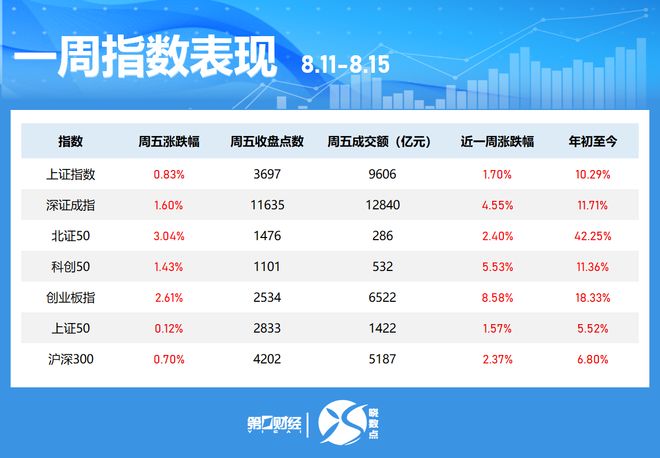
Market Performance - The three major indices experienced an increase during the week of August 11 to August 15, with the Shanghai Composite Index rising by 1.70%, the Shenzhen Component Index by 4.55%, and the ChiNext Index by 8.58% [1][2]. Individual Stock Performance - The top-performing stock for the week was Oulutong, which surged by 82.52%. Other notable gainers included Zhongyou Technology (74.05%), Sainuo Medical (69.13%), and Dayuan Pump Industry (61.11%) [3][5]. - Conversely, the worst-performing stock was Jinlihua Electric, which fell by 28.31%, followed by Jihua Group and Tianfulong with declines of 25.76% and 22.50%, respectively [3][5]. Trading Activity - A total of 105 stocks had a turnover rate exceeding 100% during the week, with C Guangjian Technology leading at 286.40% [6][7]. - The sectors with the highest turnover rates included machinery, computers, and electronics [6]. Capital Flow - Non-bank financials and banks attracted significant capital inflows, with the non-bank financial sector seeing over 12 billion yuan in net inflows. Dongfang Caifu led individual stocks with a net inflow of 9.005 billion yuan [8][9]. - Notable net inflows were also observed in Ningde Times (2.563 billion yuan) and Geer Shares (1.406 billion yuan) [8][9]. Margin Trading - New Yisheng topped the list for margin trading with a net buy of 1.153 billion yuan, reflecting a weekly increase of 27.94% [10][11]. - Other significant net buys included Industrial Fulian and Dongfang Caifu, while stocks like Muyuan Foods and Zhongkong Technology faced net sell-offs [10][11]. Institutional Research - The most researched stock by institutions was Nanwei Medical, with 183 institutions participating in its research. Other stocks like Anjisi and Jinchengzi also received significant attention [12][13]. - The focus of institutional research was primarily on sectors such as integrated circuits, industrial machinery, and electronic components [12]. New Institutional Ratings - Several stocks received new ratings from institutions, including Ousheng Electric, which was rated "Outperform" with a target price of 38.16 to 45.10 yuan [15][16]. - Other stocks like Boshang Optoelectronics and Ying Shi Innovation also received buy ratings with specified target prices [15][16].




一周主力丨非银金融、银行获资金青睐 东方财富获抢筹超90亿元
Di Yi Cai Jing· 2025-08-17 13:57
按申万一级行业来看,本周(8月11日至8月15日)五个交易日内,非银金融、银行、家用电器、公用事 业、综合板块获主力资金净流入,机械设备、国防军工、有色金属、传媒、医药生物等板块遭净流出额 居前。其中非银金融板块获加仓超120亿元。 个股方面,本周东方财富获净流入90.05亿元居首,周涨幅15.34%。宁德时代、歌尔股份、指南针主力 净流入分别为25.63亿元、14.06亿元、12.52亿元。净流出方面,航天科技、山河智能、光线传媒分别遭 抛售17.29亿元、16.25亿元、11.10亿元。 ...