
交通运输

Search documents
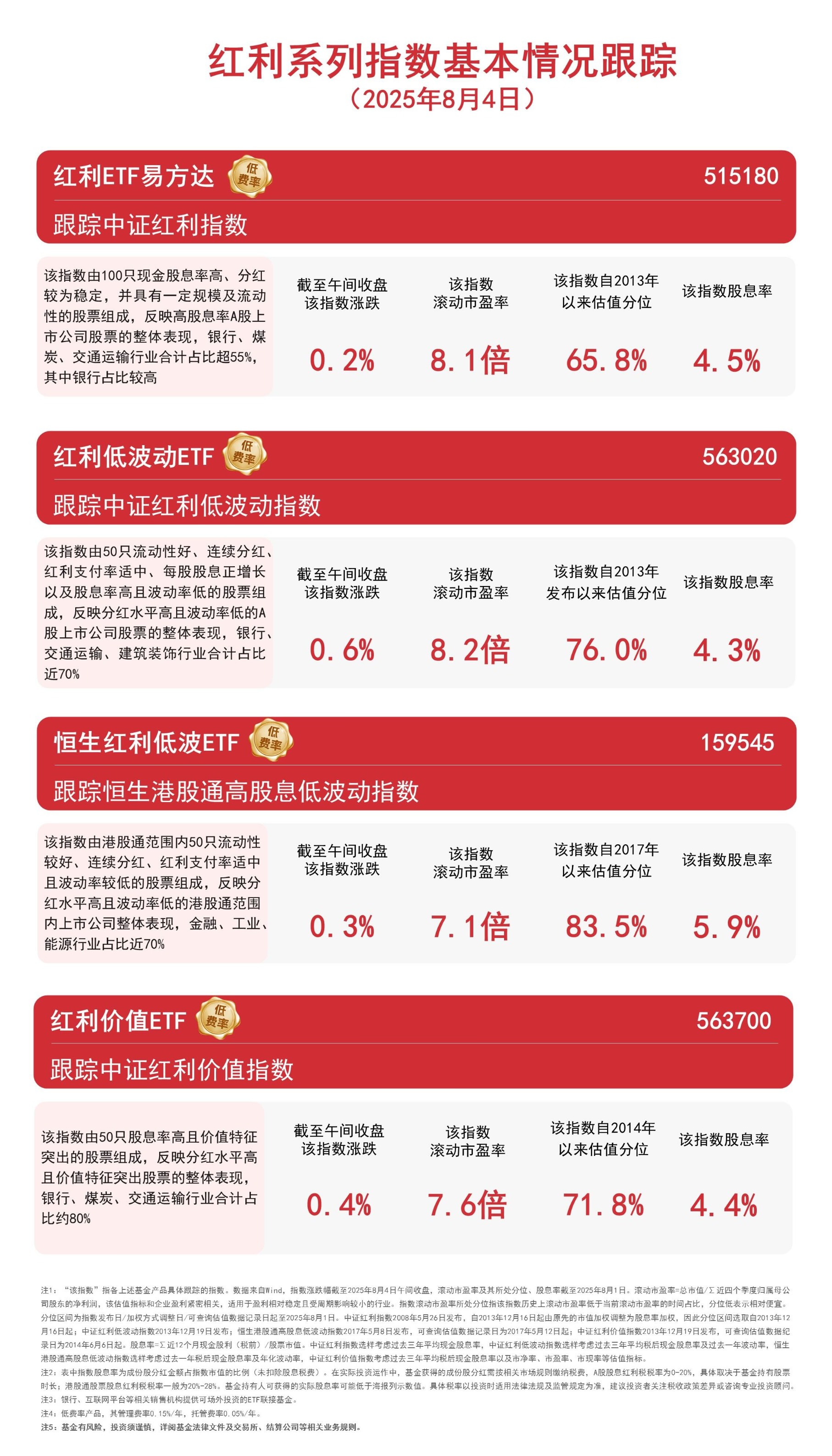
银行股走高,红利系列指数飘红,关注红利低波动ETF(563020)、恒生红利低波ETF(159545)等配置机会
Mei Ri Jing Ji Xin Wen· 2025-08-04 06:06
Group 1 - The Hang Seng Dividend Low Volatility ETF tracks the Hang Seng Stock Connect High Dividend Low Volatility Index, which consists of 50 stocks with good liquidity, continuous dividends, moderate dividend payout ratios, and low volatility, reflecting the overall performance of high dividend and low volatility companies in the Stock Connect range [4] - As of the midday close, the index increased by 0.3% with a rolling price-to-earnings ratio of 7.1 times [4] - The China Securities Dividend Value ETF tracks the China Securities Dividend Value Index, composed of 50 stocks with high dividend yields and prominent value characteristics, reflecting the overall performance of high dividend and value stocks, with banking, coal, and transportation industries accounting for approximately 80% [4] Group 2 - As of the midday close, the index increased by 0.4% with a rolling price-to-earnings ratio of 7.6 times [4] - The dividend yield is calculated as the sum of the last 12 months' cash dividends (pre-tax) divided by the market value of the stock [4] - The management fee for low-fee products is 0.15% per year, and the custody fee is 0.05% per year [5]

中信建投:连涨之后的回调,有利于A股慢牛行情行稳致远
Sou Hu Cai Jing· 2025-08-03 23:52
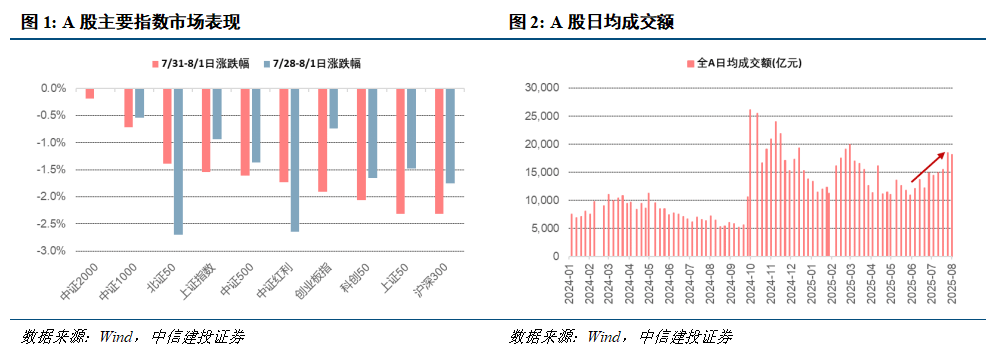
Core Viewpoint - The recent adjustment in the A-share market is a result of profit-taking pressure and changes in expectations after a period of continuous gains, with a focus on the impact of domestic and international economic indicators and policies [1][4][44]. Changes in Expectations - **Decrease in Expectations for Incremental Policies and Cyclical Recovery**: The Politburo meeting in July did not announce significant new policies, emphasizing the need for macro policies to continue while being more detailed. The July PMI data showed a larger decline in domestic demand compared to external demand, indicating a slowdown in internal demand [1][9]. - **Increased Uncertainty Regarding the Fed's Rate Cut Schedule**: The Fed's July FOMC meeting maintained the current rate, with Powell expressing concerns about inflation and labor market resilience. Following disappointing non-farm payroll data, market expectations for a rate cut in September surged from 38% to 80% [2][20]. - **Diminished Expectations for Improvement in US-China Relations**: Recent US trade agreements with allies and ongoing tensions, such as the Nvidia H20 incident, have led to a more cautious outlook on US-China economic relations [3][27]. Unchanged Factors - **Global Monetary Easing and Abundant A-share Liquidity**: The environment remains supportive for equity markets, with the Politburo emphasizing the need for liquidity and lower financing costs. The two-margin financing has seen a net inflow of approximately 169 billion yuan from late June to the end of July [2][30]. - **Investor Bull Market Expectations Remain Intact**: Historical data shows that 5-10% pullbacks are normal during bull markets, and current investor sentiment remains high, suggesting a potential return to upward trends after adjustments [2][35]. - **Structural Prosperity in New Sectors**: The Ministry of Industry and Information Technology has outlined key areas for focus, including expanding domestic demand and technological innovation. Positive earnings forecasts are noted in sectors such as non-bank financials, metals, electronics, and agriculture [3][41].

帮主郑重:下周A股关键转折!这三个信号必须紧盯
Sou Hu Cai Jing· 2025-08-03 19:42
Group 1 - The introduction of VAT on interest income from newly issued government bonds, local bonds, and financial bonds starting August 8 is expected to negatively impact financial stocks, particularly banks, which recently reached historical highs [3] - There is a potential shift of funds from high-valued financial stocks to lower-valued technology and consumer sectors, which warrants attention [3] - The U.S. market is experiencing pressure as Trump demands major pharmaceutical companies to reduce prices within 60 days, which may affect Chinese innovative drug companies with significant U.S. market revenue, such as BeiGene [3] Group 2 - In the second quarter, northbound funds increased their positions in financial, industrial, and healthcare sectors, with significant purchases in leading companies like CATL and Hengrui Medicine, while reducing holdings in liquor stocks [4] - A notable shift in funds from high-valued sectors to lower-valued themes indicates that smart money is beginning to position for opportunities in the second half of the year [4] - The real estate policy continues to strengthen with measures to cancel, reduce, and increase certain policies, which is crucial for long-term economic stability [4] Group 3 - The central bank is expected to lower the policy interest rate by 20-30 basis points and reduce the reserve requirement ratio by 0.5 percentage points in the second half of the year, which will provide support to the market [4] - The A-share market is likely to experience a bottoming rebound, with fluctuations around the 3500-point mark, suggesting a focus on low-valued technology and consumer stocks with stable performance and reasonable valuations [4] - Short-term strategies should involve cautious position management, waiting for market stabilization signals before making moves [4]
下周前瞻:柳暗花明,把握三个机会
Sou Hu Cai Jing· 2025-08-02 04:54
Market Overview - Global major stock indices faced pressure, primarily due to the unexpected slowdown in the US labor market and trade policy disruptions [1] - The US non-farm payrolls added only 73,000 jobs in July, the lowest monthly increase since April 2020, raising concerns about economic stagflation [1] - Major US indices saw declines: Dow Jones down 2.92%, S&P 500 down 2.36%, and Nasdaq down 2.17% [1] - European markets also weakened, with Germany's DAX down 3.27% and France's CAC40 down 3.68% [1] - Asian markets experienced declines, with Japan's Nikkei 225 down 1.58% and South Korea's composite index down 2.40% [1] Commodity Prices - Commodity prices showed mixed trends, with energy commodities performing strongly; INE crude oil rose by 3.79% [2] - Industrial metals faced pressure, with SHFE copper down 1.17% and aluminum prices also retreating [2] - Precious metals saw gains, with COMEX gold futures up 2.41% while SHFE silver fell by 4.84% [2] - The weak US employment data suppressed industrial demand expectations, while Trump's tariff policies raised supply chain concerns [2] - Global gold ETF holdings reached a historical high due to increased demand for safe-haven assets [2] Industry Performance - In the A-share market, the pharmaceutical and biotechnology sector rose by 2.95%, benefiting from favorable policies and strong growth among key drug companies [3] - The communication sector increased by 2.54%, driven by AI computing demand and accelerated 5G investments [3] - The media sector saw a 1.13% rise due to strong box office performance and the application of AI content generation technology [3] - The coal sector fell by 4.67% and non-ferrous metals by 4.62%, impacted by prior gains and weak industrial metal prices [3] - The real estate sector declined by 3.43% amid concerns over regulatory policies and industry adjustment pressures [3] Investment Focus - Short-term focus on three key areas: the artificial intelligence industry chain, innovative pharmaceuticals, and commodity supply-demand restructuring [4] - Investment strategy suggests selecting targets based on "high prosperity verification + dilemma reversal," focusing on AI computing infrastructure and innovative drug commercialization [4] - Long-term perspective indicates a likely upward trend in broad indices, with structural opportunities driven by industrial upgrades [4] - Key sectors to watch include technology (AI computing, military, innovative drugs), new consumption (smart home, health upgrades), and non-ferrous metals [4]
一周主力|七大行业遭抛售逾百亿元 众生药业获抢筹超9亿元
Di Yi Cai Jing· 2025-08-02 02:47
Industry Summary - Only the banking and transportation sectors received significant net inflows from main funds this week, with net inflows of 2.22 billion and 0.99 billion respectively [1] - Seven sectors, including computer, non-ferrous metals, electronics, power equipment, machinery, non-bank financials, and basic chemicals, experienced net outflows exceeding 10 billion [1] Company Summary - The top three companies with net inflows from main funds this week were Zhongsheng Pharmaceutical, Invec, and Tianfu Communication, with net inflows of 0.92 billion, 0.62 billion, and 0.61 billion respectively [1] - The companies that faced the highest net outflows included Dongfang Wealth, BYD, and CATL, with net outflows of 3.86 billion, 2.39 billion, and 1.91 billion respectively [1]

38.52亿元主力资金本周撤离交通运输板块
Zheng Quan Shi Bao Wang· 2025-08-02 02:05
Market Overview - The Shanghai Composite Index fell by 0.94% this week, with six industries experiencing gains, led by the pharmaceutical and communication sectors, which rose by 2.95% and 2.54% respectively. Conversely, the coal and non-ferrous metals industries saw declines of 4.67% and 4.62% [1][2]. Fund Flow Analysis - A total of 211.86 billion yuan in net outflow was recorded in the two markets this week, with only one industry, banking, seeing a net inflow of 4.33 billion yuan. In contrast, 30 industries experienced net outflows, with the non-ferrous metals sector leading at 25.99 billion yuan, followed by the computer industry at 20.45 billion yuan [1][2]. Transportation Sector Performance - The transportation sector declined by 3.22% this week, with a net outflow of 3.85 billion yuan. Out of 124 stocks in this sector, 14 saw gains, with Chongqing Road and Bridge, Furan De, and Shentong Express leading with increases of 8.84%, 8.11%, and 7.00% respectively. However, 109 stocks experienced declines, with Dazhong Transportation, Dazhong Transportation, and Hainan Airlines showing the largest drops of 13.53%, 8.92%, and 8.28% respectively [3][4]. Top Gainers and Losers in Transportation - The top gainers in the transportation sector included: - Daqin Railway: -3.27% with a net inflow of 412.81 million yuan - Yunda Express: +1.64% with a net inflow of 179.76 million yuan - HNA Technology: 0.00% with a net inflow of 163.13 million yuan - The top losers included: - Dazhong Transportation: -8.92% with a net outflow of 407.79 million yuan - COSCO Shipping Holdings: -5.66% with a net outflow of 388.63 million yuan - Hainan Airlines: -7.50% with a net outflow of 326.10 million yuan [5][4].




省人大常委会组成人员对关于<br>辽宁省2025年上半年经济社会发展情况及下半年工作安排的报告的审议意见
Liao Ning Ri Bao· 2025-08-02 00:12
Core Viewpoint - The report highlights the overall stable economic performance of Liaoning Province in the first half of 2023, while acknowledging challenges such as external adverse impacts, insufficient domestic demand, and increased operational pressures on enterprises [2][3]. Economic Performance - The economic operation shows a generally stable and improving trend, with enhanced industrial resilience, continuous release of effective demand, and accelerated development of emerging industries [2]. - Fiscal revenue has shown stable growth, and the employment situation remains stable [2]. Challenges - The province faces challenges including pressure on industrial economy, significant growth pressure on fixed asset investment, insufficient market vitality, and prominent fiscal revenue-expenditure contradictions [2][3]. Policy Implementation - The government is urged to accelerate the release of policy effects by accurately grasping national policy orientations and enhancing project planning and maturity [3][4]. - Emphasis on utilizing various policy tools such as fiscal subsidies and government bonds to maximize the impact of central policies [3]. Investment and Project Development - Focus on attracting significant projects and enhancing the construction of major projects to ensure timely implementation and increased operational efficiency [4][5]. - Strengthening cooperation with central enterprises and improving the quality of project reserves to align with national requirements [4]. Industrial Development - The report calls for structural adjustments in industries, promoting traditional industries to upgrade and transition towards strategic emerging industries [5][6]. - Emphasis on enhancing the role of technology in industrial development and fostering innovation platforms [6]. Consumer Market - Strategies to boost consumption include upgrading major consumer goods and promoting the silver economy, particularly in health management and wellness services for the elderly [7]. - Development of cultural and tourism industries is also highlighted, with a focus on enhancing infrastructure and service quality [7]. Service Industry Growth - Support for the modern service industry, particularly in finance, logistics, and transportation, to improve efficiency and reduce costs [8]. Foreign Trade and Investment - The report emphasizes stabilizing foreign trade and expanding domestic sales, encouraging enterprises to utilize cross-border e-commerce platforms [9]. - Efforts to attract foreign investment and enhance the province's role in international trade are also outlined [9]. Market Vitality - Initiatives to support the development of the private economy and reduce operational costs for private enterprises are emphasized [10]. - Encouragement for entrepreneurship and the establishment of a supportive environment for startups is also highlighted [10]. Employment Stability - Measures to promote employment among key groups, including university graduates, and to support flexible employment opportunities are outlined [11]. - The report stresses the importance of addressing structural employment issues and aligning educational resources with market demands [11]. Additional Recommendations - Suggestions include strengthening county economies, advancing marine economy, and promoting ecological protection and green transformation [12].
逾70家港股公司宣布中期分红,金额超500亿港元
Zheng Quan Shi Bao· 2025-08-01 14:57
Core Viewpoint - Hong Kong-listed companies are actively distributing dividends to reward investors, with over 70 companies announcing interim dividend plans totaling more than 500 billion HKD, enhancing the attractiveness of the Hong Kong stock market in a low-interest-rate environment [1][3][5]. Dividend Distribution - As of now, 74 Hong Kong-listed companies have distributed interim dividends, amounting to approximately 563.60 billion HKD, with a slight decrease in total dividend amount compared to the previous year [3]. - HSBC Holdings announced a significant dividend plan, distributing 138.39 billion HKD in the first quarter and an additional 136.75 billion HKD for the fiscal year ending December 31, 2025, ranking first in dividend distribution [3]. - Other notable companies include Brilliance China and CATL, with dividends exceeding 50 billion HKD, and several companies like Hong Kong Telecom and Hang Seng Bank distributing no less than 20 billion HKD [4]. Market Attractiveness - The trend of high dividends is expected to enhance the market's appeal, especially in the context of a low-interest-rate environment and increasing asset allocation difficulties [1][5]. - Insurance companies have been actively acquiring shares in Hong Kong banks and public utility companies, with 21 acquisitions recorded this year, surpassing the total from the previous three years [6]. - High dividends from Hong Kong-listed companies are attracting significant attention from institutional investors, particularly in light of the ongoing low-interest-rate environment [6][8]. Future Projections - Goldman Sachs projects that by the end of 2025, the total dividend distribution from onshore and offshore Chinese companies will reach 3 trillion RMB, marking a historical high [1][6]. - In 2024, over 4,300 Chinese companies listed in mainland China, Hong Kong, and the U.S. are expected to distribute 2.7 trillion RMB in dividends, reflecting a 10% increase from the previous year [7]. - The trend of increasing dividends is supported by national policies aimed at enhancing cash dividend regulations, with a notable rise in the dividend payout ratio [7].
逾70家港股公司宣布中期分红,金额超500亿港元
证券时报· 2025-08-01 14:54
Core Viewpoint - Hong Kong-listed companies are actively distributing dividends to reward investors, with over 70 companies announcing interim dividend plans totaling more than 500 billion HKD, indicating a trend towards enhancing market attractiveness in a low-interest-rate environment [1][2][4]. Dividend Distribution - As of now, 74 Hong Kong-listed companies have distributed interim dividends, amounting to approximately 563.60 billion HKD, which shows a decrease in total dividend amount compared to the same period last year, despite a similar number of companies participating [4]. - HSBC Holdings leads in dividend distribution, announcing an additional dividend plan of approximately 136.75 billion HKD, following a first-quarter distribution of 138.39 billion HKD [5][6]. - Other notable companies include Brilliance China and CATL, each distributing over 50 billion HKD in dividends [7]. Market Attractiveness - The ongoing low-interest-rate environment and increasing asset allocation difficulties are expected to enhance the attractiveness of the Hong Kong stock market, with Goldman Sachs projecting a record dividend payout of 3 trillion RMB by the end of 2025 from Chinese companies [2][11]. - Historical data indicates that traditional sectors such as finance, energy, and consumer goods are the primary contributors to dividend payouts in the Hong Kong market [9]. Insurance Companies' Activity - Insurance companies have been actively acquiring stakes in Hong Kong-listed banks and utility companies, with 21 acquisitions reported this year, surpassing the total from the previous three years combined [10]. - The pressure from low-interest rates on asset allocation is driving insurance capital to focus on high-dividend stocks, which are appealing due to their stable cash flows [11][14]. Future Outlook - The trend of high dividends is expected to continue, with a significant influx of non-public funds into high-dividend assets, particularly in the banking, energy, and telecommunications sectors [14]. - The anticipated decline in investment returns across various domestic assets may further solidify the appeal of Hong Kong stocks for mainland investors, especially those not subject to dividend taxes [13][14].

交通运输行业8月1日资金流向日报
Zheng Quan Shi Bao Wang· 2025-08-01 09:32
沪指8月1日下跌0.37%,申万所属行业中,今日上涨的有14个,涨幅居前的行业为环保、传媒,涨幅分 别为0.88%、0.82%。交通运输行业今日上涨0.37%。跌幅居前的行业为石油石化、国防军工,跌幅分别 为1.79%、1.47%。 资金面上看,两市主力资金全天净流出340.62亿元,今日有7个行业主力资金净流入,银行行业主力资 金净流入规模居首,该行业今日上涨0.22%,全天净流入资金18.47亿元,其次是电力设备行业,日涨幅 为0.54%,净流入资金为12.63亿元。 主力资金净流出的行业有24个,电子行业主力资金净流出规模居首,全天净流出资金91.77亿元,其次 是通信行业,净流出资金为39.62亿元,净流出资金较多的还有非银金融、计算机、有色金属等行业。 交通运输行业今日上涨0.37%,全天主力资金净流入5.46亿元,该行业所属的个股共124只,今日上涨的 有79只;下跌的有27只。以资金流向数据进行统计,该行业资金净流入的个股有60只,其中,净流入资 金超5000万元的有5只,净流入资金居首的是韵达股份,今日净流入资金3.32亿元,紧随其后的是申通 快递、圆通速递,净流入资金分别为1.28亿元、1. ...