锂矿

Search documents
大涨超11%后显著回落!津巴布韦“暂停锂矿出口”影响有多大,碳酸锂后续怎么走?
Qi Huo Ri Bao· 2026-02-27 00:21
Core Viewpoint - The lithium carbonate market has shown strong performance post-Spring Festival, with futures prices experiencing significant increases due to both fundamental and news-driven factors [2]. Group 1: Market Performance - On February 26, lithium carbonate futures opened strongly, with the main contract LC2605 reaching a peak of 187,700 yuan/ton, reflecting an increase of over 11% at one point, and closing at 173,660 yuan/ton, up by 3.47% [1]. - The price increase is attributed to the rise in international commodity prices during the holiday and expectations of a tighter supply-demand balance in the spot market after March [2]. Group 2: Supply Concerns - The Zimbabwean Ministry of Mines announced an immediate suspension of all raw ore and lithium concentrate exports, including in-transit shipments, to enhance mineral regulation and accountability [2]. - This suspension has raised concerns about supply, as Zimbabwe accounts for approximately 10% of global lithium supply, and any long-term restrictions could significantly impact global lithium supply-demand dynamics [4]. Group 3: Company Impact - Domestic companies such as Shengxin Lithium Energy, Zhongkuang Resources, and Huayou Cobalt have lithium mining operations in Zimbabwe [3]. - Companies like Huayou Cobalt and Zhongkuang Resources have existing lithium production capacities, with Huayou's 50,000-ton lithium sulfate project expected to be operational soon, while Zhongkuang's 30,000-ton capacity is projected for 2027 [3]. - The impact of Zimbabwe's policy is considered short-term, with companies having inventory plans in place, and the overall effect on those with mining qualifications is expected to be limited [4]. Group 4: Future Outlook - Analysts predict that the lithium carbonate market will maintain a strong fundamental position in the short term, with supply-demand dynamics remaining tight [5]. - Increased shipments of lithium salts from Chile are expected to alleviate some supply pressures, but the overall trend of inventory depletion is likely to continue [5]. - The market is anticipated to remain in a tight balance, supported by recovering production from lithium salt enterprises and positive production expectations from material companies [5].



新华财经早报:2月27日
Zhong Guo Jin Rong Xin Xi Wang· 2026-02-26 23:57
Group 1: Economic and Regulatory Developments - The Ministry of Commerce announced the upcoming sixth round of China-US economic and trade consultations, emphasizing the importance of maintaining healthy and stable bilateral trade relations through equal negotiations and practical cooperation [1] - The State Administration for Market Regulation released new regulations requiring food delivery services that do not offer dine-in options to prominently display a "no dine-in" label on their main page, with platforms also required to show this label in merchant listings [1] - The People's Bank of China issued a notice regarding cross-border interbank financing in RMB, stating that domestic banks' net lending to foreign institutions in RMB should not exceed the upper limit of net cross-border interbank financing [1] Group 2: Company Announcements - CITIC Securities received approval from the China Securities Regulatory Commission to issue bonds not exceeding 80 billion yuan [6] - Mindray Electronics plans to raise no more than 1 billion yuan through a private placement for projects related to high-pressure semiconductor devices and integrated circuit wafer foundry [6] - Ruixin Technology intends to acquire 51% of Deheng Equipment, with stock resuming trading [6] - Aokema plans to acquire 45% of a smart industry company for approximately 253 million yuan [6] - Guotou Zhonglu intends to acquire 70% of Luochuan Lingxian Company for 74.87 million yuan [6] - BeiGene expects to turn a profit in 2025 with a projected net profit of 1.422 billion yuan and revenue between 43.6 billion and 45 billion yuan for 2026 [6]

津巴布韦锂矿暂停出口 A股锂资源“自主可控”获追捧
2 1 Shi Ji Jing Ji Bao Dao· 2026-02-26 23:54
本就处于紧平衡的锂盐市场,供给端再添重要变量。 2026年2月25日,津巴布韦矿业部发布锂矿出口禁令,涵盖在途货物,且无明确恢复时间表。 津巴布韦,是过去几年全球锂精矿增长最迅速的国家之一,此前曾吸引多家中资锂业公司参与当地资源 开发。 相关数据显示,2025年,中国进口锂精矿总量约为775.1万吨,其中从津巴布韦进口量达120.4万吨,占 总进口量的15.5%左右,是仅次于澳大利亚的第二大进口来源国。 不过,也正是在2022年四季度,全球锂价触顶回落,到2025年碳酸锂价格最大跌幅更是达到90%,矿企 在当地建设冶炼产能的计划放缓。 直至2025年6月,奇坦多明确2027年1月起全面禁止锂精矿出口,仅允许出口硫酸锂等加工产品。 "2025年底,矿业部长由温斯顿·奇坦多更换为波利特·坎巴穆拉,后者采取了更为激进的执行策略。"中 粮期货指出。 因为有刚果(金)暂停出口引发2025年钴价上涨的案例在先,此次津巴布韦限制锂精矿出口也加重了市 场各方对锂产品涨价的预期。 不过,节后碳酸锂期、现价格已经连续大涨,逼近今年1月下旬的前期高点,加之该品种多空博弈激 烈,26日多个期货合约高开低走,Wind锂矿指数涨幅也大幅 ...
遭遇黑天鹅!全球锂供应链震荡,碳酸锂期价飙涨
Xin Lang Cai Jing· 2026-02-26 23:27
Core Viewpoint - The announcement by Zimbabwe to suspend all raw and lithium concentrate exports has created significant short-term supply concerns in the global new energy supply chain, particularly affecting China's lithium salt production, which relies on approximately 60% of imported lithium resources [1][9]. Group 1: Impact on Lithium Prices - Following the export ban, domestic lithium carbonate futures surged, with the main contract nearing 190,000 yuan/ton, reflecting a nearly 12% increase on February 26 [2][10]. - The lithium carbonate futures market saw a significant inflow of funds, with a net inflow of 1.64 billion yuan on February 26, making it the largest inflow in the commodity futures market that day [11][12]. Group 2: Supply Chain Dynamics - Zimbabwe's export ban, effective immediately, is expected to exacerbate supply tightness in the lithium market, particularly in China, where approximately 9% of lithium salt production materials are at risk of shortage [3][11]. - The ban was implemented earlier than the previously planned 2027 full ban on concentrate exports, indicating a shift in Zimbabwe's resource nationalism policies [5][14]. Group 3: Market Reactions and Stock Performance - A structural divergence was observed in the A-share lithium mining sector, with companies holding domestic mineral resources generally rising, while those with operations in Zimbabwe, such as Yahua Group and Shengxin Lithium Energy, experienced significant declines [13]. - The increase in export taxes on minerals, including lithium concentrate, further complicates the cost structure for companies operating in Zimbabwe [5][14]. Group 4: Future Outlook - Analysts predict that 2026 will be a pivotal year for the lithium industry, driven by supply disruptions and surging demand, with a projected growth rate of only 17.1% for global lithium resource capacity from 2024 to 2025 [16]. - The market's perception of lithium pricing is shifting from a "reality of looseness" to an "expectation of tightening," indicating potential for significant price increases as supply gaps become more pronounced [15][16].
欧美股市全线上涨,黄金美元少见齐跳水,半导体芯片却涨疯了!
Sou Hu Cai Jing· 2026-02-26 19:13
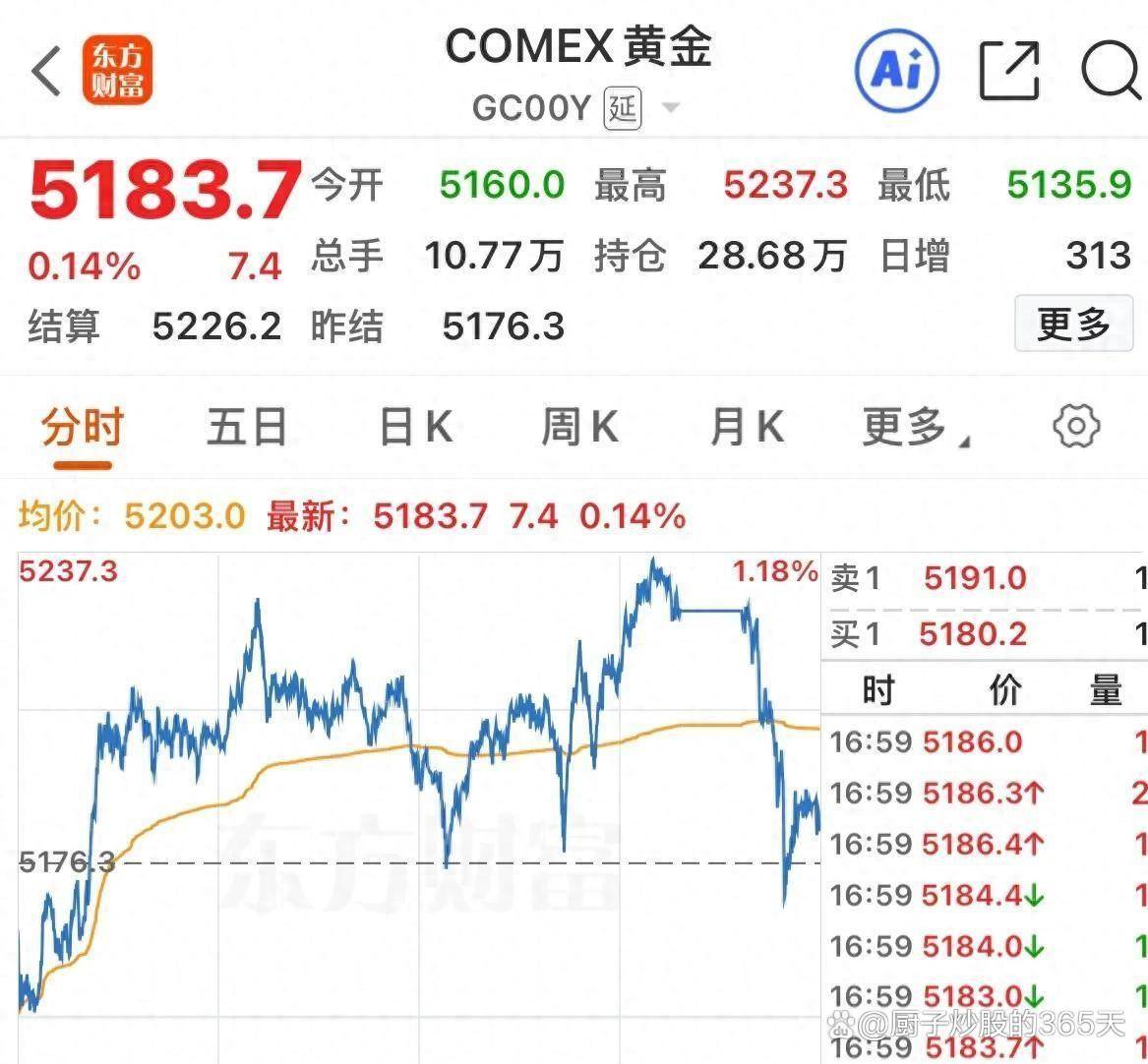
Group 1 - The global financial market witnessed a rare event where both gold and the US dollar, traditionally seen as safe havens, experienced a significant decline simultaneously [1][3] - The stock market, particularly the semiconductor and memory chip sectors, saw remarkable gains, indicating a shift in market dynamics [1][3] Group 2 - International gold prices experienced a notable pullback after four consecutive days of increase, closing at approximately $5183 per ounce, with a peak of $5248.89 earlier in the day [2][11] - The US dollar index fell by 0.26% to close at 97.67, despite a brief attempt to recover during the trading session [3][11] - The simultaneous decline of gold and the dollar suggests a significant outflow of funds from these traditional safe havens into the stock market [3][11] Group 3 - The US stock market indices, including the Nasdaq, S&P 500, and Dow Jones, all closed higher, with the Nasdaq rising by 1.26% and the S&P 500 by 0.81% [3][11] - The semiconductor and memory chip sectors were particularly strong, with Western Digital and Seagate Technology seeing gains of 7.53% and 6.52% respectively, driven by strong demand from AI clients [5][11] - Other technology stocks also performed well, with notable increases in companies like Microsoft, Meta, and Nvidia, reflecting a concentrated preference for tech growth stocks [6][11] Group 4 - European stock markets also showed strong performance, with indices such as the FTSE 100 and DAX reaching new highs, supported by corporate earnings and a rotation of funds from high-valued US tech stocks [10][12] - The lithium sector experienced a surge due to supply concerns following Zimbabwe's announcement to suspend lithium exports, with Sigma Lithium's stock soaring by over 31% [7][12] Group 5 - The overall market sentiment indicates a shift towards technology and resource sectors, with rapid fund movement away from traditional or less popular sectors [7][12] - The strong performance of the semiconductor sector is underpinned by expectations of rising memory chip prices throughout 2026, as indicated by SK Hynix's forecast [5][6]
津巴布韦暂停锂矿出口,13家锂矿公司或将受益,其中7家年报预增
Sou Hu Cai Jing· 2026-02-26 17:37
Core Viewpoint - Zimbabwe's sudden ban on lithium ore and concentrate exports has created significant disruptions in the global lithium supply chain, affecting nearly 20% of China's lithium raw material supply and potentially leading to a supply gap of approximately 14,000 to 15,000 tons of lithium carbonate equivalent per month starting in May 2026 [1][3][4]. Group 1: Impact of Zimbabwe's Ban - Zimbabwe's Ministry of Mines announced an immediate suspension of all lithium ore and concentrate exports, including shipments already at sea, to strengthen mineral regulation and promote domestic processing [1][3]. - In 2025, China imported 7.75 million tons of lithium concentrate, with 1.2 million tons (19%) coming from Zimbabwe, highlighting the critical role of Zimbabwe in China's lithium supply [3]. - The ban is expected to lead to a significant increase in lithium prices, with domestic carbonate lithium futures prices surging to over 171,440 yuan per ton, reflecting a nearly 17% increase in just two trading days [4]. Group 2: Market Reactions and Opportunities - The immediate market reaction saw a spike in lithium prices, with the benchmark price for battery-grade lithium carbonate reaching 162,000 yuan per ton, an increase of over 8% since the beginning of the month [4]. - Companies with integrated mining and processing capabilities in Zimbabwe are positioned to benefit from the ban, as they can still apply for export licenses while others face supply constraints [6]. - A total of 13 domestic companies with lithium carbonate production or lithium mining resources are now in the spotlight, with 7 of them forecasting significant profit increases for 2025 [7]. Group 3: Company Profiles and Strategies - The first tier of companies, termed "ban immune," includes Huayou Cobalt, which has established deep processing capacity in Zimbabwe and is set to produce lithium sulfate, allowing it to circumvent the export ban [9]. - Zhongjin Lingnan has a strong position with its control over the Bikita lithium mine, which allows it to apply for export licenses despite the ban, and it has a stockpile of 150,000 tons of lithium concentrate to buffer against short-term export restrictions [11]. - The second tier includes resource giants like Ganfeng Lithium, which has diversified global resources and is expected to see a significant increase in production from 200,000 tons to 500,000 tons by 2026, benefiting from rising lithium prices [11][13]. Group 4: Long-term Industry Implications - The ban is prompting a reevaluation of companies with overseas resources, local processing capabilities, or stable domestic sources, as their strategic value is being reassessed in the market [17]. - The surge in lithium carbonate futures and the rising stock prices of lithium mining companies reflect this market reassessment and the potential for long-term growth in the sector [17].



节后碳酸锂价格上涨明显
Zheng Quan Ri Bao Zhi Sheng· 2026-02-26 16:10
Group 1 - After the Spring Festival, lithium carbonate prices have surged, with battery-grade lithium carbonate spot prices reported at 173,100 yuan/ton on February 26, up 20.38% from 143,800 yuan/ton on February 13 [1] - The price increase is driven by supply disruptions overseas and post-holiday restocking demand, with domestic production temporarily shrinking due to maintenance at lithium salt companies during the holiday [1] - The demand for lithium carbonate remains strong, particularly from the power battery sector and rapidly growing energy storage needs, leading to increased restocking intentions from downstream [1] Group 2 - East Wu Securities forecasts that lithium carbonate prices will accelerate upward starting from late December 2025, with a balanced supply-demand situation expected from 2026 to 2027, and a potential reversal in 2028 [2] - The price increase benefits upstream companies, such as Tibet Mining Development Co., which holds exclusive mining rights to the Zabuye Salt Lake, the largest lithium salt lake in Asia [2] - Downstream battery companies face cost pressures and may respond through technological iterations and efficiency improvements, leading to the exit of inefficient capacities and a reshaping of the competitive landscape [2] Group 3 - Jiangsu Longpan Technology Group has implemented vertical integration in lithium carbonate raw materials, operating a lithium carbonate processing plant with an annual capacity of 40,000 tons in Yichun, Jiangxi [3] - This project helps secure raw material supply and control costs, while self-built lithium carbonate capacity reduces procurement cost volatility and creates industrial synergy [3]
融捷股份:公司截至2026年1月末的股东户数约5.41万户
Zheng Quan Ri Bao Wang· 2026-02-26 12:44
Core Viewpoint - Rongjie Co., Ltd. (002192) reported that as of the end of January 2026, the number of shareholders is approximately 54,100 [1] Group 1 - The company primarily discloses the number of shareholders at the end of each month [1]

涨价潮,轮到碳酸锂了?
Ge Long Hui A P P· 2026-02-26 12:38
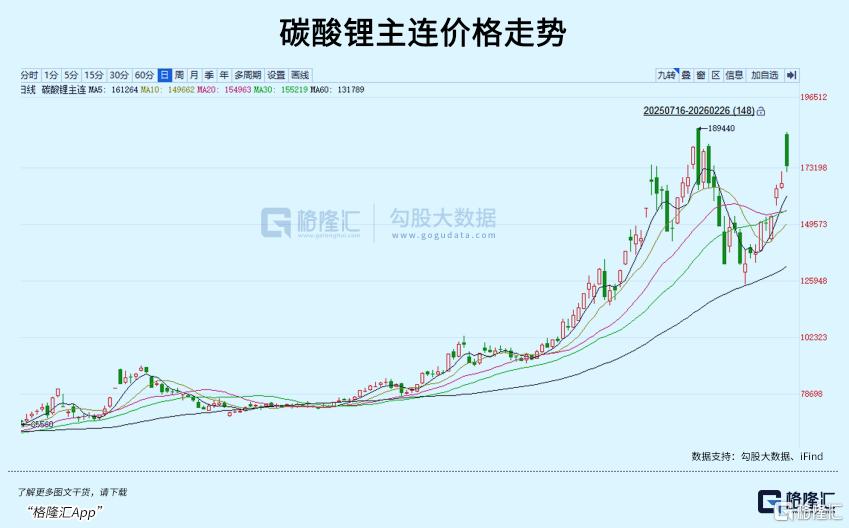
Core Viewpoint - The lithium market is experiencing significant volatility, with a sharp increase in lithium carbonate futures prices, while stock performance among lithium companies shows a stark divergence, influenced by geopolitical factors and supply chain disruptions [1][3][10]. Group 1: Market Dynamics - Lithium carbonate futures surged over 11.42%, reaching nearly 187,700 yuan/ton [1]. - Core lithium stocks like Salt Lake Co., Tianqi Lithium, and Ganfeng Lithium opened strongly, while others like Shengxin Lithium and Yahua Group faced significant declines [3]. - The supply chain is under pressure due to a sudden export ban on lithium concentrate from Zimbabwe, a major lithium producer, which has altered market expectations [6][8]. Group 2: Geopolitical Influences - Zimbabwe's government announced a complete ban on lithium concentrate exports, moving the timeline for this ban forward by a year, which is seen as a strategic move to retain more value from its resources [6][7]. - The ban is part of Zimbabwe's broader strategy to enhance local processing capabilities and reduce reliance on raw mineral exports [7][8]. - The geopolitical nature of lithium resources is becoming increasingly significant, with countries prioritizing control over these strategic materials [6]. Group 3: Supply and Demand Forecast - Global demand for lithium is projected to reach 180,000 tons of lithium carbonate equivalent (LCE) by 2026, with a year-on-year growth rate of approximately 27% [8]. - Zimbabwe's lithium production is expected to reach 235,000 tons by 2026, accounting for about 12% of global supply [8]. - The domestic lithium salt refining capacity in China is heavily reliant on Zimbabwean ore, with 19% of lithium concentrate imports coming from Zimbabwe [8]. Group 4: Company Performance and Strategy - Companies with local processing capabilities in Zimbabwe, such as Zhongjin Resources and Huayou Cobalt, may benefit from the export ban, while those relying solely on raw mineral exports could face significant challenges [10][11]. - Yahua Group and Shengxin Lithium are at risk due to their reliance on exporting raw materials without established local processing operations [11][14]. - Companies like Salt Lake Co. that have low-cost domestic resources are positioned to benefit from rising lithium prices amid supply disruptions [14][17]. Group 5: Market Comparisons - Despite the surge in lithium prices, the overall stock performance of lithium companies has not matched that of precious metals and rare earths, which are experiencing higher price elasticity due to geopolitical factors [17][21]. - The supply elasticity of lithium is higher, with forecasts indicating a 32.3% increase in global lithium production by 2026, suggesting that price increases may lead to rapid production responses [22][25]. - The market's perception of the Zimbabwean export ban may be tempered by the potential for negotiations and future cooperation between the Zimbabwean government and Chinese companies, reducing fears of a long-term supply crisis [25].
涨价潮,轮到碳酸锂了?
格隆汇APP· 2026-02-26 12:29
Group 1 - The article discusses the recent volatility in the lithium market, highlighting a significant increase in lithium carbonate futures prices, which rose by over 11.42% to nearly 187,700 yuan per ton [2][4] - There is a stark divergence in stock performance among lithium companies, with some like Salt Lake Co., Tianqi Lithium, and Ganfeng Lithium seeing strong gains, while others like Shengxin Lithium and Yahua Group faced substantial declines [5][20] - The article emphasizes the geopolitical implications of lithium resources, particularly following Zimbabwe's unexpected announcement of a complete ban on lithium concentrate exports, which was initially planned for 2027 but has been moved up by a year [10][12] Group 2 - Zimbabwe's ban is seen as a strategic move to alter the global profit distribution of mineral resources, as the country aims to enhance local value addition rather than relying on raw mineral exports [11][14] - The article notes that Zimbabwe is the fourth-largest lithium producer globally, with expectations that its lithium production will reach 235,000 tons by 2026, accounting for about 12% of global supply [12][14] - The domestic lithium salt refining capacity in China is heavily reliant on Zimbabwean ore, with 19% of lithium concentrate imports coming from Zimbabwe, amounting to approximately 120,000 tons [15][16] Group 3 - The article highlights the impact of the export ban on downstream battery manufacturers, indicating that companies like CATL have also experienced stock declines due to supply chain uncertainties [18] - The supply disruption is expected to lead to upward pressure on lithium prices, as the market anticipates potential shortages if alternative supply sources cannot be developed in the medium to long term [18][19] - The article suggests that companies with domestic low-cost resources, such as Salt Lake Co., may benefit from the price surge, while those relying on raw mineral exports could face significant challenges [24][27] Group 4 - Despite the surge in lithium futures prices, the overall stock performance of lithium mining companies has been mixed, with some companies facing operational challenges due to the export ban [20][21] - The article points out that companies with established local processing capabilities may be better positioned to navigate the new regulatory landscape, while those with a "mining and shipping" model may struggle [21][23] - The article concludes that the era of simply holding mining licenses for high valuations is over, as geopolitical factors increasingly influence operational costs and market dynamics [32][33]