资产管理

Search documents
近五分之一Z世代“非常担心”AI会抢走饭碗
财富FORTUNE· 2025-10-09 13:05
Core Insights - A recent survey by Deutsche Bank Research indicates that nearly one-fifth of Generation Z workers are concerned that artificial intelligence (AI) will take their jobs within the next two years, highlighting a significant generational divide in job security anxiety [2][3] - The survey, conducted across six countries, found that 24% of respondents aged 18-34 rated their job loss concerns at 8 or above on a scale of 0-10, compared to only 10% of those aged 55 and above [2][3] - The overall concern about job loss due to AI increases from 18% for the next two years to 22% when considering a five-year timeline, indicating a growing perception of AI as a long-term threat to job security [2][3] Generational and Regional Differences - The survey results reveal generational and regional disparities in AI application and trust, reflecting a strong demand for AI training and self-improvement among workers [3] - Younger individuals feel a higher risk of job loss due to AI, particularly in sectors like software engineering and customer service, where entry-level job openings have sharply decreased [3][4] - In contrast, only 10% of respondents aged 55 and above believe AI will significantly threaten their employment in the next two years, likely due to their experience and adaptability [4] Regional AI Usage and Employment Trends - The usage rate of AI in the workplace is higher in the U.S. (56%) compared to Europe (average of 52%), with notable differences in AI application across countries [5] - The youth unemployment rate in the U.S. has surged, contrasting with declining rates in the Eurozone and the UK, suggesting that the impact of AI on youth employment may not be uniform globally [5] - The analysis indicates that the U.S. labor market is characterized by low turnover rates, which have increased the time it takes for young job seekers to find new employment [5] Training and Trust Issues - The research highlights a lack of adequate corporate training, with only about 25% of respondents in Europe and nearly one-third in the U.S. having received AI-related training [6] - There is a trend of self-directed learning among employees to bridge skill gaps, although trust in AI remains low, with about one-third of frequent users expressing skepticism about AI-generated information, especially in sensitive areas like healthcare and personal finance [7]



因产品交由他人行使交易职责等违规问题,横琴观致资管被监管责令改正
Bei Jing Shang Bao· 2025-10-09 12:18
北京商报讯(记者郝彦)10月9日,广东证监局发布公告表示,珠海横琴观致资产管理有限公司(以下简 称"横琴观致资管")存在以下违规情形:未对珠海横琴观致精选10号私募证券投资基金等4只私募基金产 品履行主动管理职责,将该4只产品开立的证券账户及密码交由他人管理,并由他人行使交易职责。未 自行或委托第三方机构对所管理的私募基金产品进行风险评级。未在内部制度中明确投资者与产品适当 性匹配的具体依据、方法、流程。综上,横琴观致资管被监管责令改正。 广东证监局指出,孟庆平作为横琴观致资管的执行董事、总经理,未能恪尽职守、严格遵守法律法规, 对公司上述违规行为负有主要责任,广东证监局决定对其采取出具警示函的行政监管措施。 ...

贝莱德:比特币ETF管理规模超80万枚,价值约1000亿美元
Sou Hu Cai Jing· 2025-10-09 11:29
Core Insights - The assets under management (AUM) of BlackRock's Bitcoin ETF have surpassed 800,000 bitcoins, valued at approximately $10 billion [1] Group 1 - BlackRock's Bitcoin ETF has reached a significant milestone in terms of AUM, indicating strong investor interest in cryptocurrency investments [1] - The current valuation of the ETF at around $10 billion reflects the growing acceptance and integration of Bitcoin into mainstream financial products [1]

金价连创新高,该配置多少?达利欧回应
21世纪经济报道· 2025-10-09 11:03
Core Insights - The 2025 Greenwich Economic Forum focused on private capital cycles, AI and finance integration, alternative asset opportunities, and global macroeconomic outlooks [1] - Ray Dalio discussed the interplay of five major forces shaping the current macroeconomic landscape, which include debt, political polarization, international power dynamics, natural shocks, and technological advancements [5][6] Group 1: Five Major Forces - The first force is the long cycle of "debt-money-credit," where credit expansion drives demand, but debt burdens can lead to supply-demand mismatches and slower growth [6] - The second force involves wealth and value divergence leading to political polarization, complicating traditional negotiation mechanisms [6] - The third force is structural friction between rising powers and existing hegemonies in the international landscape [6] - The fourth force consists of periodic natural shocks (e.g., droughts, diseases) that can be as damaging as wars [6] - The fifth force is the leap in human knowledge, particularly through technological revolutions, which fundamentally drives improvements in life expectancy and income [6] Group 2: Economic Policies and Asset Allocation - Dalio characterized the current U.S. fiscal and financial state as a "debt-for-debt" phase, with widening spending and income gaps, leading to increased reliance on government bonds [7] - He emphasized that gold is a significant asset, acting as a "second reserve currency," especially when fiat currency credibility is diluted by debt and deficits [7][8] - In terms of asset allocation, Dalio advocates for a "neutral portfolio" to maximize after-tax returns and diversification before making tactical adjustments [9] - Gold has seen a significant rise, surpassing $4000 per ounce, with a year-to-date increase of nearly $1400 per ounce, reflecting its role as a diversifying asset [9][10] Group 3: Market Dynamics and Regional Focus - Dalio expressed a cautious view on debt assets, preferring to be bullish on gold given the current credit conditions [10] - He noted the complexity of monetary policy, highlighting disparities between high-income groups and lower-income groups, making a one-size-fits-all approach ineffective [10] - Comparing the current situation to historical periods of fiscal and monetary resets, he warned of potential currency devaluation and political fragmentation [10] - Regarding regional asset allocation, Dalio suggested maintaining a higher weight in U.S. assets due to their size and liquidity while keeping exposure to Chinese assets, which require structural reforms [11]

由于第一品牌集团“爆雷” 贝莱德试图从杰富瑞基金中抽回资金
Sou Hu Cai Jing· 2025-10-09 09:51
Core Insights - BlackRock has requested to withdraw part of its investment from a fund under Jefferies Financial Group due to significant exposure to the trade debt of bankrupt auto parts supplier First Brands Group [2] - BlackRock and other investors, including the Texas Treasury Safekeeping Trust Company, are negotiating a partial redemption of investments in Point Bonita Capital, a unit of Jefferies' Leucadia Asset Management [2] - Point Bonita Capital invested $715 million in receivables from First Brands, which ceased payments on September 15, just two weeks before the company filed for bankruptcy [2] Company Overview - BlackRock, founded in 1988 and headquartered in New York, is one of the largest asset management firms globally, with a primary focus on pension funds, sovereign wealth funds, and insurance [2]

北京公布2025年第三批重大劳动保障违法案例
Xin Jing Bao· 2025-10-09 08:39
Core Points - The Beijing Municipal Human Resources and Social Security Bureau has released the third batch of major labor security violation cases for 2025, involving five companies including Beijing Xinzuo Youcheng Construction Co., Ltd. and Beijing Pioneer Green Asset Management Co., Ltd. The cases include wage arrears and illegal use of child labor, with some companies being placed on a blacklist for failing to pay wages to migrant workers and being referred to law enforcement for criminal charges related to wage non-payment [1] Group 1: Beijing Xinzuo Youcheng Construction Co., Ltd. - The company was found to owe wages totaling 1,320,698.22 yuan to 49 migrant workers from December 2023 to December 2024 [2] - The company was issued a correction notice on July 18, 2025, but failed to pay by the deadline [2] - The company was fined 20,000 yuan and referred to the police for criminal charges related to wage non-payment [2] Group 2: Beijing Pioneer Green Asset Management Co., Ltd. - The company owed a total of 754,620.99 yuan in wages to 11 workers from September 2024 to February 2025 [3] - An administrative decision was made on May 20, 2025, requiring the company to pay the owed wages plus a compensation of 377,310.5 yuan [3] - The company did not comply with the administrative decision, leading to potential court enforcement actions [3] Group 3: Beijing Mujinghui Catering Service Management Co., Ltd. - The company was found to have illegally employed minors under the age of 16 [4] - The company was fined 35,000 yuan and had 2,800 yuan in illegal earnings confiscated [4] - The company complied with the administrative penalty [4] Group 4: Beijing Zhongwen Hongchang Property Management Co., Ltd. - The company owed wages totaling 210,436.74 yuan to 30 workers for the period from March to April 2025 [5][6] - An administrative decision was made requiring the company to pay the owed wages and an additional compensation of 105,218.44 yuan [6] - The company failed to comply with the administrative decision, leading to potential court enforcement actions [6] Group 5: Tang Yi Holdings (Shenzhen) Co., Ltd. Beijing Branch - The company owed a total of 368,708.78 yuan, including wages and economic compensation, to a worker for the period from July to December 2024 [7] - An administrative decision was issued requiring payment by May 31, 2025, but the company did not comply [7][8] - The company faces potential court enforcement actions for non-compliance with the administrative decision [8]
法国互助信贷:新兴市场和中国股票估值更具吸引力
Ge Long Hui A P P· 2025-10-09 08:05
Core Viewpoint - Emerging market stocks and Chinese stocks appear more attractive in terms of valuation compared to U.S. stocks, which are considered overvalued by the analyst François Rimeu from French mutual credit asset management company [1] Summary by Category Valuation Analysis - U.S. stock valuations have been driven up, leading to limited upside potential even under optimistic earnings forecasts [1] Investment Preference - The company shows a preference for investing in stocks, particularly in emerging markets and Chinese stocks [1]
ESG动态跟踪月报(2025年9月):NDC新目标锚定长期转型,荷兰养老金战略调整引关注-20251009
CMS· 2025-10-09 07:45
- The report focuses on the regulatory dynamics, market trends, and product issuance in the ESG field, providing a systematic review of important information from the past month for investors' reference[1] - As of the end of September, there were 930 ESG-themed funds in the A-share market, with a total scale of approximately 1.03 trillion yuan, an increase of over 4% from the beginning of the year[4] - The newly issued ESG bonds in September amounted to 125.674 billion yuan, with green bonds dominating the market[81] - The report highlights the strategic shift of the Dutch pension fund PFZW towards active investment, ending cooperation with several institutions like BlackRock[51][52] - The report also discusses the launch of the "National Tea Carbon Footprint Digital Platform," exploring the carbon management system for agricultural products[43]

经济不确定性支撑沪银价走高
Jin Tou Wang· 2025-10-09 07:32
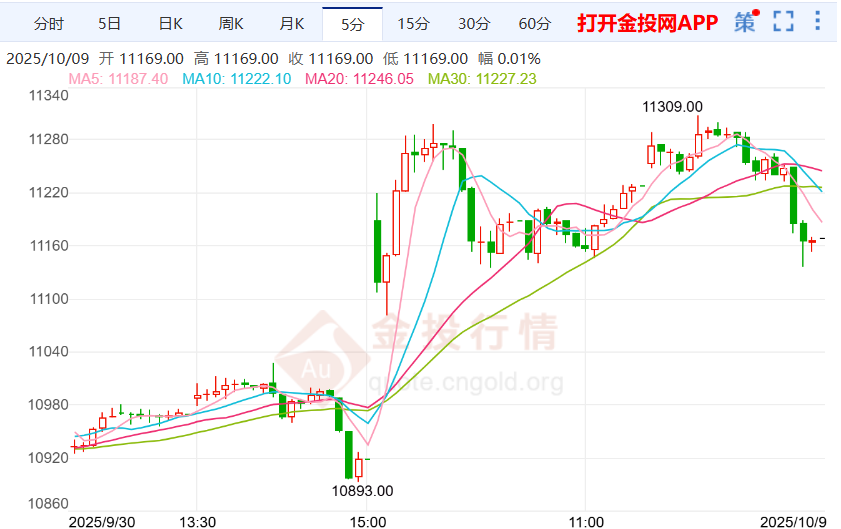
Group 1 - Silver futures are currently trading above 11115, with a reported price of 11169 per kilogram, reflecting a 2.22% increase, and a trading range between 11082 and 11309 [1] - The recent agreement between Israel and Hamas to release all hostages, facilitated by U.S. negotiations, has weakened the safe-haven demand for silver [3] - Despite this, silver prices remain near historical highs since 1993, driven by global economic uncertainty, trade concerns, and issues related to U.S. fiscal sustainability [3] Group 2 - Geopolitical tensions and the continued accumulation of silver by the largest silver ETF provide solid support for silver prices [4] - U.S. Treasury Secretary Mnuchin has concluded interviews for candidates to replace current Federal Reserve Chair Powell, indicating potential shifts in monetary policy [4] - The long-term outlook for silver remains bullish, with expectations of continued volatility post-holiday, suggesting a trading range focus between 11130 and 11300, and a broader range of 11000 to 11400 [4]
风格切换或在悄然进行︱“重阳S4”圆桌2025年四季度
重阳投资· 2025-10-09 07:04
Core Viewpoint - The A-share index has reached a new high of 3800 points, indicating a structural market characterized by significant divergence, with technology stocks led by AI continuing to rise while traditional sectors remain sluggish [1][4][9]. Group 1: Market Performance and Insights - The third quarter saw extreme structural differentiation in the market, aligning with the current economic fundamentals and interest rate environment [4][5]. - Despite the overall economic pressure, there are structural highlights driven by innovation, particularly in technology sectors [4][5]. - The market has transitioned from low volatility to increased fluctuations since September, suggesting a new critical phase [1][4]. Group 2: Future Market Outlook - The index's breakthrough of 3800 points reflects both internal and external factors, including China's strong global competitiveness in technology and abundant global liquidity [9][10]. - The sustainability of the market's upward trend depends on the transition from risk appetite to improvements in corporate earnings and further declines in interest rates [10][11]. - The potential for a market correction exists if lagging sectors do not begin to rise, indicating a need for careful monitoring of economic fundamentals [10][11]. Group 3: Investment Strategies and Style Shifts - The current extreme market differentiation may lead to a style shift, with potential beneficiaries being traditional cyclical sectors and those supported by stable growth policies [13][14]. - Historical patterns suggest that extreme differentiation often contains mean-reversion dynamics, increasing the likelihood of a style switch [13][14]. - Investment strategies should focus on identifying undervalued sectors and companies with recovery potential, while avoiding chasing high-flying stocks [13][14][15]. Group 4: Risks and Cautions - The current market environment presents heightened risks, particularly for sectors that have seen significant price increases, such as AI-related stocks [18][19]. - Investors should remain cautious, as rapid technological advancements in AI could lead to swift changes in market expectations and valuations [18][19]. - Maintaining a balanced approach and being prepared for potential corrections in overheated sectors is essential for managing investment risks [18][19][20]. Group 5: Advice for Investors - Investors who missed the recent market rally should focus on sectors that have not yet experienced significant gains, as these may present future opportunities [23][25]. - Emphasizing a long-term investment perspective and avoiding impulsive decisions based on short-term market movements is crucial [23][26]. - The importance of understanding one's investment capabilities and risk tolerance is highlighted, suggesting that professional management may be beneficial for those lacking confidence [26].