
制造业

Search documents
中国税务快讯:APA签署效率提高,双边APA受跨国企业青睐
KPMG· 2025-12-02 00:43
Group 1: APA Signing Trends - In 2024, China signed a total of 39 APAs, comprising 12 unilateral and 27 bilateral agreements, showing an increase from 36 APAs in 2023[8] - The number of bilateral APAs signed in 2024 included 22 new agreements and 5 renewals, with 70 bilateral APAs in the intention stage, up by 10 from 2023[8] - The completion rate for APAs in China was 24.20% in 2024, significantly higher than the global average of 18.1%, ranking seventh among reported jurisdictions[8] Group 2: International Cooperation and Industry Focus - From 2005 to 2024, 170 bilateral APAs were signed, with 118 (approximately 70%) involving Asian countries, 33 (20%) with European countries, and 18 with North America[8] - The manufacturing sector remains the primary focus for APA services, with 22 cases involving tangible assets, 12 involving intangible assets, and 8 involving services[8] - The transaction net profit method was the most commonly used transfer pricing method, applied 328 times (83.9% of cases), while other methods were also utilized[8] Group 3: Future Outlook and Compliance - The inventory of bilateral APAs reached 177 cases in 2024, an increase of 28 from 2023, indicating a trend towards stricter acceptance and review processes[11] - Companies are encouraged to submit comprehensive and accurate documentation to expedite the APA application process, particularly focusing on value chain and market premium analyses[11] - Chinese tax authorities are actively enhancing international tax cooperation, with 23 transfer pricing MAP cases concluded in 2024, reflecting a commitment to dispute prevention and resolution[11]
美国制造业活动连续9个月萎缩
Xin Hua She· 2025-12-02 00:38
Core Viewpoint - The US manufacturing sector continues to experience contraction, with the Purchasing Managers' Index (PMI) declining for the ninth consecutive month, indicating ongoing challenges in the industry due to tariffs and government shutdowns [1] Group 1: Manufacturing Sector Performance - The PMI for US manufacturing fell from 48.7 in October to 48.2 in November, which is below the market consensus expectation of 49 [1] - This decline signifies that manufacturing activity has been in a state of contraction for nine months in a row [1]
36城转移支付收入出炉,国际白银价格创历史新高 | 财经日日评
吴晓波频道· 2025-12-02 00:29
Group 1: Manufacturing and Economic Indicators - The official manufacturing PMI for November rose to 49.2%, a 0.2% increase from the previous month, indicating a slight recovery despite remaining below the critical point [2] - The non-manufacturing business activity index fell to 49.5%, a decrease of 0.6% from the previous month, with the construction sector showing a slight improvement while the service sector declined [2] - The RatingDog manufacturing PMI dropped to 49.9%, down from 50.6%, with new orders nearing stagnation and production halting expansion, although export orders saw the fastest growth in eight months [2][3] Group 2: Virtual Currency Regulation - The People's Bank of China reiterated its strict prohibition on virtual currencies, emphasizing that they do not hold the same legal status as fiat currencies and are considered illegal financial activities [4] - Stablecoins, a form of virtual currency, were highlighted for their inability to meet customer identification and anti-money laundering requirements, posing risks for illegal activities [4][5] - The central bank's stringent management of stablecoins is seen as an effective measure for financial risk prevention [5] Group 3: Fiscal Transfers and Local Government Finance - In 2024, Chongqing received the highest level of transfer payments at 249.165 billion yuan, followed by Beijing, Shanghai, and Tianjin, indicating disparities in local fiscal capabilities [6] - The report highlights that transfer payments are crucial for balancing regional financial disparities, with cities in the central and western regions focusing on strengthening provincial capitals [6][7] Group 4: Education and Talent Development - Seven universities, including Shanghai Jiao Tong University, have applied to establish a new undergraduate program in embodied intelligence, reflecting the industry's demand for skilled talent [8] - The average annual salary for embodied intelligence roles is reported at 333,400 yuan, surpassing that of the broader AI sector [8] Group 5: Market Performance and Trends - On December 1, the stock market saw a rebound with the Shanghai Composite Index rising 0.65%, supported by strong performance in consumer electronics and industrial metals sectors [16] - The market is experiencing structural differentiation, with various sectors showing mixed performance, indicating a cautious outlook for the upcoming year-end rally [17]


美股"五连阳"终结,中国资产逆势走强,阿里巴巴涨超4%,网易大涨5%,加密货币遭遇“黑色星期一”
Sou Hu Cai Jing· 2025-12-02 00:09
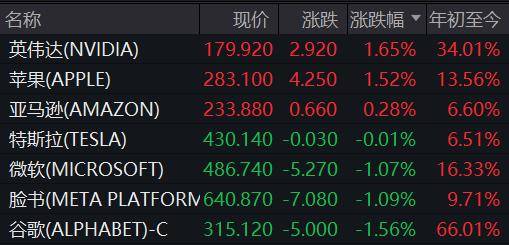
12月首个交易日,美股市场迎来寒意。三大股指集体收跌,道琼斯工业平均指数下跌0.9%,标普500指 数跌0.53%,纳斯达克综合指数跌0.38%,终结了此前的"五连阳"行情。市场风险偏好显著回落,恐慌 指数VIX单日上涨超过5%,显示投资者情绪趋于谨慎。 科技巨头表现分化。英伟达逆势上涨1.65%,苹果涨1.52%,盘中一度触及历史新高;但谷歌、微软、 Meta均跌超1%,博通重挫4.19%。值得关注的是,英伟达宣布与EDA公司新思科技深化战略合作,斥 资20亿美元入股新思科技,受此消息提振,新思科技股价大涨4.85%。 | 名称 | 现价 涨跌 涨跌幅 ▼ 年初至今 | | | --- | --- | --- | | 英伟达(NVIDIA) | 179.920 2.920 1.65% 34.01% | | | 苹果(APPLE) | 283.100 4.250 1.52% 13.56% | | | 亚马逊(AMAZON) | 233.880 0.660 0.28% | 6.60% | | 特斯拉(TESLA) | 430.140 -0.030 -0.01% | 6.51% | | 微软(MICROSOFT) ...

美股尾盘跳水,中概股逆势走强
Di Yi Cai Jing Zi Xun· 2025-12-01 23:52
作者 |第一财经 樊志菁 受美国国债收益率上升以及疲弱经济数据影响,美股主要股指周一下挫终结五连阳。截至收盘,道指跌 427.09点,跌幅0.90%,报47289.33点,纳指跌0.38%,报23275.92点,标普500指数跌0.53%,报6812.63 点。芝加哥期权交易所波动率指数(VIX)上涨5.5%,至17.23。 2025.12.02 本文字数:1663,阅读时长大约3分钟 "显然,市场目前仍由盈利驱动 ——我们刚刚经历了财报季,但现在焦点已转向美联储,"位于Themis Trading公司合伙人、联合创始人兼股票市场结构研究主管及股票交易联席主管萨卢齐(Joe Saluzzi)表 示。"我认为目前没有理由让上涨趋势停止,至少不会很快停止,或许到年底前,市场会以一种更缓慢 但稳步攀升的态势前行。" 鲍威尔计划在股市收盘后发表讲话,但由于距离美联储政策会议已非常临近,他大概率不会就货币政策 发表评论。"我猜投资者会试图从他的发言中寻找任何暗示,但目前来看,(降息)似乎已是板上钉钉 的事,"萨卢齐说道。 受日本央行行长植田和男相关言论影响,日本和欧洲国债价格走弱股市下挫,进而带动美国国债收益率 上升, ...

机构展望明年经济增速在5%左右 宏观政策和重大项目将持续发力
2 1 Shi Ji Jing Ji Bao Dao· 2025-12-01 23:13
Economic Overview - The overall economic performance in 2025 is expected to show a "high first, low second" trend, with a projected annual growth target of around 5% [1][4][6] - The economy grew by 5.2% year-on-year in the first three quarters of 2025, with quarterly growth rates of 5.4%, 5.2%, and 4.8% respectively [1][2] Economic Indicators - The manufacturing PMI for November recorded at 49.2%, indicating a slight improvement but still below the expansion threshold [2][5] - The CPI decreased by 0.1% and the PPI fell by 2.8% in the first three quarters, reflecting weak overall demand [3] Sector Performance - Industrial value added grew by 6.2% year-on-year, while the service sector increased by 5.4%, indicating resilience in supply chains despite external pressures [3] - Exports showed strong resilience, with a 5.3% year-on-year increase from January to October, attributed to competitive products and diversified market strategies [4][10] Policy Recommendations - To counteract the economic downturn in the fourth quarter, more proactive macroeconomic policies are recommended, including increased fiscal spending and monetary easing [6][9] - Suggestions include raising the fiscal deficit rate to 5% and enhancing public financial support for consumption and infrastructure projects [8][10] Future Outlook - The economic growth for 2026 is anticipated to be around 5%, with expectations of a "low first, high second" trend due to new opportunities arising from the "14th Five-Year Plan" [6][8] - The need for a robust fiscal and monetary policy framework is emphasized to support economic recovery and growth [9][10]
让互利共赢纽带更结实(开放谈)
Ren Min Ri Bao Hai Wai Ban· 2025-12-01 22:11
Group 1 - China's outbound direct investment continues to grow steadily, solidifying its position as a major investor globally, despite a decline in global cross-border direct investment [1] - Chinese enterprises are distributed across 190 countries, with nearly half of the top 20 investment destinations in 2024 being developed countries [1] - Investment in countries participating in the Belt and Road Initiative reached 234.15 billion RMB in the first ten months of 2025, a year-on-year increase of 22.3% [1] Group 2 - The manufacturing sector saw its highest investment flow in 2024, increasing by 45.3% compared to 2020 [1] - The service industry, characterized by light assets, has flourished, with investments in logistics, R&D, business, and finance growing, extending the investment value chain [2] - In 2024, outbound investments contributed to $211 billion in goods exports, 1.2 times that of 2020 [2] Group 3 - Chinese outbound investments have improved infrastructure in host countries, enhancing employment and tax revenues, and accelerating their green and digital transformation [2] - In 2024, Chinese enterprises paid a total of $82.1 billion in various taxes to host countries, employing 5.021 million people, with 3.304 million being local employees [2] - The focus on localization in investment strategies is emphasized, aiming to enhance sustainable development capabilities in host countries [3]
最新报告预测 2025年欧盟实际GDP将增长1.4% 欧元区增长1.3%——欧盟经济迎来小幅回暖(国际视点)
Ren Min Ri Bao· 2025-12-01 22:07
Economic Outlook - The European Commission forecasts a 1.4% growth in EU GDP for 2025 and a 1.3% growth for the Eurozone, with similar growth rates expected in 2026 [1] - The EU's GDP grew by 0.3% quarter-on-quarter and 1.5% year-on-year in Q3, while the Eurozone saw a 0.2% quarter-on-quarter and 1.3% year-on-year growth [1] Economic Performance Disparities - Economic performance across EU member states shows significant divergence, with 9 out of 20 Eurozone countries achieving positive quarter-on-quarter growth [2] - Spain and Portugal have emerged as key growth drivers, with Spain's GDP growing by 3.1%, 3%, and 2.8% year-on-year in the first three quarters [2] Sectoral Insights - France's economy grew by 0.5% in Q3, driven by investment and export increases, particularly in the aerospace sector [3] - Germany's economy stagnated in Q3 after a 0.2% contraction in Q2, with traditional export sectors like automotive and machinery facing slowdowns [3] Monetary Policy - The European Central Bank (ECB) has maintained key interest rates, reflecting a cautious approach amid weak economic recovery and declining inflation [4][5] - The ECB's strategy aims to balance price stability and growth, with a focus on flexible policy adjustments [5] Structural Challenges - The EU faces significant structural issues, including high public debt and an aging workforce, which may hinder long-term economic growth [6] - The EU's fiscal deficit is projected to rise, with public debt as a percentage of GDP expected to increase from 84.5% in 2024 to 85% by 2027 [6] Policy Recommendations - The European Commission emphasizes the need for structural reforms to address economic challenges, including a push for green economy initiatives and digital transformation [6] - Labor market reforms and educational investments are identified as critical for unlocking long-term growth potential [6]
U.S. manufacturing activity contracted for the ninth consecutive month in November, a decline manufacturers attribute largely to President Trump's tariffs
WSJ· 2025-12-01 16:18
U.S. manufacturing activity contracted for the ninth consecutive month in November, a decline manufacturers attribute largely to President Trump's tariffs. The Institute for Supply Management's PMI for manufacturing came in at 48.2, a decrease from 48.7 in October. The level was below the 50 score that divides contraction from expansion. ...

节假日拖累,印度10月工业产出增速跌至0.4%,创14个月新低
Hua Er Jie Jian Wen· 2025-12-01 13:41
Core Insights - India's industrial output growth slowed sharply to 0.4% in October, marking the lowest level in 14 months, indicating significant growth pressures on the economy [1][2] - The manufacturing output growth dropped from 4.8% in September to 1.8% in October, while mining and electricity production fell by 1.8% and 6.9% respectively [1][2] - The slowdown is attributed to reduced working days due to festivals like Diwali, despite the government's GST cuts aimed at stimulating domestic consumption [1][3] Industry Performance - The industrial production index (IIP) data shows a comprehensive deterioration across key sectors, with manufacturing still in positive growth but significantly down from previous months [2] - The three major sectors—manufacturing, mining, and electricity—are all experiencing a slowdown, raising concerns about the economic outlook [2] Economic Context - October is a critical month for the Indian economy, coinciding with the implementation of GST cuts on September 22, intended to boost domestic consumption and mitigate the impact of U.S. tariffs [3] - Despite facing a 50% tariff increase from the U.S., India's economic growth for the quarter ending in September exceeded expectations, reaching 8.2%, the highest in six quarters [3] Future Outlook - Economists remain relatively optimistic about the coming months, suggesting that robust consumer demand will partially offset weak export demand [4][5] - Strong rural income, low inflation, interest rate cuts, and tax reductions are expected to sustain healthy consumer spending, benefiting the manufacturing sector [5]