
科技

Search documents
美股休整,银行、科技集体转弱,中概股四连跌,黄金再创新高
Ge Long Hui· 2025-09-24 04:35
Market Overview - US stock market experienced a pullback after reaching highs, with all three major indices closing lower: Dow Jones down 0.19%, Nasdaq down 0.95%, and S&P 500 down 0.55% [1] Banking Sector - Mixed performance in bank stocks, with Goldman Sachs, JPMorgan Chase, Morgan Stanley, and Zions Bancorporation showing slight gains, while Bank of America, Citigroup, and US Bancorp recorded minor declines [3] Technology Sector - Technology stocks weakened, highlighted by Amazon's significant drop of 3.04%, Nvidia down 2.82%, and Tesla down 1.93%. Microsoft and META also saw declines exceeding 1%. Conversely, Intel rose by 2.02% and AMD increased by 0.69% [3] Chinese Concept Stocks - Chinese concept stocks continued to decline, marking a four-day losing streak with an overall drop of 2.22%. Notable declines included Baidu down 8.09%, Bilibili down 4.02%, and Tencent Music down 4.2%, while NIO and NetEase saw slight gains [3] Gold Market - COMEX gold experienced a pullback, closing up 0.42% at $3,796.9 per ounce, with intraday fluctuations showing a low of $3,772.4 and a high of $3,824.6. The market sentiment around gold remains conflicted, balancing fears of high prices against prevailing trends [3]


"9·24”一周年,A股总市值破116万亿元,四大变革重塑中国资本市场新生态
3 6 Ke· 2025-09-24 04:09
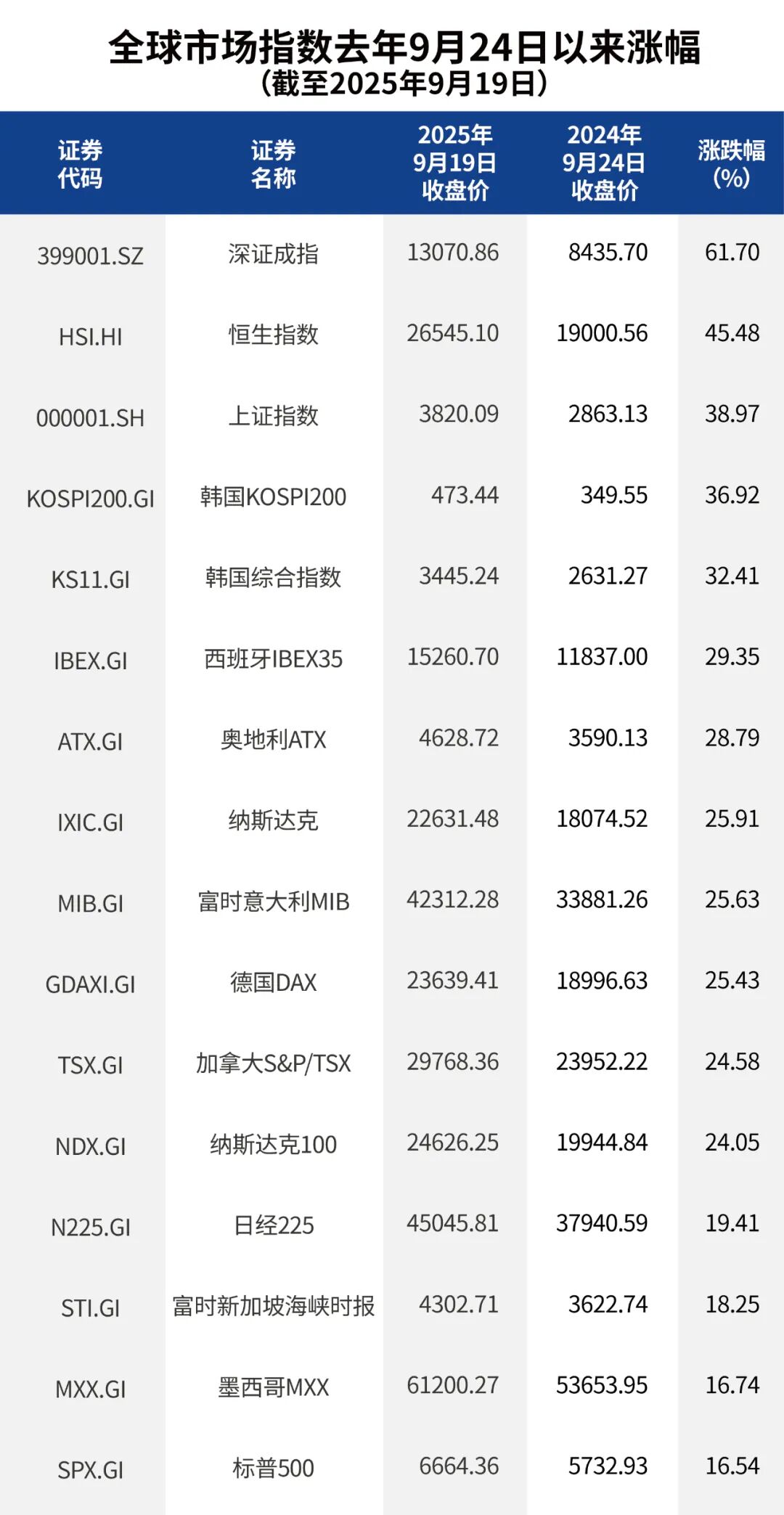
Core Insights - The "9·24 market" initiated a significant transformation in the A-share market, marking the beginning of a slow bull market characterized by a focus on technology and leading companies, which is essential for China's economic transition [1][16] Policy Foundation - On September 24, 2024, a comprehensive financial policy package was launched to stabilize the real estate, stock market, and economy, which was a critical turning point for the market [2] - The People's Bank of China introduced new monetary policy tools to support stock repurchases and long-term capital inflows, while the China Securities Regulatory Commission (CSRC) encouraged mergers and acquisitions [2][3] Market Performance - Since the launch of the "9·24 market," the total market capitalization of the Shanghai and Shenzhen stock exchanges increased from 81.8 trillion yuan to 116.6 trillion yuan, a rise of 42.54% [7] - The Shenzhen Composite Index saw a cumulative increase of 61.7%, outperforming major global indices [4][5] Capital Inflows - Foreign investment in Chinese assets has shown a positive trend, with net inflows exceeding 10.1 billion USD in the first half of 2025, reversing two years of net outflows [8] - The market has attracted significant foreign capital, particularly in May and June 2025, indicating a growing global interest in Chinese equities [8] Structural Changes - The market has shifted from a focus on small-cap stocks to a concentration on leading companies, with high-dividend sectors and technology growth driving the market [9] - The financial sector's market capitalization increased by 25.18%, while the electronic equipment sector surged by 113%, highlighting the dominance of technology in the current market landscape [11] Investor Engagement - The number of new stock accounts opened in 2025 surged by approximately 48%, reflecting increased investor confidence and market activity [15] - The A-share market has seen a significant rise in trading volume, with daily trading exceeding 2 trillion yuan for 28 consecutive trading days [15] Future Outlook - The "9·24 market" is viewed as a foundational milestone for the long-term development of the A-share market, with expectations of continued growth driven by structural reforms and enhanced investor confidence [16][17] - Analysts suggest that emerging technologies and sectors such as photovoltaics and rare earths may present future investment opportunities [17]
鲍威尔:过度宽松恐失守通胀,紧缩过久也伤就业
Di Yi Cai Jing Zi Xun· 2025-09-23 23:57
Group 1 - Federal Reserve Chairman Jerome Powell highlighted the difficult trade-off between inflation and employment risks, stating that "there is no risk-free path" [1] - The Federal Reserve recently lowered the federal funds rate target range by 25 basis points to 4% to 4.25%, reflecting a shift in risk balance due to increased downside risks in the labor market [2] - Powell noted that the U.S. economy is slowing, with GDP growth of approximately 1.5% in the first half of the year, down from 2.5% last year, and the unemployment rate rising to 4.3% in August [3] Group 2 - Powell acknowledged that inflation remains above the Federal Reserve's 2% target, with total PCE prices rising 2.7% and core PCE rising 2.9% over the past 12 months [3] - Market reactions to Powell's speech were cautious, as he did not provide clear guidance on the timing of future rate cuts, contrasting with market expectations for rapid easing [3][4] - Powell indicated that U.S. stock market valuations are "quite high," suggesting that the market may be overreacting to expectations of monetary easing [4]
跌,跌,跌,一句话惊醒了世界
Xin Lang Cai Jing· 2025-09-23 22:34
Group 1 - The core message from Federal Reserve Chairman Jerome Powell's speech indicates that stock valuations are considered high, which has caused a negative reaction in the market, leading to declines in major indices such as the Dow Jones, S&P 500, and Nasdaq [2] - Following Powell's remarks, there was a notable decline in various asset classes, including a drop in the dollar and gold prices, reflecting a chaotic market environment. Powell's dovish tone, emphasizing concerns over employment rather than inflation, contributed to the dollar's decline [2][3] - The technology sector experienced a significant drop of 1.5%, symbolizing a shift in market sentiment from exuberance to caution, as previous bullish trends driven by AI themes and interest rate cut expectations have been exhausted [3] Group 2 - The current market volatility is unusually low, suggesting a lack of awareness regarding risks, which could lead to sudden market fluctuations. Historical patterns indicate that major declines often occur during periods of calm [3] - The recent market downturn is not merely a minor dip but serves as a psychological warning, indicating that investor confidence may be wavering [4]
港股市场震荡调整 关注AI产业投资机遇
Zhong Guo Zheng Quan Bao· 2025-09-23 20:16
Market Overview - The Hong Kong stock market has shown a volatile adjustment, with the Hang Seng Index closing at 26,159.12 points, down 0.70% as of September 23 [1] - The market has experienced increased liquidity this year, with a refinancing scale reaching 2,327.35 million HKD, more than double last year's total [2] - Southbound capital has seen a cumulative net inflow of 11,183.98 million HKD this year, indicating strong interest in the Hong Kong market [2] Sector Performance - Among the 12 industry sectors, financials, utilities, and conglomerates saw slight increases, while essential consumer goods, healthcare, and real estate sectors faced the largest declines [1] - Notable gains in the financial sector included a 22.25% increase in Shankai Holdings and increases in China Everbright Holdings and Chongqing Rural Commercial Bank [1] Investment Trends - The AI industry remains a core focus for the Hong Kong stock market, with expectations of continued growth driven by strong demand for AI cloud services and self-developed chips [4] - Analysts predict that the easing of monetary policy by the Federal Reserve will positively impact the Hong Kong market, with a 75% probability of an upward trend in the weeks following a preventive rate cut [2] Foreign Investment - Southbound funds have significantly increased their holdings in key sectors, with financials, information technology, and consumer discretionary leading the way [2] - Major companies benefiting from this trend include Tencent Holdings and Alibaba, with substantial holdings reported [3] Future Outlook - The overall market is expected to maintain a trend of gradual upward movement, supported by favorable policies and the potential for synchronized monetary easing between China and the U.S. [4][5] - Analysts recommend focusing on sectors with policy and industry benefits, such as the AI industry chain and lithium batteries, as well as tourism-related stocks due to upcoming holidays [5]
金价创出今年第36个新高,什么信号?如何交易?
Hua Er Jie Jian Wen· 2025-09-23 11:50
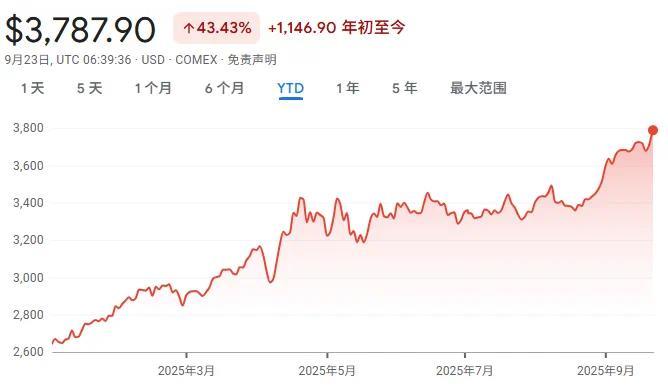
Core Viewpoint - The Federal Reserve is initiating interest rate cuts, leading to a surge in global asset prices, particularly in the U.S. stock market, with the S&P 500 index hitting new highs multiple times this year [1][4]. Group 1: Market Dynamics - Nvidia's significant investment in OpenAI has reignited interest in AI, contributing to the rise of major U.S. stock indices [1]. - The COMEX gold price closed at $3,775.10, marking the 36th record high of the year, with a year-to-date increase of approximately 43% [1]. - Risk assets and safe-haven assets are both reaching historical highs, raising questions about whether the market has perfectly priced in all favorable conditions [4]. Group 2: Economic Indicators - Analysts from Bank of America and Deutsche Bank suggest that the market is not yet in a "perfect pricing" state, indicating potential for further gains despite visible bubble signs [4][6]. - The current economic environment, characterized by tax cuts, tariff reductions, and interest rate cuts, is seen as a "run-it-hot" policy that supports economic and stock market growth [4]. Group 3: Investment Strategies - Historical data indicates that the current market rally may still have room for growth, with past bubbles showing an average increase of 244% from low to peak [8][10]. - A proposed five-point trading strategy includes investing in bubble assets, creating a "barbell" portfolio with both bubble and undervalued stocks, shorting bubble company bonds, and taking positions against U.S. bonds [11][12]. Group 4: Gold Market Analysis - The rise in gold prices is attributed to geopolitical uncertainties, inflation concerns, and expectations of interest rate cuts, creating a "perfect storm" for gold [13]. - Despite concerns about a potential bubble, key market indicators do not yet show signs of irrational exuberance, suggesting that gold is in a sustained bull market rather than a bubble [15][18].
ETF市场流动性动态报告(20250915~20250921):上指冲高回落,券商ETF申赎资金净流入
金融街证券· 2025-09-23 11:32
1. Report Industry Investment Rating No relevant content provided. 2. Core View of the Report The report focuses on the ETF market liquidity dynamics from September 15 to September 21, 2025, covering the market行情, ETF market概况, and the flow of funds in different types of ETFs [1][2]. 3. Summary by Relevant Catalogs 3.1 Market Conditions - China's 10 - year Treasury yield remained flat at 1.87% last week, while the US 10 - year Treasury yield rose slightly to 4.14% [1]. - Shanghai Composite Index decreased by 1.30%, Shenzhen Component Index decreased by 1.98%, CSI 300 decreased by 0.44%, CSI 500 increased by 0.32%, CSI 1000 increased by 0.21%, CSI 2000 decreased by 0.02%, ChiNext Index increased by 2.34%, and STAR 50 increased by 1.84% [1]. - In the Shenwan primary industries, coal (+3.51%) and power equipment (+3.07%) led the gains, while banking (-4.21%) and non - ferrous metals (-4.02%) had significant declines [1]. - The average daily trading volume of the Shanghai and Shenzhen stock markets was 2.4906 trillion yuan, an increase of about 8.55% from the previous week. The margin trading balance reached about 2.3816 trillion yuan, a new high [1]. 3.2 ETF Market Overview - The overall ETF market had a net inflow of about 13.6 billion yuan in subscriptions and redemptions. Cross - border ETFs had a net inflow of about 16.1 billion yuan, and equity ETFs had a net inflow of about 4.9 billion yuan [2]. - Among equity ETFs, broad - based ETFs had a net outflow of about 16.9 billion yuan, industry ETFs had a net inflow of about 14 billion yuan, and thematic ETFs had a net inflow of about 7.1 billion yuan [2]. - In broad - based ETFs, STAR 50ETF had a significant net outflow. In industry and thematic ETFs, brokerage and robot concept ETFs continued to have net inflows, and Hong Kong Internet concept ETFs also had continuous net inflows [2]. - Last week, 8 ETF funds were listed for trading, with a total share of about 6.3 billion. There were 23 ETFs that had completed fundraising and were waiting to be listed, with a total share of about 44 billion, mostly being CSI AAA Science and Technology Innovation Corporate Bond ETFs [2]. 3.3 Stock - related ETFs - **Stock Broad - based ETFs**: Continued net outflows, while brokerage and robot concept ETFs had net inflows [2]. - **STAR 50ETF**: Had a net outflow of funds last week [2]. - **Newly - listed and To - be - listed ETFs**: 8 ETFs were listed last week with a total share of about 6.3 billion. 23 ETFs were waiting to be listed with a total share of about 44 billion, mainly CSI AAA Science and Technology Innovation Corporate Bond ETFs [2].
AvaTrade爱华每日市场报告 2025-09-23
Sou Hu Cai Jing· 2025-09-23 11:07
Market Overview - Global financial markets exhibit complex and divergent trends, with the US market continuing to reach new highs driven by strong performance in technology and small-cap stocks [1] - The S&P 500 and Russell 2000 indices show notable gains, while the Dow Jones index experiences a slight increase, supported by robust corporate earnings and positive developments in the AI sector [1][3] - In contrast, European markets show weakness, with the UK FTSE 100 index slightly up, while the German DAX and French CAC 40 indices both decline, reflecting concerns over economic growth and policy uncertainty in the region [1][3] Commodity Performance - Gold prices have significantly risen, indicating strong demand, while WTI crude oil prices are under pressure due to expectations of increased supply [1][4] - The reopening of a major pipeline in Iraq has heightened supply concerns, contributing to a decline in oil prices [4] Key Indices and Movements - The S&P 500 index increased by 0.44% to 6,693.75, while the Dow Jones rose by 0.14% to 46,381.54 [4] - The Nasdaq 100 index saw a rise of 0.55% to 22,788.98, and the Russell 2000 index increased by 0.60% to 2,463.34 [4] - European indices such as the DAX and CAC 40 experienced declines of 0.48% and 0.30%, respectively, indicating a bearish sentiment in the region [4] Investor Sentiment - Overall, investors maintain a defensive stance with limited risk appetite, as evidenced by the mixed performance across global markets [3] - The focus for upcoming trading days will be on signals from the Federal Reserve regarding monetary policy and key inflation data [3]
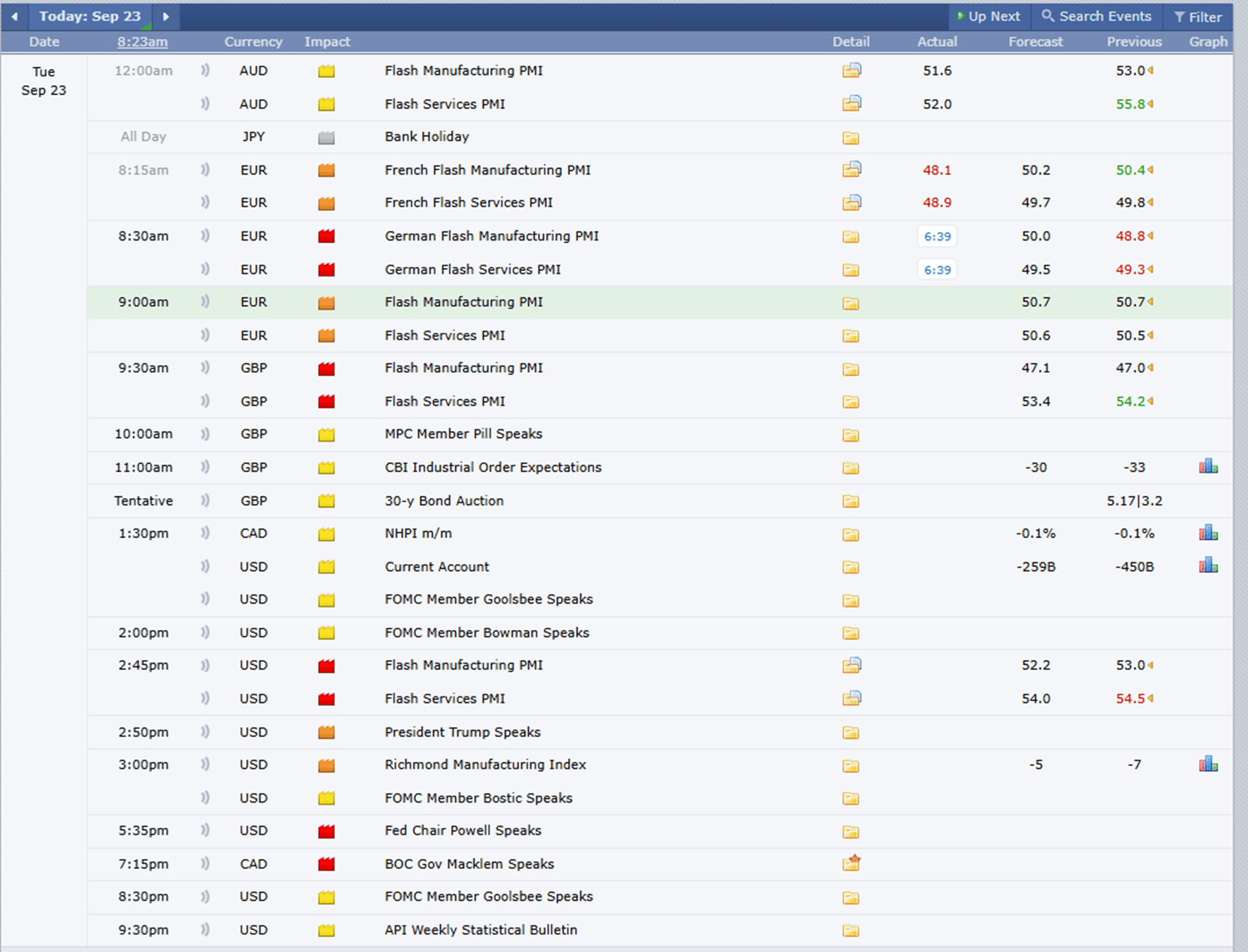
港股收盘 | 恒指收跌0.7% 科技股普遍走软 黄金、银行股表现活跃
Zhi Tong Cai Jing· 2025-09-23 09:08
Market Overview - The Hong Kong stock market opened slightly higher but experienced a decline throughout the day, with the Hang Seng Index closing down 0.7% at 26,159.12 points and a total turnover of HKD 2,945.61 million [1] - The Hang Seng Tech Index fell by 1.45%, while the Hang Seng China Enterprises Index decreased by 0.86% [1] Blue-Chip Stocks Performance - HSBC Holdings (00005) rose by 1.31% to HKD 108.6, contributing 28.6 points to the Hang Seng Index [2] - Other notable blue-chip movements included New Oriental-S (09901) up 1.85%, CITIC Limited (00267) up 1.5%, while CSPC Pharmaceutical Group (01093) fell by 4.73% [2] Sector Highlights - Large tech stocks generally declined, with Tencent down 0.86% and Xiaomi dropping over 1%, while Alibaba saw a slight increase of 0.13% [3] - Gold stocks continued to rise, with Tongguan Gold (00340) increasing by 6.38% [3] - Some banking stocks performed well, with Chongqing Rural Commercial Bank rising nearly 3% [3] Gold Market Insights - International gold prices reached new highs, with London gold hitting USD 3,759.16 per ounce and COMEX gold at USD 3,795.1 per ounce, marking a year-to-date increase of over 40% [4] - The rise in gold prices is supported by expectations of further interest rate cuts by the Federal Reserve and geopolitical tensions affecting energy supply chains [4] Cryptocurrency Sector - Cryptocurrency-related stocks faced significant declines, with Guotai Junan International (01788) dropping 11.57% following regulatory actions from the China Securities Regulatory Commission [5][6] - The overall cryptocurrency market saw a downturn, with total market capitalization falling below USD 4 trillion [6] Notable Stock Movements - Yunzhihui Technology (01037) surged by 103.23% after announcing a strategic partnership in humanoid robotics [7] - Different Group (06090) saw a 43.96% increase on its debut, focusing on high-end parenting products [8] - Kington Holdings (00412) rose by 22.25% following a share buyback authorization [9] - Liqin Resources (02245) reached a new high, increasing by 14.29% due to favorable cobalt export policies [10] - China Rare Earth Holdings (03788) rose by 12.53% after announcing a share issuance to support gold mining projects [11] - Zhejiang Shibao (01057) saw a 12.27% increase, driven by advancements in steering technology for smart vehicles [12]
港股收盘(09.23) | 恒指收跌0.7% 科技股普遍走软 黄金、银行股表现活跃
智通财经网· 2025-09-23 08:46
Market Overview - Hong Kong's three major indices opened slightly higher but fell throughout the day, with the Hang Seng Index closing down 0.7% at 26,159.12 points and a total turnover of HKD 294.56 billion [1] - The Hang Seng Tech Index dropped 1.45% to 6,167.06 points, indicating weakness in the tech sector [1] Blue Chip Performance - HSBC Holdings (00005) rose 1.31% to HKD 108.6, contributing 28.6 points to the Hang Seng Index [2] - Other notable blue chips included New Oriental-S (09901) up 1.85% and CITIC Limited (00267) up 1.5%, while CSPC Pharmaceutical Group (01093) and China Biologic Products (01177) saw declines of 4.73% and 4.46%, respectively [2] Sector Highlights - Large tech stocks generally declined, with Tencent down 0.86% and Xiaomi dropping over 1%, while Alibaba saw a slight increase of 0.13% [3] - Gold stocks continued to rise, with Tongguan Gold (00340) up 6.38% as international gold prices reached new highs, with London gold hitting USD 3,759.16 per ounce [3] - Banking stocks showed resilience, with Chongqing Rural Commercial Bank (03618) up 2.94% and other banks also posting gains, reflecting improved performance expectations in the banking sector [4] Cryptocurrency Sector - Cryptocurrency-related stocks faced significant declines, with Guotai Junan International (01788) down 11.57% following regulatory actions from the China Securities Regulatory Commission [5][6] Notable Stock Movements - Yunzhihui Technology (01037) surged 103.23% after announcing a strategic partnership in humanoid robotics [7] - Different Group (06090) saw a 43.96% increase on its debut, focusing on high-end parenting products [8] - Shankai Holdings (00412) rose 22.25% after announcing a share buyback plan [9] - Liqin Resources (02245) reached a new high, up 14.29%, due to favorable cobalt export policies in the Democratic Republic of Congo [10] - China Rare Earth Holdings (03788) increased by 12.53% after announcing a share issuance to support gold mining projects [11] - Zhejiang Shibao (01057) rose 12.27% as it prepares for mass production of advanced steering technologies [12]