
金融

Search documents
让互利共赢纽带更结实(开放谈)
Ren Min Ri Bao Hai Wai Ban· 2025-12-01 22:11
Group 1 - China's outbound direct investment continues to grow steadily, solidifying its position as a major investor globally, despite a decline in global cross-border direct investment [1] - Chinese enterprises are distributed across 190 countries, with nearly half of the top 20 investment destinations in 2024 being developed countries [1] - Investment in countries participating in the Belt and Road Initiative reached 234.15 billion RMB in the first ten months of 2025, a year-on-year increase of 22.3% [1] Group 2 - The manufacturing sector saw its highest investment flow in 2024, increasing by 45.3% compared to 2020 [1] - The service industry, characterized by light assets, has flourished, with investments in logistics, R&D, business, and finance growing, extending the investment value chain [2] - In 2024, outbound investments contributed to $211 billion in goods exports, 1.2 times that of 2020 [2] Group 3 - Chinese outbound investments have improved infrastructure in host countries, enhancing employment and tax revenues, and accelerating their green and digital transformation [2] - In 2024, Chinese enterprises paid a total of $82.1 billion in various taxes to host countries, employing 5.021 million people, with 3.304 million being local employees [2] - The focus on localization in investment strategies is emphasized, aiming to enhance sustainable development capabilities in host countries [3]
宏观经济专题:工业生产与需求边际走弱
KAIYUAN SECURITIES· 2025-12-01 13:42
Supply and Demand - Construction starts remain weak, with operating rates for asphalt plants, cement shipments, and grinding mills at historical lows[2] - Industrial production is at a historically high level, but some sectors are showing signs of weakness, such as PTA operating rates dropping to historical lows[2] - Demand for construction materials, automotive sales, and home appliances continues to decline, with rebar and building materials demand at historical lows[3] Prices - Domestic industrial product prices are fluctuating weakly, with black metals and coal prices recovering while construction materials are declining[4] - International commodity prices, including crude oil and copper, are experiencing weak fluctuations, while aluminum prices are rising[4] Real Estate - New housing transactions show significant year-on-year declines, with a 43% increase in transaction area compared to the previous two weeks, but still down 14% and 31% compared to 2023 and 2024 respectively[5] - Second-hand housing transactions remain weak, with transaction volumes in major cities like Beijing and Shanghai down 20% and 29% year-on-year respectively[5] Exports - Port throughput increased by 9.6% year-on-year, with November exports expected to show a positive growth of approximately 8.4%[6] Liquidity - Recent weeks have seen fluctuations in funding rates, with R007 at 1.52% and DR007 at 1.47% as of November 28[6] - The central bank has implemented a net injection of 12,973 billion yuan in recent weeks[6] Risk Warning - Potential risks include unexpected fluctuations in commodity prices and stronger-than-expected policy measures[6]
昊天国际建投拟溢价约0.85%配售2.49亿股 净筹约2870万港元
Zhi Tong Cai Jing· 2025-12-01 12:45
昊天国际建投(01341)发布公告,于2025年12月1日,公司拟配售合共2.49亿股配售股份,相当于经配售 股份悉数配发及发行后扩大后股本约2.25%。配售价格每股配售股份港币0.118元,较12月1日收市价每 股港币0.117元溢价约0.85%。假设所有配售股份均获悉数配售,配售的总所得款项约为2940万港元,最 高净所得款项约为2870万港元。公司拟将配售所得的估计净款项用作持牌法团融资融券业务的扩张。 ...
昊天国际建投(01341.HK)拟溢价约0.85%配售2.49亿股 净筹2870万元
Ge Long Hui· 2025-12-01 12:40
Core Viewpoint - Haotian International Investment (01341.HK) announced a conditional placement agreement to issue 249,224,000 shares at a price of HKD 0.118 per share, representing approximately 2.30% of the existing issued share capital [1] Group 1: Placement Details - The placement involves 249,224,000 shares, which is about 2.30% of the current issued share capital of 10,846,152,835 shares [1] - The placement price of HKD 0.118 per share is at a premium of approximately 0.85% compared to the closing price of HKD 0.117 on the date of the agreement [1] - If all shares are fully placed, the total proceeds are estimated to be around HKD 29.4 million, with the maximum net proceeds expected to be about HKD 28.7 million [1] Group 2: Use of Proceeds - The company intends to use the estimated net proceeds from the placement for the expansion of its licensed financing and margin trading business [1]
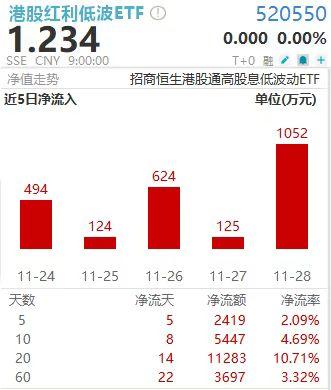
份额规模齐创历史新高!可月月分红的港股红利低波ETF获资金连续7日加仓
Ge Long Hui· 2025-12-01 12:39
Group 1 - The core viewpoint of the articles highlights the increasing preference for high-dividend assets in the Hong Kong stock market, particularly in the context of low interest rates and economic uncertainty [1][3] - As of November 28, the Hong Kong Dividend Low Volatility ETF (520550) has seen a net inflow of over 34 million, marking a cumulative net inflow of over 840 million since the beginning of the year, with the latest scale reaching nearly 1.2 billion, achieving historical highs in both net inflow and share size [1][3] - The ETF employs a "high dividend + low volatility" dual-factor stock selection strategy, which includes a low management fee of 0.2%, enhancing cost efficiency for investors [3] Group 2 - The ETF's monthly dividend mechanism and T+0 trading feature further improve capital efficiency, making it an attractive option for large institutional investors, including insurance funds [3] - The portfolio structure focuses on mature industries such as finance and energy to provide a safety net, while implementing a 5% weight limit on individual stocks to achieve risk diversification and avoid "dividend traps" [3] - Retail investors can access the ETF through feeder funds (Class A: 024029/Class C: 024030) for investment opportunities [3]

专访野村亚洲及印度首席经济学家:中国东盟数字经济合作将加速
2 1 Shi Ji Jing Ji Bao Dao· 2025-12-01 12:07
Core Insights - Southeast Asian exporters are increasing prices for goods exported to the U.S., transferring some cost pressures to American consumers [1] - The U.N. Development Programme predicts a potential 9.7% decline in Southeast Asia's total exports to the U.S. due to tariff-induced price increases [1] - Despite U.S. tariff pressures, Southeast Asian economies are showing resilience, with many countries diversifying their markets away from the U.S. [1][4] Trade Agreements and Economic Cooperation - The signing of the upgraded China-ASEAN Free Trade Area 3.0 agreement is expected to enhance cooperation in emerging fields, particularly in the digital economy [2] - Southeast Asian countries are seeking to diversify their exports and move from low-tech manufacturing to higher value-added sectors, leveraging China's technological expertise [2][6] Market Dynamics and Export Trends - The U.S. tariff policy is expected to create competitive pressures within Asian economies, leading to potential "hidden reforms" as countries strive to enhance competitiveness [3][4] - Vietnam may experience a significant potential decline of 19.2% in exports to the U.S., which is double the average decline expected for Southeast Asia [3] Regional Economic Integration - The CAFTA 3.0 upgrade is anticipated to facilitate supply chain upgrades and enhance regional economic integration, focusing on high-tech manufacturing [6] - The internal consumption in Asian countries is expected to grow, leading to increased intra-regional trade, particularly in intermediate products [5] Monetary Policy and Economic Outlook - Southeast Asian central banks may gain more policy flexibility as U.S. interest rates decline, allowing them to focus on domestic economic factors [7] - Countries like Thailand may face unique challenges, including potential deflationary risks, while most Southeast Asian nations maintain positive inflation rates [8] Stock Market Performance and Investment Climate - Southeast Asian stock markets are struggling to attract foreign investment, partly due to a lack of AI-related themes and concerns over export slowdowns [9][10] - Structural reforms in the region aim to enhance market liquidity and transparency, potentially improving the attractiveness of Southeast Asian markets for foreign investors [11] Economic Resilience and Future Prospects - Despite challenges, Southeast Asian economies are expected to demonstrate resilience, with a focus on technology-driven growth and structural reforms [13] - Malaysia is highlighted as a strong performer due to robust domestic demand and infrastructure investments, while Singapore continues to benefit from its tech sector [10][11]
五洲交通:12月1日召开董事会会议
Mei Ri Jing Ji Xin Wen· 2025-12-01 11:55
Company Overview - Wuzhou Transportation (SH 600368) announced the convening of its 11th First Board Meeting on December 1, 2025, to discuss the election of the chairman and vice-chairman of the board [1] - As of the report, Wuzhou Transportation has a market capitalization of 6.4 billion yuan [1] Revenue Composition - For the year 2024, Wuzhou Transportation's revenue composition is as follows: - Road transportation industry: 63.23% - Trade logistics: 31.19% - Other businesses: 4.78% - Asset management: 0.65% - Financial services: 0.15% [1]

积极持仓?
第一财经· 2025-12-01 11:24
Market Overview - The market is experiencing a bullish trend with 3,396 stocks rising, indicating a strong profit-making effect and a broad-based rally in individual stocks [5][6] - The trading volume in both markets has significantly increased to over 1 trillion, up 18.17%, ending a streak of declining volumes, suggesting a resurgence in capital activity [7] Sector Performance - Key sectors driving the market include AI mobile phones, smart wearables, and the semiconductor industry, particularly in photolithography machines and MCU chips [6] - Concepts such as 6G, satellite navigation, commercial aerospace, servers, and memory stocks are also showing notable gains [6] Investor Sentiment - Institutional investors have shifted from a cautious to an active stance, focusing on a "cross-year market" strategy, balancing defensive and growth-oriented investments [9] - Retail investors are actively participating, showing a tendency to follow hot trends like AI mobile phones and commercial aerospace, while maintaining some caution to avoid blindly chasing high-priced stocks [9][10] Positioning and Strategy - The current sentiment indicates that 29.96% of investors are increasing their positions, while 14.44% are reducing, and 55.60% are holding steady [14] - The overall sentiment shows that 69.78% of investors expect the market to rise in the next trading day [16]

华尔街打响年末收官战:美股剑指7000点大关?
Jin Shi Shu Ju· 2025-12-01 11:23
Group 1 - Wall Street enters a challenging year-end with optimism after experiencing its best week in nearly six months, reversing one of the worst November performances in over a decade [1] - The S&P 500 index has recorded a double-digit increase year-to-date, driven by the rise of "seven giants" in the tech sector, a strong U.S. economy, and expectations of continued interest rate cuts by the Federal Reserve [1][2] - The market's rebound after a 19% decline over seven weeks ending April 9 is seen as a strong signal for investors, with historical patterns suggesting that mid-year double-digit declines often lead to full-year gains [1] Group 2 - The probability of a 25 basis point rate cut in December is approximately 87%, as indicated by futures prices, with the labor market becoming the Federal Reserve's primary focus [2] - The Republican tax and spending bill, effective January 1, is expected to increase spending and provide a strong combination of tax cuts and accounting changes, contributing to market optimism [2] - Recent volatility in tech stocks is viewed positively, as companies with clear AI profit paths are being rewarded, while those with weak balance sheets are losing ground [3] Group 3 - Historical data suggests that the second half of December is typically one of the strongest periods for U.S. stocks, with an average return of 1% and approximately 70% of the time showing gains [4] - The market is currently experiencing a shift, with tech stocks giving way to sectors like healthcare, materials, and consumer discretionary, indicating a broader market rally [3] Group 4 - Investor sentiment among retail investors has turned cautious, with a net bearish sentiment of 42.7%, up from 36.3% at the beginning of the month, reflecting concerns over recent market volatility [5] - Seasonal factors suggest a slightly favorable market outlook at year-end, rewarding those already invested rather than those waiting for perfect entry points [5]
江苏国信:11月28日召开董事会会议
Mei Ri Jing Ji Xin Wen· 2025-12-01 11:10
截至发稿,江苏国信市值为295亿元。 每经AI快讯,江苏国信(SZ 002608,收盘价:7.8元)12月1日晚间发布公告称,公司第六届第三十二 次董事会会议于2025年11月28日在公司会议室以现场与通讯相结合的方式召开。会议审议了《关于董事 会换届选举的议案》等文件。 每经头条(nbdtoutiao)——5年期大面积下线,3年期利率低至1.5%仍一单难求:要么"售罄"要么"额度 紧张"!中长期大额存单为何在消失? 2025年1至6月份,江苏国信的营业收入构成为:电力占比97.28%,金融占比2.72%。 (记者 曾健辉) ...
