债券

Search documents
债市定价逻辑阶段性切换:从“基本面+流动性“转向”大类资产配置
Shenwan Hongyuan Securities· 2025-08-17 11:13
Group 1 - The short-term logic of the bond market may have shifted from "fundamentals + liquidity" to "asset allocation" since July, with the bond market under pressure despite a relatively loose funding environment [6][10][28] - The 10-year government bond yield has shown an upward trend, primarily due to the thin safety cushion of fixed-income products and the cooling of fixed-income assets under the asset allocation effect [6][10][28] Group 2 - Key clues to the evolution of bond market logic include: 1) Reallocation of resident assets due to declining deposit rates since 2022, leading to a weakening of the bond market's profit-making effect [14][16] 2) An increase in residents' risk appetite, with equity assets potentially becoming the focus of asset reallocation [17][20] 3) Low odds and win rates for bond assets, as long-term bond yields have already priced in future rate cuts [18][21] Group 3 - The critical points for the rebalancing of stock and bond value include: 1) The relative comparison of dividend yields and bond yields [30] 2) Fund flows, with a potential shift in investor enthusiasm from bonds to stocks [30] 3) Changes in fundamentals, where unexpected pressures on the economy could lead to a resurgence in the bond market [30] Group 4 - The bond market strategy indicates that while risks are being released, a cautious judgment is maintained, with the 10-year government bond yield around 1.7% being unattractive [28][31] - The bond market may experience volatility from August to October, with the yield expected to range between 1.65% and 1.80%, and the potential for a steepening yield curve [28][31]
尚未全面降久期
SINOLINK SECURITIES· 2025-08-17 11:06
1. Report Industry Investment Rating - No information provided. 2. Core Viewpoints of the Report - As of August 17, the weighted average trading terms of urban investment bonds and industrial bonds were 2.13 years and 2.63 years respectively. Among commercial bank bonds, the weighted average trading terms of secondary capital bonds, bank perpetual bonds, and general commercial financial bonds were 4.59 years, 3.72 years, and 4.05 years respectively, with bank perpetual bonds at a relatively low historical level. Among other financial bonds, the durations of securities company bonds, securities subordinated bonds, insurance company bonds, and leasing company bonds were 1.53 years, 2.13 years, 3.22 years, and 1.20 years respectively, with securities company bonds and securities subordinated bonds at relatively low historical percentiles [2][9]. - The coupon duration congestion index slightly declined. After reaching its peak in March 2024, the index has been falling. This week, it decreased slightly compared to last week and is currently at the 12.20% level since March 2021 [11]. 3. Summary by Relevant Catalogs 3.1 All - Variety Term Overview - Urban investment bonds: The weighted average trading term hovered around 2.13 years. The duration of Sichuan provincial urban investment bonds extended to 5.36 years, while the trading duration of Guangdong district - county - level urban investment bonds shortened to around 1.50 years. The historical percentiles of the durations of urban investment bonds in regions such as Sichuan provincial, Jiangsu district - county - level, Chongqing district - county - level, and Fujian district - county - level have exceeded 90%, and the duration of Henan prefecture - level city urban investment bonds is approaching the highest level since 2021 [3][15]. - Industrial bonds: The weighted average trading term has slightly extended compared to last week, generally around 2.63 years. The trading duration of the pharmaceutical and biological industry shortened to 1.05 years, while that of the building materials industry extended to 2.49 years. The trading duration of the food materials industry is at a relatively low historical percentile, and industries such as public utilities and building materials are at historical percentiles above 90% [3][20]. - Commercial bank bonds: The duration of general commercial financial bonds extended to 4.05 years, at the 99.5% historical percentile, higher than the level of the same period last year. The duration of secondary capital bonds extended to 4.59 years, at the 99.1% historical percentile, lower than the level of the same period last year. The duration of bank perpetual bonds extended to 3.72 years, at the 66.3% historical percentile, higher than the level of the same period last year [3][22]. - Other financial bonds: In terms of the weighted average trading term, insurance company bonds > securities subordinated bonds > securities company bonds > leasing company bonds, at historical percentiles of 65.3%, 48%, 31%, and 67.6% respectively. The duration of insurance company bonds has slightly extended compared to last week, while the durations of the others have slightly shortened [3][25]. 3.2 Variety Microscope - Information in this part is mainly included in the "All - Variety Term Overview" above, with detailed data and analysis of different types of bonds such as urban investment bonds, industrial bonds, commercial bank bonds, and other financial bonds. For example, specific data on the durations and historical percentiles of bonds in different regions and industries are provided [3][15][20].
权益市场持续走强,债市熊陡
Dong Zheng Qi Huo· 2025-08-17 10:42
1. Report Industry Investment Rating - The rating for treasury bonds is "oscillating" [4] 2. Core Viewpoints of the Report - Although most economic and financial data in July fell short of expectations, the market risk - appetite continued to rise, resulting in weak performance of treasury bonds and a steeper yield curve. The bear - steepening trend of the curve is expected to continue next week [15]. - The stock - bond assets are desensitized to the fundamentals. The rising equity market suppresses the bond market, and this pattern is difficult to change in the short term. The equity market's self - strengthening characteristic will likely lead to continued upward oscillations, putting pressure on long - term bond varieties [16]. - The capital market is relatively balanced, but there is limited room for further loosening in the short term. The capital market cannot effectively offset the negative impact of the rising equity assets, but it will make the upward range of short - term bond interest rates slightly smaller [16]. 3. Summary According to the Directory 3.1 One - Week Review and Views 3.1.1 This Week's Trend Review - From August 11th to August 17th, treasury bond futures oscillated downward. Various factors such as the less - than - expected loosening of funds, stock market trends, and policy news affected the daily performance of treasury bond futures. As of August 15th, the settlement prices of the main contracts of 2 - year, 5 - year, 10 - year, and 30 - year treasury bond futures were 102.346, 105.675, 108.325, and 117.660 yuan respectively, with changes of - 0.024, - 0.145, - 0.285, and - 1.590 yuan compared to last weekend [13]. 3.1.2 Next Week's View - Next week, the market will be in a data and policy vacuum period. The capital market and the performance of the equity market will dominate the bond market trend. The bear - steepening of the curve is expected to continue. The fundamentals are favorable for the bond market, but the pattern of the rising equity market suppressing the bond market is hard to change in the short term [15][16]. 3.2 Weekly Observation of Interest - Rate Bonds 3.2.1 Primary Market - This week, 50 interest - rate bonds were issued, with a total issuance volume of 5556.92 billion yuan and a net financing amount of 3437.94 billion yuan, down 2528.17 billion yuan and 2521.04 billion yuan respectively from last week. 26 local government bonds were issued, with a total issuance volume of 914.32 billion yuan and a net financing amount of - 137.36 billion yuan, down 740.27 billion yuan and 965.84 billion yuan respectively from last week. 455 inter - bank certificates of deposit were issued, with a total issuance volume of 7760.30 billion yuan and a net financing amount of - 1311.10 billion yuan, with a change of + 13.00 billion yuan and - 3075.70 billion yuan respectively from last week [23]. 3.2.2 Secondary Market - Most treasury bond yields rose. As of August 15th, the yields of 2 - year, 5 - year, 10 - year, and 30 - year treasury bonds were 1.40%, 1.58%, 1.74%, and 2.04% respectively, up 0.22, 3.14, 5.02, and 7.70 basis points respectively from last weekend. The spreads of 10Y - 1Y, 10Y - 5Y, and 30Y - 10Y all widened [27]. 3.3 Treasury Bond Futures 3.3.1 Price, Trading Volume, and Open Interest - Treasury bond futures oscillated downward. As of August 15th, the settlement prices of the main contracts of 2 - year, 5 - year, 10 - year, and 30 - year treasury bond futures were 102.346, 105.675, 108.325, and 117.660 yuan respectively, with changes of - 0.024, - 0.145, - 0.285, and - 1.590 yuan compared to last weekend. The trading volumes of 2 - year, 5 - year, 10 - year, and 30 - year treasury bond futures this week were 44773, 75807, 113721, and 174122 lots respectively, with changes of + 7747, + 10770, + 27453, and + 53719 lots respectively from last weekend. The open interests were 103646, 175683, 235249, and 152407 lots respectively, with changes of - 4559, - 9501, - 727, and - 1348 lots respectively from last weekend [35][38]. 3.3.2 Basis and IRR - This week, the opportunity for cash - and - carry arbitrage was not obvious. The capital market was generally loose, the market oscillated weakly, and the futures basis generally oscillated within a narrow range. The IRR of the CTD bonds of each variety's main contract was between 1.4% - 1.8%, and the current certificate of deposit interest rate was between 1.5% - 1.6%. The opportunity for cash - and - carry arbitrage strategy was relatively limited [42]. 3.3.3 Inter - delivery and Inter - variety Spreads - As of August 15th, the inter - delivery spreads of the 2509 - 2512 contracts of 2 - year, 5 - year, 10 - year, and 30 - year treasury bond futures were - 0.038, + 0.005, + 0.100, and + 0.450 yuan respectively, with changes of + 0.028, + 0.060, - 0.005, and + 0.080 yuan respectively from last weekend. The market sentiment of treasury bond futures was weak this week, and the inter - delivery spreads generally oscillated and widened. The T contract was an exception, and its inter - delivery spread mainly oscillated within a narrow range. The bond market is expected to remain weak, and the inter - delivery spreads are expected to continue to oscillate upward [43][44]. 3.4 Weekly Observation of the Capital Market - This week, the central bank conducted 7118 billion yuan of reverse repurchase operations in the open market, with 11267 billion yuan of reverse repurchases maturing, resulting in a net withdrawal of 4149 billion yuan. In addition, the central bank also conducted 5000 billion yuan of 6 - month outright reverse repurchase operations. As of August 15th, R007, DR007, SHIBOR overnight, and SHIBOR 1 - week were 1.49%, 1.48%, 1.40%, and 1.47% respectively, up 3.21, 3.94, 8.36, and 2.94 basis points respectively from last weekend. The average daily trading volume of inter - bank pledged repurchase this week was 8.15 trillion yuan, 0.04 trillion yuan more than last week, and the overnight proportion was 89.82%, slightly lower than last week [48][51][53]. 3.5 Weekly Overseas Observation - The US dollar index oscillated weakly, and the yield of 10Y US treasury bonds rose. As of August 15th, the US dollar index fell 0.43% to 97.8467 compared to last weekend's close. The yield of 10Y US treasury bonds was 4.33%, up 6 basis points from last weekend. The spread between Chinese and US 10Y treasury bonds was inverted by 259.0 basis points [58]. 3.6 Weekly Observation of High - Frequency Inflation Data - This week, industrial product prices rose across the board. As of August 15th, the Nanhua Industrial Product Index, Metal Index, and Energy and Chemical Index were 3658.04, 6466.21, and 1687.68 points respectively, up 13.09, 28.42, and 9.95 points respectively from last weekend. Agricultural product prices showed mixed trends. As of August 15th, the prices of pork, 28 key vegetables, and 7 key fruits were 20.05, 4.75, and 6.91 yuan/kg respectively, with changes of - 0.36, + 0.11, and - 0.13 yuan/kg respectively from last weekend [61]. 3.7 Investment Suggestions - In the short term, the sentiment in the bond market is weak, and traders should be cautious when betting on rebounds. It is recommended to pay attention to short - hedging strategies, use T or TL for hedging in a strong stock market environment. Also, pay attention to the strategy of steepening the yield curve (such as 10Y - 1Y in the short - to - medium term, long 4TS and short T; long 3T and short TL in the long - term), and moderately pay attention to the strategy of widening the T09 - 12 spread [17][18][19][20]
债券收益受何影响?
Sou Hu Cai Jing· 2025-08-17 10:40
Core Insights - Bonds are influenced by various factors, including interest rates, credit risk, bond duration, inflation expectations, and tax policies [1][2] Interest Rates - Market interest rates have an inverse relationship with bond prices; when rates rise, existing bonds with lower rates decrease in value, potentially leading to capital losses for investors [1] - Conversely, when market rates fall, existing bonds increase in value, allowing investors to realize capital gains [1] Credit Risk - The creditworthiness of bond issuers significantly impacts bond yields; higher-rated issuers typically offer lower yields due to lower default risk, while lower-rated issuers must provide higher yields to compensate for increased risk [1][2] - Default by an issuer can result in loss of both interest income and principal for investors [1] Bond Duration - Longer-duration bonds generally carry higher risks and uncertainties, necessitating higher yields to attract investors, known as the term premium [2] - Long-term bonds face more risks from interest rate fluctuations and inflation compared to short-term bonds [2] Inflation Expectations - Rising inflation expectations lead investors to demand higher yields to offset the loss of purchasing power, which can pressure bond prices and reduce actual yields [2] - Conversely, lower inflation expectations can alleviate downward pressure on bond prices, potentially increasing yields [2] Tax Policies - Different types of bonds may have varying tax treatments, with some offering tax-exempt interest income, making them more attractive despite lower nominal rates [2] - The tax-adjusted yield can influence investor choices and overall returns on bonds [2]
债市值言:中债指数2025年7月统计及分析月报
Sou Hu Cai Jing· 2025-08-17 09:13
Group 1 - The bond market has shown volatility this year, with the China Bond New Comprehensive Index rising by 0.97% year-to-date. Short-term policy bank bonds have outperformed medium to long-term bonds in a low-interest environment, leading to a narrowing of credit spreads and better performance of credit bonds compared to interest rate bonds [1][6][10] - In July, the overall wealth index return of the domestic RMB bond market declined, with the net price index and wealth index returns of the China Bond New Comprehensive Index at -0.30% and -0.08%, respectively [8][21] - Government bond yields have slightly increased, with fluctuations in the yield spreads between government bonds and policy bank bonds. The wealth index of the China Bond Total Index fell by 0.17%, while the short-term government bond index showed slightly better returns [21][15] Group 2 - Credit bond yields have experienced fluctuations, benefiting from coupon income, with the overall wealth index return of the credit bond market increasing by 0.10%. High-grade credit bond spreads have narrowed [26][29] - The green bond market remains stable, with the market value of "green" bonds reaching 6.67 trillion yuan, up 1.01% from the previous month. The China Bond Green Bond Comprehensive Index, which includes 1,002 bonds from 401 issuers, has a market value of 1.76 trillion yuan [12][2] - The performance of various industry credit bonds has been positive, with the real estate industry credit bond index returning approximately 0.20%, marking the best performance among sectors [31][33]

全球央行"用钱投票",美债持仓创历史新高!所谓崩盘不过是场谣言
Sou Hu Cai Jing· 2025-08-17 04:44
Core Viewpoint - The latest TIC report from the U.S. Treasury reveals that foreign holdings of U.S. Treasury securities have reached a historic high of $9.13 trillion, countering claims of a "June debt collapse" and indicating a trend of increasing investment in U.S. debt instruments [1][9]. Group 1: Foreign Holdings Overview - The total amount of U.S. Treasury securities held by foreign entities surpassed $9.1 trillion for the first time, increasing by $130 billion since March [1]. - Japan, the UK, and mainland China remain the top three holders of U.S. Treasuries, with Japan increasing its holdings by $12.6 billion to $1.1476 trillion, the UK adding $48.7 billion to reach $858.1 billion, and China slightly increasing its holdings by $1 billion to $756.4 billion [3][4]. Group 2: Country-Specific Changes - Japan's net purchase of U.S. Treasuries in June was $4.21 billion, while the UK saw a net increase of $17.58 billion, both benefiting from the appreciation of Treasury prices [5][7]. - In contrast, mainland China's increase in holdings was primarily due to the rise in the value of existing bonds rather than new purchases, as it sold $55.36 billion in long-term Treasuries while buying $1.91 billion in short-term ones, resulting in a net sell-off of $53.45 billion [5][7]. Group 3: Market Dynamics and Future Outlook - The anticipated interest rate cuts by the Federal Reserve are expected to further influence investor behavior, leading to both passive increases in the value of existing holdings and active buying as investors seek capital gains [7]. - Despite ongoing geopolitical risks and concerns regarding U.S. debt levels exceeding $40 trillion, U.S. Treasuries continue to be viewed as a reliable "safe asset" in the global financial landscape, reinforcing their status as a cornerstone of liquidity and risk management [9].

究竟是谁在增持美债,究竟是哪些国家、地区持续给美国“输血”呢
Sou Hu Cai Jing· 2025-08-16 23:37
Core Insights - The total amount of U.S. Treasury securities held by foreign investors reached a record high of $9.1277 trillion in June 2025, marking a month-over-month increase of $80.2 billion, or 1.11%, and a year-over-year increase of $828.4 billion, or nearly 10% [1][4]. Group 1: Changes in Major Holders - Japan, the largest holder of U.S. Treasuries, increased its holdings by $12.6 billion to $1.1476 trillion in June, continuing its trend since 2025, closely linked to its yen exchange rate policy [3][4]. - The UK saw a significant month-over-month increase of $48.7 billion, bringing its total holdings to $858.1 billion, with a year-over-year increase of $111.6 billion [3][4]. - China’s holdings slightly increased by $0.1 billion to $756.4 billion, marking its first increase after three months of reductions, but it remains down $23.8 billion year-over-year [4][5]. Group 2: Capital Flow Dynamics - The increase in holdings by the UK, Cayman Islands, and Belgium reflects a surge of short-term speculative capital, particularly from international hedge funds betting on potential interest rate cuts by the Federal Reserve [3][5]. - Belgium's holdings surged by 36.3% year-over-year to $433.4 billion, indicating that many central banks may be using Belgian accounts to hold U.S. Treasuries [5][6]. - Offshore financial centers like the Cayman Islands, Canada, and Singapore also saw significant increases in their U.S. Treasury holdings, with Cayman Islands up 35.7% to $442.7 billion [6][9]. Group 3: Geopolitical Implications - The shift in U.S. Treasury holdings indicates a transition from official state capital to private capital, suggesting a potential reconfiguration of the global financial system [5][9]. - Countries like Japan and the UK are increasing their holdings not only for economic reasons but also to maintain geopolitical alliances, with Japan supporting the dollar's dominance and the UK reinforcing its status as a global financial center [8][10]. - Emerging markets, including China, India, and Brazil, are collectively reducing their U.S. Treasury holdings, indicating a diversification of their foreign exchange reserves away from dollar assets [9][10].

国债周报:需求偏弱,宽货币延续-20250816
Wu Kuang Qi Huo· 2025-08-16 14:32
1. Report Industry Investment Rating No relevant content provided. 2. Core Viewpoints of the Report - The overall economic data in July showed a slight slowdown, with external demand better than domestic demand. The "anti - involution" concept boosted price expectations, but the coordination between demand and production needs further observation. Exports may face pressure in the future due to the over - drafting of the front - loading effect and the rising base in the second half of the year. The strong market expectation of a US interest rate cut in September is beneficial to the liquidity of the financial market [10]. - In the context of weak domestic demand recovery and the expected continuation of loose funds, interest rates are expected to decline in the long - term, but the bond market may return to a volatile pattern in the short - term. In the long - run, the bond market should be considered for long - position trading on dips [13][14]. 3. Summary According to the Table of Contents 3.1. Weekly Assessment and Strategy Recommendation - **Economic and Policy Situation**: In July, the added value of industrial enterprises above designated size increased by 5.7% year - on - year; the total retail sales of consumer goods were 3.7% higher than the previous year; from January to July, the national fixed - asset investment (excluding rural households) increased by 1.6% year - on - year, and real estate development investment decreased by 12.0%. The suspension of 24% of the additional tariffs on US imports continued for 90 days. The central bank will implement a moderately loose monetary policy to maintain sufficient liquidity. The market expects a 50 - basis - point interest rate cut by the Fed in September [10][11][12]. - **Liquidity**: The central bank conducted 1126.7 billion yuan of reverse repurchase operations this week, with 711.8 billion yuan of reverse repurchase maturing, resulting in a net withdrawal of 414.9 billion yuan. The DR007 rate closed at 1.48% [13]. - **Interest Rates**: The latest 10 - year Treasury yield was 1.74%, up 5.02 BP week - on - week; the 30 - year Treasury yield was 2.04%, up 7.70 BP week - on - week. The 10 - year US Treasury yield was 4.33%, up 6.00 BP week - on - week [13]. - **Summary**: The economic data in the first half of the year remained resilient under tariff disturbances. In July, economic and financial data were generally lower than expected, and domestic demand needs to be boosted. Exports may face pressure in the future. The central bank will maintain a loose attitude towards funds. In the context of weak domestic demand recovery and loose funds, interest rates are expected to decline in the long - term, and the bond market may return to a volatile pattern in the short - term [13]. 3.2. Futures and Spot Markets - The report presents the closing prices, annualized discounts, settlement prices, and net basis of T, TL, TF, and TS contracts, as well as the closing prices and trading volumes of TS, TF, T, and TL contracts, but does not provide specific analysis conclusions [18][21][24][27]. 3.3. Main Economic Data - **Domestic Economy** - GDP: In the second quarter of 2025, the actual GDP growth rate was 5.4%, exceeding market expectations [44]. - PMI: In July, the manufacturing PMI was 49.3%, down 0.4 percentage points from the previous value; the non - manufacturing PMI was 50.1%, also down 0.4 percentage points from the previous value [44]. - Price Index: In July, CPI was flat year - on - year, core CPI increased by 0.8% year - on - year, and PPI decreased by 3.6% year - on - year. On a month - on - month basis, CPI increased by 0.4%, core CPI increased by 0.4%, and PPI decreased by 0.2% [53]. - Exports: In July, China's exports (in US dollars) increased by 7.2% year - on - year, and imports increased by 4.1% year - on - year. Exports to the US decreased by 21.67% year - on - year, while exports to ASEAN increased by 16.59% year - on - year [56]. - Industrial Added Value: In July, the year - on - year growth rate of industrial added value was 5.7%, down from 6.8% in the previous month [59]. - Retail Sales: In July, the year - on - year growth rate of total retail sales of consumer goods was 3.7%, down 1.1 percentage points from the previous month [59]. - Fixed - Asset Investment: From January to July, the cumulative year - on - year growth rate of fixed - asset investment was 1.6%. Real estate investment decreased by 12.0% year - on - year, infrastructure investment (excluding electricity) increased by 3.2% year - on - year, and manufacturing investment increased by 6.2% year - on - year [62]. - Real Estate: In July, the new housing start - up area decreased by 19.4% year - on - year, and the housing construction area decreased by 9.2% year - on - year. The completion data decreased by 29.46% year - on - year, and the sales data of new houses in 30 large and medium - sized cities weakened [65][68]. - **Foreign Economy** - US: In the second quarter, the US GDP increased by 1.99% year - on - year and 3.0% quarter - on - quarter. In July, the non - seasonally adjusted CPI increased by 2.7% year - on - year, and the PPI increased by 3.3% year - on - year. In June, durable goods orders increased by 10.93% year - on - year. In July, non - farm payrolls increased by 73,000, and the unemployment rate was 4.2%. In July, the ISM manufacturing PMI was 48, and the ISM non - manufacturing PMI in June was 50.8 [71][74][77]. - EU: In the second quarter, the EU GDP increased by 1.5% year - on - year and 0.2% quarter - on - quarter [77]. - Eurozone: In July, the preliminary CPI increased by 2% year - on - year, and the core CPI increased by 2.4% year - on - year. The preliminary manufacturing PMI was 49.8, and the preliminary service PMI was 51.2 [80]. 3.4. Liquidity - In July, the M1 growth rate was 5.6%, and the M2 growth rate was 8.8%. The social financing increment was 1.16 trillion yuan, mainly from government bond issuance. Both corporate and household credit weakened. The MLF balance in July was 525 billion yuan, with a net investment of 100 billion yuan. This week, the central bank conducted 1126.7 billion yuan of reverse repurchase operations, with 711.8 billion yuan maturing, resulting in a net withdrawal of 414.9 billion yuan [85][91]. 3.5. Interest Rates and Exchange Rates - **Interest Rates**: The yields of 2 - year, 5 - year, 10 - year, and 30 - year Treasury bonds were 1.40%, 1.58%, 1.74%, and 2.04% respectively, with weekly increases of 0.22 BP, 3.14 BP, 5.02 BP, and 7.70 BP respectively. The 10 - year US Treasury yield was 4.33%, up 6.00 BP week - on - week [94]. - **Exchange Rates**: No specific analysis of exchange rate trends was provided in the report, only the presentation of exchange rate data [102].
7月经济数据点评:供需双承压,但债市仍谨慎
Shenwan Hongyuan Securities· 2025-08-16 13:48
Group 1 - The report highlights that consumer spending has weakened since peaking in May-June 2025, with retail sales growth for January to July 2025 at 4.8%, down 0.2 percentage points from the previous period, significantly impacted by the restaurant sector, which saw a growth rate of 3.8% [2][3] - Industrial value-added growth for July 2025 was 6.3%, a decline of 0.1 percentage points from June, with production in "anti-involution" sectors like automotive and photovoltaic experiencing notable decreases [3][4] - Fixed asset investment growth has accelerated its decline, with a cumulative year-on-year growth rate of 1.6% in July 2025, down 1.2 percentage points from June, driven by weak performance in real estate, infrastructure, and manufacturing sectors [3][5] Group 2 - The bond market has shown a weakening in pricing based on fundamentals, with the yield curve flattening, indicating pessimistic expectations for the economy despite weak demand in the real sector [3] - The report anticipates that the 10-year government bond yield will range between 1.65% and 1.80% in August and September 2025, with conditions for further yield declines being more stringent [3] - The report notes that August is a peak supply month for government bonds, and if market adjustments worsen, there is a possibility that the central bank may restart bond purchases [3]
“FOMO”情绪掀起抢购潮!美国公司债利差创27年来新低
智通财经网· 2025-08-16 02:11
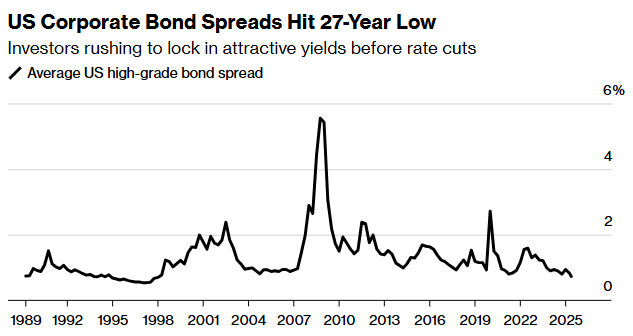
智通财经APP获悉,美国企业债券估值的一项关键指标飙升至近三十年来的最高水平,原因是投资者纷 纷急于锁定仍处于高位的收益率,同时市场还存在美联储将于下月重启降息的猜测。 据彭博指数数据,投资者持有投资级公司债券而非美国国债所获得的额外收益在周五已降至仅 73 个基 点,这是自 1998 年以来的最低水平。这一下降表明,债券价格已异常高涨,因为投资者纷纷锁定当前 的利率,尽管经济放缓和美国贸易战给企业带来了风险。债券交易员认为,美联储也会采取同样的行 动,最快在下个月就会降息,因为近期的经济数据表明通胀基本符合预期,而劳动力市场则有所疲软。 在美联储将利率从接近零的水平上调以抑制疫情后的通胀飙升之后,过去三年里,平均高评级债券收益 率一直保持在 5%以上。这极大地推动了需求,即便在面对特朗普加征关税所引发的经济和地缘政治不 确定性的情况下,尤其是来自大型机构投资者、保险公司和养老基金的需求也帮助稳定了风险利差。 不过,据景顺集团北美投资级信贷业务主管Matt Brill称,在 2022 年美联储大幅加息引发的市场暴跌中 遭受损失的一些投资者此前一直持观望态度。截至 6 月底,景顺集团管理着 2 万亿美元的资产。 ...